
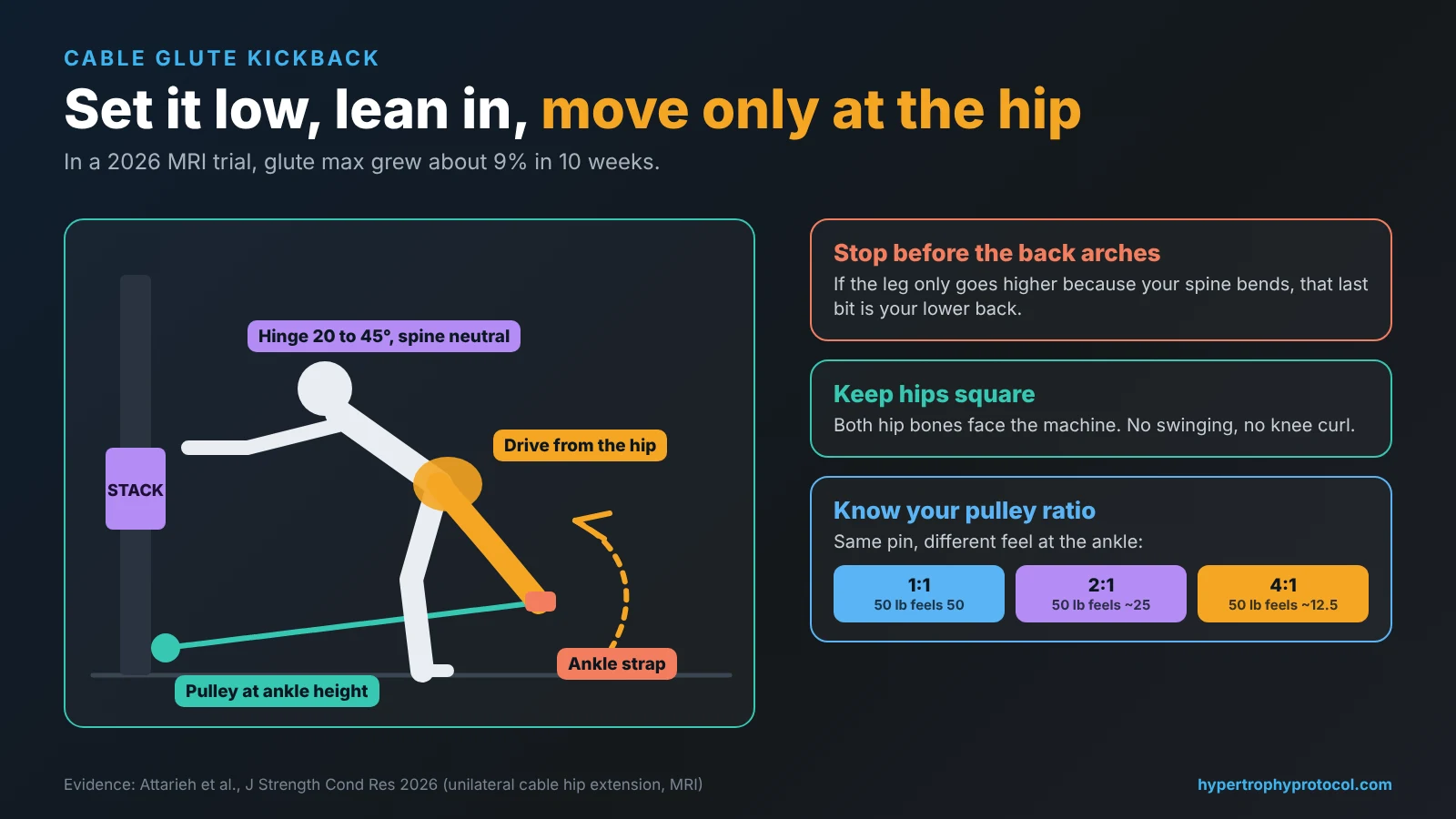
The cable glute kickback is one of the few glute exercises with a direct MRI growth result behind it, and it needs nothing more than a low pulley and an ankle strap. It’s also easy to do badly. Too much weight turns it into a lower back arch, the wrong pulley height puts the load where your glutes aren’t working hardest, and a 2:1 cable makes your numbers mean something different from the gym’s.
This guide covers the setup, the form cues that keep it on the glutes, where the cable pulls hardest and how to read your pulley ratio. It ends with how to program it alongside the rest of your glute work.
At a glance
| Verdict | A worthwhile glute exercise if you own a cable. Set the pulley low, lean forward slightly, and move only at the hip. |
|---|---|
| Key numbers | In a 2026 MRI trial, 10 weeks of cable hip extension at about 10 sets a week grew the gluteus maximus about 9%. On a 2:1 cable, 50 lb on the stack is about 25 lb at the ankle. |
| Evidence strength | One small within-subject MRI trial, plus muscle activation studies. Good support for a single exercise, but not a large body of research. |
| What to do | Use it as a main or second glute exercise in the 8 to 12 rep range, with a controlled tempo and no lower back arch. |
| Main caveat | Stack numbers don’t carry over between cable machines. Track progress on your own machine. |
Research checked October 29, 2026.
Do cable kickbacks build glutes?
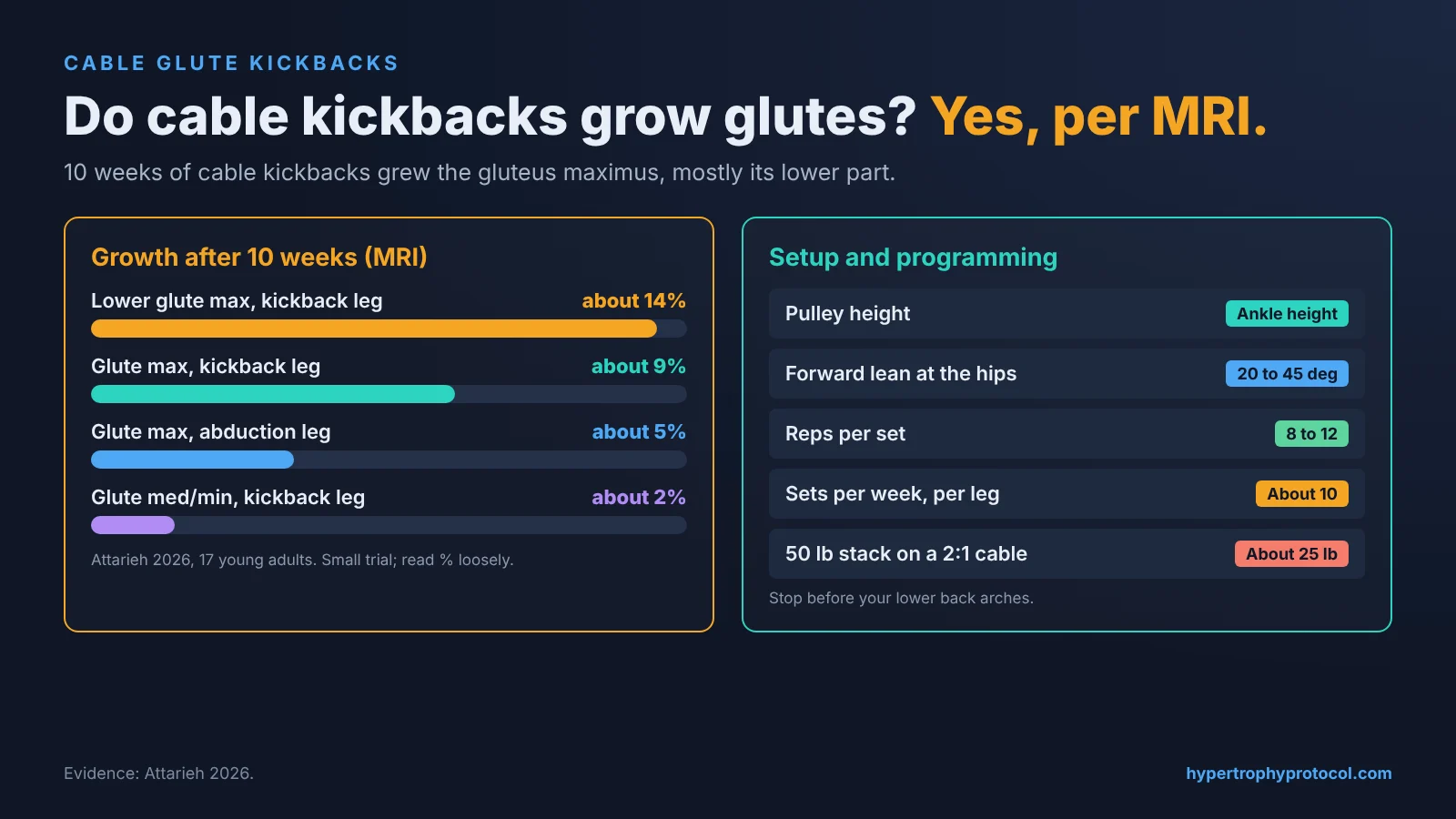
Yes, and there is unusually direct evidence. In a 2026 trial by Attarieh and colleagues, 17 young adults trained one leg with a unilateral cable hip extension, the kickback pattern, and the other leg with cable hip abduction. They trained twice a week for 10 weeks, about 10 sets a week, using 8 to 12 rep maxes. MRI showed:
- The kickback leg’s gluteus maximus grew about 9% overall, compared with about 5% for the abduction leg.
- Growth on the kickback side was strongest in the lower part of the glute max (about 14% there).
- Kickbacks did little for the gluteus medius and minimus (about 2%), which abduction trained better.
It was a small trial, so treat the exact percentages loosely. The direction is clear, though: a cable kickback is a real glute builder, and pairing it with an abduction movement covers the upper and side glutes too. An activation study in trained women by Stevens and colleagues (2022) also found the kickback works the hamstrings hard, so expect some hamstring involvement.
What you need
- A low pulley. A cable tower, functional trainer, rack-mounted pulley or a smart cable like the VOLTRA all work. The pulley should go down to about ankle height.
- An ankle strap. A padded cuff with a D-ring is the standard. Some people loop a strap around the foot instead. Use whichever stays put without digging in.
- Something to hold. The cable tower, an upright or a bench, so your balance doesn’t limit the set.
If you train on a VOLTRA, the VOLTRA exercise setup guide covers mount height and cable line for lower body moves.
How to set up and do a cable glute kickback
- Set the pulley at or just above ankle height and clip the strap to the working ankle.
- Face the machine and step back until there’s tension on the cable with your working foot slightly in front of your hip.
- Hinge forward slightly at the hips, about 20 to 45 degrees, with a neutral spine, and hold the frame. The lean lets your hip start in a flexed position, so the glute works from a longer length.
- Bend the standing knee a little and keep your hips square to the machine.
- Drive the working leg back from the hip, keeping a slight bend in the knee, until the thigh is in line with your torso or just past it. Stop before your lower back arches.
- Pause briefly, then lower under control until the foot is back in front of the hip. Don’t let the stack touch down between reps.
Form mistakes that move the work off your glutes
- Arching the lower back at the top. If the leg goes higher only because your spine bends, that last bit is your back, not your glute. Shorten the range or drop the weight.
- Rotating the hips open. Turning the pelvis to get more height shifts the work to other muscles. Keep both hip bones pointing at the machine.
- Swinging. Momentum skips the hardest part of the rep. Use a tempo you could stop at any point.
- Kicking with the knee. Bending and straightening the knee turns it into a hamstring curl. Keep the knee angle about the same from start to finish.
- Cutting the bottom short. Bringing the foot back in front of the hip trains the glute at a longer length, which the research on training at long muscle lengths suggests may help growth.
Where does the cable pull hardest?
A cable resists most when it pulls at a right angle to the part that’s moving, here your leg. As the angle between the cable and your leg narrows, the same weight produces less resistance at the hip. Pulley height and how far you stand from the machine decide where in the rep that right angle happens:
- Low pulley (ankle height) with a forward lean: the cable runs close to a right angle with the leg near the start, so the rep is hardest early, where the hip is flexed. This is the common setup and loads the glute toward its longer length.
- Higher pulley (knee to hip height): the hardest point moves later in the rep, toward the back position. Some lifters like this feel, but it tends to make the top of the rep the limit.
- Standing closer or farther away: this changes the cable angle too. Whatever you choose, use the same foot position every week so your numbers stay comparable.
No study has compared pulley heights for growth. The low pulley is a sensible default because it puts the most resistance where the glute is stretched.
Reading your pulley ratio
Cable machines aren’t all 1:1. On a 2:1 machine, two cable segments hold the stack, so the strap feels about half the pin weight and moves twice as far. On a 4:1, it’s about a quarter. That’s why 40 lb on a home functional trainer can feel lighter than 40 lb on a gym’s single-pulley tower.
- Check the ratio the maker states, and watch for brands that print it backward (“1:2” for a 2:1).
- Use the cable pulley ratio calculator to find which pin gives you the resistance you want, or to match a gym machine at home.
- For the full explanation, see cable pulley ratios explained.
A 2:1 isn’t worse for kickbacks. The smaller real jumps between pins can make progress easier on a light, single-leg exercise.
How to program cable kickbacks
- Reps and effort: 8 to 12 reps a set, matching the trial, stopping a rep or two short of failure on most sets.
- Weekly volume: the trial used about 10 sets a week per leg across two sessions. Count kickbacks with your other glute sets, not on top of them. The weekly sets planner helps.
- Order: after a heavier lift like a hip thrust or squat, or as the main glute move on a lighter day.
- Pairing: add a hip abduction exercise to cover the side glutes. A cable version works with the same strap.
- Progress: add reps first, then move up a pin. Small steps matter on a single-leg move.
Cable kickback or kickback machine?
Dedicated kickback machines guide the leg on a fixed arc and often add a chest pad, which takes balance out of the equation. They’re convenient, but they take up floor space for one exercise. The evidence above comes from a cable. If you already own a cable station, it’s the better first choice; a machine makes sense mainly when you’ll use it often enough to justify the room.
Bottom line
The cable kickback grew the gluteus maximus in a direct MRI trial, which makes it one of the better-supported glute exercises you can do at home. Set the pulley low, lean forward, keep the movement at the hip and stop before your back arches. Check your pulley ratio so the numbers make sense, and pair it with an abduction movement for complete glute coverage.
Research checked October 29, 2026. This guide is general training information, not medical advice. Stop and get assessed if an exercise causes pain.
Sources
- Attarieh P, Nunes JP, et al. Regional hypertrophy of the gluteal muscles is task-specific: differential responses to 10 weeks of hip extension versus hip abduction training. J Strength Cond Res. 2026. doi:10.1519/JSC.0000000000005701
- Stevens BM, Nichols BR, Doty HI, Korak JA. Muscle activation patterns of the proximal, medial and distal biceps femoris and gluteus maximus among 6 hip extension and knee flexion exercises in trained women. Int J Exerc Sci. 2022. doi:10.70252/DWMB8342