
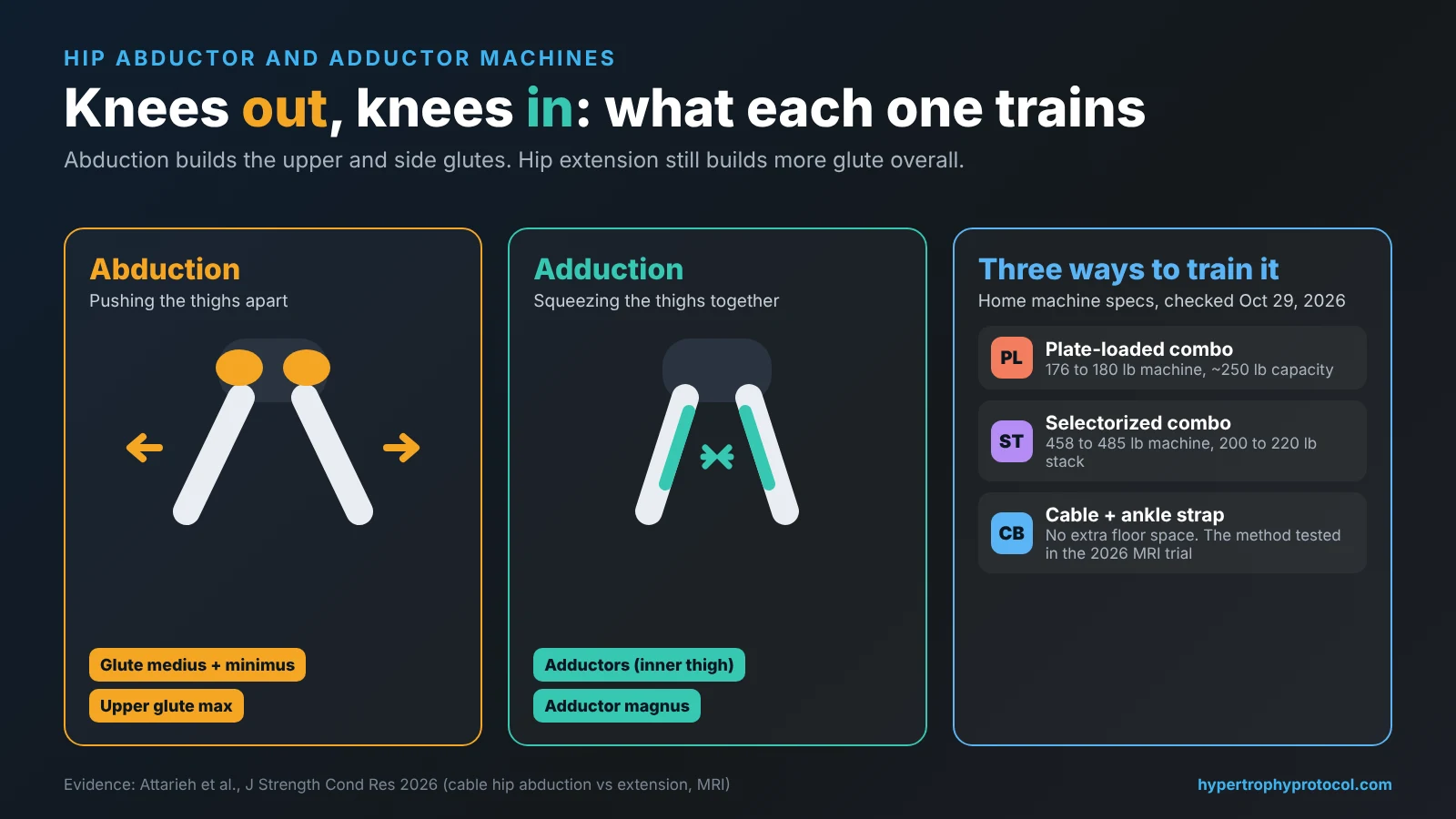
A hip abductor machine trains the muscles that move your thighs apart. An adductor machine trains the muscles that squeeze them together. Most home models do both, by flipping pads or changing the start angle. They’re among the most-searched glute machines, but they train a different job than a hip thrust, and the research on what they build is newer than most buying guides admit.
This guide covers what each movement trains, then compares the home models whose makers publish real specs. Last comes whether a machine beats a cable or bands for the same work. Every spec comes from the manufacturer’s own product page, checked on October 29, 2026.
At a glance
| Verdict | A combo abductor/adductor machine is a reasonable home buy if you have the room and want both movements fast. A cable with an ankle strap trains the same muscles for no extra floor space. |
|---|---|
| Key numbers | Home plate-loaded models list about 250 lb of load capacity and weigh 176 to 180 lb. Selectorized models carry 200 to 220 lb stacks and weigh 458 to 485 lb. |
| Evidence strength | One 2026 MRI trial found hip abduction grows the upper glute max and the glute medius and minimus, while hip extension grows more glute overall. It used a cable, not a machine. |
| What to do | Keep a hip extension movement as your main glute lift and add abduction as a second exercise, not a replacement. |
| Main caveat | “Weight capacity” means different things on different spec sheets, and some makers don’t say whether it’s the load or the user. |
Specs checked against manufacturer pages on October 29, 2026.
What do abductor and adductor machines train?
- Abduction (knees out). Works the gluteus medius and minimus on the side of the hip, plus the upper part of the gluteus maximus. These muscles hold your pelvis level when you stand on one leg.
- Adduction (knees in). Works the adductor group on the inner thigh. The biggest of them, the adductor magnus, also helps extend the hip, so it does a lot of work in squats and lunges.
Neither one is the same as a hip thrust. A hip thrust trains hip extension, which is the main job of the gluteus maximus. If your goal is bigger glutes overall, abduction adds to that work rather than replacing it. The posterior chain guide covers the extension side.
What the research shows
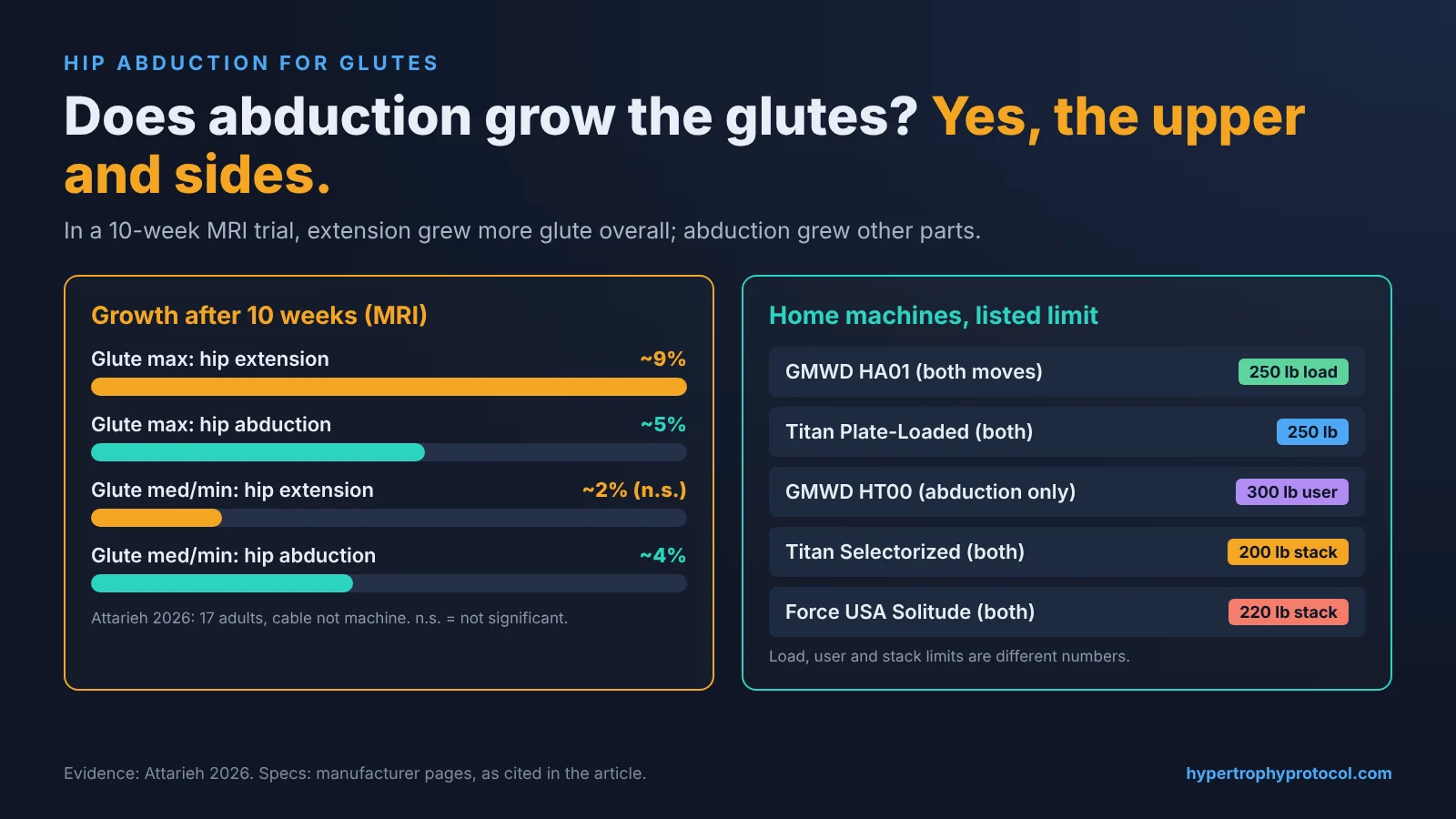
The clearest data is a 2026 MRI trial by Attarieh and colleagues. Seventeen young adults trained one leg with cable hip extension and the other with cable hip abduction for 10 weeks, at about 10 sets a week in the 8 to 12 rep range. Both grew the gluteus maximus, but they grew different parts of it:
- Hip extension: about 9% more gluteus maximus overall, mostly in the lower part. Only about 2% growth in the gluteus medius and minimus, which wasn’t significant.
- Hip abduction: about 5% more gluteus maximus, mostly in the upper part, and about 4% more gluteus medius and minimus.
So abduction is not a wasted exercise, and it builds the upper and side of the glutes that extension mostly leaves alone. It just isn’t the bigger driver of overall glute size. The trial used a cable, not a machine, and it was small. A machine that loads the same movement should do something similar, but no machine has been tested this way yet.
For the inner thigh, the best home data comes from squats. In the Plotkin 2023 trial, back squats grew the adductors more than hip thrusts did. If you already squat deep, your adductors are getting real work. We found no growth trial of an adductor machine itself.
Home abductor and adductor machines compared
Dimensions are as each maker labels them, in inches. “Not listed” means the manufacturer doesn’t publish that number. Capacity is quoted exactly as each maker words it, because a load rating and a user rating are different things.
| Model | Moves | Size (in) | Weight | Resistance and published limit | Notes |
|---|---|---|---|---|---|
| GMWD HA01 | Abduction and adduction | 65.2 L x 44.1 W x 42.7 H (42.9 H in the page overview) | 176 lb | Olympic plates. 250 lb total weight-load capacity, 300 lb plate storage | 6 angle settings in 15° steps, 2 thigh pad positions, 4 backrest settings. Lifetime frame, 6-month parts |
| Titan Plate-Loaded Hip Abductor and Adductor | Abduction and adduction | 41 x 58.75 footprint, 43.25 H | 180 lb | Olympic plates, 10 in sleeves. 250 lb “weight capacity” (the page doesn’t say whether that’s load or user) | Adjustable seat (12 to 16 in), backrest and thigh pads, dual foot positions. 1-year warranty |
| GMWD HT00 3D Hip Abductor | Abduction only | 59.3 L x 42.8 W x 52.2 H | Not listed | Olympic plates, listed as “150 lbs *2”. 300 lb user weight limit | Thighs move out and back in one arc, 0 to 56° per side. 2 start positions, thigh pad spacing 13 to 24.2 in. Lifetime frame, 6-month parts |
| Titan Selectorized Hip Abductor Adductor | Abduction and adduction | 70 D x 67 W (arms open) or 25 W (closed) x 63 H | 458 lb | 200 lb stack, 10 lb starting resistance, 10 lb steps. User limit not listed | 6 leg bar positions from 0° to 75°, 4 seat positions. 1-year warranty |
| Force USA Solitude Abductor / Adductor | Abduction and adduction | 64 L x 65.5 W x 57 H | 485 lb | 220 lb stack. 396 lb maximum user weight | Commercial rated. Home warranty: lifetime frame, 10 years moving parts, 1 year upholstery. Page says retail locations only |
We left out models whose makers don’t publish basic specs, and commercial-only standing abductors that most home buyers won’t be shopping for.
Plate-loaded or selectorized?
- Plate-loaded machines are much lighter (about 180 lb here vs about 460 to 485 lb) and use plates you probably already own. Changing weight means loading horns, which is slower between the two movements.
- Selectorized machines have a built-in stack, so you change weight with a pin and can switch between abduction and adduction quickly. They cost more, weigh a lot more and need a solid floor and a clear path to move in.
On either type, the loaded weight isn’t comparable between machines. The lever length and pivot set how heavy it feels, so track progress on your own machine only.
Do you need a machine at all?
Not necessarily. The 2026 trial above used a cable. If you have a cable station or functional trainer, a standing cable hip abduction with an ankle strap trains the same movement for no extra floor space, and you can do adduction the same way by facing the other direction. Check your pulley ratio first, because a 2:1 cable feels half as heavy as the stack says. The cable pulley ratio calculator does the math.
Bands are the cheapest option. Seated or lying band abductions are easy to do between sets, but the resistance is hard to measure and to increase in small steps.
A machine earns its space when you want both movements with a fast setup, a fixed seat that’s easy to repeat, and loads you can track precisely.
Which one fits your gym?
- You want both movements and already own plates: a plate-loaded combo like the GMWD HA01 or Titan plate-loaded model. They’re the lightest and smallest combo machines here.
- You want fast changes between abduction and adduction: a selectorized machine like the Titan Selectorized or Force USA Solitude, if your floor and budget can take it.
- You only care about the side and upper glutes: the abduction-only GMWD HT00, which moves the thighs out and back in one arc. That’s a different path from a standard abductor, and it isn’t proven to build more glute.
- You have a cable station: use an ankle strap first. Buy a machine later if you find yourself skipping the cable version.
How to use it for glute growth
- Do it after your main hip extension lift, not instead of it.
- Use a full controlled range and take sets close to failure. The trial above used 8 to 12 rep maxes.
- Count abduction as glute sets in your weekly total. The weekly sets planner keeps glutes, hamstrings and adductors separate.
- Keep the seat, backrest and pad settings the same week to week so the numbers mean something.
Before you order
- Measure the open width. Combo machines are widest with the leg arms open, up to 67 in on the Titan Selectorized.
- Read the capacity wording. Load capacity, user limit and stack weight are three different numbers.
- Check the floor and delivery path. Selectorized models weigh 458 to 485 lb.
- Confirm the current specs and stock. GMWD lists two slightly different heights for the HA01, and Force USA lists the Solitude as retail only.
Bottom line
Abduction builds the upper glutes and the glute medius and minimus, and hip extension builds more glute overall, so use both. A combo abductor/adductor machine is the most convenient way to train abduction and adduction at home. A cable with an ankle strap does the same job if you already have one. Buy the machine when convenience and repeatable loading are worth the floor space.
Specifications checked against manufacturer product pages on October 29, 2026. Manufacturers change specs and stock; confirm on the product page before ordering. Hypertrophy Protocol has not hands-on tested these machines.
Sources
- Attarieh P, Nunes JP, et al. Regional hypertrophy of the gluteal muscles is task-specific: differential responses to 10 weeks of hip extension versus hip abduction training. J Strength Cond Res. 2026. doi:10.1519/JSC.0000000000005701
- Plotkin DL, et al. Hip thrust and back squat training elicit similar gluteus muscle hypertrophy and transfer similarly to the deadlift. Front Physiol. 2023. doi:10.3389/fphys.2023.1279170
- Manufacturer pages: GMWD HA01, GMWD HT00, Titan Plate-Loaded Hip Abductor and Adductor, Titan Selectorized Hip Abductor Adductor, Force USA Solitude Abductor / Adductor.