
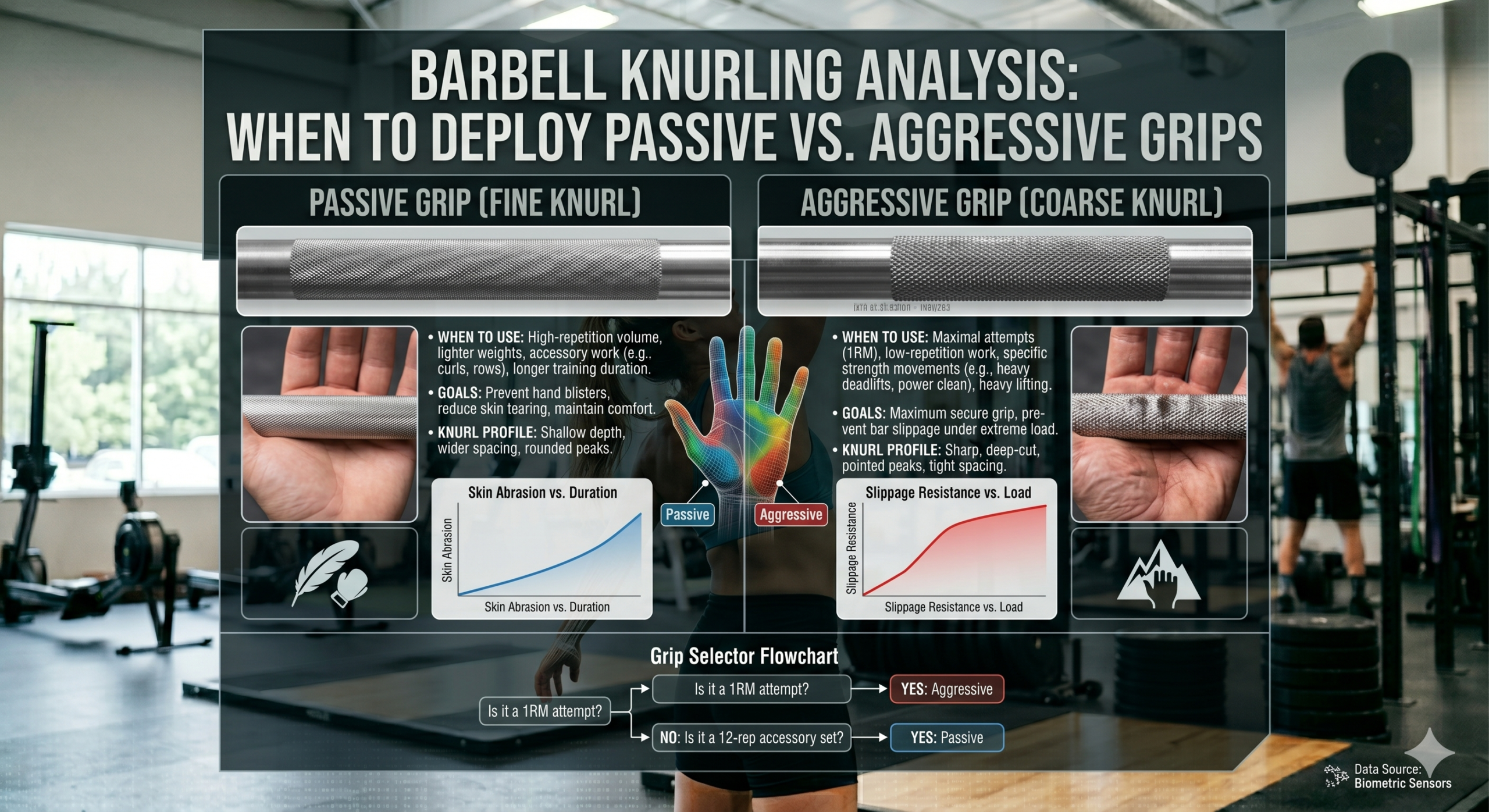
When we evaluate the structural interface between a lifter and a loaded barbell, we consistently identify one variable that is chronically underanalyzed in most training environments: knurling geometry. At the Hypertrophy Protocol Lab, we consider the knurl pattern on a barbell to be a critical piece of biomechanical hardware, not a cosmetic afterthought. It is the sole friction interface between human skin and cold-rolled or stainless steel, and its geometry directly determines force transfer efficiency, grip fatigue rate, and long-term palmar tissue integrity.
In our testing protocols, conducted using barbells housed in 11-gauge steel 3×3 rack systems (the structural standard we require for any reliable loading scenario), we have observed measurable differences in grip endurance, rep quality, and hand trauma markers when athletes rotate between passive and aggressive knurling profiles. This article presents our full analysis: when to deploy each knurl type, why the geometry matters beyond surface-level “feel,” and how to match your barbell selection to your programming demands.
Before we can prescribe passive or aggressive knurling for a given application, we need to establish what knurling actually is from an engineering standpoint. Knurling is a subtractive machining process in which a lathe-mounted knurling tool presses a diamond or straight-line pattern into the surface of a steel shaft. The result is a series of raised points or ridges that increase the coefficient of static friction between the bar and the lifter’s hand.
The Three Primary Knurl Profiles
Not all knurl patterns are created equal. We classify them into three primary geometries based on the shape of the raised points when viewed in cross-section:
- Hill Knurling: The peaks of the diamond pattern are rounded and broad. This produces a low-aggression, high-contact-area surface that distributes pressure across a wider region of the palm. Hill knurling is the most passive profile we encounter in commercial and home gym barbells. It provides adequate friction for moderate loads but does not “bite” into the skin.
- Mountain Knurling: The peaks are sharply pointed, forming narrow, tall ridges. This is the most aggressive profile we test. Mountain knurling maximizes static friction by concentrating force onto smaller contact points, effectively creating micro-anchor points in the skin’s surface. The trade-off is significant: it is far more punishing to soft tissue, particularly during high-volume work or when the bar is dragged across the body (as in a conventional deadlift).
- Volcano Knurling: The peaks resemble truncated cones, with flat tops instead of sharp points. We consider this the balanced-architecture profile. Volcano knurling provides strong traction and grip security comparable to mountain patterns, but the flattened peaks distribute load more evenly, reducing the incidence of callus tears and palmar abrasion. In our assessment, volcano knurling represents the most versatile geometry for multi-purpose training barbells.
Why Knurl Depth and Spacing Also Matter
It is a common misconception that aggression level is the only variable. Knurl depth (the height of the peaks relative to the valleys) and knurl spacing (the density of the diamond pattern) are equally important. A shallow mountain knurl may feel less aggressive than a deep hill knurl. Similarly, a tightly spaced pattern increases the total number of contact points, which can paradoxically make an aggressive geometry feel more tolerable because force is distributed across more peaks. We always evaluate these three variables together: profile shape, depth, and spacing.
In addition to the insights provided in the article “Barbell Knurling Analysis: When to Deploy Passive vs. Aggressive Grips,” readers may find it beneficial to explore the engineering aspects of weightlifting equipment in the article on rack safety. This related piece, which discusses the differences between 11-gauge and 14-gauge steel, offers a deeper understanding of how the materials used in gym equipment can impact safety and performance. For more information, you can read the article here: 11-Gauge vs. 14-Gauge Steel: The Engineering Behind Rack Safety.
Passive Knurling: Clinical Indications and Deployment Strategy
We define passive knurling as any knurl profile that prioritizes comfort and palmar tissue preservation over maximum grip friction. Hill patterns and shallow volcano patterns fall into this category. Passive knurling is not “bad” knurling; it is purpose-built for specific training contexts.
When We Recommend Passive Knurling
Our lab recommends passive knurling in the following scenarios:
- High-volume hypertrophy blocks. When a lifter is performing sets of 8 to 15 repetitions across multiple working sets, cumulative friction exposure becomes a real concern. Aggressive knurling in a high-volume context accelerates callus formation, increases the probability of skin tears, and introduces a pain variable that can compromise rep quality. Passive knurling allows the lifter to maintain consistent hand placement and grip pressure across extended sets without progressive tissue degradation.
- Beginner and general-population training. Novice lifters have not yet developed the callus architecture or grip conditioning to tolerate aggressive knurling. Introducing them to a mountain-knurl barbell on day one is, in our assessment, a programming error. Passive knurling allows new trainees to focus on motor pattern acquisition without the distraction of hand discomfort.
- Back squats and front squats. During squatting movements, the barbell rests on the upper trapezius (back squat) or the anterior deltoids (front squat). The hands serve primarily as stabilizers, not as the primary load-bearing interface. Aggressive knurling in this context offers no biomechanical advantage and may actually cause unnecessary abrasion on the upper back or clavicular region. We consistently recommend passive-to-moderate knurling for squat-dominant barbells.
- Bench press variations. While the hands do grip the bar during a bench press, the load is transferred primarily through the wrist and forearm into the shoulder girdle. Grip failure is rarely the limiting factor in a bench press unless the lifter is using an excessively wide grip or has a specific pathology. Passive knurling is more than adequate for this application and reduces the likelihood of palm irritation during high-volume pressing blocks.
Passive Knurling and Rack Compatibility
We want to note an important hardware consideration. When barbells with passive knurling are racked in 3×3, 11-gauge steel power racks (our institutional standard for structural integrity under heavy loads), the J-cup liner material becomes relevant. UHMW polyethylene liners, which we require on all our rack hardware, protect the knurl pattern from deformation during racking and unracking. A passive knurl that has been damaged by bare metal J-cups may lose what little friction geometry it had, rendering it effectively useless for any serious loading. Protect your knurling, especially if it is passive.
Aggressive Knurling: Clinical Indications and Deployment Strategy
We define aggressive knurling as any profile where the primary design objective is maximum grip friction, even at the cost of palmar tissue comfort. Deep mountain patterns and deep volcano patterns with tight spacing fall into this category.
When We Recommend Aggressive Knurling
Our lab recommends aggressive knurling in the following scenarios:
- Heavy deadlifts, particularly conventional pulls. The deadlift is the lift where grip is most frequently the performance-limiting factor. When a lifter is pulling maximal or near-maximal loads, the bar must not rotate or slip in the hand. Aggressive knurling provides the micro-anchoring necessary to maintain a secure double-overhand or hook grip under peak loading. We have observed measurable improvements in grip endurance at loads above 85% of one-rep max when athletes switch from passive to aggressive knurling.
- Competition preparation and max-effort singles. If a lifter is preparing for a powerlifting meet, they need to train with equipment that replicates competition conditions. Most competition-grade deadlift bars (such as the Texas Deadlift Bar) feature aggressive knurling. Training exclusively on passive knurling and then competing on an aggressive bar introduces a novel sensory variable on meet day, which is a programming risk we advise against. We recommend introducing the aggressive bar during peaking blocks, typically 4 to 6 weeks out from competition.
- Barbell rows and heavy pulling accessories. Any movement where the bar is held in the hands for an extended time under significant load benefits from increased friction. Pendlay rows, Yates rows, and heavy barbell shrugs are all candidates for aggressive knurling deployment.
The Cost of Aggressive Knurling: Hand Trauma Analysis
We do not recommend aggressive knurling without acknowledging its costs. Aggressive knurl patterns increase the incidence of callus tears, palmar blistering, and skin abrasion, particularly in lifters who have not progressively conditioned their hands. Additionally, during conventional deadlifts where the bar is dragged up the shins, aggressive knurling can cause significant tibial abrasion. We recommend knee-high socks or shin guards as standard protective equipment when pulling with an aggressively knurled bar.
Sure, here is the sentence with the clickable link:
Check out the latest fitness program at Hypertrophy Protocol for effective muscle building.
The Periodized Knurling Strategy: Matching Bar Selection to Programming Phase
One of our core recommendations, and one that we find is rarely discussed in the broader training community, is the concept of periodized barbell selection based on knurling profile. Just as we periodize volume, intensity, and exercise selection, we believe the friction interface should be periodized as well.
Accumulation and Hypertrophy Phases
During high-volume accumulation blocks, where rep ranges are elevated and the primary training objective is metabolic stress and mechanical tension across many repetitions, we deploy passive-to-moderate knurling exclusively. This preserves hand tissue integrity across the weeks-long block and prevents cumulative grip fatigue from becoming a confounding variable in hypertrophy stimulus delivery.
Intensification and Peaking Phases
As the program transitions toward lower reps and higher percentages of one-rep max, we introduce progressively more aggressive knurling. By the final 3 to 4 weeks of a peaking block, the lifter should be training with the same knurl profile they will encounter in competition or on test day. This ensures neurological familiarity with the grip stimulus and allows the lifter to refine their grip strategy (hook grip width, chalk application, hand placement relative to knurl marks) under realistic conditions.
Deload and Recovery Weeks
During deload phases, we return to passive knurling or, in some cases, remove barbell pulling movements entirely to allow palmar tissue recovery. Callus maintenance, including controlled filing and moisturizing, should be performed during these windows to ensure the hands are prepared for the next aggressive knurling exposure.
In the exploration of optimal grip techniques for barbell training, understanding the nuances of knurling can significantly enhance performance and safety. For those interested in the science behind muscle growth and recovery, a related article discusses the role of mechanical tension in modern hypertrophy protocols, which can provide valuable insights into how grip variations may influence training outcomes. You can read more about this fascinating topic by following this link.
Knurling Selection by Lift: A Practical Reference
| Barbell Knurling Analysis | Passive Grip | Aggressive Grip |
|---|---|---|
| Knurling Depth | Shallow | Deep |
| Grip Intensity | Light | Strong |
| Hand Fatigue | Low | High |
| Recommended Use | Warm-up sets, high-rep sets | Heavy lifting, low-rep sets |
To make our recommendations immediately actionable, we have compiled the following reference table based on our lab’s testing data and programming experience.
| Lift / Application | Recommended Knurl Profile | Rationale |
||||
| Conventional Deadlift (heavy) | Aggressive (Mountain or deep Volcano) | Grip is the limiting factor; maximum friction is required |
| Sumo Deadlift (heavy) | Moderate to Aggressive (Volcano) | Grip demands are slightly lower due to shorter ROM, but still significant |
| Back Squat | Passive (Hill or shallow Volcano) | Hands are stabilizers, not primary load bearers; comfort is prioritized |
| Front Squat | Passive (Hill) | Minimal hand contact; aggressive knurling serves no purpose |
| Bench Press | Passive to Moderate (Hill or Volcano) | Grip failure is rare; comfort during volume work is the priority |
| Barbell Row | Moderate to Aggressive (Volcano or Mountain) | Extended hold time under load; grip security matters |
| Overhead Press | Moderate (Volcano) | Moderate grip demand; balance of comfort and security |
| General Home Gym / All-Purpose | Moderate (Volcano) | Best compromise for lifters using a single barbell across all movements |
Key takeaway: If we are advising a lifter who owns only one barbell, we recommend a volcano knurl pattern with moderate depth. This provides the broadest functional range across all major compound lifts without the extremes of either passive or aggressive profiles.
In exploring the nuances of grip techniques in weightlifting, a fascinating article on the importance of grip strength can be found at Hypertrophy Protocol. This resource delves into how different grip styles can impact performance and injury prevention, complementing the insights from the Barbell Knurling Analysis on when to deploy passive versus aggressive grips. By understanding these concepts, lifters can optimize their training and enhance their overall effectiveness in the gym.
Hardware Integration: Knurling in the Context of Your Rack and Accessories
We cannot discuss barbell knurling in isolation from the broader equipment ecosystem. The barbell interfaces with J-cups, safety bars, band pegs, and plate sleeves, all of which are mounted to or housed within the power rack. Our institutional standard is a 3×3 upright, 11-gauge steel rack because this specification provides the structural rigidity necessary for reliable barbell re-racking under maximal loads, and it ensures that J-cup hardware is robust enough to accommodate barbells of varying shaft diameters and knurl geometries.
Why Rack Quality Affects Knurl Longevity
Cheap racks with bare metal J-cups will destroy your knurling over time. Every time a barbell is racked and unracked, the knurl pattern contacts the J-cup surface. Without a protective UHMW or nylon liner, this metal-on-metal contact progressively flattens the knurl peaks, degrading friction performance. We have documented measurable reductions in knurl depth after as few as 6 months of heavy use on unlined J-cups. If you invest in a quality barbell with a specific knurl geometry, protect that investment with appropriately lined rack hardware.
Band Peg and Safety Considerations
When using resistance bands attached to band pegs on a 3×3 rack, the barbell may experience lateral forces that cause it to shift in the J-cups during accommodating resistance work. Aggressive knurling can actually provide a slight benefit here by increasing the friction between the bar shaft and the J-cup liner, reducing unwanted lateral movement. This is a secondary consideration, but it is worth noting for lifters who program banded work regularly.
Conclusion: Deploying the Right Friction Interface for the Right Context
Our position is clear: knurling selection is a programmable training variable, not a static equipment feature. Passive knurling serves a defined and valuable role in high-volume, comfort-priority, and beginner contexts. Aggressive knurling is a performance tool deployed when grip is the limiting factor, particularly during heavy pulling and competition preparation. Volcano knurling occupies the pragmatic middle ground and is our default recommendation for single-barbell home gym environments.
We encourage every serious trainee to evaluate their barbell inventory through this lens. Assess the knurl profile, depth, and spacing of every bar in your facility. Map those characteristics to your programming phases. And ensure that your rack hardware, specifically 3×3, 11-gauge steel construction with lined J-cups, is protecting the knurl geometry you have invested in. The barbell-hand interface is too critical to leave to chance.