
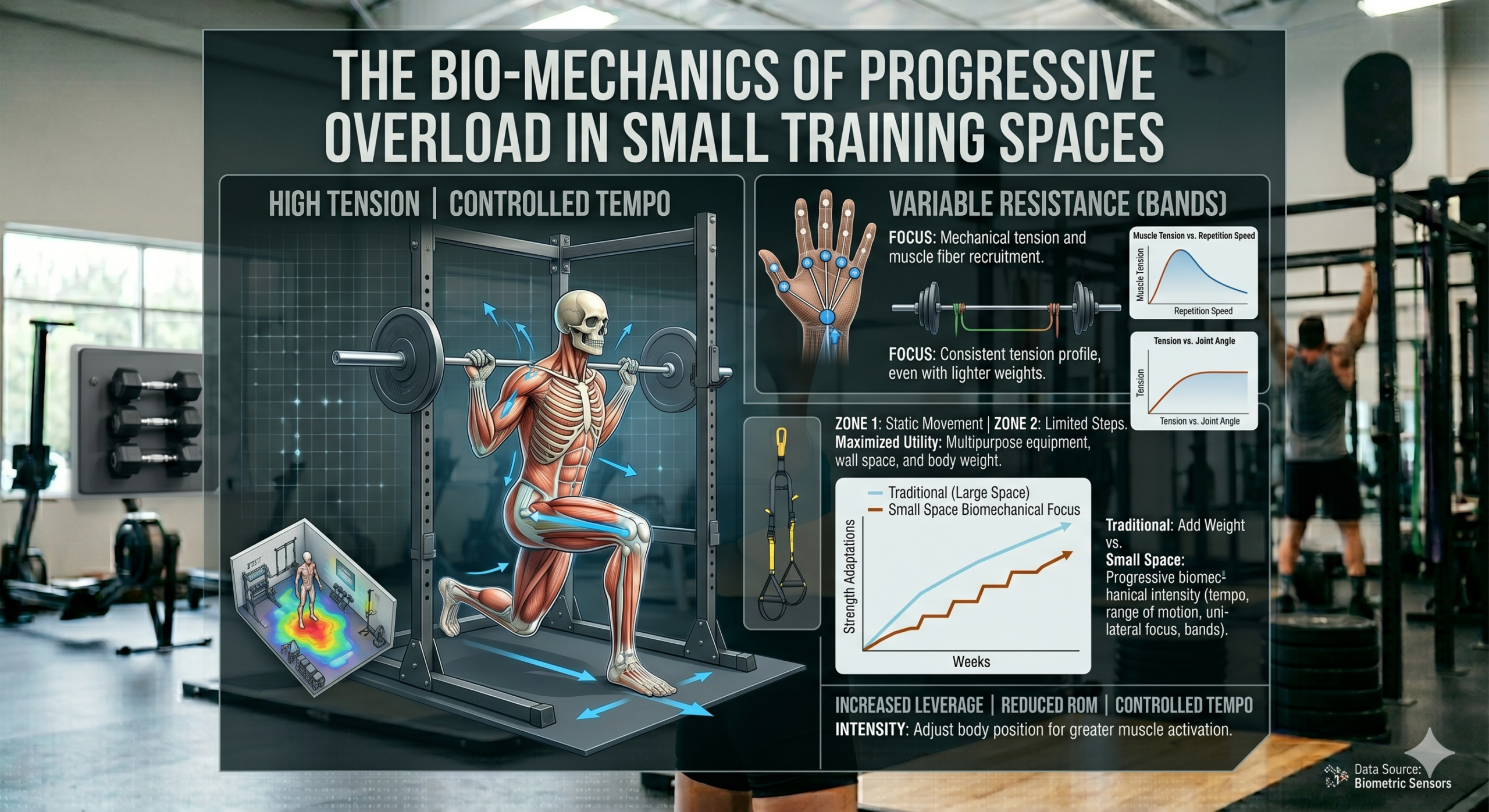
At the Hypertrophy Protocol Lab, we routinely encounter a persistent misconception: that meaningful progressive overload requires expansive floor space, loaded barbells, and a full rack ecosystem. Our clinical and biomechanical assessments tell a different story. Progressive overload is a principle rooted in physiology, not geography. The square footage of a training environment does not dictate the magnitude of adaptive stimulus available to skeletal muscle. What matters is how intelligently we manipulate the mechanical variables that drive tissue remodeling.
In this analysis, we break down the biomechanics of progressive overload as they apply specifically to constrained training environments. We examine the primary mechanisms of muscular adaptation, outline the key overload variables that operate independently of space, and provide a framework for systematically advancing stimulus in areas as small as six-by-eight feet. Every recommendation we present is grounded in current evidence and the mechanical realities of human movement.
Progressive overload refers to the systematic increase of demands placed on the musculoskeletal system over time. At its core, the principle is simple: for a muscle to continue adapting—whether through hypertrophy, strength gains, or improved endurance—it must be exposed to a stimulus that exceeds what it has previously encountered and recovered from.
Mechanical tension remains the primary driver of muscle hypertrophy. When we load a muscle fiber and force it to generate force through its contractile elements (actin-myosin cross-bridges), we trigger a cascade of mechanotransduction signals. These signals—transmitted through integrins and focal adhesion complexes on the cell membrane—activate pathways such as mTOR (mechanistic target of rapamycin) that regulate muscle protein synthesis. The greater and more novel the tension stimulus, the stronger the adaptive signal.
Why Load Is Not the Only Variable
Here is where the conventional understanding often breaks down. Many practitioners equate progressive overload exclusively with adding weight to the bar. While external load is indeed one method of increasing mechanical tension, recent evidence confirms that increasing repetitions and total training volume can produce hypertrophic outcomes comparable to simply adding weight, particularly over short-to-medium training cycles spanning four to twelve weeks. This finding is critical for anyone training in a small space, where equipment options and maximum available loads are inherently limited.
We must think of overload not as a single dial but as a multi-variable control panel. Load is one dial. Repetitions, sets, tempo, range of motion, rest intervals, and exercise complexity are all additional dials, each capable of independently increasing the mechanical and metabolic demands placed on muscle tissue.
The Mechanotransduction Framework
To understand why these alternative variables work, we need to revisit the mechanotransduction framework. Muscle fibers do not have a “weight sensor.” They respond to tension magnitude, tension duration, and the metabolic environment surrounding the contraction. A slower eccentric phase, for example, does not add external load—but it increases the time under tension (TUT) per repetition, which elevates both the mechanical strain on individual sarcomeres and the metabolic byproduct accumulation (hydrogen ions, inorganic phosphate) within the fiber. Both of these factors contribute to the adaptive signal. The muscle, in short, cannot distinguish between a heavier weight moved quickly and a moderate weight moved with deliberate, controlled precision—what it registers is the total mechanical work and the internal environment that work creates.
In exploring the principles of progressive overload within limited training environments, it is essential to consider the role of mechanical tension in muscle growth. A related article that delves deeper into this concept is titled “The Role of Mechanical Tension in Modern Hypertrophy Protocols.” This piece provides valuable insights into how mechanical tension influences muscle adaptation and recovery, which can be particularly beneficial for those training in small spaces. For more information, you can read the article here: The Role of Mechanical Tension in Modern Hypertrophy Protocols.
The Primary Overload Variables for Constrained Environments
When we work with athletes and clients operating in limited spaces—home gyms, studio apartments, hotel rooms, or small clinical rehabilitation settings—we focus on six overload variables that require no additional floor space to manipulate. Each variable has a distinct biomechanical mechanism of action.
Volume: Sets and Repetitions
Total training volume, typically expressed as sets × reps × load, is the most well-supported predictor of hypertrophy across the literature. In a small space, increasing volume is often the most straightforward path to overload. If a client performed three sets of twelve goblet squats at 20 kilograms last week, progressing to four sets of twelve—or three sets of fifteen—at the same load represents a measurable increase in total mechanical work without requiring a single additional kilogram of equipment or an additional square foot of space.
We recommend tracking volume in terms of hard sets per muscle group per week, defined as sets taken within approximately one to three repetitions of momentary muscular failure. For most individuals, a range of ten to twenty hard sets per muscle group per week is the productive training zone. Within a small space, distributing these sets across multiple short sessions throughout the week (a strategy known as high-frequency training) can be particularly effective, as it reduces per-session fatigue and equipment demands.
Tempo Manipulation
Tempo refers to the speed at which each phase of a repetition is performed. We typically notate tempo as a four-digit code: eccentric–pause at bottom–concentric–pause at top. For example, a 4-1-2-0 tempo on a Romanian deadlift means a four-second lowering phase, a one-second pause at the stretched position, a two-second lifting phase, and no pause at the top.
Slowing the eccentric (lowering) phase is a particularly potent overload strategy in small spaces. Eccentric contractions generate greater force per motor unit than concentric contractions. By extending the eccentric phase from one second to three or four seconds, we substantially increase the total time under tension and the peak force experienced by each recruited fiber—without adding any external load. A single 25-kilogram dumbbell used with a four-second eccentric becomes a meaningfully different stimulus than the same dumbbell used with a one-second eccentric, even though the external load is identical.
Range of Motion
Range of motion (ROM) refers to the arc through which a joint moves during an exercise. Increasing ROM increases the total mechanical work performed per repetition because the muscle must generate force over a greater displacement. Recent research has shown that training through a full or elongated range of motion produces superior hypertrophic outcomes compared to partial-range training, particularly for the stretched portion of the strength curve.
In practical terms, this means that elevating the front foot during a split squat (to achieve a deeper hip flexion angle and greater stretch on the quadriceps and glutes) is a legitimate form of progressive overload. The space requirement is negligible—a single weight plate or a low step is sufficient—but the biomechanical demand increases meaningfully. We classify ROM expansion as one of the most space-efficient overload tools available.
Rest Period Modulation
Shortening rest intervals between sets increases the metabolic stress component of the hypertrophic stimulus. When we reduce rest from 120 seconds to 60 seconds, the muscle enters subsequent sets in a state of incomplete phosphocreatine recovery and elevated metabolite concentration. This forces greater motor unit recruitment to compensate for fatigued fibers and amplifies the cell-swelling response, both of which contribute to adaptive signaling.
We must note a critical caveat: excessively short rest periods can reduce total volume capacity, which may offset the metabolic benefit. We therefore recommend rest period reduction as a supplementary overload strategy rather than the primary driver, and we typically apply it in a structured, periodized fashion—reducing rest by ten to fifteen seconds per week over a three-to-four-week mesocycle before resetting.
Exercise Selection and Variation in Small Spaces
The choice of exercise is not merely a logistical consideration in constrained environments—it is a biomechanical overload variable in its own right. Progressing from a bilateral movement to a unilateral movement, for example, effectively doubles the per-limb load demand without adding any external weight.
Unilateral Progressions
Consider the progression from a bilateral bodyweight squat to a rear-foot-elevated split squat to a pistol squat. Each variation increases the force demand on the working limb, challenges single-leg stability (which recruits additional stabilizer musculature), and requires virtually no additional space. Unilateral work is one of the most biomechanically efficient strategies for progressive overload in small environments, because it exploits the simple mechanical reality that supporting the same body mass on one limb instead of two approximately doubles the compressive and tensile loads through the working joints.
Band-Resisted and Accommodating Resistance
Resistance bands introduce what we call accommodating resistance: the force curve of the band increases as it stretches, meaning resistance is greatest at the top of the movement where the muscle is typically strongest. This matches the ascending strength curve of many compound movements (squats, presses, hip hinges) and allows us to overload the end-range of contraction without requiring heavy external loads. Bands are compact, portable, and can be combined with dumbbells or bodyweight movements to create hybrid loading profiles that are impossible to replicate with free weights alone.
Compact Movement Patterns
In a small space, we prioritize movements with a minimal spatial footprint. Vertical pressing, hinge patterns performed in place, floor-based movements (glute bridges, floor presses, dead bugs), and isometric holds all deliver substantial mechanical tension without requiring lateral or forward displacement. The key is that spatial compactness does not inherently reduce biomechanical demand. A heavy dumbbell floor press in a six-foot space imposes the same mechanical tension on the pectorals and triceps as the same movement performed in a 5,000-square-foot facility.
Sure, here is the sentence with the clickable link:
Check out the latest fitness program at Hypertrophy Protocol for effective muscle building.
Microloading and the Principle of Gradual Progression
We advise against large, abrupt jumps in training demand regardless of the environment, but this guidance becomes especially important in small-space contexts where equipment variety is limited and training frequency tends to be higher. We recommend a progression rate of approximately ten percent or less per week across any given overload variable. This means adding one to two repetitions per set, five to ten seconds of total time under tension, or a single additional set—not all of these simultaneously.
Why Small Increments Outperform Large Jumps
From a tissue-remodeling perspective, connective tissues (tendons, ligaments, fascial structures) adapt more slowly than contractile muscle tissue. The collagen turnover rate in tendons, for instance, is significantly longer than the protein turnover rate in muscle fibers. Rapid escalation of training demand can outpace connective tissue adaptation, creating a mismatch that increases injury risk. Gradual, consistent microloading allows the entire musculoskeletal system—not just the muscle—to adapt in a coordinated fashion.
In small-space training, where adjustable dumbbells may jump in 2.5-kilogram increments (which can represent a disproportionately large percentage increase on lighter lifts), we often use fractional plates, band additions, or tempo adjustments to create intermediate loading steps that keep the progression curve smooth.
For those interested in optimizing their training routines, a related article that delves into effective strategies for maximizing results is available at Hypertrophy Protocol. This resource complements the insights provided in The Bio-Mechanics of Progressive Overload in Small Training Spaces by offering practical tips and techniques that can be easily implemented, even in limited environments. By exploring both articles, readers can gain a comprehensive understanding of how to enhance their workouts and achieve their fitness goals.
Technique Refinement as a Legitimate Overload Mechanism
| Metrics | Data |
|---|---|
| Number of Exercises | 15 |
| Duration of Workouts | 30-45 minutes |
| Frequency of Training | 3-4 times per week |
| Progressive Overload Techniques | Increasing weight, reps, or sets |
| Equipment Needed | Dumbbells, resistance bands, stability ball |
This is a variable we find consistently undervalued. Improvements in movement efficiency, joint positioning, and neuromuscular control constitute a genuine form of progressive overload. When a client improves their squat mechanics—achieving better pelvic alignment, more even force distribution across the foot, improved bracing coordination—they are able to direct a greater proportion of the external force into the target musculature rather than dissipating it through compensatory patterns.
The Neural Efficiency Argument
In the early phases of any training program, a substantial portion of strength gains comes from neural adaptations: improved motor unit recruitment, rate coding (the frequency at which motor neurons fire), and intermuscular coordination. These neural improvements allow the trainee to generate more force with the same muscle mass. In a constrained environment where external load is capped, maximizing neural efficiency extends the productive lifespan of each load increment. A 20-kilogram dumbbell used with poor form is not the same stimulus as a 20-kilogram dumbbell used with optimized mechanics—the latter delivers more tension to the target tissue per unit of external load.
Range of Motion as a Technique Variable
We also categorize range of motion improvement under the technique umbrella. If a client’s hip flexion mobility improves over four weeks, allowing them to achieve five additional degrees of depth in a lunge, the working muscles are now producing force through a longer excursion. This is overload. It requires no additional weight, no additional space, and no additional equipment. It requires only deliberate attention to movement quality—something that is equally available in a 50-square-foot room and a 10,000-square-foot gym.
Managing Fatigue and Recovery in Small-Space Training
We must address recovery with particular seriousness in the context of constrained environments. Small-space training tends to involve higher training frequencies (because sessions are shorter and more accessible), greater reliance on high-effort techniques (because external loads are limited, intensity of effort must compensate), and less exercise variety (which concentrates repetitive stress on the same joint structures). All of these factors accelerate fatigue accumulation.
Structured Deload Protocols
We program a deload—a planned reduction in training volume and/or intensity—every three to five weeks for clients training in small spaces. During a deload week, we typically reduce total sets by forty to fifty percent while maintaining load and movement quality. This allows for systemic recovery (central nervous system, hormonal milieu, connective tissue repair) without a complete cessation of training that might cause detraining effects.
Autoregulation and Readiness Assessment
We also employ autoregulation strategies, such as rating of perceived exertion (RPE) scales and repetitions-in-reserve (RIR) tracking, to modulate daily training demands based on real-time readiness. If a client reports an RPE of nine on a set that was programmed as RPE seven, that is a signal to reduce volume for that session rather than pushing through accumulated fatigue. This approach is especially valuable when training in isolation without a coach present, as is common in home-based small-space setups.
Conclusion: Principles Over Equipment
Our position at the Hypertrophy Protocol Lab is unambiguous: the biomechanical principles of progressive overload are environment-agnostic. Mechanical tension, metabolic stress, and progressive demand can all be systematically increased in a space no larger than a yoga mat. What changes in a small training space is not the science—it is the strategy. We shift from load-dominant progression to multi-variable progression. We prioritize tempo, range of motion, unilateral work, and technique refinement. We plan recovery with greater precision because the margin for error is narrower.
The trainee who understands these biomechanical realities will outperform the trainee who believes overload requires a fully equipped facility. Space is a constraint. It is not a limitation.