
Affiliate disclosure: this post contains a marked affiliate link to the Innodigym store. If you buy through it, Hypertrophy Protocol may earn a commission at no extra cost to you. This is a researched buyer’s guide built from Innodigym’s US product pages and FAQ, checked October 12, 2026, plus the owner’s use of a P1 Max where noted.
You’ve narrowed it to an Innodigym P1, and the Lite, Plus and Max look alike except for price. Short answer: buy the Innodigym P1 Max if you already train heavy, the Lite if you don’t, and the Plus only in a narrow middle. All three run the same four resistance modes and the same app, so the choice comes down to how much load you need on a single cable. Pick by your heaviest one-arm exercise and your heaviest two-cable exercise, not by the big total on the box. Here’s how to tell which lifter you are.
How do the three P1 models compare?
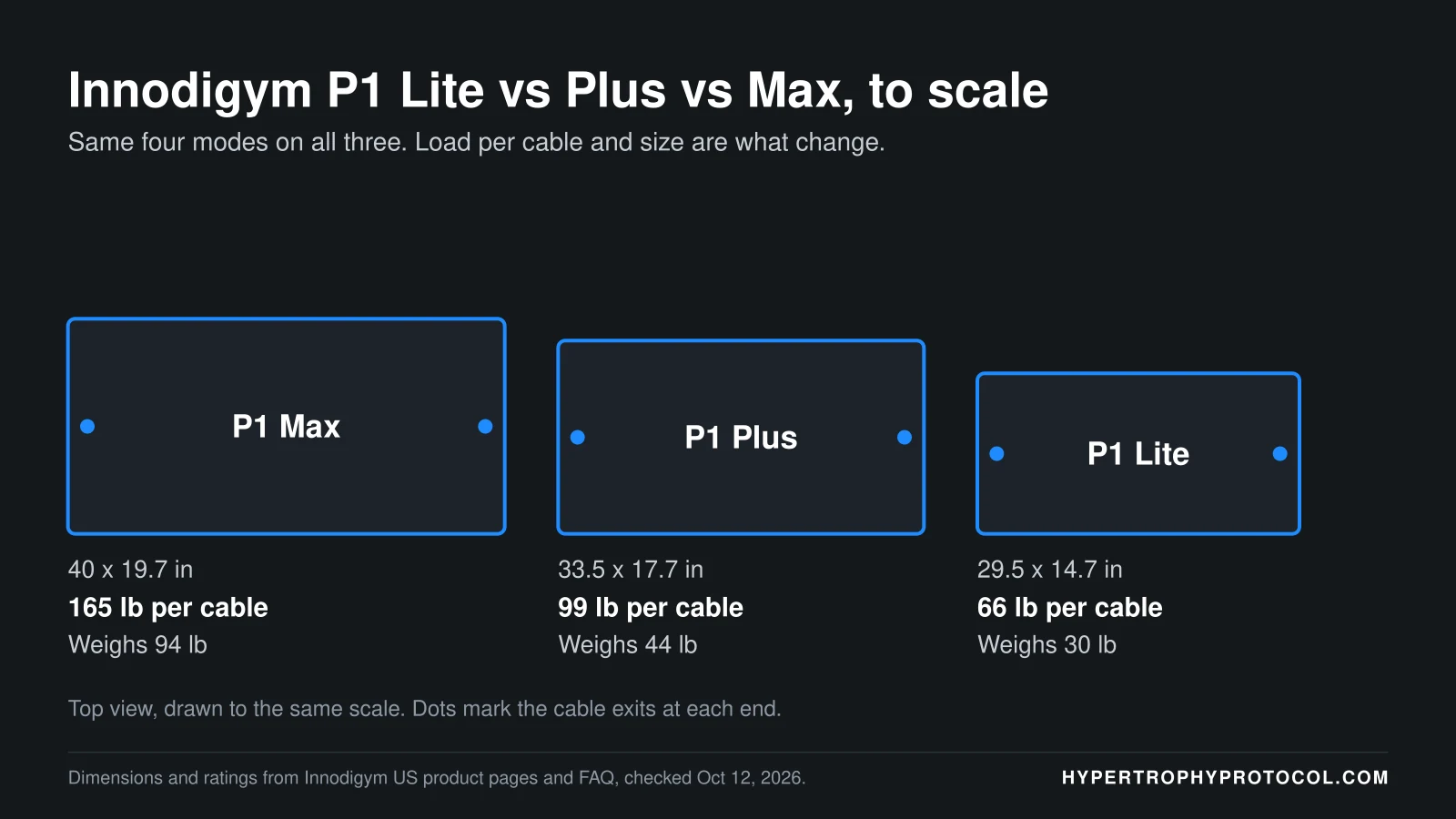
Every P1 is a flat motor panel that sits on the floor with a cable at each end. What changes from model to model is the motor ceiling, the size and weight of the panel, and a few controls.
| P1 Lite | P1 Plus | P1 Max | |
|---|---|---|---|
| Max load, total | 132 lb | 198 lb | 331 lb |
| Range per cable | 4.4 to 66 lb | 4.4 to 99 lb | 4.4 to 165 lb |
| Panel size | 29.5 x 14.7 in | 33.5 x 17.7 in | 40 x 19.7 in |
| Thickness | 2.1 in | 2.3 in (FAQ: 2.6 in) | 4.3 in (FAQ: 4.2 in) |
| Weight | 30 lb | 44 lb | 94 lb |
| Safety buttons, failure protection | Conflicting: not in the comparison table, but the Lite page lists a safety button | Yes | Yes |
| Stereo speakers | Conflicting: not in the comparison table, mentioned on the Lite page | Yes | Yes |
| Approved wall mount | Yes, $59 kit | No | No |
| Base price (at the time of writing, October 2026) | $562 to $599 | $1,124 to $1,199 | $1,687 to $1,799 |
Innodigym US product pages, comparison table and FAQ, checked October 12, 2026. The P1 Max per-cable figure appears as 165 lb in the comparison table and 166 lb (75 kg) in the FAQ. The lower prices come from the collection page, which says they reflect a launch discount that needs a code at checkout; the product pages showed $599, $1,199 and $1,799. Bundles with a bench, bar or extra handles cost more.
All three share the same modes (Standard, Eccentric, Chain and Speed), the same 11.2 ft cable length and the same free app. So once the load question is settled, you’re mostly choosing size and controls.
Start with your heaviest one-arm exercise
That per-cable row in the table is the ceiling for anything you do one side at a time: a single-arm row, a one-leg kickback, a lateral raise, a one-arm press. The headline total only applies when both cables pull on the same bar or harness.
Take a lifter whose heaviest one-arm row is around 80 lb. The Lite tops out at 66 lb per cable, so it can’t load that row at all. The Plus reaches 99 lb, which covers it with some room to progress. The Max’s listed 165 lb per cable leaves far more room above that 80 lb row, though training loads and progression vary from lifter to lifter. If your one-arm work stays in curl and lateral-raise territory, the Lite’s 66 lb is plenty.
Expect the felt load to run a little under the display. A 2024 P1 Max review from Connect The Watts estimated that 330 lb felt closer to 275 to 300 lb, though the reviewer had no measuring tools. Build in some headroom rather than buying a model that only just reaches your number.
Then check your heaviest two-cable lift
Two-cable lifts are where the totals matter. With a long bar or a harness clipped to both cables, the machine can deliver its full rating: 132, 198 or 331 lb.
Say the same lifter does Romanian deadlifts with about 180 lb on a bar. The Lite can’t get there. The Plus’s 198 lb total is barely above it, which leaves almost nothing for progression and nothing if the felt load runs low. The Max at 331 lb handles it with room to grow for years. That pattern holds for squats and hinges generally, which is why the Max, with the highest published load in the P1 line, is the one to consider if lower-body work is the priority; whether it is enough depends on the lifter and the exercise.
I’ve used the P1 Max with a Squat Harness V4 for squats and good mornings. At higher loads the harness split the resistance evenly across both cables, so neither hip took more than the other, and good mornings felt stable with no bar to balance. The full write-up is in the Squat Harness V4 review.
Size, weight and where the panel lives
Once you know which models clear your loads, the space question usually decides between the survivors. The Lite covers about 3 sq ft and weighs 30 lb, so it slides under a bed or couch and comes out in seconds. The Plus covers about 4.1 sq ft at 44 lb. The Max covers about 5.5 sq ft and weighs 94 lb; it has wheels, but you won’t want to carry it up stairs after every session.
The Lite is also the only P1 that Innodigym approves for wall mounting, using a separate $59 mounting kit. Nothing on the site approves wall-mounting the Plus or Max. Innodigym sells a Wall-mounted Pulley pair ($129) for those two, which redirects the cable for vertical pulling, but its listing gives no anchor spec or load rating, so treat installation as your own engineering problem.
Every P1 needs a wall outlet; there’s no battery. Plan the spot around a safe cord run.
What do the P1 Plus and P1 Max add besides load?
Beyond more motor, the Plus and Max are listed with two things Innodigym’s comparison table doesn’t credit to the Lite: remote safety buttons on the handles and long bar that drop the resistance with one press, and failure protection that the product pages say is on by default. They also have stereo speakers.
Read the safety claims carefully. The P1 FAQ still states that the P1 series “does not have spotter mode,” while the Plus and Max pages describe failure protection that backs off the load when it detects exhaustion. Those may be different features, but the public pages don’t settle it. Connect The Watts also found the Bluetooth unload buttons on the Max’s accessories finicky, sometimes needing several presses, and the reviewer said they would think twice before max-effort squats or bench on it.
The Lite’s standard handles have no Bluetooth buttons at all. The FAQ suggests buying Smart Handles instead, but the only Smart Handles listing ($99 a pair) says it fits the OMNI X1 Pro only, so confirm compatibility with Innodigym before ordering them for a Lite.
What will the full setup cost?
The base price buys the panel with basic handles. A bench, long bar or smart handles push the total up quickly. At the time of writing (October 2026), the P1 product pages listed three packages per model:
- P1 Lite: Basic $599, Intermediate $989, Advanced $1,079
- P1 Plus: Basic $1,199, Beginner $1,589, Advanced $1,729
- P1 Max: Basic $1,799, Beginner $2,189, Advanced $2,329
The pages barely itemize what each package includes (the Lite Advanced set is the one confirmed to include the wall-mount kit), so confirm the contents in the cart before you pick a tier. Individually, the bench lists at $524 (down from $699; it was $489 on October 12), the long bar with its safety button at $149 and smart handles at $99.
Before you order, know the policies. The formal warranty is a two-year limited warranty that excludes cables, pulleys, grips and software, while the older FAQ still says one year, so get your coverage confirmed in writing. Returns outside the EU have a 7-day window, and for a change-of-mind return you pay shipping and possible restocking costs.
Which P1 should you buy?
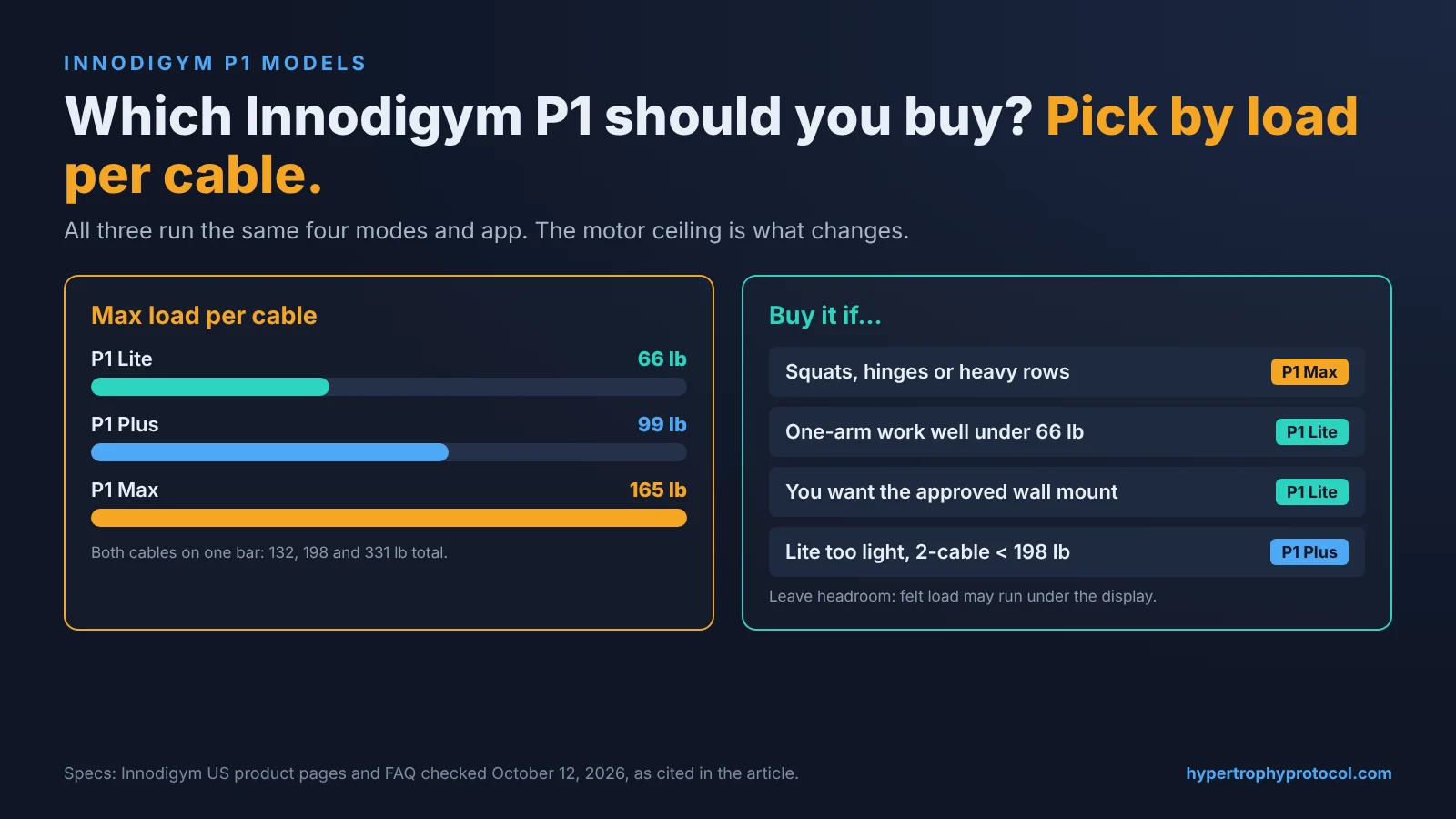
Buy the P1 Max if you train squats, hinges or heavy rows and want the panel to carry real load for years. It’s the only P1 with clear headroom for a trained lifter’s two-cable lifts, and its 165 lb per cable covers any one-arm movement.
Buy the P1 Lite if your heaviest one-arm exercise stays comfortably under the Lite’s 66 lb per-cable ceiling, you value a 30 lb panel you can stash anywhere, or you want the approved wall mount. It’s also the cheapest way to find out whether digital cable training suits you.
Buy the P1 Plus only if the Lite falls short on one-arm work, you want the safety buttons, and your two-cable lifts stay well under 198 lb. If your squats or deadlifts are already near that number, skip straight to the Max.
If you need high pulley angles without building your own pulley setup, none of the P1s is the right tool. For the broader verdict on the brand, see the Innodigym review. Live package prices are on the Innodigym store (affiliate link).
Sources
- Innodigym US: P1 comparison, P1 Lite, P1 Plus, P1 Max, FAQ, warranty, returns.
- Connect The Watts, P1 Max review (2024).
Considering the step up? See Innodigym OMNI X1 Pro: is it worth it over the P1 Max? and which bench and accessories are worth adding.