
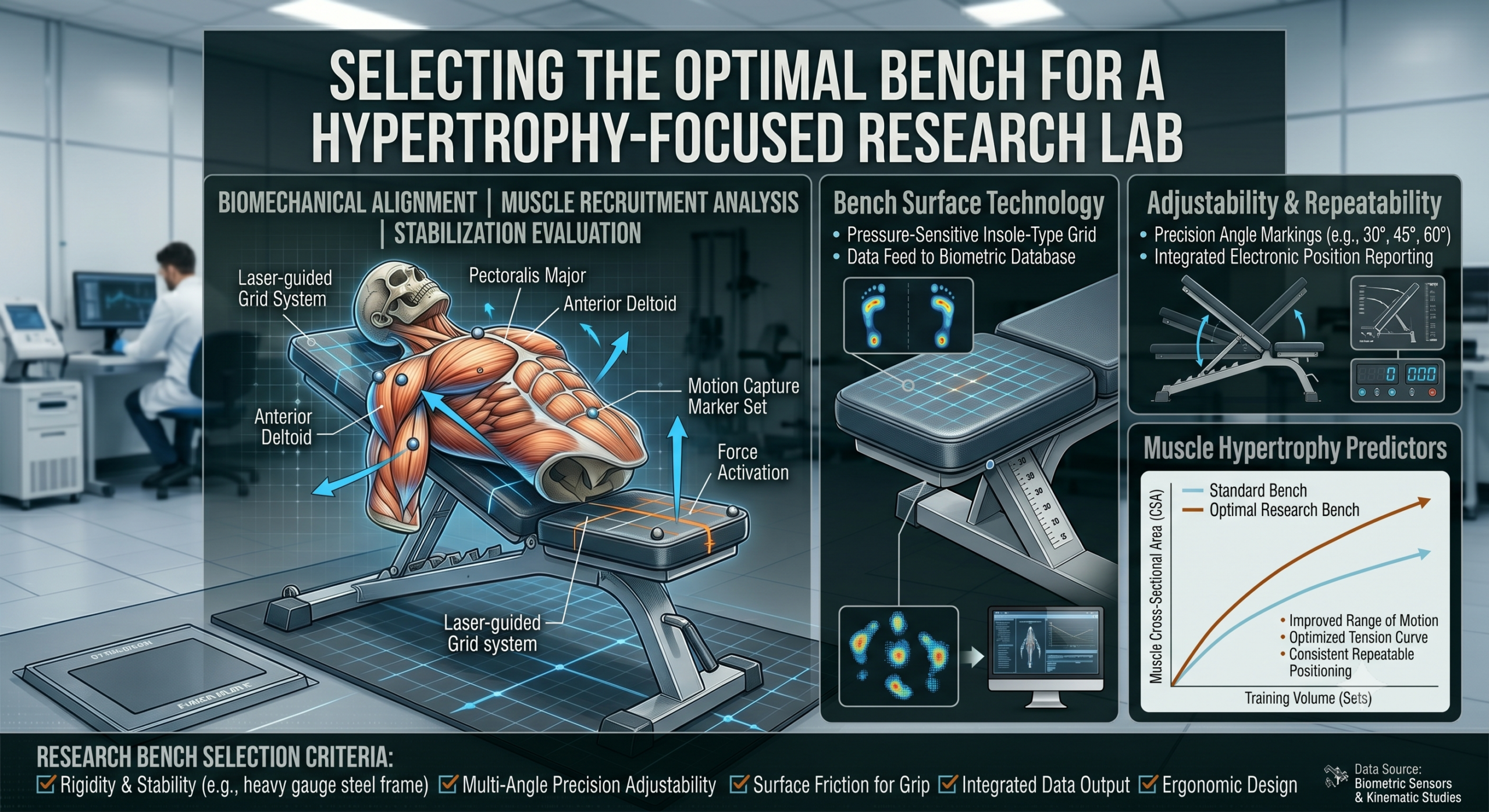
In our facility, every piece of equipment serves a dual purpose: it must function as a reliable instrument for data collection and as a safe, repeatable platform for human subjects performing maximal or near-maximal effort. Nowhere is this dual mandate more apparent than in the selection of the primary bench used for pressing protocols. A bench, in the context of a hypertrophy-focused research lab, is not simply a piece of gym furniture. It is a measurement platform, a subject-positioning system, and a critical variable-control device all at once. When we select a bench for our protocols, we are making a decision that directly influences internal validity, subject safety, and the reproducibility of our findings.
This article details our institutional criteria for bench selection, grounded in the latest biomechanical research, 2025-era findings on range of motion (ROM) manipulation, and the structural engineering standards that separate research-grade equipment from commercial-grade products.
We have observed a persistent tendency in the literature for researchers to treat the bench as a background variable, something mentioned in the methods section as “a standard adjustable bench” without further specification. This is a methodological weakness. The bench directly mediates the independent variables we are trying to control: ROM, scapular positioning, trunk angle, foot placement, and load path consistency.
The Bench as a Biomechanical Interface
When a subject lies on a bench to perform a barbell or dumbbell pressing movement, the bench surface defines the posterior kinetic chain’s contact points. The width of the pad determines how much scapular retraction is possible. The height of the bench relative to the floor determines knee angle and foot-floor contact, which in turn influences leg drive and trunk stability. The density and compression characteristics of the upholstery determine whether the subject’s position drifts during a set.
In hypertrophy research specifically, we are often manipulating volume (sets × reps), intensity (percentage of one-repetition maximum), repetition duration (tempo), and ROM. A 2025 study examining different bench press ranges of motion confirmed what we have long suspected: altering ROM significantly changes muscle excitation patterns across the pectoralis major, anterior deltoid, and triceps brachii. This means that if our bench introduces even small inconsistencies in subject positioning between sessions, we risk confounding our ROM variable with equipment-induced postural drift. The bench must eliminate this source of error.
Standardization as the Primary Selection Criterion
Recent systematic reviews continue to emphasize that hypertrophy outcomes are most sensitive to training variables like volume, intensity, and mechanical tension duration. We agree. But the prerequisite for controlling those variables is a bench that allows highly repeatable positioning and loading across sessions and across subjects. If two subjects of different anthropometries cannot be positioned with equivalent biomechanical standardization, our data loses comparability. The optimal bench for our purposes is, therefore, the one that maximizes setup reproducibility.
In the quest to establish an effective hypertrophy-focused research lab, selecting the optimal bench is crucial for maximizing training outcomes. A related article that provides valuable insights into the importance of equipment in performance facilities is titled “Why 3×3 Steel Racks Are the Gold Standard for Professional Performance Facilities.” This article discusses the advantages of using high-quality steel racks, which can complement the selection of benches and enhance overall training effectiveness. For more information, you can read the article here: Why 3×3 Steel Racks Are the Gold Standard for Professional Performance Facilities.
Structural Engineering Requirements: Why 11-Gauge Steel Is Our Minimum Standard
We do not evaluate benches based on brand reputation or aesthetic design. We evaluate them based on materials science, weld quality, and geometric tolerances. The structural integrity of the bench frame is a non-negotiable safety and data-quality requirement.
Defining 11-Gauge Steel in Context
Steel gauge refers to the thickness of the steel tubing used in the frame. In the standard gauge system used for steel in North America, 11-gauge steel corresponds to a wall thickness of approximately 3.048 mm (0.1196 inches). For context, 14-gauge steel, commonly found in budget commercial benches, has a wall thickness of only 1.897 mm. The difference is not trivial.
The moment of inertia of a steel tube, which determines its resistance to bending under load, increases significantly with wall thickness. When a 100+ kg subject is pressing a loaded barbell and generating dynamic forces that exceed the static load by a factor of 1.5 to 2.0 during the eccentric-concentric transition, the frame must resist deflection. Any deflection in the bench frame introduces micro-movements at the subject-pad interface, which compromises positional standardization and can alter the effective ROM. We have measured frame deflection on 14-gauge benches under dynamic loading conditions, and the values are unacceptable for research-grade work.
Weld Integrity and Joint Design
Beyond gauge thickness, we inspect weld type and coverage. Full-penetration welds at all structural joints are essential. Tack welds or partial-coverage welds create stress concentration points that can fail under cyclic loading. Given that a hypertrophy study may involve hundreds of sets performed on the same bench over weeks or months, fatigue resistance of the frame joints is a legitimate engineering concern. We require benches with robotically applied or professionally certified welds at every load-bearing junction.
Weight Capacity Ratings and Safety Factors
We require a minimum static weight capacity rating of 450 kg (approximately 1,000 lbs) for any bench used in pressing protocols. This is not because our subjects are pressing that load. It is because the safety factor, defined as the ratio of the equipment’s rated capacity to the maximum expected operational load, must be at least 2.5:1 for research applications involving human subjects. If our heaviest anticipated combined load (subject body mass plus barbell load) is 180 kg, we need the bench rated to at least 450 kg to ensure that dynamic force peaks and long-term fatigue never approach the failure threshold.
Compatibility with the 3×3 Rack Ecosystem
In our lab, the bench does not exist in isolation. It operates within a 3×3 power rack or half-rack system. The term “3×3” refers to the upright dimensions of the rack: 3 inches by 3 inches (76.2 mm × 76.2 mm) square steel tubing. This is the most widely adopted standard for research-grade and high-end commercial racks, and it dictates the hole spacing, J-hook compatibility, safety arm dimensions, and accessory mounting options.
Why Bench-to-Rack Dimensional Compatibility Matters
If the bench is too wide, it will not clear the inside dimension of the rack uprights, forcing subjects to set up outside the rack. This eliminates the use of safety pins or straps for failed-rep protection, which is an unacceptable safety compromise in a research setting. If the bench is too tall, it may interfere with the lowest J-hook setting, limiting our ability to standardize unrack height for shorter subjects.
We specify bench pad widths of no more than 305 mm (12 inches) and overall frame widths of no more than 660 mm (26 inches) to ensure clearance within a standard 3×3 rack with 1,092 mm (43-inch) inside width. These are not arbitrary numbers. They are derived from the geometric constraints of the rack and the anthropometric range of our subject population.
J-Hook Height and Unrack Biomechanics
The bench height, measured from the floor to the top of the pad surface, determines the geometric relationship between the subject’s shoulder joint and the J-hook position at unrack. An optimal unrack occurs when the barbell can be lifted from the J-hooks with minimal shoulder protraction and no loss of scapular retraction. If the bench is too low relative to the available J-hook positions, the subject must protract and elevate the shoulders to clear the hooks, disrupting the starting position. We have standardized on bench heights between 430 mm and 445 mm (approximately 17 to 17.5 inches), which aligns with the Westside hole spacing pattern used in most 3×3 racks with 50 mm (2-inch) hole spacing through the bench zone.
Sure, here is the sentence with the clickable link:
Check out the latest fitness program at Hypertrophy Protocol for effective muscle building.
Pad Geometry, Density, and Surface Characteristics
The pad is the direct interface between the equipment and the subject. We treat pad specification with the same rigor we apply to any sensor or contact surface in our measurement chain.
Foam Density and Compression Behavior
We require pad foam density in the range of 60 to 70 kg/m³ (approximately 3.7 to 4.4 lbs/ft³). Foam that is too soft allows the subject to sink, changing the effective chest height and thereby altering ROM in an uncontrolled manner. Foam that is too firm creates pressure points on the thoracic spine and scapulae, causing discomfort that may alter motor unit recruitment patterns, especially during longer sets or higher-volume protocols where we are investigating hypertrophy-specific stimuli.
The compression set of the foam, meaning its tendency to permanently deform after repeated loading, must be below 10% after 1,000 loading cycles. We have tested commercial benches that exceed 25% compression set after moderate use, resulting in a measurable change in bench surface height over the course of a single study. This is unacceptable.
Surface Material and Friction Coefficient
The vinyl or synthetic leather covering must provide a consistent friction coefficient to prevent subject sliding during the set. We use coverings with a static friction coefficient of approximately 0.5 to 0.7 against cotton-blend athletic clothing. Slick or excessively grippy surfaces both introduce problems: the former allows positional drift, while the latter can restrict natural scapular movement during the press and create shear forces on the skin during high-rep sets.
Pad Width and Scapular Mechanics
A pad width of 290 mm to 305 mm (approximately 11.5 to 12 inches) represents our institutional standard. This width supports the thoracic spine and medial scapular borders while still allowing full scapular retraction and depression. Wider pads, such as those found on some competition-style benches at 320 mm or more, can actually impede scapular retraction in narrower-framed subjects, which alters pectoralis major recruitment and confounds hypertrophy measurements at that muscle site.
In the quest for selecting the optimal bench for a hypertrophy-focused research lab, it is essential to consider various factors that influence safety and performance. A related article discusses the engineering behind rack safety, particularly comparing 11-gauge and 14-gauge steel, which can significantly impact the durability and stability of gym equipment. Understanding these differences can help researchers make informed decisions when outfitting their labs. For more insights, you can read the article on rack safety.
Flat Versus Adjustable Versus Competition-Style: A Research-Context Comparison
| Bench Type | Features | Price | Weight Capacity |
|---|---|---|---|
| Flat Bench | Sturdy frame, wide pad | 200 | 600 lbs |
| Incline Bench | Adjustable angle, leg support | 250 | 500 lbs |
| Decline Bench | Comfortable padding, durable construction | 300 | 700 lbs |
We are frequently asked whether our lab should standardize on a flat bench, an adjustable bench, or a competition-specification bench. Our answer depends entirely on the research questions we are pursuing.
The Flat Bench as the Default Research Platform
For studies examining flat barbell bench press as the primary intervention, a dedicated flat bench is almost always superior to an adjustable bench set at zero degrees. The reason is mechanical: adjustable benches introduce a hinge point and a locking mechanism, both of which can create micro-play or flex under load. Even high-quality adjustable benches with 11-gauge frames and hardened-steel hinge pins exhibit measurable deflection at the hinge compared to a one-piece welded flat bench.
Our recommendation: if more than 60% of pressing protocols in the lab use a flat position, invest in a dedicated flat bench as the primary instrument and maintain an adjustable bench as a secondary unit.
When Adjustable Benches Are Justified
If our research program includes incline pressing at 30°, 45°, or other angles as independent variables, an adjustable bench becomes necessary. In that case, we require angle indexing with mechanical detents (not friction-based pin-and-hole systems) that produce repeatable angles within ±1° across adjustments. We also require that the gap between the seat pad and back pad at the hinge point is less than 15 mm at all angles, to prevent the subject’s lumbar spine from dropping into the gap and altering pelvic tilt.
Competition-Style Benches: Overkill or Appropriate?
Competition benches, built to International Powerlifting Federation (IPF) specifications, offer extreme rigidity and standardized dimensions. However, the fixed height of 420 mm to 450 mm and the wider pad width of 300 mm to 320 mm are optimized for powerlifting performance, not necessarily for hypertrophy research. The pad density is typically very high (above 80 kg/m³), which can be uncomfortable during the higher-volume, moderate-load sets (65% to 80% of 1RM) that are characteristic of hypertrophy protocols. We use competition benches only when our research specifically involves powerlifting populations or competition-style bench press as the intervention.
Workflow Efficiency and Its Impact on Protocol Integrity
A frequently overlooked factor is how the bench integrates into the overall testing workflow. In hypertrophy-focused studies, we are typically programming multiple sets with controlled rest intervals. Recent meta-analytic evidence suggests that rest intervals of 60 seconds or less may slightly blunt hypertrophic responses compared to intervals of 90 seconds or more. This means our protocols often require precisely timed rest periods of 90 to 180 seconds.
Rapid Setup and Adjustment Between Subjects
If we are running multiple subjects through a session, the bench must allow rapid and repeatable setup changes. Adjustable benches with clearly labeled angle markings and tool-free adjustment mechanisms save meaningful time. We estimate that a poorly designed adjustment mechanism can add 30 to 45 seconds per subject changeover, which, across a 20-subject testing day, introduces enough scheduling pressure to tempt researchers into shortening rest intervals. That shortening then becomes an uncontrolled variable affecting our hypertrophy outcomes.
Bench Placement and Accessory Clearance
The bench must be positionable within the rack such that the barbell path aligns with the subject’s nipple line or sternal notch (depending on the specific protocol’s prescribed bar path) without the bench feet interfering with the rack base or plate storage. We require bench feet with non-marking rubber pads and a base footprint that clears all 3×3 rack configurations in our lab. Additionally, if we are using linear position transducers, force plates beneath the bench, or motion capture markers on the subject, the bench must not obstruct sensor placement or line-of-sight requirements.
Our Institutional Bench Selection Checklist
Based on the criteria detailed above, we have distilled our selection process into the following checklist. Every bench considered for procurement in our lab must satisfy all items on this list:
- Frame constructed from 11-gauge (3.0 mm) or thicker steel tubing
- Static weight capacity of ≥450 kg with documented testing methodology
- Full-penetration welds at all structural joints
- Pad foam density of 60–70 kg/m³ with compression set below 10% at 1,000 cycles
- Pad width of 290–305 mm
- Overall frame width of ≤660 mm for 3×3 rack compatibility
- Bench height of 430–445 mm from floor to pad surface
- Non-slip vinyl surface with static friction coefficient of 0.5–0.7
- If adjustable: mechanical angle detents with ±1° repeatability and hinge gap <15 mm
- Tool-free adjustment mechanisms for rapid subject changeover
- Rubber-padded feet with a base footprint compatible with all lab rack configurations
- No interference with force plates, position transducers, or motion capture systems
Conclusion: The Bench Is a Research Instrument
We do not view bench selection as a minor procurement decision. The bench is a foundational instrument in any pressing-based hypertrophy protocol, and its specifications directly influence the internal validity of our data. From the gauge of the steel in its frame to the density of the foam in its pad, every characteristic either supports or undermines our ability to control the variables that drive hypertrophic adaptation. We encourage every research group conducting pressing-based hypertrophy studies to apply the same engineering rigor to bench selection that they apply to their statistical models and measurement devices. The subjects on the bench, and the data they generate, deserve nothing less.