
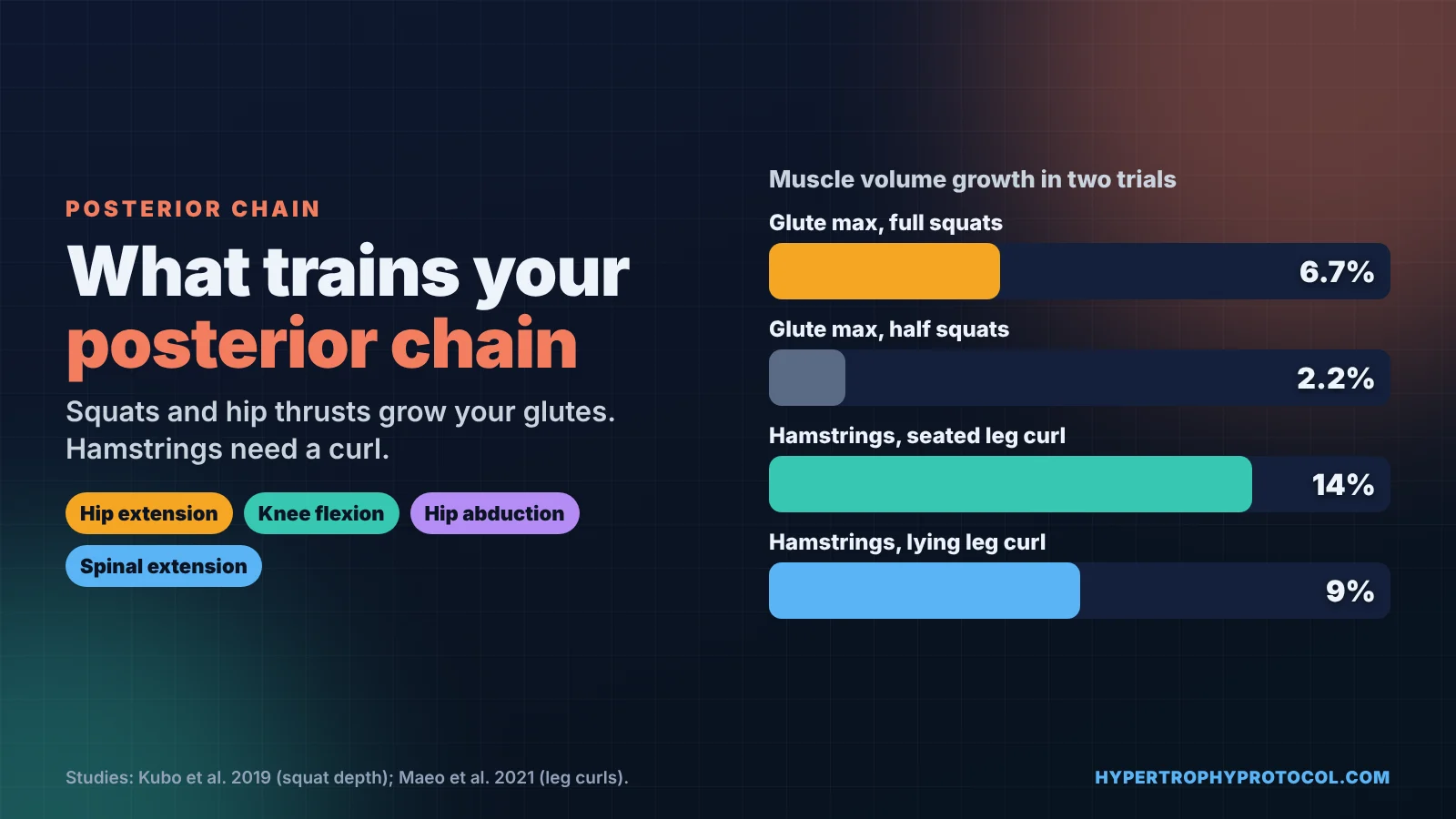
Your posterior chain is everything on the back side that drives your hips and knees: glutes, hamstrings, the big adductor on the inside of your thigh, and the muscles along your spine. A home gym can train all of it, but not with any one machine, and the research shows a gap most home programs miss. Squats and hip thrusts grow your glutes, yet in two MRI trials they did close to nothing for your hamstrings.
This guide maps each movement pattern to the muscles it trains and to the home equipment that loads it, from a rack and barbell up to a glute ham developer or reverse hyper. It also says plainly where the evidence stops, because several popular posterior chain machines have never been tested for muscle growth. Every study below was checked on PubMed on October 28, 2026.
At a glance
| Verdict | Cover four patterns: a deep squat or hip thrust for glutes, a knee-flexion curl for hamstrings, a hip hinge or back extension, and some hip abduction. |
|---|---|
| Key numbers | Full squats grew glutes 6.7% vs 2.2% for half squats, with no hamstring growth in either; seated leg curls grew hamstrings 14% vs 9% for lying curls. |
| Evidence strength | Moderate for patterns (small MRI trials, mostly untrained adults); none for specific machines like reverse hypers or GHDs. |
| What to do | Before buying a glute machine, make sure you have a way to curl. A seated leg curl or Nordic setup fills the most common gap. |
| Main caveat | Machines change convenience, loading and footprint; no trial shows a dedicated glute machine growing more muscle than the free-weight version. |
Studies checked on PubMed on October 28, 2026.
What counts as the posterior chain?
For muscle growth, five groups matter, and they do four different jobs.
- Gluteus maximus. The main hip extensor. It drives you up out of a squat, locks out a hip thrust and finishes a deadlift. Its upper fibers also help lift the leg out to the side.
- Gluteus medius and minimus. The smaller glutes on the side of the hip. Their main job is hip abduction, moving the leg out to the side, and holding the pelvis level when you stand on one leg.
- Hamstrings. Three of the four hamstring muscles cross both the hip and the knee, so they extend the hip and bend the knee. The fourth, the short head of the biceps femoris, crosses only the knee and only bends it.
- Adductor magnus. Usually filed under inner thigh, but its rear portion is a strong hip extensor that works hard at the bottom of a deep squat.
- Spinal erectors. They hold your spine in position during hinges and extend it during back extensions.
That gives four movement patterns to cover: hip extension, knee flexion, hip abduction and spinal extension. Most equipment trains one or two of them, which is why no single machine covers the whole chain.
Which home equipment trains which muscles?
The table lists each pattern, the muscles it mainly loads and the home equipment that can load it. The last column says whether a growth trial tested that pattern or whether the link is an inference from how the muscle works.
| Pattern | Main muscles | Home equipment | Growth evidence |
|---|---|---|---|
| Deep squat and lunge | Glute max, adductors, quads | Rack and barbell, belt squat, safety squat bar, leg press with a deep range | Tested: full vs half squat (Kubo 2019) |
| Hip thrust and glute bridge | Glute max | Barbell and bench, Smith machine, plate-loaded or selectorized hip thrust machine, band machines | Tested: barbell hip thrust vs squat (Plotkin 2023). Machine versions inferred. |
| Seated or lying leg curl | All four hamstrings | Leg curl machine, rack-mounted leg curl attachment, cable curl with an ankle strap | Tested: seated vs lying curl (Maeo 2021) |
| Nordic curl and glute ham raise | Hamstrings, mainly semitendinosus | Nordic bench, glute ham developer (GHD), low rack-mounted ankle roller | Tested: Nordic vs hip extension (Bourne 2017). Glute ham raise inferred. |
| Hip hinge and back extension | Hamstrings (long head), glute max, erectors | Romanian deadlift, 45 degree back extension bench, GHD, cable pull-through | Tested: loaded hip extension (Bourne 2017). Romanian deadlift and pull-through inferred. |
| Reverse hyper | Glute max, hamstrings, erectors | Reverse hyper machine, rack-mounted reverse hyper, bench with bands | No growth trial located |
| Cable kickback (standing hip extension) | Glute max, lower portion most | Cable stack or digital trainer with an ankle strap, kickback machine | Tested: cable hip extension vs abduction (Attarieh 2026) |
| Hip abduction | Glute med and min, upper glute max | Cable with an ankle strap, seated abductor machine, bands | Tested: cable abduction (Attarieh 2026). Machine and band versions inferred. |
What does the research say about training the posterior chain?
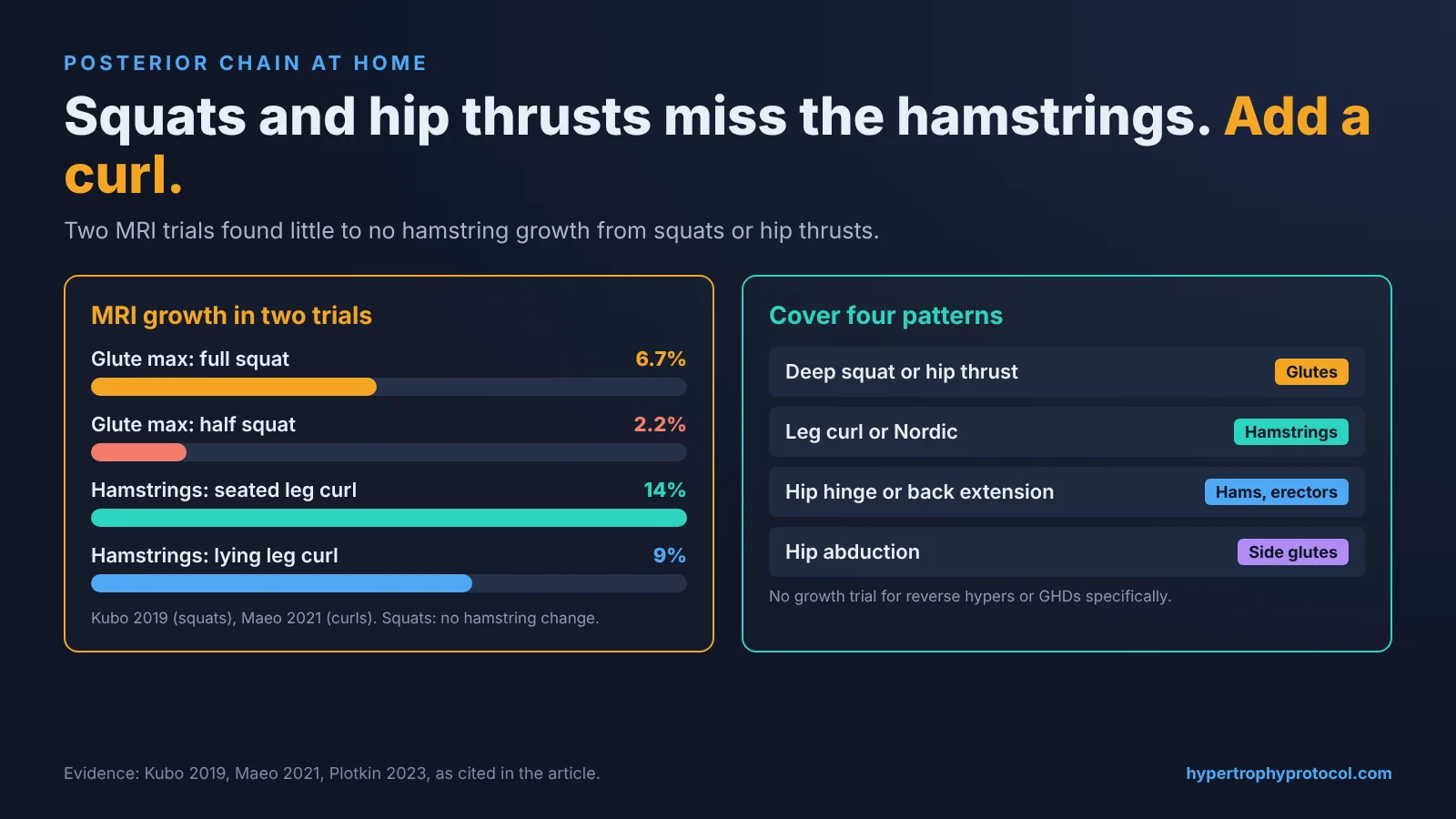
Five trials and one meta-analysis carry most of the weight here. Together they point to one clear gap and a few smaller choices.
Squats and hip thrusts grow glutes, not hamstrings
In a 9-week trial by Plotkin and colleagues (2023), 34 untrained college-aged adults trained either the back squat or the barbell hip thrust with equal sets. MRI showed similar glute growth in both groups, with estimates leaning slightly toward the hip thrust but with wide uncertainty. The squat group grew more quadriceps and adductor muscle. Hamstrings showed little to no growth in either group.
The same trial measured muscle activity with surface EMG. The hip thrust produced higher glute activation, but that did not reliably predict who grew more. Picking exercises by activation readings alone is a weak guide.
Depth matters for the squat. In a 10-week trial by Kubo and colleagues (2019), 17 men trained full or half squats. Glute max volume rose 6.7% with full squats against 2.2% with half squats, and adductor volume rose 6.2% against 2.7%. Hamstring volume did not change in either group.
Two different trials, two different exercises, the same result for the hamstrings. If your lower body work is squats, hip thrusts and leg presses, your hamstrings are probably undertrained.
Hamstrings respond to curls, and seated curls did best
In Maeo and colleagues (2021), 20 adults trained one leg with a seated leg curl and the other with a lying (prone) curl for 12 weeks. Whole hamstring volume rose 14% on the seated side against 9% on the lying side. The extra growth came from the three muscles that cross the hip, which are stretched further when you sit. The single-joint short head grew about the same either way. The long muscle lengths guide covers why the stretch seems to matter.
Nordics and hip extensions grow different parts of the hamstrings
Bourne and colleagues (2017) gave 30 recreationally active male athletes 10 weeks of either Nordic curls or a loaded hip extension exercise. Both lengthened the fascicles of the biceps femoris long head and both grew the semitendinosus by a similar amount. The hip extension group grew more biceps femoris long head volume than the Nordic group. In practice, a knee-dominant move (Nordic or curl) plus a hip-dominant move (back extension or Romanian deadlift) covers more of the muscle than either alone.
Nordics also have the strongest injury evidence of any exercise here. A meta-analysis by van Dyk and colleagues (2019) pooled 15 studies covering 8,459 athletes and found that prevention programs including the Nordic cut hamstring injuries by about half (risk ratio 0.49). Those were field and court athletes, not lifters, so treat it as a reason to include Nordics rather than a promise for a garage gym.
Kickbacks and abduction grow different regions of the glutes
The newest trial, published in October 2026 by Attarieh and colleagues, had 17 young adults train one leg with a cable kickback (standing hip extension) and the other with cable hip abduction for 10 weeks, about 10 sets a week at 8 to 12 rep maximums. The kickback leg grew more glute max overall (9% vs 5%), mostly in the lower glute (14% distal). The abduction leg grew the upper glute max most (10% proximal) and grew glute medius and minimus slightly more (4% vs 2%).
It is one small study, so the regional numbers need confirming. It still supports a simple point: hip abduction is not wasted on glute growth, and a cable stack you already own can train both patterns.
Where the evidence runs out
No controlled trial located on PubMed measured muscle growth from reverse hypers, glute ham raises or back extension machines specifically. Lifters use reverse hypers for low back work and glute ham developers for combined hip and knee work, and both load the right muscles. Whether they beat a Romanian deadlift plus a curl for growth is untested. Buy them for convenience, variety or a specific need, not because they are proven to build more muscle.
What should a home gym own for the posterior chain?
Start from what you have, then add the piece that fills the biggest gap. For most rack owners that gap is knee flexion.
A rack, barbell and bench
This covers more than most people think. Deep squats and barbell hip thrusts handle the glutes, Romanian deadlifts handle the hinge, and a padded bench with a bar pad makes hip thrusts comfortable. The missing piece is a curl. A rack-mounted leg curl attachment or a low ankle roller for Nordics fills it without a second machine. If you use Bulletproof gear, the Lock-N-Float guide shows the rack-mounted curl and extension option, and the rack compatibility checker tells you whether it fits your uprights.
A cable stack or digital trainer
Cables add kickbacks, hip abduction, pull-throughs and seated cable curls with an ankle strap, which together cover every pattern in the Attarieh and Maeo trials. Check your pulley ratio first: on a 2:1 system the felt load is half the stack, which matters for single-leg work. The cable pulley ratio calculator works it out, and the VOLTRA setup guide covers mount heights and cable lines on a digital trainer.
One dedicated machine
If you have room for one more piece, choose by gap, not by popularity.
- No way to curl yet: a seated leg curl, based on the Maeo result, or a Nordic bench if space is tight.
- Curls covered, want hip extension: a 45 degree back extension bench is small and inexpensive and gives you a loaded hip extension, the movement type that grew the biceps femoris long head most in the Bourne trial.
- Want both in one frame: a glute ham developer does glute ham raises, back extensions and Nordic-style work, at the cost of a long footprint.
- Want faster glute sessions: a hip thrust machine removes the barbell setup. Plotkin tested the barbell version, so expect convenience, not extra growth.
- Want low back work with less spinal loading: a reverse hyper, keeping in mind there is no growth trial behind it.
For deep squat options without a loaded bar on your back, the Squat Machine Finder compares belt squats, pendulum squats and other styles by footprint and rack fit, and the leg press guide compares every home leg press type.
How much posterior chain work per week?
The trials above used modest doses: the Attarieh groups did about 10 sets a week per exercise, and the Maeo groups did 5 sets twice a week. Count each of the four patterns separately when you plan, because a week of squats and hip thrusts can look like plenty of leg work while giving your hamstrings almost nothing. The weekly sets planner tallies sets per muscle so the gap shows up before you train it for months.
Recovery matters with this much hip work. Heavy hinges and Nordics leave more soreness than most lifts, so spread them across the week. The leg day recovery guide covers spacing.
Who should change their setup, and who can leave it alone?
Change it if your lower body days are squats, leg presses and hip thrusts with no curl or Nordic. That pattern matches the trials where hamstrings did not grow, and a curl option is the cheapest fix.
Consider adding abduction if you only do hip extension work and want fuller upper glutes. A cable and an ankle strap are enough to start.
Leave it alone if you already squat deep, hinge, curl and do some abduction or kickbacks. A specialty machine would add convenience or variety, which can be worth paying for, but the research does not show it adds growth on top of a program that already covers the four patterns.
Sources
- Plotkin DL, et al. Hip thrust and back squat training elicit similar gluteus muscle hypertrophy and transfer similarly to the deadlift. Front Physiol. 2023. doi:10.3389/fphys.2023.1279170
- Kubo K, et al. Effects of squat training with different depths on lower limb muscle volumes. Eur J Appl Physiol. 2019. doi:10.1007/s00421-019-04181-y
- Maeo S, et al. Greater hamstrings muscle hypertrophy but similar damage protection after training at long versus short muscle lengths. Med Sci Sports Exerc. 2021. doi:10.1249/MSS.0000000000002523
- Bourne MN, et al. Impact of the Nordic hamstring and hip extension exercises on hamstring architecture and morphology: implications for injury prevention. Br J Sports Med. 2017. doi:10.1136/bjsports-2016-096130
- van Dyk N, et al. Including the Nordic hamstring exercise in injury prevention programmes halves the rate of hamstring injuries: a systematic review and meta-analysis of 8459 athletes. Br J Sports Med. 2019. doi:10.1136/bjsports-2018-100045
- Attarieh P, et al. Regional hypertrophy of the gluteal muscles is task-specific: differential responses to 10 weeks of hip extension versus hip abduction training. J Strength Cond Res. 2026 (ahead of print). doi:10.1519/JSC.0000000000005701