

A barbell hip thrust works, but the setup is the reason most people stop doing it at home: drag the bench out, roll a loaded bar over your legs, pad your hips, then reverse it all. A hip thrust machine removes that friction. The catch is that “hip thrust machine” covers five very different things, from a 26 lb folding band platform to a 317 lb plate-loaded station, and their published specs are not measured the same way.
This guide sorts the home options by type, lists the specs each maker actually publishes, and shows which ones fit a garage. Every spec below comes from the manufacturer’s own product page or product guide, checked on October 28, 2026. Where a maker does not publish a number, the table says so rather than filling it in.
At a glance
| Verdict | Pick the type before the brand. Barbell platforms load heaviest, band machines store smallest, plate-loaded stations are fastest to use, and rack benches cost the least floor space if you already own the right rack. |
|---|---|
| Key numbers | Footprints run from a folded 25 x 30 in band platform to a 67 x 57 in plate-loaded station. Published limits range from a 440 lb plate capacity to an 800 lb “weight capacity”, and they measure different things. |
| Evidence strength | The barbell hip thrust has an MRI growth trial behind it. No trial has tested a hip thrust machine against the barbell version. |
| What to do | Measure your floor space, check your rack model, and decide how heavy you want to go. Those three answers narrow the list to one or two types. |
| Main caveat | A machine buys convenience and consistency, not proven extra growth. Stock changes fast in this category; several models were sold out on the check date. |
Specs checked against manufacturer pages on October 28, 2026.
What types of hip thrust machines are there?
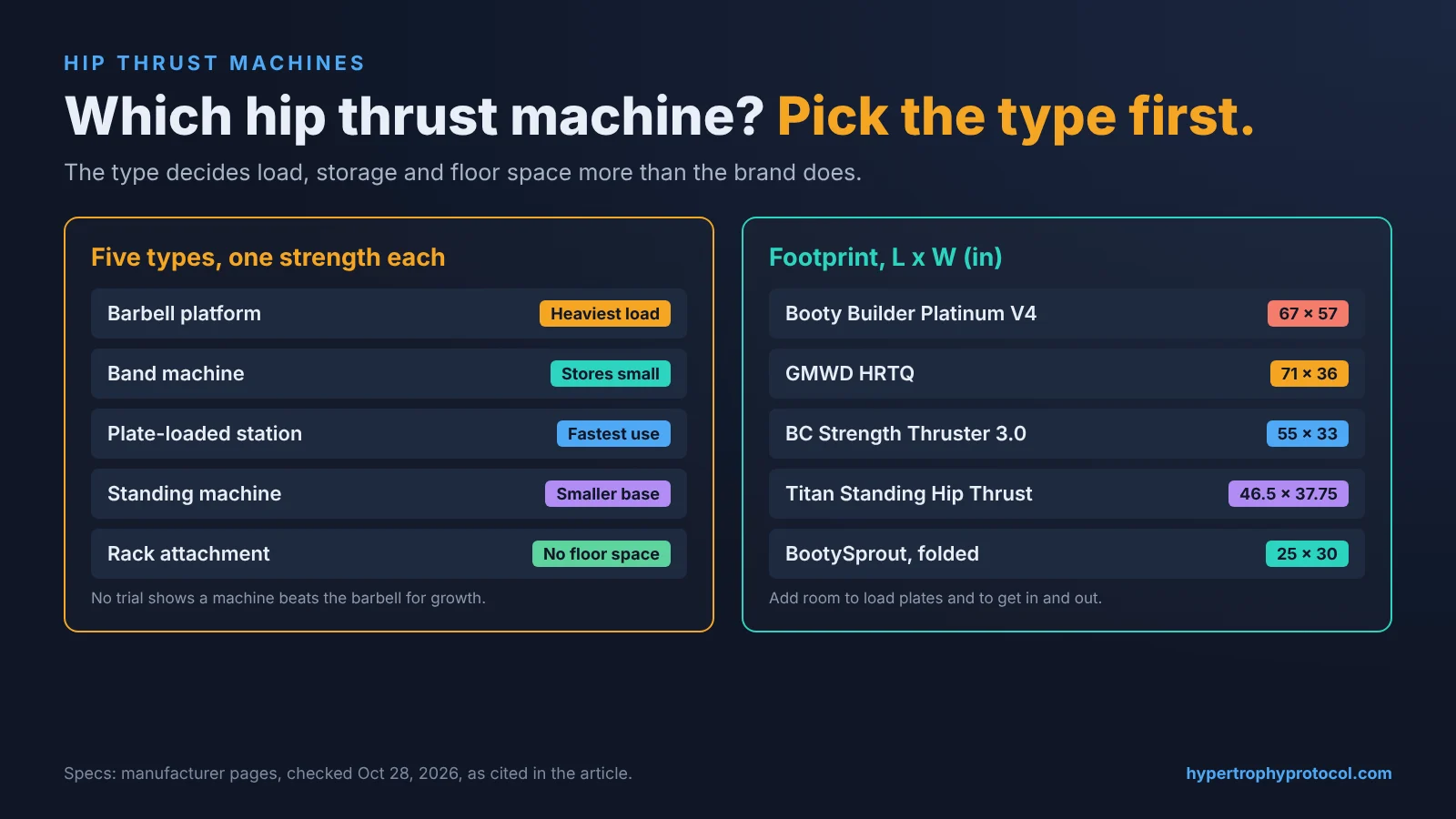
The machines split into five groups, and the group matters more than the brand because it decides how you load the movement, how much space it takes and how heavy you can go.
- Barbell platforms. A base with a padded back rest and a foot platform. You still use a barbell and plates, sometimes with bands added. They hold the most weight and keep the barbell feel. Example: BC Strength Thruster 3.0.
- Band machines. A low platform with band pegs. Bands supply all the resistance, so they are light, quiet and easy to store, but the load is limited by how many bands you stack. Examples: BC Strength Thruster Lite, BootySprout, Lifepro GluteBlast.
- Plate-loaded lying or seated stations. You sit or lie under a padded lever or belt and load plates on horns. No barbell to roll over your legs, and changing weight takes seconds. Examples: GMWD HRTQ, Booty Builder Platinum V4, Nautilus Glute Drive.
- Standing hip thrust machines. You stand and drive your hips forward into a padded lever. A different feel from a lying thrust, with a smaller footprint than most lying stations. Examples: Titan Standing Hip Thrust Machine, Booty Builder Standing Hip Thrust.
- Rack attachments. A padded crossmember or pad that pins into your power rack and replaces the bench for barbell hip thrusts. They take no extra floor space but only fit specific racks. Examples: Rogue Monster and Monster Lite Hip Thruster Benches, Bells of Steel Seal Row Pad.
Hip thrust machines compared: verified specs
Dimensions are length (or depth) x width x height in inches, as each maker labels them. “Not listed” means the manufacturer does not publish that figure. The capacity column quotes each maker’s own label, because a plate capacity, a total load and a band rating are not the same measurement.
| Model | Type | Size (in) | Weight | Resistance and published limit | Notes |
|---|---|---|---|---|---|
| BC Strength Thruster 3.0 | Barbell platform | 55 L x 33 W x 14.5 to 17.5 H | 96 lb | Barbell, plates and/or bands. “Load tested to 2,200lbs, recommended for use up to 1,300lbs” | 4 back pad heights. Optional 58″ base for users 6’4″ and up. No bar, plates or bands included. |
| BC Strength Thruster Lite | Band machine | 42 L x 28 W x 16 H | 33 lb | Bands only (2 included, about 75 to 100 lb). “Recommended for use up to 500lbs” | Recommended for users 5’0″ to 6’3″. Removable back pad for storage. |
| BootySprout | Band machine | Folded about 25 x 30 x 7. Open size not listed. | 26 lb | 3 bands (about 45 lb each). “safe up to 400 lbs of resistance” | Folds flat. Maker lists heights 4’8″ to 6’5″. Sold out on the check date, as was the BootySprout Pro. |
| Lifepro GluteBlast | Band machine | Not listed | Not listed | Bands (2 thruster band options). Capacity not listed. | Folds for storage. Maker lists heights up to 6’3″. The product page publishes few specs, so confirm before you buy. |
| GMWD HRTQ | Plate-loaded, lying | 71 L x 36.3 W x 22 H | 190 lb (gross) | 1″ or 2″ plates. “Weight Capacity: 800 lb”. Starts at 22 lb unloaded. | 4 footplate angles, adjustable safety limiter. Frame lifetime, parts 6 months. Stock status conflicted on the check date. |
| Booty Builder Platinum V4 | Plate-loaded, seated | 67 L x 57 W x 30 H | 317 lb | Plates plus optional bands. “Max total load: 200 kg / 441 lbs”. Starts at 15 lb unloaded. | Raised footplate, seat on rollers, cushioned belt. Warranty not listed. |
| Nautilus Glute Drive | Plate-loaded, seated | 62 L x 60 W x 35 H | 252 lb | Plates, optional band pegs. “360 lb max load capacity”. Starts at 15 lb. | Commercial grade, sold by quote. The machine many gym-goers know by name. |
| Titan Standing Hip Thrust Machine | Standing, plate-loaded | 46.5 D x 37.75 W x 53.75 H | 157 lb | Olympic plates plus band pegs. “Weight Plate Capacity: 440 lb.” “Max User Weight: 300 lb.” | 6 thigh pad heights, 3 thrust angles. 1-year warranty. In stock on the check date. |
| Booty Builder Standing Hip Thrust | Standing, plate-loaded | 45 L x 43 x 56 H | 185 lb | Plates and bands. Capacity not listed. | Adjustable thigh pad, multiple hand positions. Maker says it suits home gyms and studios. |
| Rogue Monster Hip Thruster Bench | Rack attachment | 50.2 L x 8.5 W (41″ pad) | 36 lb | Barbell. No rated capacity published. | “Compatible ONLY with Rogue Monster Series Rack and Rigs”, for the 43″ space. Pins with 1″ detent pins. |
| Rogue Monster Lite Hip Thruster Bench | Rack attachment | 49.85 L x 10 D (41″ pad) | 32 lb | Barbell. No rated capacity published. | “Compatible ONLY with Rogue Monster Lite Racks and Rigs”, for the 43″ space. Pins with 5/8″ detent pins. |
| Bells of Steel Seal Row Pad | Rack attachment | Not listed | Not listed | Barbell. “beefy 500lb capacity” (attachment rating) | 7 positions. Versions for 2.3″ (5/8″ holes), Hydra and Manticore racks. Maker lists hip thrusts as a use. |
Two products from earlier research are left out on purpose. The GMWD RSTQ was sold out and its page lists its length and width two different ways. REP’s Hip Thrust Pad is a foam pad that clips onto a barbell, not a machine, and it was also sold out.
Why the capacity numbers don’t compare
Read the label, not just the number. Titan publishes two separate figures, a 440 lb plate capacity and a 300 lb maximum user weight. Booty Builder’s 441 lb is a “max total load”. GMWD’s 800 lb is a “weight capacity” with no user weight given. BC Strength’s 1,300 lb is a “recommended for use” figure from a 2,200 lb load test. The BootySprout’s 400 lb is a band resistance rating, not a body weight limit.
For a home buyer the practical question is simpler: can it hold more than you will ever thrust, plus you? On every plate-loaded machine here the answer is yes for most lifters. The bigger differences are footprint and how the load is applied.
Starting resistance matters more than the top number if you are new to the movement. The Booty Builder Platinum V4 and Nautilus Glute Drive both start at 15 lb unloaded and the GMWD HRTQ at 22 lb, while a barbell starts at the bar’s weight plus whatever you need to clear your hips.
Which hip thrust machine fits your home gym?
You already own a Rogue Monster or Monster Lite rack
Start with the matching Rogue Hip Thruster Bench. It uses the 43″ space inside the rack, so it adds no floor footprint, and you keep the barbell. Check which line you own: the Monster version pins with 1″ hardware and the Monster Lite version with 5/8″, and Rogue lists each as compatible only with its own series. The Monster vs Monster Lite guide covers which attachments fit each line, and the Rack Attachment Fit Checker checks other attachments against your rack.
Owners of 2.3″ racks or the Bells of Steel Hydra and Manticore can get a similar result from the Bells of Steel Seal Row Pad, which Bells of Steel lists for hip thrusts.
You want to go heavy with a barbell
A barbell platform such as the BC Strength Thruster 3.0 has the highest published rating here and keeps the movement identical to the barbell hip thrust in the research. It does take a 55 x 33 in footprint, and you still roll the bar into place, so it saves the bench fiddling more than the barbell work. Tall lifters should note the optional 58″ base for users 6’4″ and up.
You want the fastest sessions
Plate-loaded stations are the most convenient: sit or lie down, buckle or set the pad, and go. The trade-off is size. The Booty Builder Platinum V4 needs about 67 x 57 in and the GMWD HRTQ about 71 x 36 in, before room to load plates and get in and out. Measure your floor, and add space at the plate horns for loading.
You are short on floor space
A standing machine like the Titan Standing Hip Thrust Machine has a smaller footprint (46.5 x 37.75 in) than the lying stations, but it stands 53.75 in tall, so it is not a fold-away. If you need to store it between sessions, a band machine is the only real option. The BC Strength Thruster Lite has a removable back pad, and the BootySprout folds to about 25 x 30 x 7 in when it is in stock.
You train in an apartment or a shared space
Band machines win here. No plates means no clanging, and the whole unit weighs 26 to 33 lb on the models with published weights. The ceiling is the band load: the Thruster Lite comes with bands rated about 75 to 100 lb, and the BootySprout with about 135 lb, so strong lifters will add bands or outgrow it.
Does a hip thrust machine grow more glute than a barbell?
No trial has tested that. The evidence is for the barbell version. In a 9-week trial by Plotkin and colleagues (2023), 34 untrained young adults trained either the barbell hip thrust or the back squat. MRI showed similar glute growth in both groups, with estimates leaning slightly toward the hip thrust but with wide uncertainty. The squat grew more quadriceps and adductor muscle.
A machine that loads the same hip extension should train the glutes in a similar way, but that is an inference, not a tested result. Buy a hip thrust machine for convenience, consistency and an easier setup, which can matter a lot if it means you actually do the movement every week. Don’t buy one expecting faster growth than a barbell and bench.
It also only covers one pattern. In the same trial, the hip thrust did little for the hamstrings. The posterior chain guide covers what to pair it with, and the weekly sets planner helps you count glute and hamstring sets separately.
Before you order
- Measure the floor and the working space. Add room to load plates and to get in and out, not just the machine’s footprint.
- Read the capacity label. Plate capacity, total load, user weight and band rating are different numbers.
- Check your height. Several makers publish a user height range: 5’0″ to 6’3″ for the Thruster Lite, up to 6’3″ for the GluteBlast, and a longer base for users 6’4″ and up on the Thruster 3.0.
- Match rack attachments to your exact rack line. The Rogue benches fit only their own series, and the Seal Row Pad comes in versions by upright and hole size.
- Confirm stock and current specs. Several models were sold out on the check date, and makers change specs.
Bottom line
If you already own a compatible rack, a rack-mounted thruster bench is the cheapest way to make barbell hip thrusts easy. If you want to load heavy, a barbell platform keeps the movement the research tested. If convenience decides whether you train glutes at all, a plate-loaded station or standing machine is worth the floor space. And if space is the limit, a band machine is the one you can put away. None of them is proven to beat the barbell for growth, so choose the one you will use most.
Specifications checked against manufacturer product pages and product guides on October 28, 2026. Manufacturers change specs and stock; confirm on the product page before ordering. Hypertrophy Protocol has not hands-on tested these machines.
More glute guides
- Best glute machines for a home gym
- Hip thrust machine vs barbell vs Smith machine
- Hip thrust machine dimensions and space
- DIY hip thrust bench setup
- Are Booty Builder machines worth it at home?
- Home glute program for women
Sources
- Plotkin DL, et al. Hip thrust and back squat training elicit similar gluteus muscle hypertrophy and transfer similarly to the deadlift. Front Physiol. 2023. doi:10.3389/fphys.2023.1279170
- Manufacturer pages: BC Strength Thruster 3.0, Thruster Lite, BootySprout product details, Lifepro GluteBlast, GMWD HRTQ, Booty Builder Platinum V4, Nautilus Glute Drive product sheet, Titan Standing Hip Thrust Machine, Booty Builder Standing Hip Thrust, Rogue Monster Hip Thruster Bench guide, Bells of Steel Seal Row Pad.