
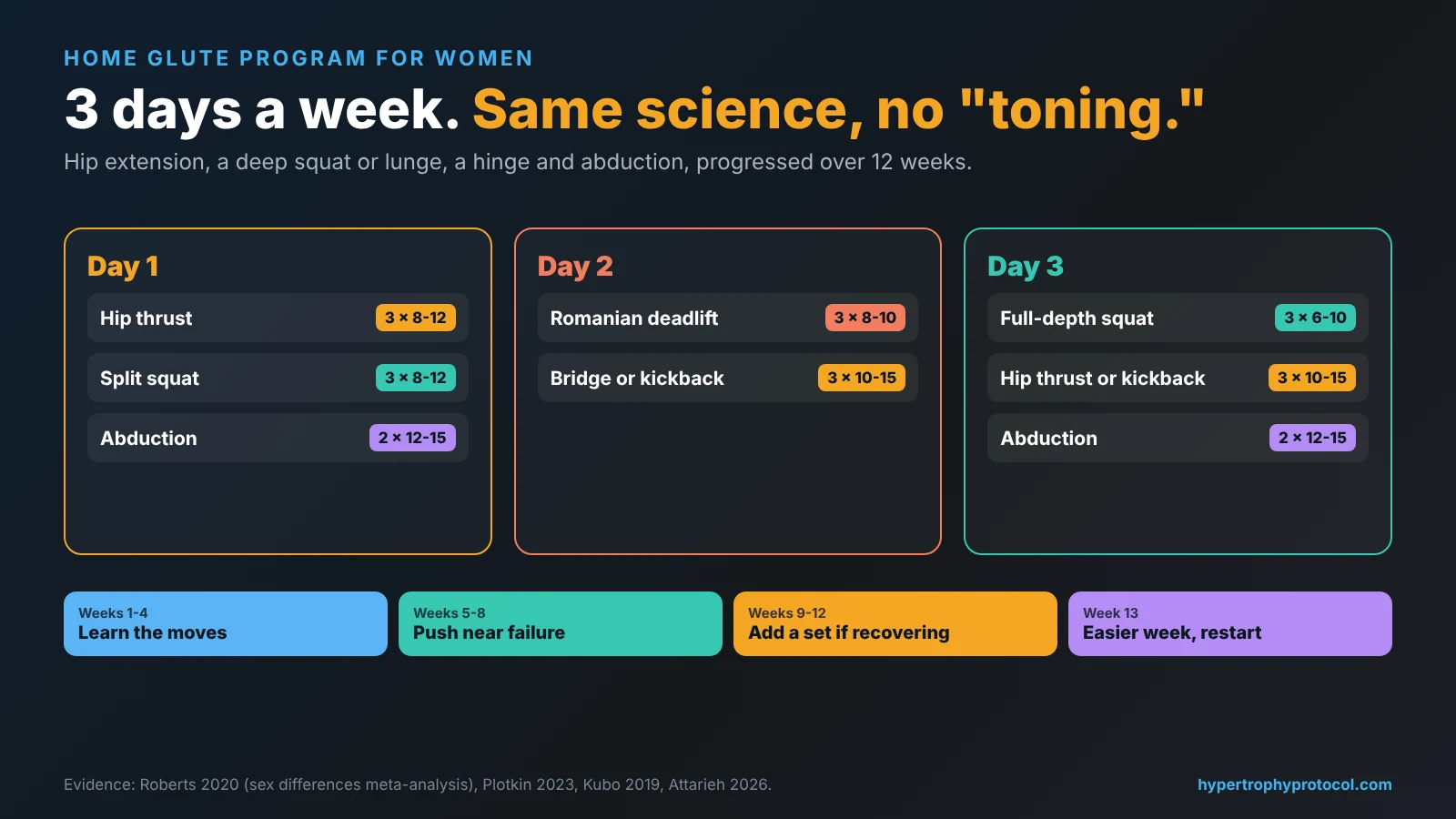
This is a home glute program written for women, but the training itself isn’t different for women. Glute anatomy and the way muscle grows are the same for everyone, and a meta-analysis found men and women build muscle at similar relative rates on the same program. What does differ is goals, equipment and the advice women are often given. “Toning” with light weights and endless reps isn’t how glutes grow. Hard sets on the right movements, done consistently, are.
Below is a 3-day home program built on the research, with a version for a barbell-and-bench gym and one for a cable or band setup. It also covers how to progress it over 12 weeks.
At a glance
| The plan | 3 sessions a week covering hip extension, a squat or lunge, a hinge and abduction, about 10 to 16 hard glute sets a week. |
|---|---|
| Why this way | MRI trials show hip thrusts, deep squats and cable kickbacks grow the glute max, and abduction grows the upper and side glutes. |
| Evidence strength | Good support for the exercise choices and for similar results in women and men. The exact set counts are a reasonable starting point, not a proven optimum. |
| What to expect | Steady strength gains within weeks. Visible size change takes months, and it varies a lot from person to person. |
| Main caveat | No program can promise a specific amount of growth or change your body’s fat distribution. It can make the muscle bigger and stronger. |
Research checked October 29, 2026.
What the research says about glute training
- Women and men grow at similar rates. A meta-analysis by Roberts, Nuckols and Krieger (2020) found no significant difference in relative muscle growth between sexes on the same training. You don’t need a separate “women’s” method.
- Hip thrusts and squats both grow the glutes. In a 9-week MRI trial by Plotkin and colleagues (2023), untrained young men and women grew similar amounts of glute with either exercise. The squat also grew the quads and adductors.
- Squat depth matters. In a 10-week trial by Kubo and colleagues (2019), full squats grew the glute max about three times as much as half squats (6.7% vs 2.2%).
- Different exercises grow different parts. In a 2026 MRI trial by Attarieh and colleagues, cable kickbacks grew mostly the lower glute max, while cable abduction grew the upper glute max and the glute medius and minimus.
Put together: train a hip extension movement, a deep squat or lunge, and an abduction movement, and add a hinge for the hamstrings. The small home gym glute setup shows what gear covers each one.
The 3-day home glute program
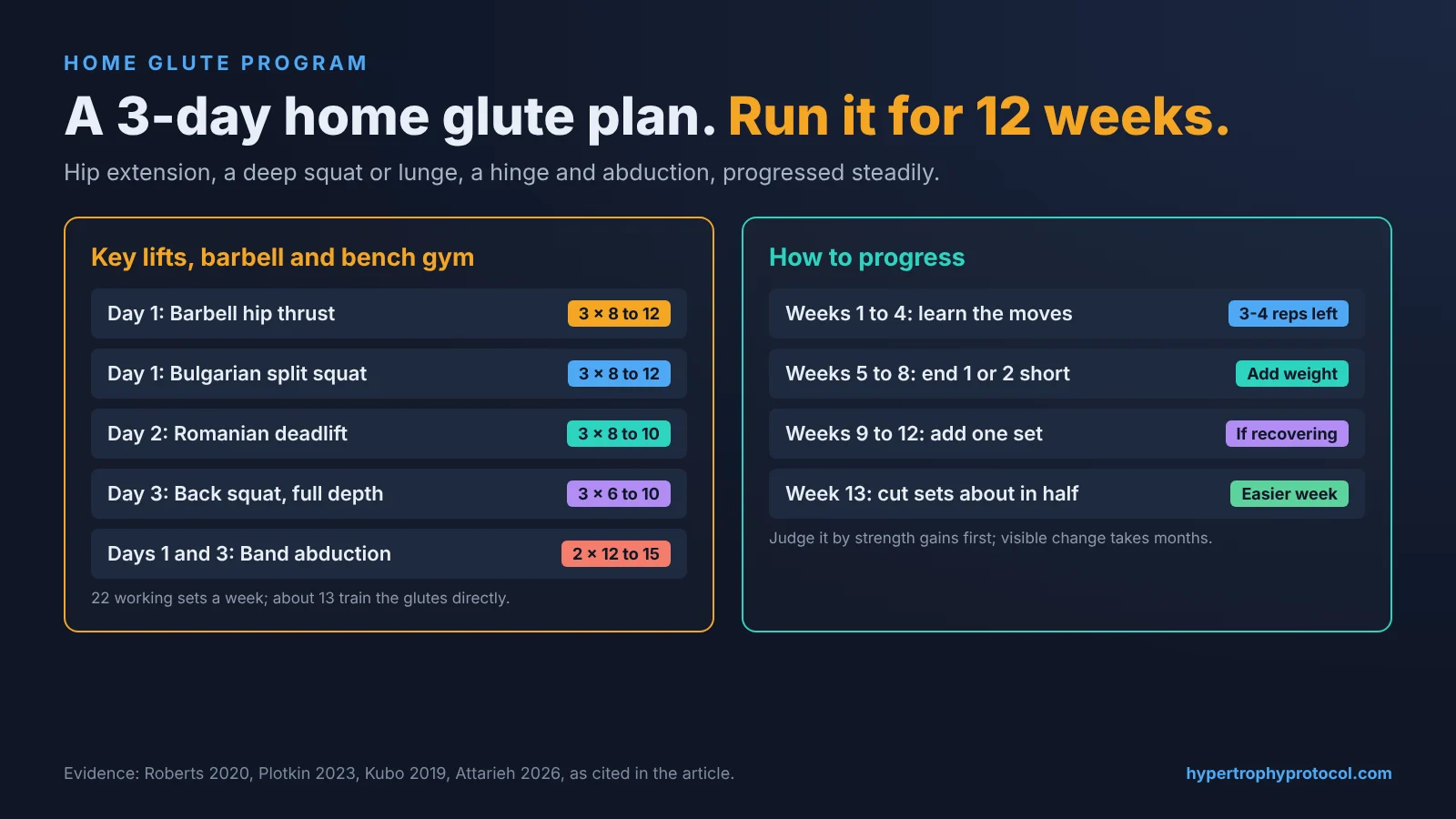
Pick the column that matches your equipment. Do each day once a week with at least a day between sessions. Rep ranges are a guide. Stop most sets one or two reps before you couldn’t do another with good form.
| Day | Barbell and bench gym | Cable or band gym | Sets x reps |
|---|---|---|---|
| Day 1 | Barbell hip thrust | Band or machine hip thrust | 3 x 8 to 12 |
| Day 1 | Bulgarian split squat | Bulgarian split squat (dumbbells) | 3 x 8 to 12 per leg |
| Day 1 | Band hip abduction | Cable hip abduction | 2 x 12 to 15 |
| Day 2 | Romanian deadlift | Cable pull-through or dumbbell RDL | 3 x 8 to 10 |
| Day 2 | Glute bridge, feet elevated | Cable kickback | 3 x 10 to 15 |
| Day 3 | Back squat, full depth | Goblet or belt squat, full depth | 3 x 6 to 10 |
| Day 3 | Barbell hip thrust (lighter, pause at top) | Cable kickback | 3 x 10 to 15 |
| Day 3 | Band hip abduction | Cable hip abduction | 2 x 12 to 15 |
That’s 22 working sets a week. About 13 of them train the glutes directly. Romanian deadlifts add hinge work for the glutes and hamstrings, and split squats and squats train the glutes and quads together. The weekly sets planner lets you see glute, hamstring and quad sets side by side.
How to progress over 12 weeks
- Weeks 1 to 4: learn the movements. Start with weights you could do for 3 or 4 more reps. Focus on full range, especially squat depth and a full hip lockout on thrusts.
- Weeks 5 to 8: push closer to failure. Most sets should end 1 or 2 reps short. When you hit the top of a rep range on every set, add weight next time.
- Weeks 9 to 12: add a set where you recover well. If you’re progressing and not overly sore, add one set to your hip thrust and kickback or abduction. If progress stalls, keep sets the same and check sleep and food first.
- Week 13: take an easier week. Cut sets roughly in half, then start a new block with slightly heavier starting weights.
Small jumps matter. On a cable, check your pulley ratio with the cable pulley ratio calculator, and use fractional plates or extra reps where the jumps are too big. For more ideas, see progressive overload in a small home gym.
Common questions
Will lifting heavy make me bulky?
Muscle grows slowly for everyone. Lifting challenging weights builds glute size and strength gradually, and you control how far you take it. Light “toning” work mostly just builds less muscle.
Do I need special glute machines?
No. A barbell, bench and bands or a cable cover every pattern in this program. A machine is worth it when it makes you train more consistently. The best glute machines guide explains which ones earn their space.
Can I train glutes every day?
Muscles grow during recovery, and three focused sessions a week give plenty of hard sets. If you want a fourth day, add a few abduction or kickback sets, but watch whether your main lifts keep progressing.
Can I spot-reduce fat around my hips?
No. Training grows the muscle underneath, but where you store and lose fat is set by your body, not by which exercises you do.
What about cardio?
It’s fine for health and doesn’t cancel glute growth in reasonable amounts. Keep hard leg cardio away from your heaviest lower-body day if it affects your performance.
Bottom line
The best glute program for women is the same evidence-based program that works for anyone: a hip extension movement, a deep squat or lunge, a hinge and some abduction, trained hard about three times a week and progressed steadily. A barbell and bench or a cable station is enough to run it at home. Give it 12 weeks, track your weights, and judge it by strength gains first. Visible change follows with time.
Research checked October 29, 2026. This program is general training information, not medical advice. If you’re pregnant, postpartum, recovering from an injury or managing a health condition, check with a qualified professional before starting.
Sources
- Roberts BM, Nuckols G, Krieger JW. Sex differences in resistance training: a systematic review and meta-analysis. J Strength Cond Res. 2020. doi:10.1519/JSC.0000000000003521
- Plotkin DL, et al. Hip thrust and back squat training elicit similar gluteus muscle hypertrophy and transfer similarly to the deadlift. Front Physiol. 2023. doi:10.3389/fphys.2023.1279170
- Kubo K, Ikebukuro T, Yata H. Effects of squat training with different depths on lower limb muscle volumes. Eur J Appl Physiol. 2019. doi:10.1007/s00421-019-04181-y
- Attarieh P, Nunes JP, et al. Regional hypertrophy of the gluteal muscles is task-specific: differential responses to 10 weeks of hip extension versus hip abduction training. J Strength Cond Res. 2026. doi:10.1519/JSC.0000000000005701