
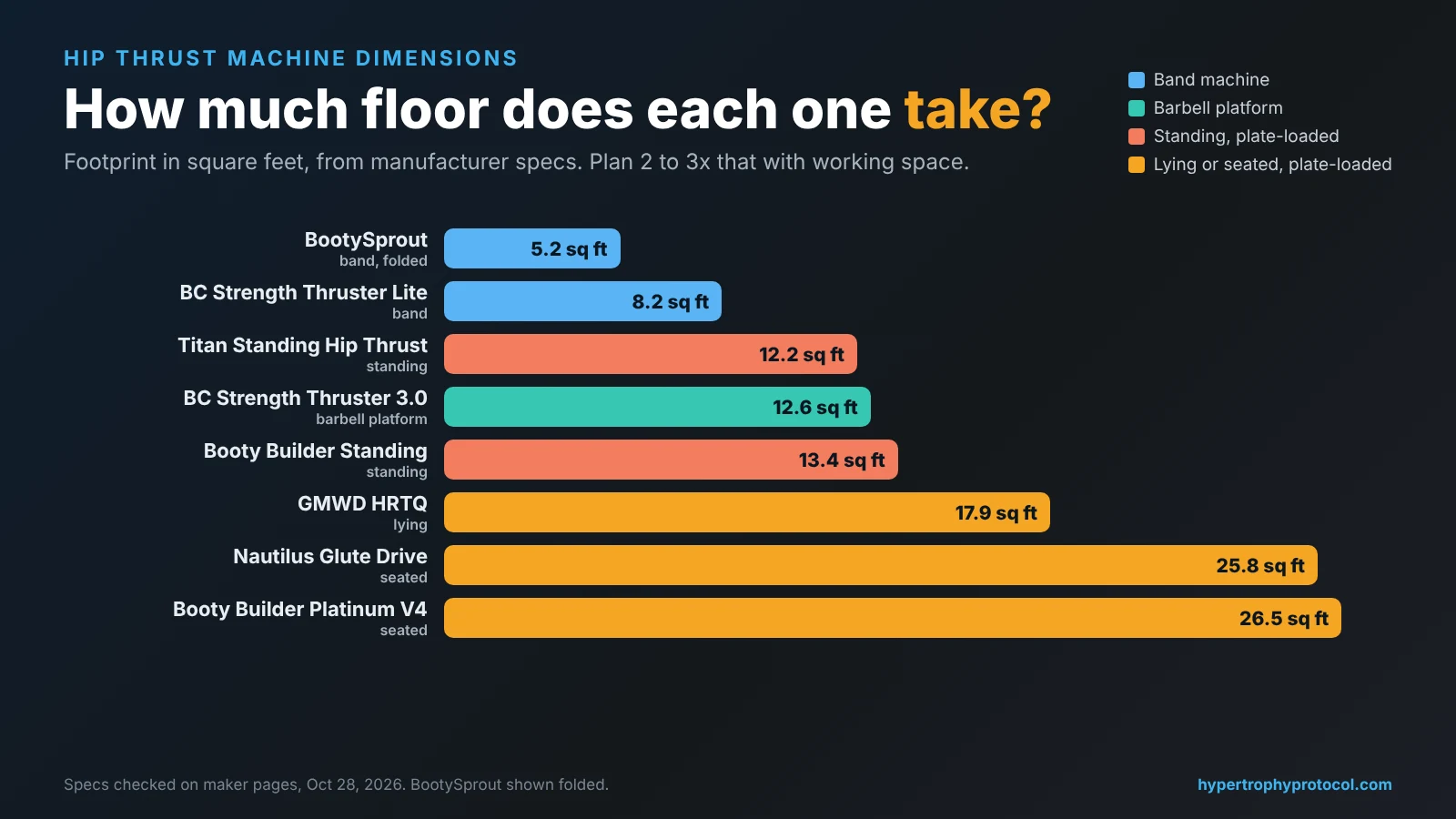
Hip thrust machines range from a band platform that folds smaller than a doormat to plate-loaded stations as big as a power rack’s footprint. If you’re fitting one into a garage or spare room, the footprint is only part of the answer. You also need room to load plates, get in and out, and move through the rest of your gym.
This page lists the published dimensions of the main home hip thrust machines, converts them to square feet, and shows how to plan the working space around them. Every dimension comes from the manufacturer’s own product page or product guide, checked on October 28, 2026.
At a glance
| Smallest | BootySprout, folded to about 25 x 30 in (about 5 sq ft). Its open size isn’t published. |
|---|---|
| Largest | Booty Builder Platinum V4 at 67 x 57 in (about 26.5 sq ft) and Nautilus Glute Drive at 62 x 60 in (about 26 sq ft). |
| Tallest | Standing machines, at 53.75 to 56 in. Lying and seated machines are 14.5 to 35 in tall, so ceiling height rarely matters. |
| What to do | Add working space to the footprint before you measure your room. Tape the full area on the floor before you buy. |
| Main caveat | Makers measure differently (length vs depth, folded vs open), and some don’t publish dimensions at all. |
Dimensions checked against manufacturer pages on October 28, 2026.
Hip thrust machine dimensions compared
Sorted from smallest to largest footprint. Sizes are in inches as each maker labels them. Square feet is length times width divided by 144, rounded.
| Model | Type | L x W x H (in) | Footprint | Weight | Fit notes |
|---|---|---|---|---|---|
| BootySprout | Band machine | About 25 x 30 x 7 folded. Open size not listed | About 5 sq ft folded | 26 lb | Maker lists heights 4’8″ to 6’5″. Sold out on the check date |
| BC Strength Thruster Lite | Band machine | 42 x 28 x 16 | About 8 sq ft | 33 lb | Recommended for 5’0″ to 6’3″. Removable back pad |
| Titan Standing Hip Thrust Machine | Standing, plate-loaded | 46.5 D x 37.75 W x 53.75 H | About 12 sq ft | 157 lb | 300 lb max user weight. 6 thigh pad heights |
| BC Strength Thruster 3.0 | Barbell platform | 55 x 33 x 14.5 to 17.5 | About 12.5 sq ft | 96 lb | Optional 58 in base for users 6’4″ and up. Add room for the barbell’s length |
| Booty Builder Standing Hip Thrust | Standing, plate-loaded | 45 x 43 x 56 | About 13.5 sq ft | 185 lb | Maker says it suits home gyms and studios |
| GMWD HRTQ | Plate-loaded, lying | 71 x 36.3 x 22 | About 18 sq ft | 190 lb (gross) | Longest of the lying machines here |
| Nautilus Glute Drive | Plate-loaded, seated | 62 x 60 x 35 | About 26 sq ft | 252 lb | Commercial grade, sold by quote |
| Booty Builder Platinum V4 | Plate-loaded, seated | 67 x 57 x 30 | About 26.5 sq ft | 317 lb | Heaviest here. Plan the delivery path |
| Rogue Monster and Monster Lite Hip Thruster Benches | Rack attachment | About 50 in long, 41 in pad | Inside your rack | 32 to 36 lb | Fit only their own Rogue rack series, in the 43 in space |
Lifepro doesn’t publish GluteBlast dimensions, and Bells of Steel doesn’t list Seal Row Pad dimensions, so they’re left out. The hip thrust machine buying guide covers capacity, loading and the full spec list for each model.
How much space do you really need?
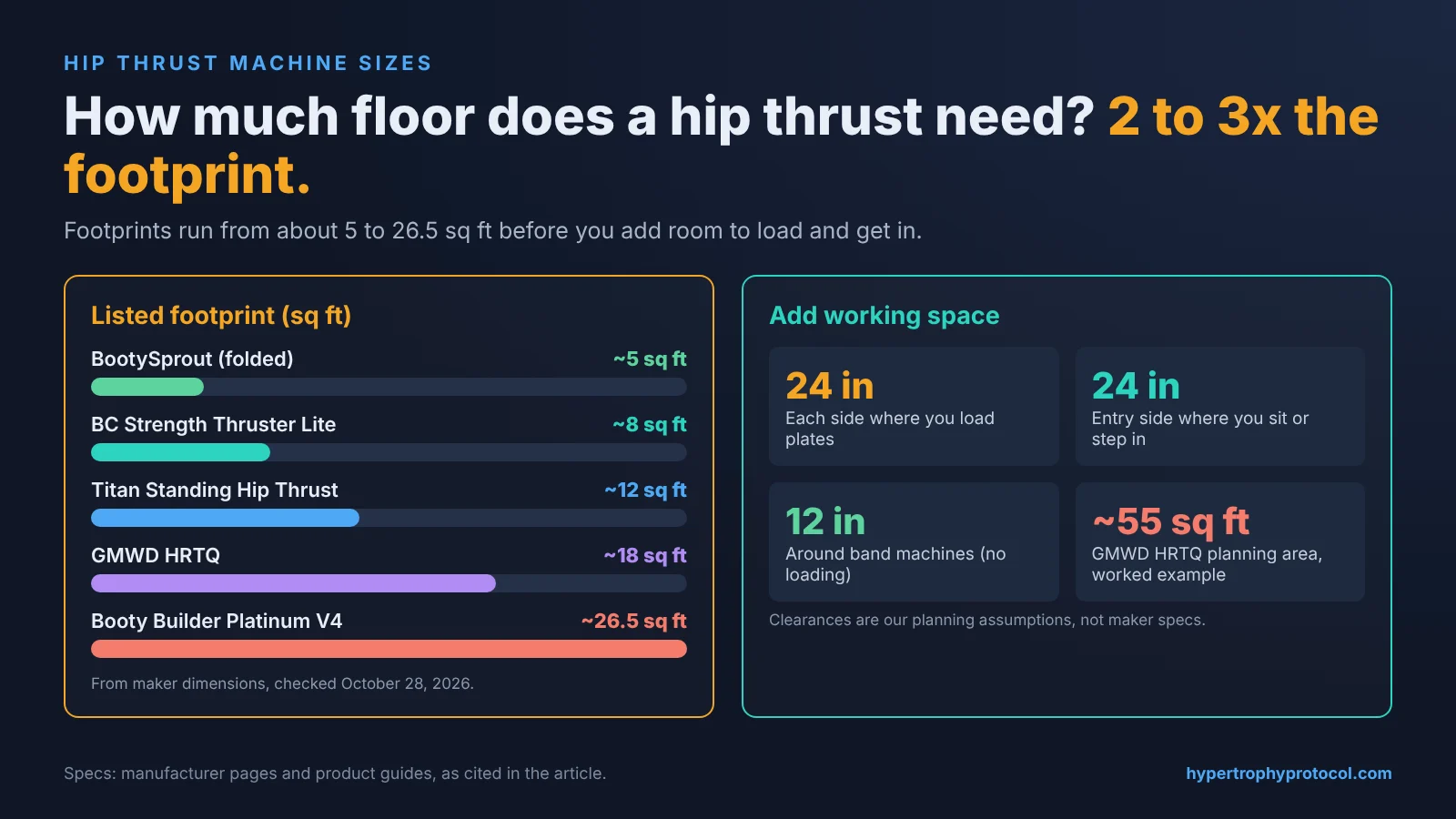
The footprint is the machine. The working space is the machine plus the room to use it. Makers don’t publish clearance numbers for these machines, so the figures below are our planning assumptions, not manufacturer specs. Adjust them to your body and plates.
- Loading sides: about 24 in on each side where you slide plates on and off. Bumper plates are about 18 in across, and you need room for your hands.
- Entry side: about 24 in where you sit, lie or step in.
- Band machines: less. Band setups don’t need loading room, so about 12 in around the platform is usually enough.
- Barbell platforms: the barbell sets the width. A standard 7 ft Olympic bar is about 86 in long, so a barbell platform needs that width cleared even though the base is only 33 in wide.
Worked example: the GMWD HRTQ is 71 x 36.3 in. Add 24 in on both loading sides and 24 in at the entry end, and the planning area becomes about 95 x 84 in, roughly 55 sq ft. That’s about three times the machine’s own footprint.
The home gym room planner lets you lay out the machine with your rack, bench and walkways to see what actually fits.
Ceiling height
Lying and seated hip thrust machines stand 14.5 to 35 in tall, so they fit under any normal ceiling and most garage door tracks. Standing machines are 53.75 to 56 in tall, still well under an 8 ft ceiling. Ceiling height matters more for overhead work elsewhere in your gym than for any machine here.
User height and fit
Dimensions also tell you whether a machine fits your body. A few makers publish a height range:
- BC Strength Thruster Lite: 5’0″ to 6’3″.
- BC Strength Thruster 3.0: an optional 58 in base for users 6’4″ and up.
- BootySprout: 4’8″ to 6’5″.
- Lifepro GluteBlast: up to 6’3″.
If you’re near either end of a range, check that the back pad lands just below your shoulder blades and your feet sit flat with shins close to vertical at the top of the rep.
Fitting a hip thrust setup into a small gym
- No extra floor: a rack-mounted thruster bench, if your rack line has one. The rack attachment fit checker confirms fit.
- Stores away: a band machine. Some fold or come apart for storage.
- Smallest plate-loaded: the standing models, at about 12 to 13.5 sq ft.
- Use what you own: a barbell and bench need no new footprint at all. The barbell vs Smith vs machine guide compares the options.
Before you order
- Tape the footprint plus working space on your floor and walk around it.
- Check the delivery path, doors and stairs. Plate-loaded stations weigh 157 to 317 lb.
- Confirm whether a listed size is folded or open, and length or depth.
- Check current specs and stock on the maker’s page. Several models were sold out on the check date.
Bottom line
Footprints run from about 5 sq ft for a folded band machine to about 26.5 sq ft for the biggest seated stations. Plan for roughly two to three times the footprint once you add room to load and get in. If space is the limit, a rack attachment, a band machine or a standing model is the place to start.
Dimensions checked against manufacturer product pages and product guides on October 28, 2026. Clearance figures are Hypertrophy Protocol planning assumptions, not manufacturer specifications. Confirm current specs before ordering.