
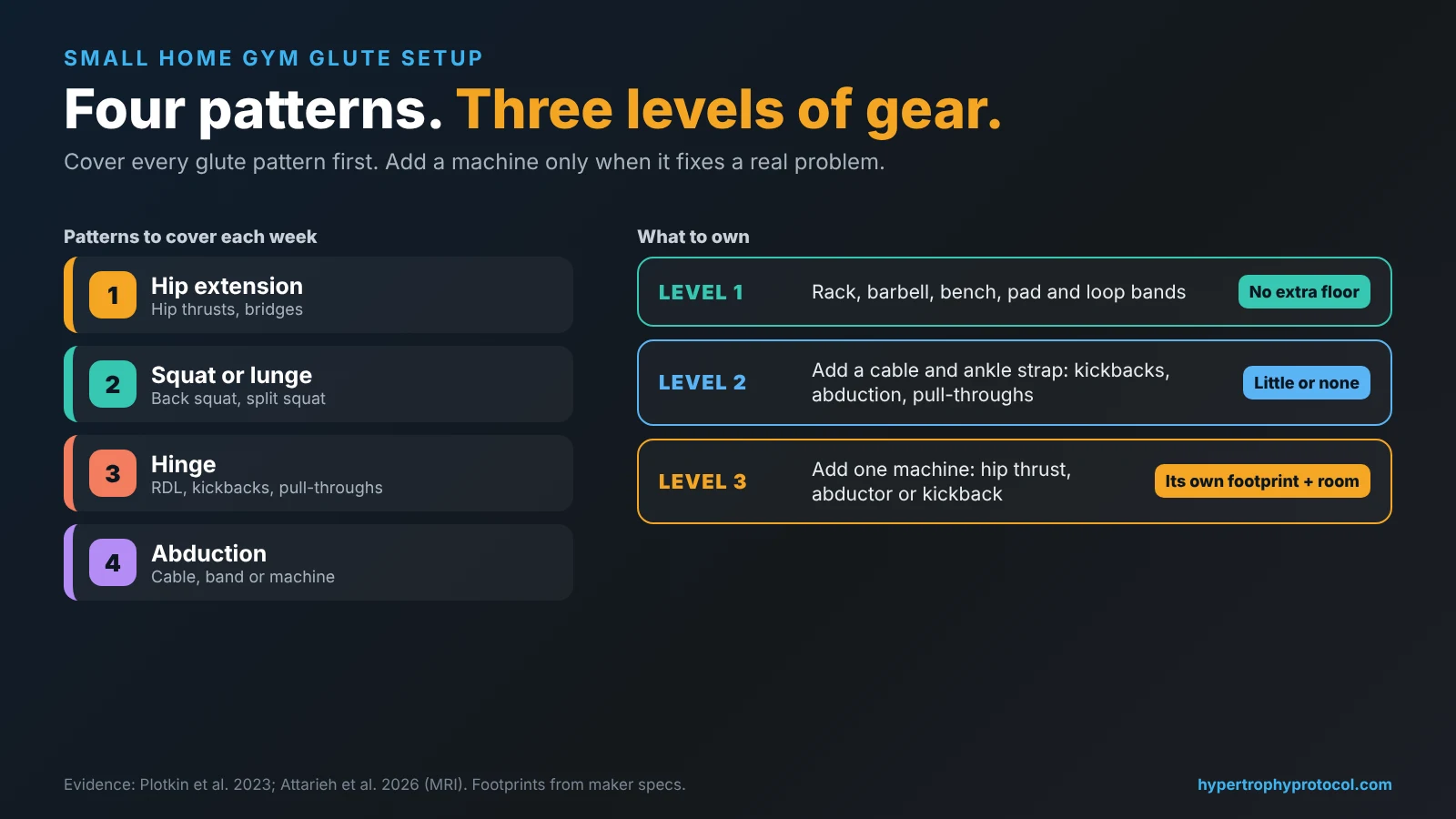
You don’t need a row of glute machines to train glutes well at home. The research points to a small set of movement patterns, and most of them can be loaded with a barbell, a bench and a cable or a few bands. The trick in a small gym is covering each pattern with the least floor space, then adding a dedicated machine only where it removes a real problem.
This guide covers the movement patterns, the equipment that covers them at each space level, and a sample week. It also explains when a dedicated machine is worth the room.
At a glance
| Verdict | A barbell, a sturdy bench and a cable or bands cover every main glute pattern. Add a machine later, for convenience, not because the basics stop working. |
|---|---|
| Patterns to cover | Hip extension (thrusts, bridges, kickbacks), a squat or lunge, a hinge, and hip abduction. |
| Evidence strength | MRI trials show hip thrusts, squats and cable kickbacks all grow the glutes, and abduction grows the upper and side glutes. Few trials compare whole home setups. |
| What to do | Pick one exercise per pattern, train glutes two or three times a week, and add weight or reps over time. |
| Main caveat | Space numbers here combine maker specs with our own planning assumptions. Measure your room and tape it out before you buy. |
Research checked October 29, 2026.
The four patterns a glute setup should cover

- Hip extension with the knees bent: hip thrusts and glute bridges. In a 9-week MRI trial by Plotkin and colleagues (2023), barbell hip thrusts grew the glutes about as much as back squats.
- A squat or lunge: squats, split squats or lunges. In the same trial, squats grew the glutes plus more quadriceps and adductors.
- A hinge or straight-leg extension: Romanian deadlifts, back extensions or cable kickbacks. In a 2026 MRI trial by Attarieh and colleagues, cable kickbacks grew the gluteus maximus about 9% in 10 weeks.
- Hip abduction: cable, band or machine abductions. In that 2026 trial, abduction grew the upper glute max and the gluteus medius and minimus, which extension mostly missed.
You don’t need all four every session. Covering them across the week is enough. The posterior chain guide covers the hinge and hamstring side in more depth.
What to buy at each space level
Level 1: no extra floor space
If you have a power rack, a barbell and a bench, you can already train every pattern.
- Hip thrusts: barbell and bench, with a thick bar pad. Push the bench against the rack so it can’t slide.
- Squat or lunge: back squats or split squats in the rack.
- Hinge: Romanian deadlifts with the same barbell.
- Abduction: a set of loop bands for seated or side-lying abductions.
Add-ons that take no floor space: a hip thrust pad, bands, and possibly a rack-mounted thruster bench if your rack line offers one. Check fit with the rack attachment fit checker.
Level 2: add a cable
A cable is the most useful single glute upgrade for a small gym, because one pulley covers two patterns.
- Kickbacks: low pulley and an ankle strap. The cable kickback guide covers setup and form.
- Abduction: the same strap, standing side-on to the pulley.
- Pull-throughs: a rope between the legs, for a hinge that’s easy on the back.
Rack-mounted pulleys and compact smart cables add this without a new footprint. Check your pulley ratio with the cable pulley ratio calculator, because a 2:1 cable feels about half the stack weight.
Level 3: add one dedicated machine
Add a machine only when it fixes something you keep running into:
- Hip thrust setup is why you skip them: a hip thrust machine. Footprints run from about 8 sq ft for a band platform to about 26.5 sq ft for the biggest seated stations. The hip thrust machine dimensions page compares them.
- You want both abduction and adduction with quick changes: a combo abductor/adductor machine. The abductor and adductor machine guide lists verified specs.
- Balance limits your cable kickbacks: a kickback or multi-hip machine. See kickback machine vs cable.
How much room each level needs
These are planning figures. Machine footprints come from manufacturer specs. The working space around them is our own assumption: about 24 in on loading and entry sides.
- Barbell hip thrusts: the bench plus the width of the barbell. A 7 ft Olympic bar is about 86 in long, so clear that width.
- Cable work: about one leg’s length behind you for kickbacks, and a step to the side for abductions.
- A plate-loaded hip thrust station: roughly two to three times its footprint once you add loading and entry space. A 71 x 36 in lying machine needs about 55 sq ft to use comfortably.
The home gym room planner lets you place each piece and check walkways. If your space is very tight, the 10×10 home gym guide shows a full layout.
A sample glute week for a small home gym
This is one simple way to cover all four patterns in two sessions. Adjust sets to your recovery and the rest of your training.
| Day | Exercise | Pattern | Sets x reps |
|---|---|---|---|
| Day A | Barbell or machine hip thrust | Hip extension | 3 x 8 to 12 |
| Day A | Romanian deadlift | Hinge | 3 x 8 to 10 |
| Day A | Cable or band hip abduction | Abduction | 2 to 3 x 10 to 15 |
| Day B | Back squat or split squat | Squat or lunge | 3 x 6 to 10 |
| Day B | Cable kickback | Hip extension | 3 x 8 to 12 per leg |
| Day B | Cable or band hip abduction | Abduction | 2 x 10 to 15 |
Take most sets within a rep or two of failure and add weight or reps when you hit the top of the range. The weekly sets planner counts glute, hamstring and quad sets so you can see the full picture. For more on progressing with limited equipment, see progressive overload in a small home gym.
Common small-gym mistakes
- Buying a machine for every pattern. Three single-use machines can take more room than a rack and cable that cover everything.
- Skipping abduction. Extension alone leaves the side glutes mostly untrained.
- Only doing hip thrusts. In the Plotkin trial, squats grew more quads and adductors than hip thrusts, and hip thrusts did little for the hamstrings. Keep a squat and a hinge.
- Forgetting working space. A machine that fits only when you’re not using it doesn’t fit.
Bottom line
Cover four patterns: hip extension, a squat or lunge, a hinge and abduction. A barbell, a bench and bands handle all of them with no extra floor. A cable is the best next step because one pulley adds kickbacks and abduction. Add a single dedicated machine only when it solves a problem you keep hitting, and plan its working space, not just its footprint.
Research checked October 29, 2026. Space figures combine manufacturer dimensions with Hypertrophy Protocol planning assumptions. This is general training information, not medical advice.
Sources
- Plotkin DL, et al. Hip thrust and back squat training elicit similar gluteus muscle hypertrophy and transfer similarly to the deadlift. Front Physiol. 2023. doi:10.3389/fphys.2023.1279170
- Attarieh P, Nunes JP, et al. Regional hypertrophy of the gluteal muscles is task-specific: differential responses to 10 weeks of hip extension versus hip abduction training. J Strength Cond Res. 2026. doi:10.1519/JSC.0000000000005701