
Your home gym has a rack, a cable attachment and a set of dumbbells, and you keep hearing that real size comes from barbells. On machines vs free weights for muscle growth, the controlled research points one way: when sets are taken hard, both grow muscle by about the same amount. The difference shows up in strength, because you get strongest on the equipment you actually train with.
That means a cable-heavy or machine-heavy setup is a legitimate way to build muscle, and the real question is how to mix the tools you own. Every study below was checked on PubMed on September 28, 2026.
What does the research show on machines vs free weights for muscle growth?

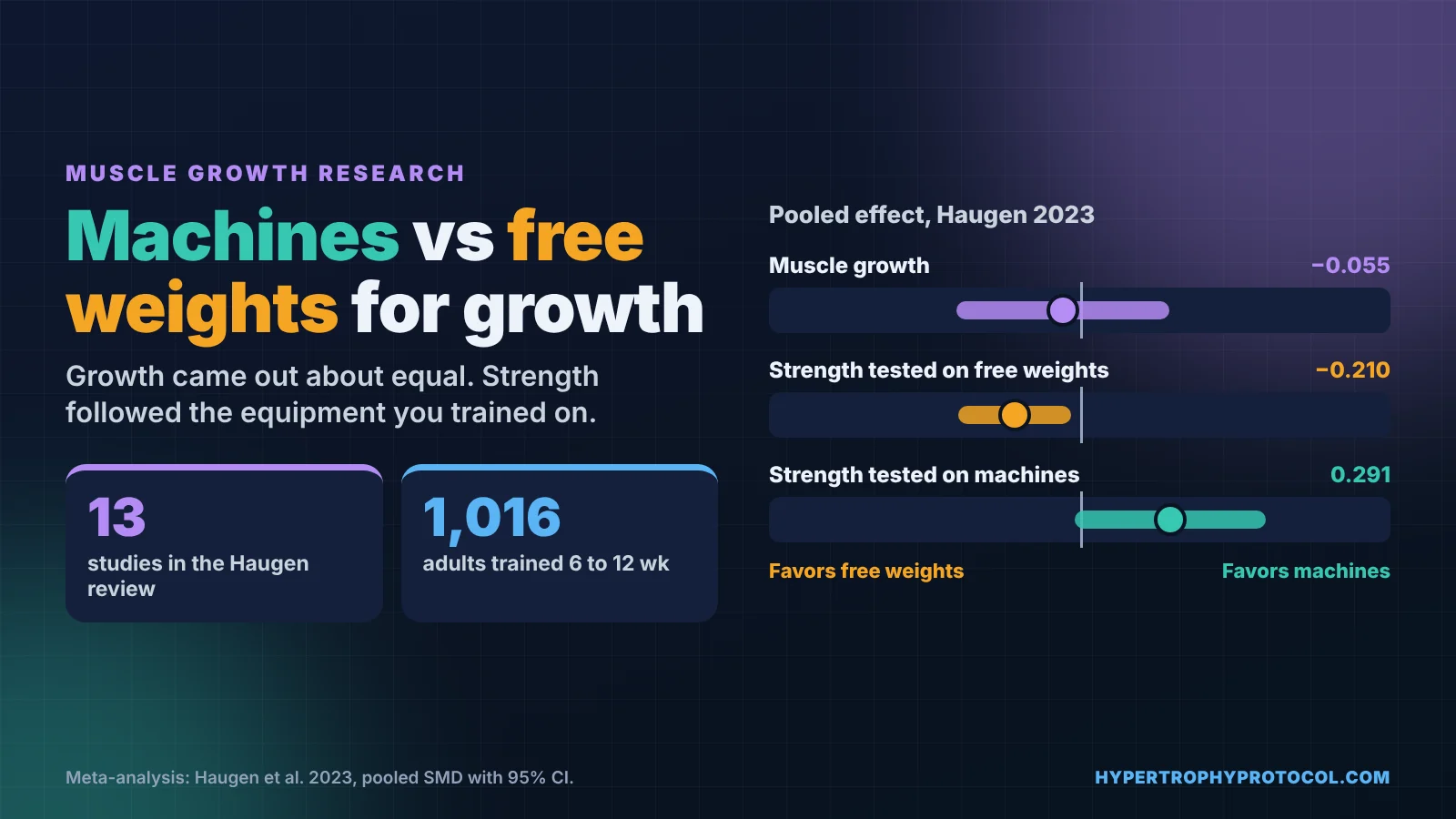
The clearest answer comes from pooled data. A 2023 meta-analysis by Haugen and colleagues gathered 13 studies that trained adults with free weights or machines for at least six weeks. Five of them measured muscle size, and the pooled difference between the two was essentially zero.
An earlier meta-analysis by Heidel and colleagues reached the same place for hypertrophy. Newer head-to-head trials, including one in trained men using full squats, bench press, rows and shoulder press, have kept landing on similar growth.
| Study | Comparison | Who and how long | Growth result | Strength result |
|---|---|---|---|---|
| Haugen 2023 (meta-analysis) | Free weights vs fixed-path machines; cable machines excluded | 13 studies, 1,016 adults, 6–12 wk (5 studies measured size) | No difference: SMD −0.055 (95% CI −0.397 to 0.287) | Free-weight tests favored free-weight training; machine tests leaned toward machine training |
| Heidel 2021 (meta-analysis) | Free weights vs machines | Studies published through September 2020 | No difference: ES −0.01 (95% CI −0.525 to 0.545) | Each group gained more on its own equipment (ES 0.655 and −0.784); similar on a neutral device |
| Schwanbeck 2020 | Full program with free weights vs machines | 46 young adults (26 women), 8 wk | Biceps and quadriceps thickness rose with no group difference | Machine group gained more on machine bench (+13.9% vs +8.6%); free-weight bench, squat and Smith squat similar |
| Hernández-Belmonte 2023 | Barbell vs machine: full squat, bench press, prone bench pull, shoulder press | 38 resistance-trained men, 8 wk | Quadriceps, pectoralis major and rectus abdominis grew similarly (difference ≤2.0%) | Similar overall (difference ≤1.8%), with larger gains on the trained equipment |
| Saeterbakken 2019 | Smith machine vs free-weight squat (plus a wobble-board group) | 59 men, 3 wk familiarization then 7 wk | Similar muscle thickness gains | Smith group improved more on the Smith squat than on the other versions |
| Amanuma 2025 | Lunge vs incline leg press, one leg each | 8 untrained women, 9 wk | Vastus lateralis +13.3% vs +12.1% at the 50% site; no difference at any site | Not the focus |
| Nunes 2020 | Cable vs barbell preacher curl | 35 young adults, 10 wk | Biceps thickness +7% vs +8% | Barbell group stronger only near full elbow extension |
| Larsen 2025 | Cable vs dumbbell lateral raise, one arm each | 24 resistance-trained men and women, 8 wk | Lateral deltoid +3.3–4.6%; Bayes factors 0.22–0.27 favored no difference | Not the focus |
Two limits keep this from being a closed case. The Haugen hypertrophy analysis rests on only five studies, and some of them estimated muscle with circumference or skinfolds rather than imaging. Nearly every trial ran 12 weeks or less, so nobody has tested whether small differences add up over years.
Why does strength favor one tool when growth does not?
Those limits apply to growth; the strength pattern is sturdier. When both groups were tested on free weights, the free-weight group gained more. When both were tested on machines, the machine group tended to gain more. On a neutral device that neither group trained with, the gap closed.
Haugen 2023: pooled effect sizes with 95% confidence intervals
The growth bar straddles zero almost evenly, while the free-weight strength bar sits entirely on the free-weight side. That is skill specificity at work: a barbell squat demands balance and bar-path control that a machine removes, and those skills carry into a barbell test.
For you, this changes what to measure. A lifter who switches to a cable or plate-loaded setup and then retests a barbell max will likely see a smaller jump than a barbell-only lifter would, even if the muscle underneath grew the same. Judge a machine block by machine loads or by size, and retest the barbell only after you have trained it again.
Does cable vs free weight change the answer?
Cables need their own look, because the Haugen review left them out on purpose. It excluded cable machines without a fixed path, so its “machine” means leg presses, chest presses and Smith machines, not a cable column on your rack.
The direct cable trials are small but consistent. Nunes compared cable and barbell preacher curls, which load the biceps hardest at opposite ends of the rep, and biceps thickness rose by nearly the same amount. The Larsen lateral raise study trained one arm with a cable and the other with a dumbbell in experienced lifters, and the data favored no difference in deltoid growth.
Both of those studies used single-joint moves for the arms and shoulders. No trial checked on PubMed tested an all-cable program against barbell compound lifts for whole-body growth, so that claim for a cable-only gym is an extrapolation from the machine data plus these smaller studies.
Many of these trials trained one limb each way, which is also how most home cable work gets done. The unilateral training guide covers whether single-arm and single-leg sets change growth on their own.
Can a home gym built on cables and machines match barbells for size?
On current evidence, yes, with one condition. The trials that showed equal growth gave both groups the same sets, reps and effort targets, and several took sets to failure. The tool mattered less than the effort and volume put through it.
Machines may even make that effort easier to reach. The Haugen authors speculated that free-weight sets can end when a stabilizer or your trunk gives out before the target muscle does, while a machine lets the target muscle work closer to its own limit. That idea is plausible but has not been tested directly.
Resistance profile is a separate lever that often gets mixed into this debate. A cable keeps tension where a dumbbell pointed straight down goes slack, and that matters most at long muscle lengths. The long muscle lengths guide covers which exercises benefit, and the Nunes curl trial is a reminder that a different profile does not automatically mean different growth.
How should you mix a rack, cable and dumbbells?
Since growth is roughly equal, the mix comes down to what you want to get strong at and what is easiest to load hard. The table pairs a free-weight anchor with a cable or attachment option for each area and marks what was tested versus inferred.
| Area | Free-weight anchor | Cable or attachment option | Evidence behind the pairing |
|---|---|---|---|
| Quads and glutes | Barbell squat in the rack; dumbbell lunge | Leg press, belt squat or knee extension attachment | Tested: barbell vs machine squat, lunge vs leg press, similar growth. Keep the barbell squat if a squat max matters to you. |
| Chest | Barbell or dumbbell bench press | Cable fly or standing cable press | Tested: barbell vs machine bench, similar growth. Cable press and fly inferred. |
| Back | Dumbbell or barbell row | Lat pulldown and low-row attachment | Barbell vs machine prone bench pull sat inside a program with similar overall growth, but back size was not measured. Inferred. |
| Side delts | Dumbbell lateral raise | Single-arm cable lateral raise | Tested in trained lifters: similar growth. Pick either. |
| Biceps | Barbell or dumbbell curl | Cable curl or cable preacher curl | Tested: cable vs barbell preacher curl, similar growth. |
| Triceps and hamstrings | Overhead dumbbell extension; Romanian deadlift | Overhead cable extension; seated cable leg curl with ankle strap | Not tested as free weight vs cable. Choose by stretch position (see the long muscle lengths guide). |
A simple rule follows from the table. Keep one free-weight compound lift for any pattern where you care about a barbell or dumbbell number, and fill the rest of your volume with whichever tool lets you take sets closest to failure with a steady setup.
Handles and straps decide how comfortable those cable options feel. The cable attachments guide matches each one to a muscle. For lower-body machines that bolt onto or sit beside a rack, the squat machine styles comparison covers eight loading options.
Which setup fits your goal?
With the evidence and the mix laid out, the verdict depends on what you are training for. Find the line that matches your goal.
- You mainly want muscle and already own cables or rack attachments: a cable- and machine-heavy program can match free weights for growth in the trials so far. Train it hard and track size or machine loads.
- You want a bigger barbell squat, bench or deadlift: keep training those lifts, since strength follows the equipment. Use cables for the extra volume around them.
- You train with dumbbells and a barbell only: you are not leaving growth behind. A cable adds convenience and a different resistance profile, though no trial shows a size advantage from it.
- You are new to lifting: either works for size. Machines and cables have fewer degrees of freedom, while free weights build the balance and bar-path skill a barbell test rewards.
Your next step: if a cable or leg attachment is the missing piece, run your rack through the Rack Attachment Fit Checker before you order, so the attachment matches your upright size and hole pattern. Then give the new cable work a full block of 6 to 12 weeks, the range the trials above ran, before judging it.
Sources
- Haugen ME, et al. Effect of free-weight vs. machine-based strength training on maximal strength, hypertrophy and jump performance: a systematic review and meta-analysis. BMC Sports Sci Med Rehabil. 2023. doi:10.1186/s13102-023-00713-4
- Heidel KA, Novak ZJ, Dankel SJ. Machines and free weight exercises: a systematic review and meta-analysis comparing changes in muscle size, strength, and power. J Sports Med Phys Fitness. 2021. doi:10.23736/S0022-4707.21.12929-9
- Schwanbeck SR, et al. Effects of training with free weights versus machines on muscle mass, strength, free testosterone, and free cortisol levels. J Strength Cond Res. 2020. doi:10.1519/JSC.0000000000003349
- Hernández-Belmonte A, et al. Free-weight and machine-based training are equally effective on strength and hypertrophy: challenging a traditional myth. Med Sci Sports Exerc. 2023. doi:10.1249/MSS.0000000000003271
- Saeterbakken AH, et al. The short- and long-term effects of resistance training with different stability requirements. PLoS One. 2019. doi:10.1371/journal.pone.0214302
- Amanuma MT, et al. Comparable regional hypertrophy of the knee extensor muscles in response to resistance training with machines versus free weights: a randomized within-subject approach. J Bodyw Mov Ther. 2025. doi:10.1016/j.jbmt.2025.09.027
- Nunes JP, et al. Placing greater torque at shorter or longer muscle lengths? Effects of cable vs. barbell preacher curl training on muscular strength and hypertrophy in young adults. Int J Environ Res Public Health. 2020. doi:10.3390/ijerph17165859
- Larsen S, et al. Dumbbell versus cable lateral raises for lateral deltoid hypertrophy: an experimental study. Front Physiol. 2025. doi:10.3389/fphys.2025.1611468
Sources checked September 28, 2026. Research summaries describe the cited studies; individual results vary.