
You’re setting up a home gym to build muscle, and every barbell page hits you with the same wall of numbers: millimeters, PSI, bushings, zinc. If you’re working out how to choose a barbell for hypertrophy training, the specs you will notice every week are knurl, loadable sleeve length and finish. Shaft diameter, sleeve spin and exact bar weight mostly matter to people who compete or train the snatch and clean and jerk.
That leaves a wide field of good options, because squats, presses, rows and Romanian deadlifts ask little of a bar beyond grip and room for plates. Every spec below was checked on September 28, 2026, on the maker’s own product page or in the current IPF and IWF rulebooks.
Which specs matter when you work out how to choose a barbell?

Those specs sit next to four others on every product page, so it helps to see them side by side. The table sets eleven real bars from five makers against the two federation standards most of them are built around.
| Bar | Shaft | Center knurl | Tensile (as stated) | Sleeve | Loadable sleeve | Finish | Weight |
|---|---|---|---|---|---|---|---|
| Rogue Ohio Bar | 28.5 mm | No | 190,000 PSI | Bronze bushing | 16.40″ | Black zinc shaft, bright zinc sleeves | 20 kg |
| Rogue Ohio Power Bar, 45 lb | 29 mm | Yes | 205,000 PSI | Bushing | 16.25″ | Black zinc shaft, bright zinc sleeves | 45 lb |
| Rogue Ohio Power Bar, 20 kg | 29 mm | Yes | 205,000 PSI | Bushing | 16.875″ | Black zinc shaft | 20 kg |
| REP Colorado Bar, 20 kg | 28.5 mm | No | 190 ksi | Composite bushing | 16.1″ | Hard chrome or Cerakote shaft | 20 kg |
| REP Colorado Bar, 15 kg | 25 mm | No | 190 ksi | Composite bushing | 12.4″ | Hard chrome or Cerakote shaft | 15 kg |
| REP Black Diamond Power Bar | 29 mm | Yes | 200 ksi | Bronze bushings | 16.3″ | Cerakote or stainless shaft | 20 kg |
| Titan Series Power Bar | 28.5 mm | 5 in. | 200,000 PSI | Bronze bushings | 15.25″ | Black zinc shaft, hard chrome sleeves | “20 KG (45 lb.)” |
| Titan Performance Series Olympic | 28 mm | No | 165,000 PSI | Bronze bushing | 16.25″ | Chrome | “20 KG (45 lb.)” |
| Bells of Steel Utility Bar | 28.5 mm | 120 mm | 190,000 PSI | Brass bushings | 410 mm / 16.2 in | Black and bright zinc, or Cerakote | 20 kg |
| Bells of Steel Powerlifting Bar | 29 mm | Yes | 210,000 PSI | Bushings | 430 mm / 16-15/16″ | Bare steel or black Cerakote | 20 kg |
| American Barbell Performance Bearing Bar | 28 mm (men’s), 25 mm (women’s) | No | 190K | Bearing | 16.338″ / 12.598″ | Hard chrome | 20 kg / 15 kg |
| IPF rulebook (2026) | 28 to 29 mm | Knurl zones set by diagram | Not set | Not set | 1.31 to 1.32 m between collar faces | No chrome on the knurling at IPF Championships | Bar and collars 25 kg |
| IWF men’s bar (2025 rules) | 28 mm | 12 cm | Not set | Must rotate freely | Sleeve 41.5 cm long (whole sleeve) | Not set | 20 kg |
| IWF women’s bar (2025 rules) | 25 mm | None specified | Not set | Must rotate freely | Sleeve 32 cm long (whole sleeve) | Not set | 15 kg |
Two patterns stand out. Ten of the eleven bars spin on bushings, and not one maker page here gives a yield strength, only tensile. The real spread sits in the columns a hypertrophy lifter feels: center knurl comes and goes, and loadable sleeve length runs from 12.4 to almost 17 inches.
Diameter and tensile strength vary less than the marketing suggests. Every 20 kg bar in the table sits between 28 and 29 mm, the same window the IPF allows, and tensile ratings run from 165,000 to 210,000 PSI.
Which grip specs will you feel on every set?
Of those columns, knurl is the one your hands meet on every rep of a long set. Rogue pitches the Ohio Bar knurl as “middle of the road,” with “solid grip for a heavy pull, yet not too aggressive for multiple, high rep sets.” Bells of Steel sits at the other end, cutting its Powerlifting Bar knurl “as coarse as we can cut it without shredding your hands.”
Long sets are the use case Rogue names for a medium knurl, which makes it the closer match for hypertrophy work. An aggressive power knurl is aimed at heavy pulls and squats where the bar must not shift.
Center knurl is a squat feature. On the Bells of Steel Powerlifting Bar, the “center knurl bites into your back for low-bar squats,” and the IWF men’s bar carries a 12 cm center section as well. If you squat high-bar or train legs mostly on machines, a bar without center knurl, like the Ohio Bar or Colorado, drops a patch of texture you would rarely use.
Diameter is the smaller decision. The IWF men’s bar is 28 mm, the IPF allows 28 to 29 mm, and 28.5 mm multipurpose bars split the difference. Rogue sells its 29 mm power bar on “superior rigidity and virtually zero whip/flex,” and no maker page or rulebook here ties diameter to muscle growth.
Is a higher tensile strength worth chasing?
Knurl and diameter you feel in your hands; tensile strength you only read about. American Barbell’s terminology page defines tensile strength as “the force to pull apart material (breaking)” and yield strength as “the force to create a permanent bend.” Yield is the number that tells you when a bar takes a permanent bend, yet the table carries no yield figure at all.
Rogue’s F-Scale overview adds two cautions. There is “no industry standard for reporting barbell properties,” and strength that is too high “can be detrimental, making the metal brittle.” With every bar here inside a 45,000 PSI band, the tensile number is a weak way to rank them against each other.
Do bearings or bushings matter if you never snatch?
Like tensile strength, sleeve spin is a spec aimed mainly at competitors. REP’s sleeve guide explains that bearings “essentially roll around the sleeve” for “fast, consistent spin under dynamic loads,” and points Olympic lifters toward them. A bushing “is a metal sleeve with no moving parts inside,” so it turns less freely.
REP puts bushings on its power bars because, without small moving parts, “a bushing sleeve can handle heavier loads.” The American Barbell Performance Bearing Bar is the one bearing bar in the table, sold for Olympic weightlifting, and the IWF rule only asks that the sleeve rotate freely. Unless snatches and cleans are part of your plan, a bushing bar covers squats, presses, rows and hinges.
How much loadable sleeve do your plates need?
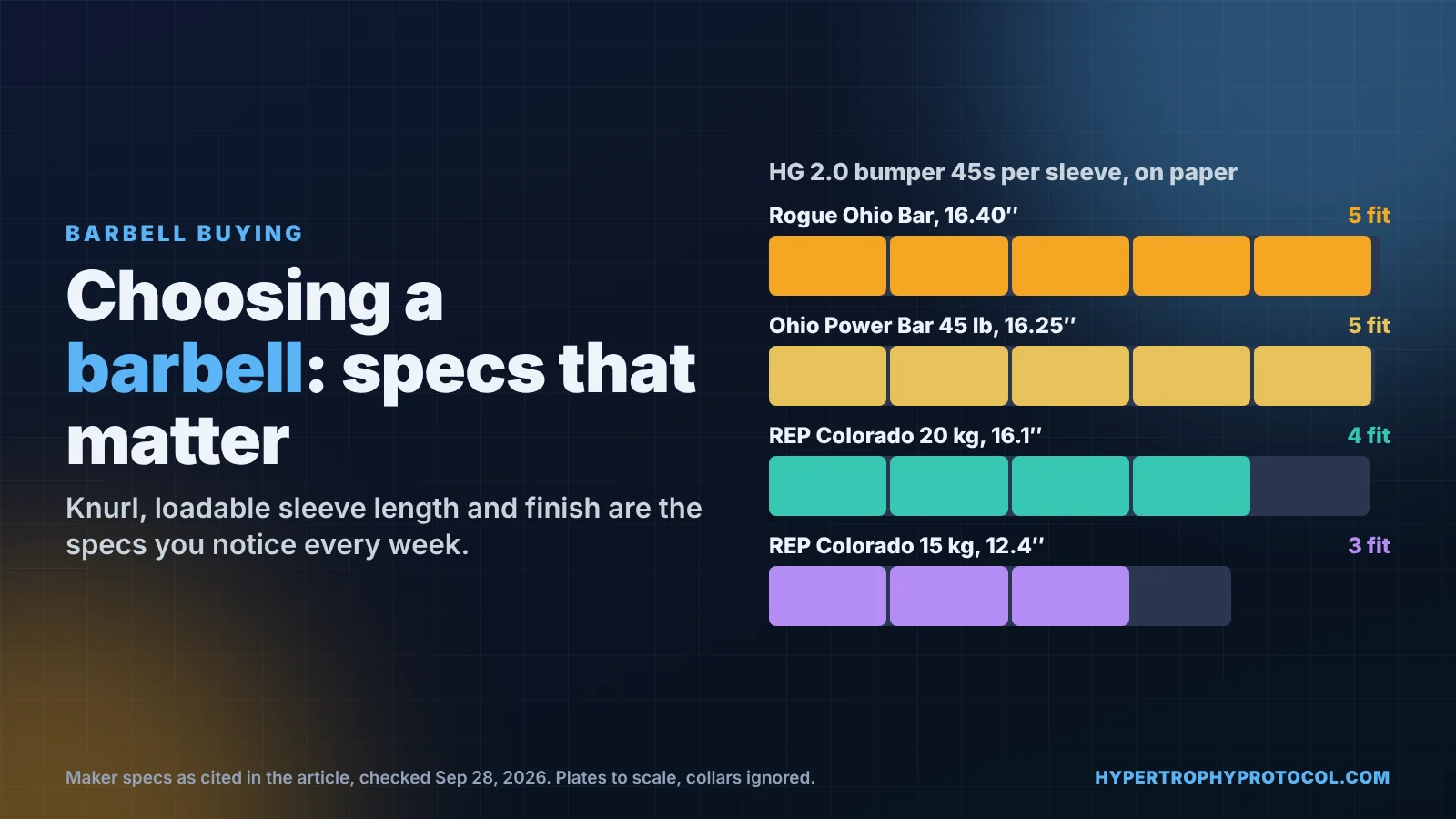
Spin barely affects a hypertrophy lifter, but sleeve length decides how much weight fits on the bar. Plate width sets the limit: Rogue’s HG 2.0 bumper 45s are 3.25 inches wide, while its Olympic iron 45s are 1.3 inches thick.
HG 2.0 bumper 45s per sleeve, on paper (plate width divided into loadable sleeve length)
Grey is empty sleeve. Ignores collars and manufacturing tolerance.
The line between four and five bumpers is thin. The Ohio Bar clears the fifth plate by 0.15 inches, and the 45 lb Ohio Power Bar fits five with nothing left for a collar. The Colorado’s 16.1 inches falls 0.15 inches short of a fifth, so on paper it stops at four.
Iron plates change the picture, since twelve iron 45s fit on the Ohio Bar’s 16.40 inches. If your plan leans on adding load week to week, as in the progressive overload in a small home gym guide, check the sleeve against the plates you own before you buy.
Which finish holds up in a humid garage?
Once the bar is loaded, the next question is how it looks after a few humid summers. American Barbell’s terminology page rates zinc plating as “a very superficial finish providing moderate corrosion resistance,” stainless steel as “very good corrosion resistance,” and Cerakote as “excellent corrosion resistance when properly cared for.”
Makers split once wear enters the picture. American Barbell’s California Bar page credits Cerakote with lasting “as much as 70x longer than chrome and even stainless steel” in salt spray testing, without showing the test. REP rates hard chrome on the Colorado as “the most durable finish we offer, beating even Cerakote,” a claim about wear, not rust.
Rogue’s case for zinc is that it gives “corrosion and wear resistance while maintaining the feel of the knurl.” Bare steel sits at the far end, and Bells of Steel warns that “small surface oxidation may appear on arrival.” Near the coast or in an unconditioned garage, stainless or Cerakote gives you the most margin by the makers’ own ratings.
Should your bar weigh 20 kg, 45 lb or 15 kg?
Finish is a long-term question; bar weight is mostly bookkeeping. A 20 kg bar weighs 44.09 lb and a 45 lb bar weighs 20.41 kg, a gap of about 0.91 lb. That only matters if you log in one unit and load in the other, or if you want your numbers to match a meet.
The versions can differ in more than weight. Rogue’s Ohio Power Bar has 16.25-inch sleeves at 45 lb and 16.875-inch sleeves at 20 kg, a 5/8-inch difference that counts when you stack thick bumpers. Titan labels its bars “20 KG (45 lb.)”, so ask which figure is exact if that matters to you.
A 15 kg bar changes more than the starting weight. REP’s 15 kg Colorado drops to a 25 mm shaft and 12.4-inch sleeves, close to the IWF women’s bar at 25 mm with a 32 cm sleeve. Three bumper 45s per side is its ceiling on paper, so it suits loads that stay moderate or a gym that uses iron plates.
Which barbell fits your home gym?
With every column covered, the verdict depends on how you train. Find the line that matches your plans.
- You train for size with squats, presses, rows and hinges: a 28.5 mm bushing bar with medium knurl, such as the Ohio Bar, Colorado 20 kg or Utility Bar. If you load five bumper 45s a side, only the Ohio Bar of those three has the sleeve for it on paper.
- You low-bar squat heavy or plan to enter a powerlifting meet: a 29 mm power bar with center knurl, like the Ohio Power Bar, Black Diamond or Bells of Steel Powerlifting Bar.
- You snatch and clean and jerk: a 28 mm bearing bar built to the IWF spec, such as the American Barbell Performance Bearing Bar.
- You want a lighter bar: a 15 kg bar with a 25 mm shaft, checked against your plate widths first.
- Your gym is damp or near salt air: stainless or Cerakote over zinc or bare steel.
If a safety squat bar or trap bar comes after the straight bar, the specialty bars and power rack fit guide covers the clearance math. Your next step: place the bar in your buying order with the home gym in phases guide.
Sources checked September 28, 2026. Manufacturers change specs; confirm on the product page before ordering.