
Enter your height, weight and body fat to get your fat-free mass index (FFMI), the height-adjusted version, and how it compares with research on lifters.
From a DXA scan, smart scale, calipers or your best honest guess. The table below shows how much the answer moves if your number is off.
Neck just below the Adam’s apple. Men: waist level with the navel. Women: waist at the narrowest point and hips at the widest point of the glutes. Uses the U.S. Navy (Hodgdon and Beckett) equations.
| If your body fat is | Lean mass | FFMI | Normalized |
|---|
Same height and weight, different body fat readings. Body fat estimates from tapes, scales and calipers can be off by several points, so read your FFMI as a range, not a single number.
Last updated November 2026. Free to use, no sign-up. The research behind this calculator was checked on PubMed on November 7, 2026.
This FFMI calculator turns your height, weight and body fat into a fat-free mass index, a number that shows how much muscle and other lean tissue you carry for your height. It also gives the height-adjusted (normalized) FFMI, compares your result with published research, and shows how much your answer changes if your body fat reading is off. No body fat number? Switch to “Estimate with a tape” and use a tape measure.
What is FFMI?
FFMI stands for fat-free mass index. It works like BMI, but it only counts the part of your weight that isn’t fat:
- Lean mass = body weight x (1 minus body fat %)
- FFMI = lean mass in kg / (height in meters x height in meters)
Example: a lifter who is 5 ft 10 in (1.78 m), weighs 180 lb (81.6 kg) and carries 15% body fat has about 153 lb (69.4 kg) of lean mass. Divide 69.4 by 1.78 squared and the FFMI is about 22.0.
BMI can’t tell a muscular lifter from someone carrying extra fat, because both can be heavy for their height. FFMI separates the two, which is why lifters use it to track muscle gain over time.
Normalized FFMI
FFMI still rises a little with height, so researchers adjust it to a standard height of 1.8 m (about 5 ft 11 in). The original paper by Kouri and colleagues added 6.3 x (1.80 minus your height in meters) (Kouri et al., 1995). Many calculators use 6.1 instead; the difference is a fraction of a point. We use 6.3, the figure in the paper.
If you are close to 5 ft 11 in, the two numbers are nearly the same. The adjustment was built from data on men, so women should compare the plain FFMI.
What is a good FFMI?
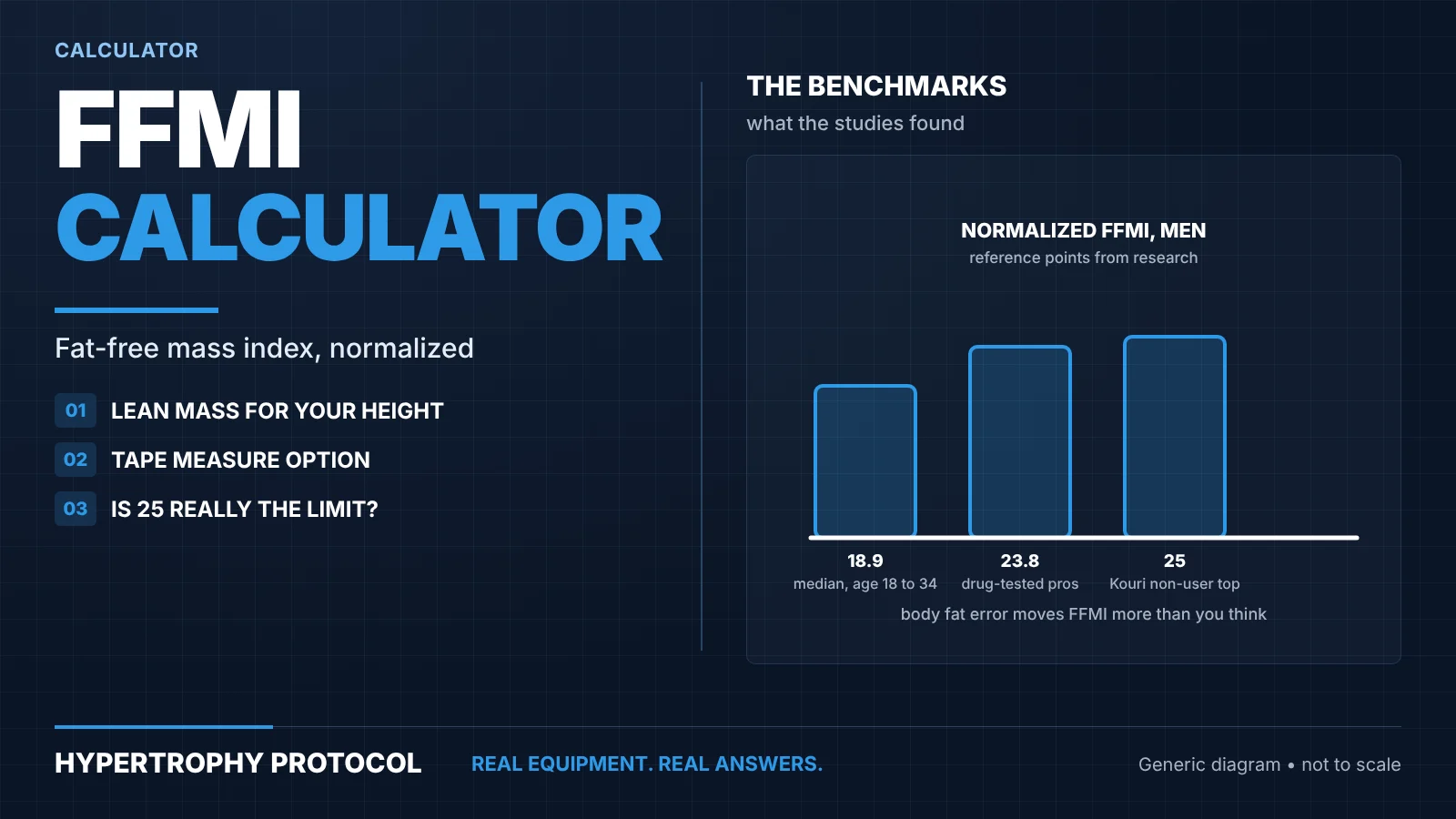
In a study of 5,635 healthy Swiss adults, the median FFMI for ages 18 to 34 was 18.9 for men and 15.4 for women, measured by bioelectrical impedance (Schutz et al., 2002). That’s the general population, not lifters. Use this table as a rough guide for men:
| Normalized FFMI (men) | What it usually means |
|---|---|
| Under 17 | Below the typical adult man |
| 17 to 20 | Around typical |
| 20 to 22 | Above average, usually a man with some steady lifting behind him |
| 22 to 24 | Very muscular; drug-tested pro bodybuilders in one 2024 study averaged about 23.8 on contest day |
| 24 to 25 | Near the top of what Kouri found in athletes who had not used steroids |
| Over 25 | Rare without drugs, and often a sign the body fat reading is too low |
The cutoffs at 17, 20 and 22 are our own rough guide, not research thresholds. For women the research is thinner. The median is 15.4, and an FFMI a few points above that usually reflects real training, but no study we found sets a reliable upper limit for women, so the calculator doesn’t give one.
Is an FFMI of 25 the natural limit?
The number comes from a 1995 study of 157 male athletes: 83 who used anabolic steroids and 74 who didn’t. The non-users’ normalized FFMI went up to about 25.0, while many users went past 25 and some past 30. Twenty Mr. America winners from 1939 to 1959, before steroids were common, had an estimated average of 25.4 (Kouri et al., 1995). The authors called their findings preliminary.
Newer data push back on treating 25 as a hard line. A 2024 study of drug-tested WNBF bodybuilders measured an average FFMI of about 23.8 in pros and 22.8 in amateurs on contest day, and the authors wrote that the accepted limits for natural athletes “warrant reconsideration” (González-Cano et al., 2024). It was a small study of 11 men.
So treat 25 as a marker that very few drug-free lifters pass, not a lie detector. A result above 25 is far more often a body fat reading that’s too low than proof of anything.
Why your body fat number matters most
FFMI is only as good as the body fat percentage you put in. Take the same 5 ft 10 in, 180 lb lifter:
| Body fat | Lean mass | FFMI |
|---|---|---|
| 9% | 164 lb | 23.5 |
| 15% | 153 lb | 22.0 |
| 21% | 142 lb | 20.4 |
A 12 point swing in body fat moves FFMI by about 3 points, enough to jump two rows in the table above. Home methods can easily be off by that much.
The tape option uses the U.S. Navy circumference equations (Hodgdon and Beckett). In about 1,400 Army recruits, the military’s tape equations read about 6 points lower than DXA scans on average (Foulis et al., 2023), and a study of 1,904 soldiers also found tape equations underestimated body fat (McClung et al., 2025). A low body fat reading makes your FFMI look higher than it is, so the calculator flags tape results and shows the table with readings above and below yours.
For tracking progress, use the same method, at the same time of day, every time. The trend matters more than any single number.
How to raise your FFMI
Raising FFMI means adding muscle. The basics that matter most:
- Train each muscle with enough hard sets each week. The weekly sets planner helps you set and spread your volume.
- Take sets close to failure in a wide range of reps. See the best rep range for hypertrophy.
- Add weight or reps over time. Our guide to progressive overload in a small home gym covers small jumps.
- Eat enough protein every day. The protein calculator gives you a daily target.
Gains slow down as you get more trained, so a change of a point or two in FFMI usually takes a long time for an experienced lifter. Recheck every few months instead of every week.
FFMI calculator FAQ
Is FFMI better than BMI for lifters?
Yes, for most lifters. BMI uses total weight, so muscle and fat count the same. FFMI removes the fat first, but it needs a body fat number, which brings in its own error.
What is the average FFMI?
In the large Swiss study, the median for adults aged 18 to 34 was 18.9 for men and 15.4 for women. Lifters usually sit above that.
Can you have an FFMI over 25 naturally?
It’s uncommon. Kouri’s non-users topped out around 25, and drug-tested pros in a 2024 study averaged about 23.8. A few people may exceed 25 naturally, but first check that your body fat reading isn’t too low.
Should I use FFMI or normalized FFMI?
Men comparing themselves with research numbers like 25 should use the normalized value, since that’s what the studies used. Women should use the plain FFMI.
Does FFMI work for women?
The formula works the same way, but there’s much less research on trained women, and the height adjustment was built from men. Use it to track your own progress rather than to compare with a limit.
Studies behind this calculator
| Study | Who | Main finding |
|---|---|---|
| Kouri 1995 | 157 male athletes, 83 steroid users | Non-users’ normalized FFMI reached about 25; many users went past it |
| Schutz 2002 | 5,635 Swiss adults | Median FFMI at 18 to 34 years: 18.9 men, 15.4 women |
| González-Cano 2024 | 11 drug-tested male bodybuilders | Pros averaged about 23.8 on contest day, amateurs 22.8 |
| Foulis 2023 | About 1,400 Army recruits | Tape equations read about 6 points lower than DXA |
| McClung 2025 | 1,904 soldiers | Tape equations and impedance underestimated body fat compared with DXA |
Related: Protein calculator · One rep max calculator · Weekly sets planner · Best rep range for hypertrophy