
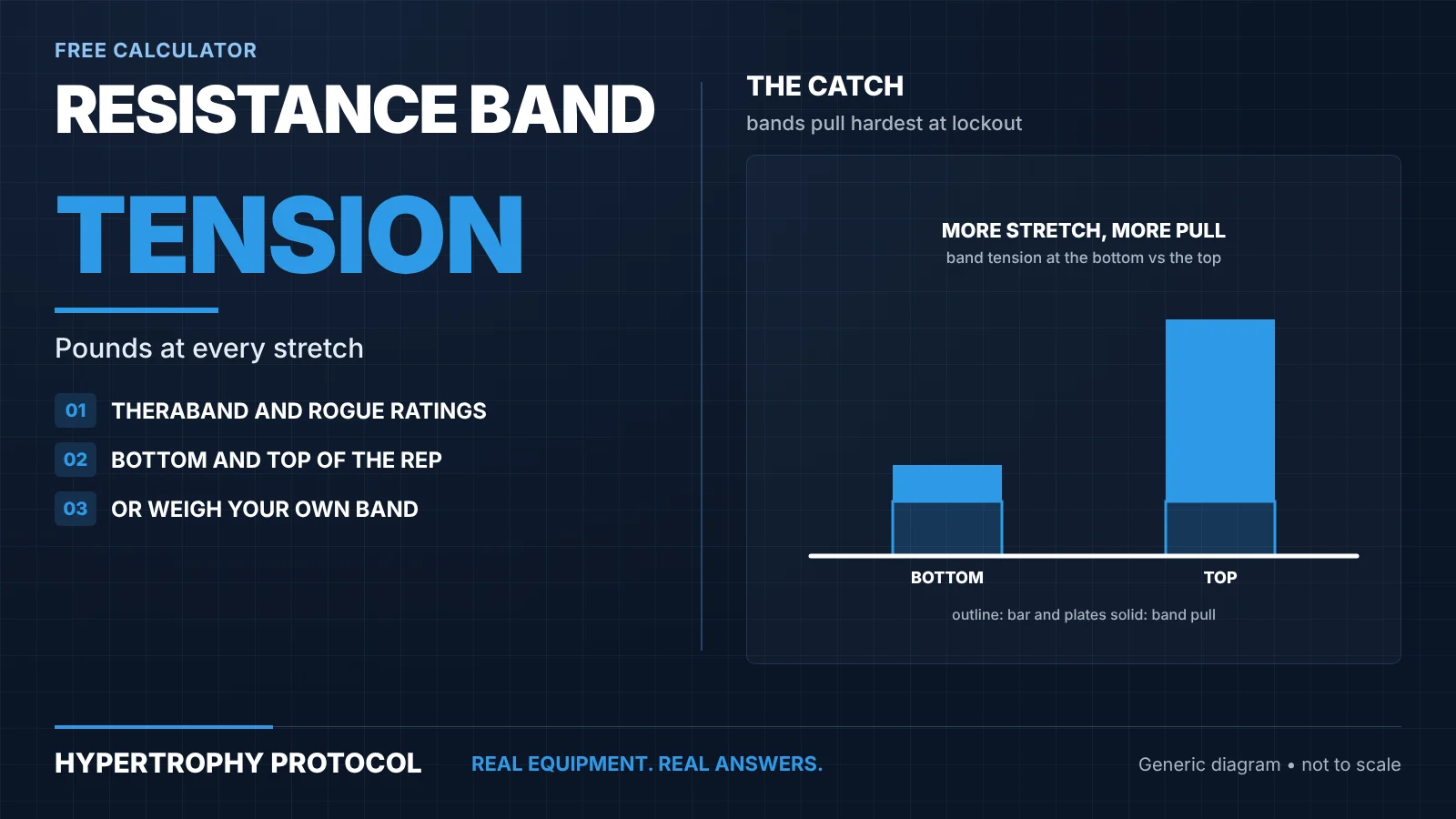
Resistance bands don’t have a fixed weight. The pull rises as the band stretches, so the same band can add a few pounds at the bottom of a squat and several times that at lockout. This calculator estimates the pull at both ends of the rep from published ratings or from one measurement you take yourself.
Resistance band tension calculator
Estimate how many pounds your bands add at the bottom and the top of a lift. Pick a band, enter how long it is at rest and at each end of the rep, and the calculator works out the stretch and the pull.
1. Your band
2. Your setup
3. Result
Same-color bands can differ by about 8 to 19% in tension (McMaster and others, 2010), and independent testing has measured less force than some makers list (Uchida and others, 2016), so the range under each number is a realistic spread. For exact numbers, weigh your own band with a scale and use “I measured mine”.
How to measure your band
- Rest length. Lay a loop band flat without stretching it and measure end to end. A 41 inch loop measures about 20.5 inches flat. For a flat band or tube, measure from the anchor point to where you hold it.
- Bottom and top lengths. Set up the band as you train with it, then measure from the anchor (rack peg, band peg or under your feet) to the bar sleeve or handle with the bar at the bottom, and again at lockout.
- Count the bands. For a barbell, one band on each side counts as two. Doubling a band over counts as two bands.
- For range-only bands, weigh one. Hook the band to a luggage or hanging scale, stretch it to a length you can measure and note the reading. The calculator scales that one reading to your rep lengths. Most makers give a range like 40 to 110 lb without saying at what stretch, which is why our resistance band database lists how each brand rates its bands.
How the numbers are worked out
Stretch is the extra length divided by the rest length: a 20.5 inch band pulled to 41 inches is at 100% stretch. TheraBand publishes pounds at 100% and 200% stretch for each color, so the calculator draws a straight line through those points. Rogue rates each Monster Band at 100% stretch, so the calculator scales that rating to your stretch. If you weigh your own band, it scales your reading the same way.
Real latex doesn’t stretch in a perfectly straight line, and bands of the same color vary. One study found 8 to 19% differences in tension between same-color bands (McMaster and others, 2010), and another measured less force than the maker listed for several TheraBand colors (Uchida and others, 2016). That’s why each result shows a range. Weighing your own band is the most accurate option.
What to do with the result
- Accommodating resistance. If the bands make up a large share of the top load, expect the lockout to feel much heavier than the bottom. Many lifters keep band tension to a modest share of the total at first and build up.
- Slack at the bottom. If the bottom pull is zero, the band is loose there. Choke it around the peg or anchor it lower to keep tension through the whole rep.
- Band pegs. For barbell work, anchor the bands to band pegs directly under the bar path so they pull straight down. Our band pegs guide covers which pegs fit your rack and a step-by-step setup.
- Overstretching. TheraBand’s instructions warn against stretching a band past three times its rest length. The calculator flags it if your setup goes beyond that.
- Band-only training. For building muscle with bands alone, see how to build muscle with resistance bands.
Band tension calculator FAQ
How much weight does a resistance band add?
It depends on the band and how far it stretches. The same band adds little near its rest length and much more when stretched. Enter your rest length and the band’s length at the bottom and top of the rep to estimate both.
Are resistance band ratings accurate?
Treat them as estimates. Ratings are taken at different stretches or given as ranges, same-color bands can differ by up to about 19%, and independent testing has found some maker values run high. Weighing your own band with a scale gives the best number.
How do I measure resistance band tension?
Hook the band to a luggage or hanging scale, stretch it to a length you can measure, and read the scale. Enter that pull and length in the calculator to scale it to any other length.
Is it safe to stretch a band to three times its length?
TheraBand’s instructions say not to stretch past three times the rest length. Tension gets less predictable and the risk of the band snapping rises, so choke the band shorter or use a lighter band instead.
Related: Resistance band database · All free tools · Cable pulley ratio calculator · Progressive overload in a small home gym