
Resistance band labels look alike, but the bands behind them are not. This database lists what each brand says its bands and band bars are made of, how they are built, and how it rates their resistance, with a link to the source for every row. Switch to X3 and band bars to compare the X3 Bar with Harambe, Clench, XBAR and Gorilla Bow.
Resistance band materials and ratings, by brand
What each brand says its bands and band bars are made of, how they are built, and how it rates resistance. Every row links to its source, checked November 7, 2026.
Resistance bands
| Brand / product | Family | Material, in the maker’s words | Construction | Latex | Stated levels | How it’s rated | Top band, lb | Source |
|---|
| Brand / product | Format | Bar | Base | Bands | Resistance | Top rating, lb | Sources |
|---|
The three materials
Natural rubber latex
Most loop, mini and tube bands, and the standard X3 bands. Layered bands are thin latex sheets stacked and bonded into a loop; Serious Steel says this spreads stress and contrasts it with mold-injected bands, which it says can hide air bubbles and thin spots. Not for anyone with a latex allergy.
Thermoplastic elastomer
The usual latex-free option, molded rather than layered. REP’s TPE loops top out at 20-85 lb against 70-175 lb for its heaviest latex band, so heavy pull-up, barbell and band-bar work still leans on latex.
Woven fabric
Hip circles and booty bands: polyester woven with elastic, which grips the leg and doesn’t roll. Rogue’s is latex-free; Sling Shot’s hides a latex core inside the polyester; REP’s FAQ says its fabric bands contain latex. Few list pounds.
Why the pound ratings don’t compare
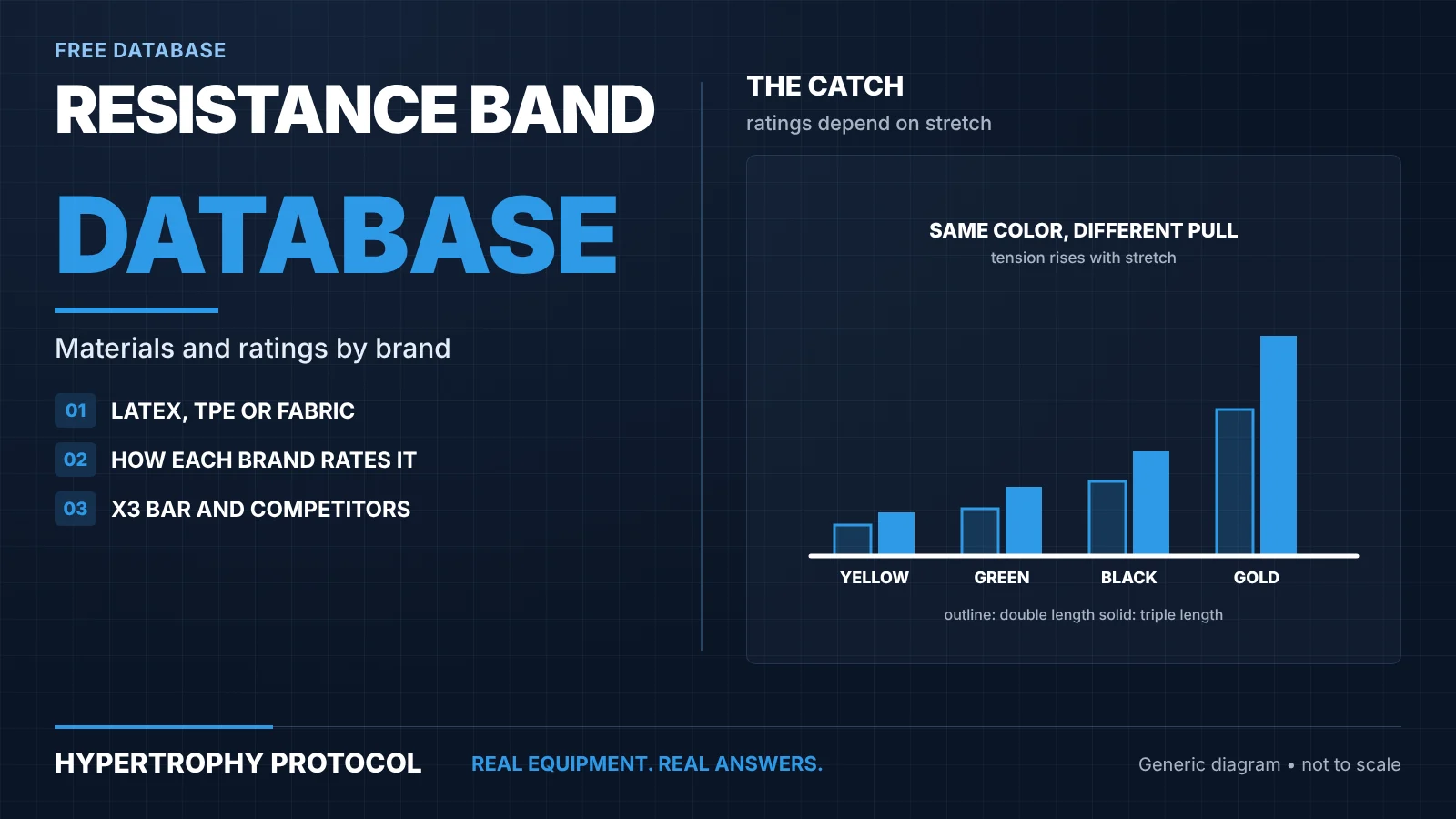
- Tension depends on stretch. TheraBand’s own table shows about 40 to 50% more force at 200% elongation than at 100% (Green 4.6 to 6.7 lb). A rating means little without the stretch it was measured at.
- Brands rate differently. Rogue gives one figure at 100% stretch. REP, Titan and Bodylastics give a range with no method. X3 quotes peak force. Band-bar makers often rate the bar, not the bands.
- The curve isn’t a straight line. Thera-Band tubing behaves non-linearly early in the stretch and linearly after about 50% elongation; large loop bands fit a curved tension curve.
- Same color, different band. Resting length differences of 3.5 to 5.2% in same-color loop bands produced 8 to 19% tension differences in one study.
- Maker numbers can run high. Independent tensiometer testing found TheraBand’s values were overestimates for five of eight colors.
Pounds at 100% (outline) and 200% (solid) elongation. Source: TheraBand instruction manual.
Research behind the notes
- Patterson RM et al. Material properties of Thera-Band tubing. Phys Ther 2001. doi:10.1093/ptj/81.8.1437
- McMaster DT, Cronin J, McGuigan MR. Quantification of rubber and chain-based resistance modes. J Strength Cond Res 2010. doi:10.1519/JSC.0b013e3181dc4200
- Uchida MC et al. Thera-band elastic band tension: reference values for physical activity. J Phys Ther Sci 2016. doi:10.1589/jpts.28.1266
- Hughes CJ et al. Resistance properties of Thera-Band tubing during shoulder abduction exercise. J Orthop Sports Phys Ther 1999. doi:10.2519/jospt.1999.29.7.413
- Lopes JSS et al. Elastic versus conventional resistance training on muscular strength: systematic review and meta-analysis. SAGE Open Med 2019. Similar strength gains for both. doi:10.1177/2050312119831116
- Thomas M, Müller T, Busse MW. Tension in Thera-Band and Cando tubing at different strains and starting lengths. J Sports Med Phys Fitness 2005;45(2):188-98.
Study details retrieved from PubMed. Band data comes from each maker’s product page except where a row notes a third-party source (shown in orange). Specs change; confirm on the product page before relying on a number.
How to read the database
Use the material buttons to narrow the list to latex, TPE (latex-free) or fabric bands, and sort any column by tapping its heading. The “How it’s rated” column matters as much as the number: a band rated at 100% stretch, a band given as a range with no method, and a band bar rated by what the bar can hold are three different measurements, so compare like with like.
Resistance band database FAQ
What are resistance bands made of?
Most loop, mini and tube bands are natural rubber latex. Latex-free bands are usually thermoplastic elastomer (TPE). Hip circles and booty bands are woven polyester and elastic, and some hide a latex core inside the fabric.
Are fabric resistance bands latex-free?
Not always. In this database Rogue’s fabric hip band is listed as latex-free, the Sling Shot Hip Circle has a latex core inside a polyester cover, and REP’s FAQ says its fabric hip bands contain latex. Check the listing if you have a latex allergy.
How much resistance does a band give?
It depends on how far you stretch it. TheraBand’s own table shows about 40 to 50% more force at triple the resting length than at double, and independent testing has found maker ratings can run high. Treat any single pound figure as an estimate.
What are the alternatives to the X3 Bar?
Band bar systems in the database include the Harambe System, Clench Fitness Carbon Pro Kit, XBAR 2.0 and Gorilla Bow. They differ in whether they use a footplate, what the bar is rated to, and which bands they use; the X3 and band bars table lists each one’s specs and sources.
Related: Band tension calculator · Building muscle with resistance bands · Band pegs and how to use them · All free tools · Cable pulley ratio calculator · Progressive overload in a small home gym