
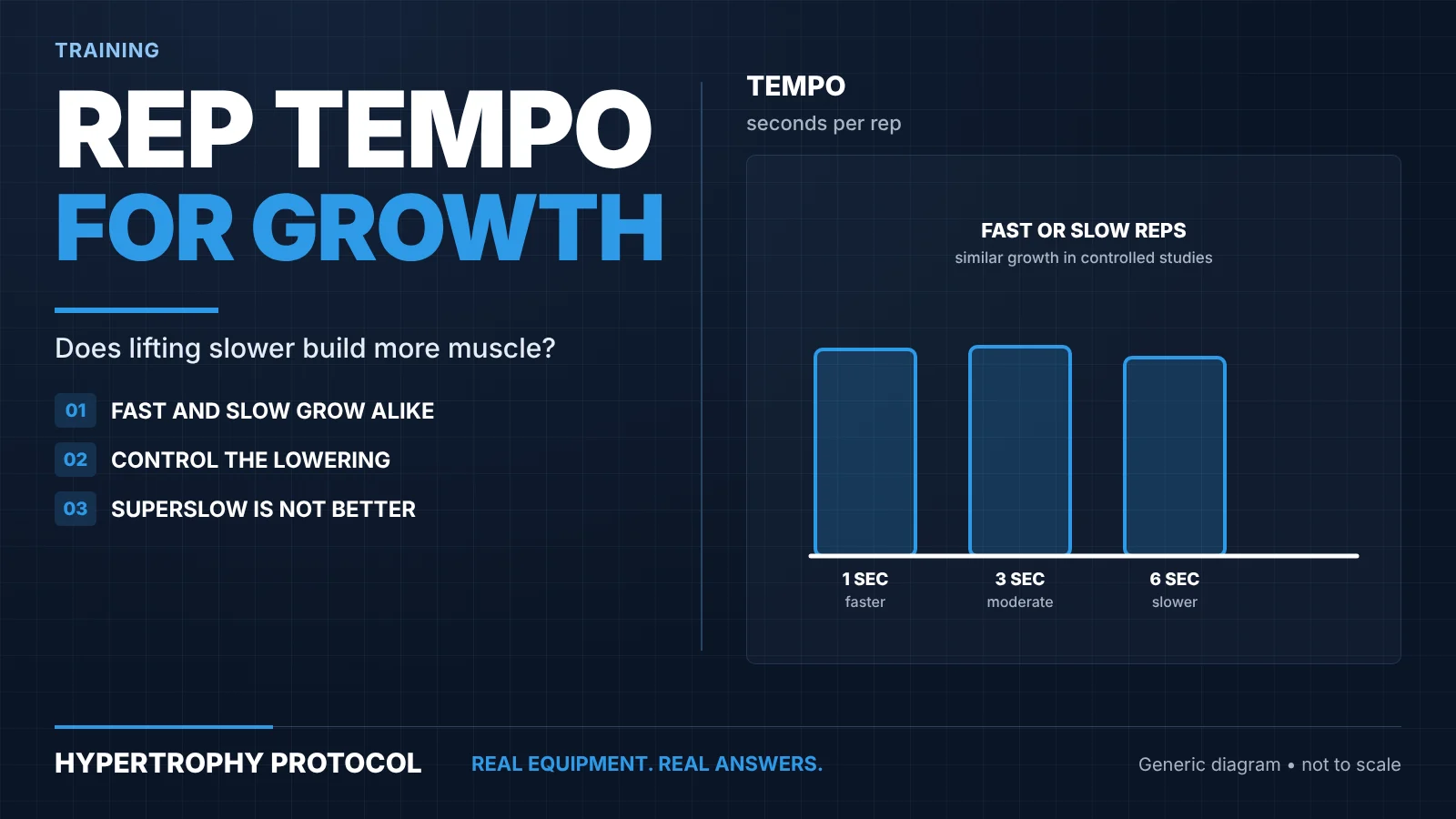
You have seen programs that prescribe every rep as a count, like a 3-second lowering and a 1-second lift, sold on the idea that slower reps keep a muscle under tension longer and so build more of it. The research on rep tempo for hypertrophy points the other way: in controlled studies, muscles grew about the same whether a rep took half a second or several seconds. Only very slow reps, longer than about 10 seconds each, looked worse.
So the useful rules are simple. Lower the weight under control and lift it with intent, then put your effort into hard sets instead of counting seconds. Every study below was checked on PubMed on September 28, 2026.
At a glance
| Verdict | Muscles grew about the same from 0.5 to 8 seconds per rep; only reps over about 10 seconds looked worse |
|---|---|
| Effect size / key numbers | Slower vs faster reps: 0.09 (95% CrI −0.04 to 0.22), trivially favoring faster. Eccentric length: g 0.05, uncertain |
| Evidence strength | A 14-study meta-analysis with other variables held equal; most trials are small and in untrained people |
| What to do | Lower under control, lift with intent, keep one tempo per exercise, and put effort into hard sets |
| Main caveat | Few controlled superslow studies, and only one growth trial in trained lifters |
Studies checked on PubMed, September 28, 2026.
Where does the time-under-tension idea come from?
The myth rests on a chain that sounds reasonable. A slower rep keeps the muscle working longer, and a longer set burns and pumps more, so it should grow more. Slow tempos do change what you feel and what a lab can measure in a single session.
Slow knee extension sets pushed muscle oxygen lower than normal-speed sets, and a 6-second lowering on the bench press raised lactate, creatine kinase and testosterone in trained men more than a 2-second lowering did. Those are acute proxies measured over an hour, and none of them is muscle growth. The mechanical tension guide covers the signal that growth research points to instead.
The weak link is load. A 2021 tempo review by Wilk and colleagues points out that slower tempos require a lighter weight, and with the same weight you get fewer reps before you fail. Time under tension goes up while load or reps go down, so the real question is which side of that trade wins.
Does more time under tension build more muscle?
Several trials tested that trade head-on, and extra seconds under tension kept failing to add growth. In the Azevedo trial, 10 untrained adults did knee extensions to failure for 8 weeks with a 2-second lowering on one leg and a 4-second lowering on the other. The slow leg spent about twice as long under tension for almost the same number of reps, and thigh thickness grew by a similar amount.
Azevedo 2022: twice the time under tension, similar growth
Two trials from one Brazilian lab pulled the variables apart further. When 2-second and 6-second reps were both taken to failure, the fast leg did twice as many reps per set and the slow leg spent more seconds under tension (43 vs 30 per set), yet thigh cross-sectional area grew similarly. When bench press groups were matched at 36 seconds per set, 12 reps of 3 seconds and 6 reps of 6 seconds grew the chest and triceps equally.
The 2026 ACSM position stand, an overview of 137 systematic reviews, reached the same verdict: time under tension did not affect hypertrophy, while higher weekly volume did. The muscle hypertrophy guide walks through the variables that do move growth.
What do meta-analyses say about rep tempo for hypertrophy?
Those single trials fit the pooled data. The table lists the reviews and key trials with the population and growth measure for each.
| Study | Comparison | Who and how long | Measure | Result |
|---|---|---|---|---|
| Enes 2025 (meta-analysis) | Slower reps (1.7–4.5 s, about 3.5 s on average) vs faster (0.3–2 s, about 1 s), all else controlled | 14 studies, healthy adults | Lean or muscle mass | Difference 0.09 (95% CrI −0.04 to 0.22), trivially favoring faster; growth within groups 0.43 faster vs 0.34 slower |
| Schoenfeld 2015 (meta-analysis) | Rep durations, sets to failure | 8 studies, at least 6 wk | Biopsy, imaging or densitometry | Similar growth from 0.5 to 8 s per rep; very slow reps (over 10 s) looked inferior, with few controlled studies |
| Amdi 2025 (meta-analysis) | Shorter vs longer eccentric phase | 9 studies, 166 people (46% trained, 77% male) | Pooled Hedges’ g | Growth g = 0.05 (90% CI −0.22 to 0.33), uncertain; strength favored longer eccentrics in trained people (g = 0.33) |
| Hackett 2018 (systematic review) | Fast vs moderate-slow, load and volume matched | 6 studies, 119 untrained | Muscle size | 3 of 5 quad studies favored moderate-slow; both biceps studies favored fast; too few studies to conclude |
| Hermes 2023 (meta-analysis, strength only) | Intentionally slow concentric vs fast or traditional | 24 studies, 625 healthy people | Strength | Faster built more strength, ES 0.21 (95% CI 0.02 to 0.41) |
| Azevedo 2022 | 2 s vs 4 s lowering, knee extension to failure, one leg each | 10 untrained adults, 8 wk | Ultrasound thickness | Similar summed growth; vastus medialis favored 4 s (g 0.47) |
| Lacerda 2021 | 2 s vs 6 s reps to failure, knee extension, one leg each | 10 untrained men, 14 wk | Ultrasound cross-section | Similar growth in both quad muscles measured |
| Martins-Costa 2022 | 12 reps of 3 s vs 6 reps of 6 s, both 36 s per set, bench press | Untrained men, 11 per group, 10 wk | Cross-section, 3 sites | Similar chest and triceps growth |
| Chaves 2020 | 2 s up, 2 s down vs self-selected tempo, one leg each | 20 untrained men, 8 wk | Ultrasound cross-section | No difference |
| Schuenke 2012 | Superslow (10 s up, 4 s down) vs normal speed, light and heavy loads | 34 untrained women, 6 wk | Biopsy fiber size | Superslow grew type IIA and IIX fibers; heavy normal speed grew all three types and showed the largest overall response |
| Keeler 2001, Neils 2005 | Superslow vs traditional speed | 14 sedentary women, 10 wk; 16 untrained adults, 8 wk | Body composition, strength | No lean mass change in either group in either trial; traditional gained more strength (Keeler) and power (Neils) |
| Tanimoto 2008 | 3 s up, 3 s down, no relaxing phase, at 55–60% 1RM vs 1 s each way at 80–90% 1RM | 36 untrained men, 13 wk | Ultrasound thickness, 6 sites | +6.8% vs +9.1%, both significant and comparable |
| Kojic 2025 | 1 s vs 4 s lowering, squat to failure | 18 untrained adults, 7 wk | Ultrasound cross-section, 1 site | Total quad growth similar (p = 0.84); vastus lateralis favored 4 s |
| Cornejo-Daza 2026 | Squat lifted at maximal intended speed vs half speed, with and without blood flow restriction | 46 trained men, 8 wk | Ultrasound thigh cross-section and volume | No speed effect on overall size; the distal region grew only with half speed (free flow) and fast speed with restriction |
| Wang 2024 | 0.5 s vs 3 s concentric knee extension | 33 young women, 8 wk | Ultrasound thickness | Both grew; no group difference |
Read together, the pooled numbers rank tempo near the bottom of what moves growth. The Enes meta-analysis carries the most weight because it only included studies that held everything else equal, and it put the chance of even a small true difference below one in two, and of a medium one near zero. The one-muscle wins go both ways (the vastus medialis and vastus lateralis for slower lowering, the biceps for faster reps), which fits an average close to zero.
The evidence has clear limits. Most trials used untrained people, one or two exercises, and ultrasound at a few sites, and several had 10 to 20 participants. Only one growth trial in the table used trained lifters, and its tempo change was on the lifting half of the rep.
Is superslow training worse for growth?
The slow extreme is where the flat line bends. Superslow sets, 10 seconds up in the Schuenke study, force a load so light that only two of three fiber types grew, against all three with heavier normal-speed training. The Schoenfeld meta-analysis drew its line at more than 10 seconds per rep, while cautioning that few controlled studies exist there.
The two older superslow trials cannot settle size, because neither group in either trial changed lean mass enough to detect. Both leaned against superslow on strength or power, and the Hermes meta-analysis confirms that slow concentrics build less strength across 24 studies.
Moderately slow reps are a different case. In the Tanimoto trials, 3-second lifts and 3-second lowerings with no relaxing phase between reps grew muscle with about 50 to 60% of 1RM, close to heavy normal-speed training. In their 2006 knee extension trial, the same light load at normal speed with matched work did not grow the quads significantly, so a slow continuous tempo is one tested way to make a light set productive.
Should you control the eccentric?
Slowing only the lowering is the most common tempo cue, and the eccentric overload guide covers that evidence in depth. The newest meta-analysis on eccentric duration put the growth difference close to zero with wide uncertainty. Longer lowerings held up as well or better for strength in trained people.
Two squat and knee extension trials favored the slower lowering in one quad head each, both in untrained people, while total quad growth matched. That is a regional hint with small samples behind it. Lowering under control, anywhere in the 1- to 4-second range these trials tested, gives you what the research supports.
Do explosive concentrics build more or less muscle?
The lifting half has the opposite reputation, as if fast reps were only for athletes. In 46 trained men, squats lifted at maximal intended speed grew the thigh about as much as squats at half speed, and the fast free-flow group was the only free-flow group to jump higher afterward. In young women, half-second concentric reps grew the quads as much as 3-second reps.
Intent is the key word. The Wilk review separates intentional slowness from the unintentional kind, where a heavy load or fatigue slows the bar however hard you push. Trying to move the weight quickly costs you nothing in growth and keeps strength gains on the table.
Which rep tempo fits your training?
With tempo mattering this little for size, the choice comes down to your goals and your equipment. Find the line that matches you.
- You count long tempos on every rep because of time under tension: drop the count and keep the lowering controlled. The pooled data show no growth penalty for faster reps, so spend your attention on taking sets close to failure.
- You like a slow lowering: keep it if it helps you control the movement. Expect fewer reps with the same weight and no reliable size bonus, though strength may gain slightly in trained lifters.
- You train with light loads or limited equipment: slow, continuous reps of about 3 seconds each way are a tested way to grow with 50 to 60% of 1RM.
- You were thinking about superslow training: the evidence is thin and leans against it for growth and strength.
- You care about strength or athletic power too: push every concentric as fast as the load allows.
Your next step: pick one tempo per exercise, keep it the same from week to week, and track load and reps with the progressive overload guide. A steady tempo means a rep added in week six is the same kind of rep you counted in week one.
Sources
- Enes A, Piñero A, Hermann T, et al. How slow should you go? A systematic review with meta-analysis of the effect of resistance training repetition tempo on muscle hypertrophy. J Strength Cond Res. 2025. doi:10.1519/JSC.0000000000005302
- Schoenfeld BJ, Ogborn DI, Krieger JW. Effect of repetition duration during resistance training on muscle hypertrophy: a systematic review and meta-analysis. Sports Med. 2015. doi:10.1007/s40279-015-0304-0
- Amdi CH, King A. The effect of eccentric phase duration on maximal strength, muscle hypertrophy and countermovement jump height: a systematic review and meta-analysis. J Sports Sci. 2025. doi:10.1080/02640414.2025.2535198
- Hackett DA, Davies TB, Orr R, Kuang K, Halaki M. Effect of movement velocity during resistance training on muscle-specific hypertrophy: a systematic review. Eur J Sport Sci. 2018. doi:10.1080/17461391.2018.1434563
- Hermes MJ, Fry AC. Intentionally slow concentric velocity resistance exercise and strength adaptations: a meta-analysis. J Strength Cond Res. 2023. doi:10.1519/JSC.0000000000004490
- Wilk M, Zajac A, Tufano JJ. The influence of movement tempo during resistance training on muscular strength and hypertrophy responses: a review. Sports Med. 2021. doi:10.1007/s40279-021-01465-2
- Currier BS, et al. American College of Sports Medicine position stand. Resistance training prescription for muscle function, hypertrophy, and physical performance in healthy adults: an overview of reviews. Med Sci Sports Exerc. 2026. doi:10.1249/MSS.0000000000003897
- Azevedo PHSM, Oliveira MGD, Schoenfeld BJ. Effect of different eccentric tempos on hypertrophy and strength of the lower limbs. Biol Sport. 2022. doi:10.5114/biolsport.2022.105335
- Lacerda LT, et al. Resistance training with different repetition duration to failure: effect on hypertrophy, strength and muscle activation. PeerJ. 2021. doi:10.7717/peerj.10909
- Martins-Costa HC, et al. Equalization of training protocols by time under tension determines the magnitude of changes in strength and muscular hypertrophy. J Strength Cond Res. 2022. doi:10.1519/JSC.0000000000004004
- Chaves TS, et al. Effects of resistance training with controlled versus self-selected repetition duration on muscle mass and strength in untrained men. PeerJ. 2020. doi:10.7717/peerj.8697
- Schuenke MD, et al. Early-phase muscular adaptations in response to slow-speed versus traditional resistance-training regimens. Eur J Appl Physiol. 2012. doi:10.1007/s00421-012-2339-3
- Keeler LK, Finkelstein LH, Miller W, Fernhall B. Early-phase adaptations of traditional-speed vs. superslow resistance training on strength and aerobic capacity in sedentary individuals. J Strength Cond Res. 2001;15(3):309-14. PubMed 11710656 (no DOI listed)
- Neils CM, et al. Influence of contraction velocity in untrained individuals over the initial early phase of resistance training. J Strength Cond Res. 2005. doi:10.1519/R-15794.1
- Tanimoto M, Ishii N. Effects of low-intensity resistance exercise with slow movement and tonic force generation on muscular function in young men. J Appl Physiol. 2006. doi:10.1152/japplphysiol.00741.2005
- Tanimoto M, et al. Effects of whole-body low-intensity resistance training with slow movement and tonic force generation on muscular size and strength in young men. J Strength Cond Res. 2008. doi:10.1519/JSC.0b013e318185f2b0
- Kojic F, et al. The effects of eccentric phase tempo in squats on hypertrophy, strength, and contractile properties of the quadriceps femoris muscle. Front Physiol. 2025. doi:10.3389/fphys.2024.1531926
- Cornejo-Daza PJ, et al. Effects of movement velocity in squat training with and without blood flow restriction. Biol Sport. 2026. doi:10.5114/biolsport.2026.160853
- Wang Z, Taniguchi M, Saeki J, et al. Effects of high-velocity versus low-velocity resistance training on muscle echo intensity in healthy young women: a randomized controlled trial. Sports Health. 2024. doi:10.1177/19417381241257181
- Formenti D, et al. Effects of knee extension with different speeds of movement on muscle and cerebral oxygenation. PeerJ. 2018. doi:10.7717/peerj.5704
- Wilk M, et al. Physiological responses to different neuromuscular movement task during eccentric bench press. Neuro Endocrinol Lett. 2018. PubMed 29803204 (no DOI listed)
Sources checked September 28, 2026. Research summaries describe the cited studies; individual results vary.