
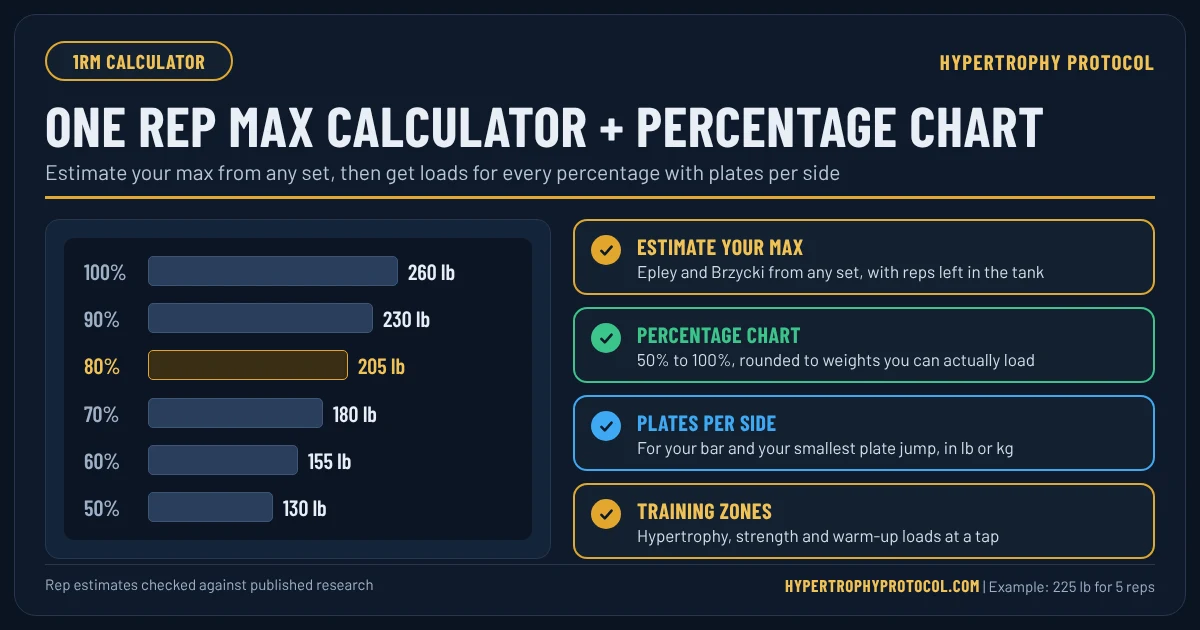
Enter a weight and the reps you got to estimate your one rep max, then use the chart to pick loads for any percentage, with plates per side.
| % of max | Load | Plates per side | Typical reps |
|---|
Loads are rounded to your smallest jump. Typical reps come from the classic strength coaching table; many people get more, especially at lighter loads, so treat them as a guide. For bar capacity and how many plates fit, use the plate calculator.
Last updated November 2026. Free to use, no sign-up. The research behind the rep chart was checked on PubMed on November 6, 2026.
This one rep max calculator estimates your 1RM from any set, then builds a percentage chart rounded to weights you can actually load, with the plates for each side of the bar. If you already know your max, switch to “I know my max” and use the chart to work out training weights fast, like 80% for sets of 8.
How the calculator estimates your one rep max
It uses two of the most common formulas and shows both, because they disagree more as reps go up:
- Epley: 1RM = weight x (1 + reps / 30)
- Brzycki: 1RM = weight x 36 / (37 minus reps)
The big number is the midpoint of the two, rounded to your smallest plate jump. For example, 225 lb for 5 reps gives 262.5 lb with Epley and 253.1 lb with Brzycki, so the calculator shows about 260 lb. No formula is exact for everyone, so treat the result as a starting point for picking training weights, not a guarantee of what you can lift.
Estimates are best from heavy sets of about 3 to 6 reps. Above about 10 reps the two formulas spread apart and people differ more, so the calculator warns you.
Reps left in the tank
Most calculators assume you went to true failure. If you stopped with reps to spare, set “Reps left in the tank” and the calculator adds them to the reps you did. So 5 reps with 2 left counts as a 7 rep max. This follows the reps in reserve scale used in strength research, where an effort of 9 out of 10 means 1 rep left and 10 means none (Zourdos et al., 2016). Guessing reps left takes practice, so this makes the estimate less certain, and the calculator says so.
One rep max percentage chart
This is the classic strength coaching chart the calculator uses for the typical reps column. Use it to pick a weight for a target number of reps, or the reverse.
| % of 1RM | Typical reps | Example: 300 lb max |
|---|---|---|
| 100% | 1 | 300 lb |
| 95% | 2 | 285 lb |
| 90% | about 4 | 270 lb |
| 85% | about 6 | 255 lb |
| 80% | about 8 | 240 lb |
| 75% | about 10 | 225 lb |
| 70% | about 11 | 210 lb |
| 65% | about 15 | 195 lb |
A 2023 review pooled 269 studies and more than 7,000 people who did as many reps as they could at set percentages of their max (Nuzzo et al., 2023). On average, people got more reps than the classic chart at lighter loads: about 5 reps at 90% and about 15 at 70%, compared with 4 and 11 in the classic chart. People also varied a lot: the typical spread around the average was about 2.5 reps at 80% and about 4.4 reps at 60%. Sex, age and training experience made little clear difference.
Bench press, squat and deadlift
- Bench press: the review found about 9 reps at 80% and about 14 at 70%, close to the classic chart at heavier loads.
- Squat and deadlift: there wasn’t enough data for separate tables, so the general results apply: expect a few more reps than the chart at lighter loads.
- Leg press: people got far more reps, about 13 at 80% and 19 at 70%. The calculator shows a note when you pick it.
To load any number from the chart, the calculator lists plates per side for your bar. For bar capacity and how many plates fit on the sleeve, use our plate calculator.
3 rep max and 5 rep max to 1RM
Quick conversions from the two formulas:
- 3 rep max: your 1RM is about 1.06 to 1.10 times the weight. A 3 rep max of 250 lb works out to about 265 to 275 lb.
- 5 rep max: your 1RM is about 1.13 to 1.17 times the weight. A 5 rep max of 225 lb works out to about 253 to 263 lb.
Pick “Estimate from a set”, enter the weight and 3 or 5 reps, and the calculator does this for you.
Using percentages for muscle growth
For building muscle, the load matters less than effort. A review of 21 studies where every set went to failure found similar muscle growth with light loads (60% of max or less) and heavy loads, while heavy loads built more maximal strength (Schoenfeld et al., 2017). Most lifters do well with loads around 60% to 80% for sets of about 6 to 15, taken close to failure. The Hypertrophy button in the chart shows that range. Our guide to the best rep range for hypertrophy goes deeper, and the weekly sets planner helps you set volume.
As you get stronger, update your max every few weeks so the percentages stay accurate. Our guide to progressive overload in a small home gym covers small jumps when you only have a few plates.
Should you test a true 1RM at home?
You don’t need to. An estimate from a hard set of 3 to 6 reps is accurate enough for setting training weights and is much safer when you train alone. If you do test a true max, do it inside a power rack with the safeties set just below the bottom of the lift, or with a spotter. See our comparison of power rack safeties for what holds a missed rep best.
One rep max calculator FAQ
How accurate is a one rep max calculator?
It gives a good starting point from a heavy set of 3 to 6 reps, but your real max can be higher or lower. People with a lot of muscular endurance get more reps at a given percentage, so the formulas can overestimate their max.
Which 1RM formula is best?
No single formula wins for every lift and person. That’s why the calculator shows Epley and Brzycki side by side and uses the midpoint.
How do I find 80% of my 1RM?
Multiply your max by 0.8. For a 300 lb max that’s 240 lb. Tap 80% in the chart and it rounds to a weight you can load and lists the plates.
Does it work for machines and dumbbells?
Yes. Set the bar to “No bar” and the chart shows loads without plates. Use your machine’s own increments as the smallest jump where you can.
How often should I recalculate my max?
Every 4 to 8 weeks, or whenever your sets feel clearly easier at the same percentage.
Studies behind this calculator
| Study | Who | Main finding |
|---|---|---|
| Nuzzo 2023 | 269 studies, more than 7,000 people | Reps at each % of max, with wide differences between people; more reps on leg press than bench press |
| Zourdos 2016 | 29 lifters, squat | Reps in reserve scale: effort 10 = 0 reps left, 9 = 1 left |
| Schoenfeld 2017 | 21 studies, sets to failure | Similar muscle growth with light and heavy loads; heavy loads built more maximal strength |
Related: Plate calculator · Best rep range for hypertrophy · Weekly sets planner · Power rack safeties