
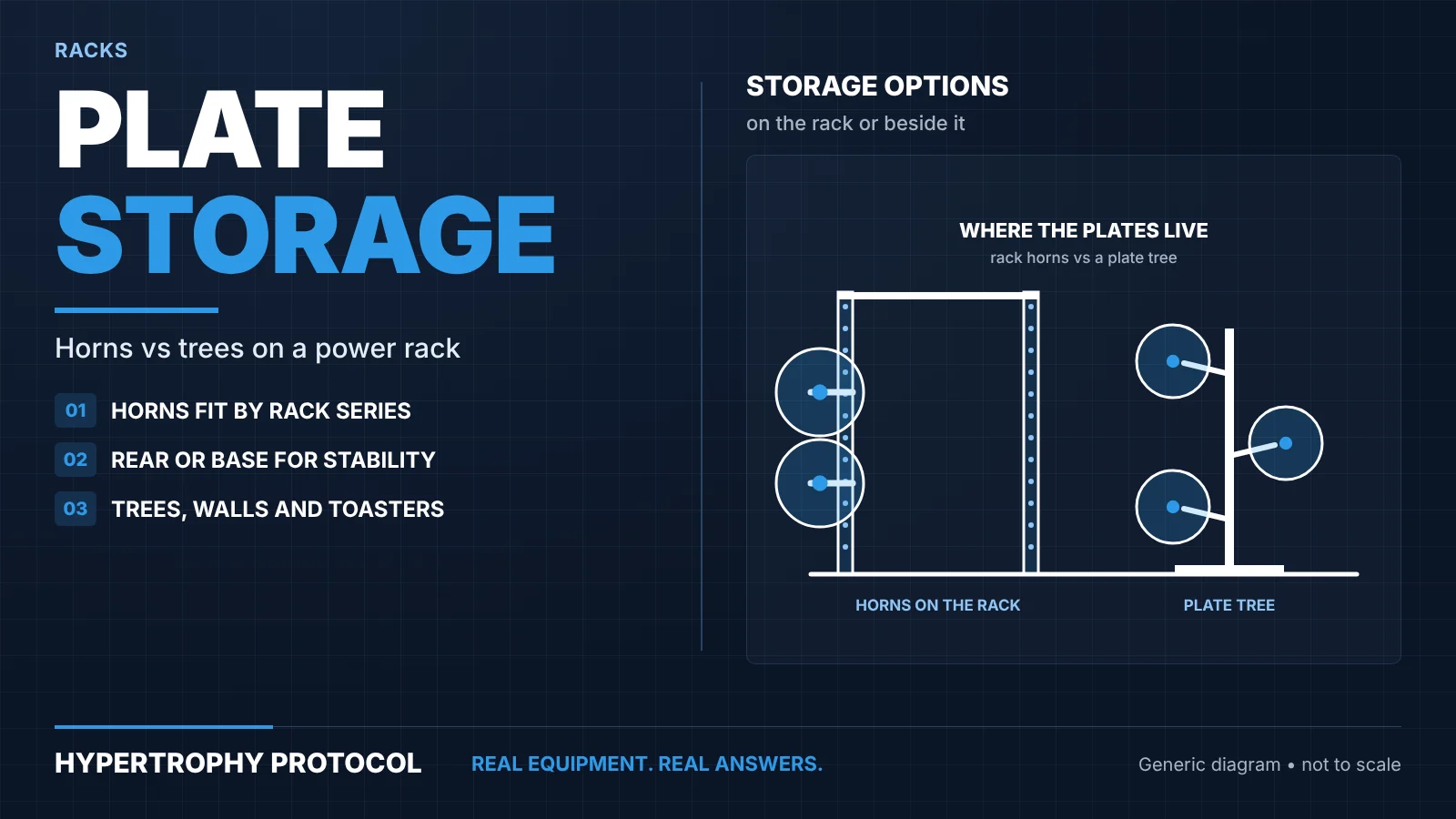
Your plates are stacked against the wall or leaning on the rack, and you want them stored without buying the wrong part. Power rack plate storage is the tidy pick when your rack maker sells horns for your exact series and those horns sit at the rear or on the base, where Rogue and REP both tie stored plates to added stability. If your rack can’t be bolted down or only takes horns on the front uprights, a plate tree or wall rack keeps that weight off the frame.
Bumper toasters are the fourth option, suited to a small bumper set you roll out of the way. Every spec and maker quote below was checked on September 28, 2026, on the maker’s own product page or support guide.
At a glance
| Option | Best for | Key spec | Main catch |
|---|---|---|---|
| Horns at the rear or on the base | Racks with rear storage uprights or a base built for horns | The placement Rogue and REP tie to added stability | Sold by rack series; buy your maker’s horns for your rack |
| Horns on the main uprights | Bolted racks | e.g. Titan T-3/X-3 holders: 11.5″ long, 330 lb per sleeve | No maker credits front horns with stability; they use attachment holes |
| Plate tree | Free-standing racks, or racks that only take front horns | Rogue 2.0: six 12″ posts, 26″ x 24″ base; Titan: 1,000 lb, casters | Costs floor space plus room to reach every post |
| Wall storage | Tight floors with solid studs | Titan 4-peg: 800 lb with stud and floor anchors | Must be installed exactly to the maker’s instructions |
| Bumper toaster | A small bumper set you roll away after training | Rogue 2.0: 310 lb, 15.25″ x 38.25″, wheels | Slots hold up to 11 bumpers, sized by weight |
Specs from the makers’ product pages and support guides, checked September 28, 2026. Confirm before ordering.
Which power rack plate storage fits your uprights and holes?
That short answer starts with fit, because each maker sells rack-mounted storage by rack series. Rogue splits its posts between Infinity, Monster Lite and Monster, REP between its 1000, 4000 and 5000 lines, and Titan between T-3, X-3 and TITAN Series. Bells of Steel is the one maker here that sells by upright size and hole diameter.
| Product | Type | Fits / mounting | Loadable length | Sleeve diameter | Published capacity | Source |
|---|---|---|---|---|---|---|
| Rogue Infinity Short Plate Storage Post Pair | Bolt-on post | 5/8″ Rogue Infinity, R-Series and S-Series (not S-1 or S-4); bolts 6″ on center | 5″ | Not published | 90 lb per post | Rogue |
| Rogue Infinity Vertical Plate Storage | Pin, no bolts | Detent pin; 2×3 Infinity uprights only | 13″ | Not published | 180 lb+ per single unit | Rogue |
| Rogue Monster Lite Short Plate Storage Post Pair | Bolt-on post | Monster Lite only; 5/8″ x 4.5″ hardware, 6″ on center | 5″ | Not published | 90 lb per post | Rogue |
| Rogue SP3358 Plate Storage Pair, Long | Bolt-on post | Monster Lite only (not SML-1, S-1 or S-4); 5/8″ hardware, 6″ on center | 12.5″ | Not published | 180 lb+ per post | Rogue |
| Rogue Monster Plate Storage Pin | Keyhole or keyless pin | Monster Series only; keyless version fits keyholes and standard 1″ holes | 6.75″ or 12.75″ | 1.9″ | 12.75″: 180 lb of bumpers, up to 540 lb of steel; 6.75″: 180 lb of steel | Rogue |
| REP Weight Horns, 1000 Series | Mounts like a J-cup, no hardware | REP 1000 Series racks | 8.9″ | 1.8″ | Three 45 lb bumpers or five 45 lb irons | REP |
| REP Weight Horns and Horn Sets, 4000 / 5000 and Apollo | Bolt-on horn | 4000: 5/8″ hardware; 5000 and Apollo: 1″ hardware | 4000: 5.1″ or 11.6″; 5000/Apollo: 4.6″ or 11.4″ | 1.8″ | Four 45 lb bumpers; seven or eight 45 lb irons (see below) | REP sets, REP horns |
| Titan Weight Plate Holders (T-3 and X-3) | Bolt-on holder, set of 4 | T-3 and X-3 Series; mounts 6″ on center | 11.5″ | 50 mm | 330 lb per sleeve | Titan |
| Titan Compact Weight Plate Holders | Bolt-on holder, pair | Front or back of a T-3, any upright on an X-3; 11/16″ holes; side of a T-3 needs extra hardware | 5″ | 48 mm | Not published | Titan |
| TITAN Series Weight Plate Holders | Bolt-on holder, pair | TITAN Series racks; mounts 4″ on center | 11.25″ | 50 mm | 330 lb per sleeve | Titan |
| Bells of Steel Pin Plate Pegs | Drop-in peg | 2.3×2.3 with 5/8″ holes; Hydra 3×3 with 5/8″ holes; Manticore 3×3 with 1″ holes | 9″ (2.3×2.3); 12.5″ (Hydra, Manticore) | Not published | Not published | Bells of Steel |
| Bells of Steel Utility Horn | Cotter-pin horn, uses one hole | Same three upright and hole options as the pegs | 12″ | Not published | 100 lb; 132 lb for Manticore | Bells of Steel |
| Rogue Vertical Plate Tree 2.0 | Plate tree | Bolt-together base; 26″ x 24″ x 50″ H; optional wheels | Six 12″ posts | 1.9″ OD | Not published | Rogue |
| Titan Portable Weight Plate and Barbell Storage Tree | Plate tree | 24.5″ x 24.5″ x 57.625″ H; locking casters; two barbell sleeves | Six 8.25″ posts | 50 mm | 1,000 lb | Titan |
| REP Wall Mounted Plate Storage | Wall mount | 16″ stud mount spacing | 8.25″ horns | Not published | Not published | REP |
| Titan Wall Mounted 4-Peg Olympic Bumper Plate Weight Rack | Wall mount | Wall stud and floor anchors; 74″ H, 10.5″ deep | Four 9.5″ pegs | 49 mm | 800 lb | Titan |
| Rogue Horizontal Plate Rack 2.0 | Bumper toaster | Wheels and handle; 15.25″ x 38.25″ footprint | Slots, not posts | Not applicable | 310 lb | Rogue |
Two gaps matter when you shop. Several makers publish no capacity or no sleeve diameter, and REP gives two different iron counts for its 4000 Series horns: eight 45 lb irons on the weight horns page and seven on the horn set page. Where a figure is missing or conflicts, plan on the lower one or ask the maker.
Length decides what a horn is for. REP’s PR-4000 FAQ puts its 12-inch horns to work on “larger iron plates (25# and up) or bumper plates” and its 6-inch horns on “smaller iron plates (10# or less) and change plates.” If you are unsure what your uprights measure, the power rack upright sizes guide and the 5/8 vs 1 inch hole guide show how to check both before you order.
Do loaded weight horns make your rack more stable?
Once a horn fits, the next question is what the plates on it do to the rack. Makers that address it tie stability to rear or base storage. Rogue’s HR-2 half rack guide puts it this way: “The rear uprights are specifically designed for plate storage, keeping your gym organized and adding ballast to the rack for even greater stability.”
REP makes the same point about its SR-4000 squat rack: “Long, flat-footed base removes the need to bolt down the rack, and it’s made extra stable with rear base weight horns and triangular reinforcements at the base of the uprights.” Rogue sells base storage for its squat stands with the line “It also adds stability to your rack for kipping pullups.”
None of those statements covers horns on the front uprights. The no-bolt statements also rest on a base designed for it. Rogue credits the HR-2’s “flat-foot base and additional rear weight” together, and REP’s Rear Base Stabilizer “even removes the need to bolt down your PR-4000 or PR-5000 with 41″ crossmembers (but not with shallower crossmembers, due to stability).”
Where a maker gives general advice, it leans toward bolting. Titan’s T-3 page reads “We recommend bolting down your rack for added stability,” and Rogue’s Monster Lite Stabilizer Kit page opens its advice with “We always recommend bolting a power rack to the ground.” REP’s PR-4000 FAQ recommends bolting “if you plan to use the front spotter arms without the front feet, or if you plan to use the pull-up bar for kipping movements.”
Some racks give you no bolting option at all. REP’s PR-1100 FAQ answers “No, you cannot bolt the PR-1100 Home Gym Power Rack down,” and adds that the PR-1000 ships with weight horns on its back base while the PR-1100 does not. On any rack, follow the maker’s guidance for your model.
Does it matter whether horns sit on the uprights or on rear extensions?
Those maker statements all point to the rear, and simple levers show why. A rack tips over one edge of its base. Plates stored inside that edge hold the rack down, while plates hung past it pull it over, and either effect grows with distance from the edge.
Illustration only: the same 180 lb of plates in two spots
180 lb is REP’s figure for four 45 lb bumpers on one 12-inch horn. The 12 and 6 inch distances are invented for the example; no maker checked here publishes tipping figures for any rack.
Rear storage uprights sit on a base the maker designed to carry stored plates, away from where you work the bar. That covers the weight storage uprights on REP’s 4000 and 5000 builds and the HR-2’s rear posts. Horns on the front uprights put the same plates on the edge nearest the bar path, which no maker quoted here credits with adding stability.
The same lever logic applies from side to side. Stripping one side’s horns while the other stays full moves the stored weight across the base, and no maker page checked here gives a loading order, so your rack’s manual is the authority.
When is a standalone plate tree the better choice?
If your rack has no rear spot for horns, or you would rather not load it at all, a tree moves the weight onto its own base. Rogue’s tree carries six 12-inch posts on a bolt-together base with triangle plates. Titan’s portable tree trades post length for two barbell sleeves and locking casters.
The cost is floor space, not rack stability. Each tree needs its full base footprint from the table plus room to reach every post, and a loaded tree sits on whatever surface you give it. The home gym flooring guide covers mats and platforms under heavy storage.
A tree also frees your uprights. Every hole a horn uses is a hole an attachment can’t, which matters most on a rack whose holes are already busy.
Are wall storage and bumper toasters worth the floor space they save?
A tree still needs floor, while wall storage takes the least floor of all and moves the load question to your wall. REP’s wall unit uses “traditional, 16″ stud mount spacing,” and REP ties its security to being “properly installed.” Titan’s four-peg rack uses “Dual anchor points in a wall stud and floor” for its 800 lb rating, so confirm where your studs are and what the wall is built from before you commit.
A bumper toaster is a low, rolling rack that holds bumpers on edge. Rogue’s version takes up to four 35 to 45 lb plates, four 15 to 25 lb plates and three 10 lb plates, rated at 310 lb, and rolls on wheels with a handle. It suits a bumper set you pull out to lift and park afterward.
Which plate storage should you choose for your rack?
Once you know where your rack can take weight, match your gym to one of these cases. Each points to a row in the table or to a freestanding option.
- Your rack has rear storage uprights or a base built for horns (an HR-2, an SR-4000, or a REP 4000 or 5000 build with storage uprights): put your plates there first. That is the placement Rogue and REP tie to stability.
- Your rack is bolted and only takes horns on the main uprights: buy your maker’s horns for your series and follow that maker’s bolting guidance.
- Your rack stands free or only takes horns on the front uprights: use a plate tree, and keep the rack for attachments.
- Floor space is the limit and you have solid studs: wall storage, installed exactly to the maker’s instructions.
- You own a bumper set and clear the floor after each session: a rolling toaster.
Whichever case fits, check your rack before you buy anything that mounts to it. Run it through the Rack Attachment Fit Checker to confirm your upright size and hole diameter, then match the result to a row in the table or move to a tree or wall rack if nothing fits.
Sources checked September 28, 2026. Manufacturers change specs; confirm on the product page before ordering.