
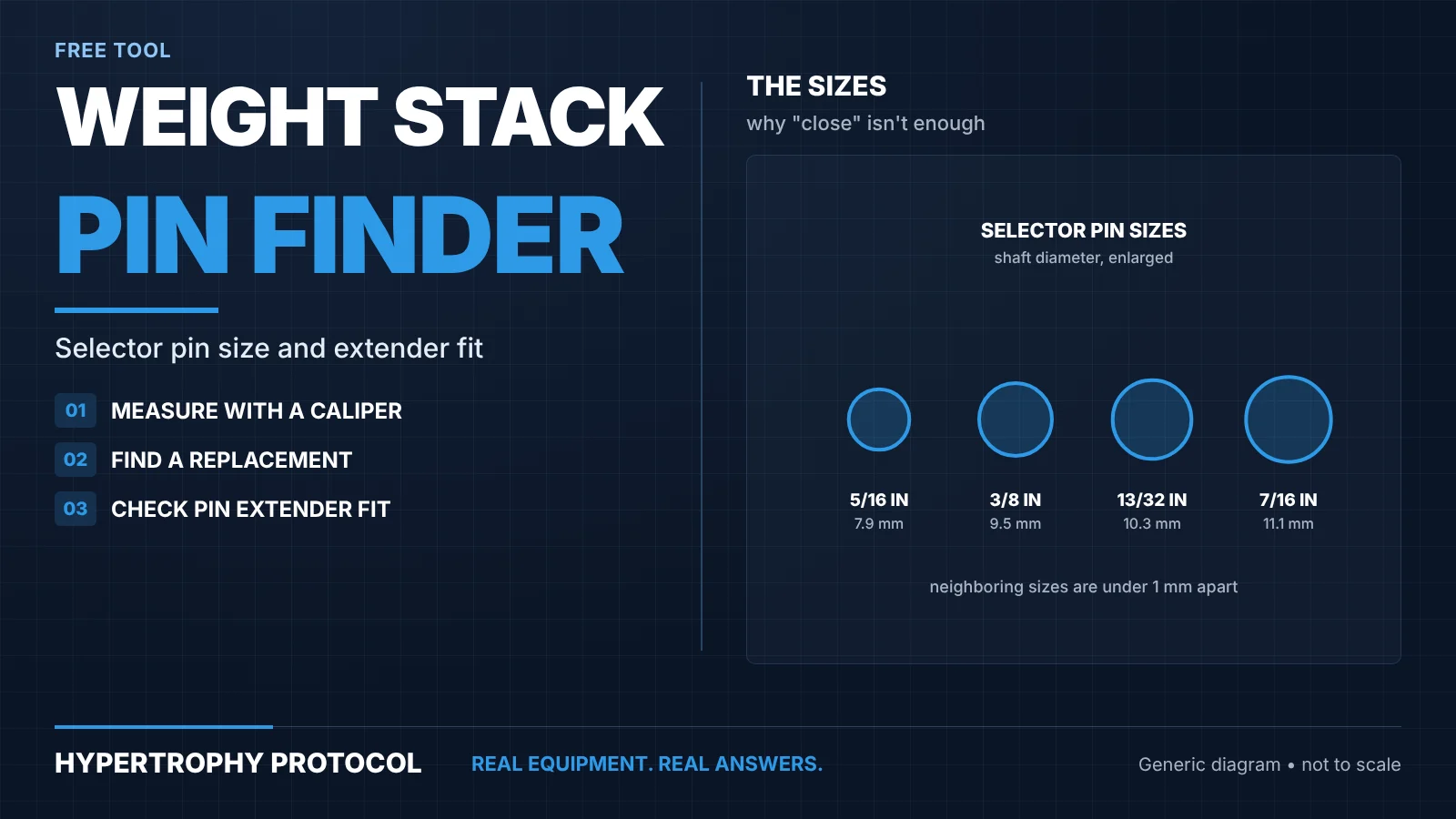
Measure your selector pin, and this finder tells you its standard size, what to search for when you replace it, and which pin extenders and add-on weights should fit.
Measure the round shaft of the selector pin, not the knob. A caliper reading like 0.373 or 9.48 is fine; the finder rounds to the nearest standard size.
The usable shaft length from under the knob to the tip. Match it when you buy a replacement.
| Product | Pin or rod size | Fit with your pin | Notes |
|---|
Fit is a rule of thumb from diameters alone: the stock pin’s size is what the stack was built for. Always test-fit by hand. A pin or rod should slide in smoothly and sit fully through the stem without forcing, and an extender adds load the machine’s maker may not allow. See our pin extender guide for load limits.
| Brand and line | Pin size listed | Locking space |
|---|
From replacement part listings and maker or seller notes checked November 7, 2026. One brand often uses several sizes across its lines and years, so measure your own pin before you order.
Last updated November 2026. Free to use, no sign-up. Pin sizes were checked against replacement part listings and maker or seller guides on November 7, 2026.
Weight stack pins look alike, but they come in several diameters, and the difference between them is often less than a millimeter. This finder turns your measurement into a standard size, tells you what to search for when you replace a pin, and checks which pin extenders and add-on weights list a matching size.
How to measure a weight stack pin
- Use a caliper on the shaft. Measure the round part that goes into the stack, not the knob, on a part of the shaft that isn’t worn.
- Measure the locking space too. That’s the usable shaft length from under the knob to the tip. A replacement needs at least the same length to pass fully through the stem.
- No caliper? Bare Steel Equipment suggests a quick check with a standard hexagonal #2 pencil, which is about 7 to 8 mm across (Bare Steel sizing guide). It’s a rough guide, not a measurement. Our printable measuring guide has pin circles for another rough check.
- Note the brand, model and serial number. The maker’s part number is the surest way to get the right replacement.
Standard weight stack pin sizes
Pins come in inch and metric sizes that are very close to each other, which is why the finder groups them into families:
| Size | In mm | Family | Where we’ve seen it |
|---|---|---|---|
| 5/16 in | 7.94 | 8 mm | Precor, Freemotion and Star Trac HumanSport pins in parts listings |
| 8 mm | 8.00 | 8 mm | Technogym, typically, per OFFSET’s guide |
| 3/8 in | 9.53 | 10 mm | Some Hammer Strength, Cybex, Matrix and ParaBody pins |
| 10 mm | 10.00 | 10 mm | Inspire FTX per Bare Steel; Force USA G6 per a GymPin review |
| 13/32 in | 10.32 | 10 mm | Cybex Classic and VR2 push-button pins |
| 7/16 in | 11.11 | 11 mm | Many Life Fitness pins, including Cable Motion |
A 5/16 inch pin and an 8 mm pin are only 0.06 mm apart, so they are effectively the same size. A 3/8 inch pin is about 0.5 mm thinner than 10 mm, which is enough to matter for a snug fit.
Sizes vary within one brand
Don’t assume one size per brand. In the parts listings we checked, Cybex sells a 3/8 inch pin for some models (Sportsmith) and a 13/32 inch push-button pin for Classic and VR2 (Sportsmith). Life Fitness sells 7/16 inch pins (Sportsmith) while some Hammer Strength machines use a 3/8 inch pin (Sportsmith). Lines, years and even individual machines differ, so measure the pin you actually have.
Replacing a weight stack pin
- Match the diameter exactly. A thinner pin sits loose in the stem; a thicker one won’t go in.
- Match or exceed the locking space so the pin passes all the way through the stem.
- Search by the maker’s part number first, then by size, for example “3/8 inch selector pin, 3 1/2 inch locking space”.
- Replace bent or cracked pins right away and don’t use a bolt or a screwdriver as a stand-in.
Pin extenders and add-on weights
Most pin extenders and increment pins come in 8 mm or 10 mm, so they suit the 8 mm and 10 mm families. A 7/16 inch pin is about 1.1 mm thicker than a 10 mm rod, so a 10 mm extender sits with more play than the stock pin in those stacks. Our weight stack pin extender guide covers each product’s load limits and what the machine makers say. Magnetic and top-plate add-ons skip the pin question entirely, and they are another way to make small jumps for progressive overload.
Remember that a pulley system changes how heavy the stack feels at the handle. The cable pulley ratio calculator works that out.
Weight stack pin FAQ
What size is a standard weight stack pin?
There isn’t one standard. The common sizes are 5/16 inch or 8 mm, 3/8 inch or 10 mm, 13/32 inch and 7/16 inch. Measure yours.
Are 3/8 inch and 10 mm pins the same?
Close, but not the same. 3/8 inch is 9.53 mm, about 0.5 mm thinner than 10 mm. A 10 mm rod may or may not slide into a stack built for a 3/8 inch pin, so test-fit it.
Will a GymPin fit my machine?
GymPin’s Original comes with an 8 mm or 10 mm end and the KingPin is 10 mm only. If your pin measures in the 8 mm or 10 mm family it should fit; on 7/16 inch stacks it will be loose. Also check that plates clear the frame when the stack rises.
Can I use any pin in a weight stack?
No. Use a selector pin of the right diameter and locking space. Bolts and makeshift pins aren’t made for the job.
Sources
- Sportsmith: Life Fitness 7/16 in selector pin
- Sportsmith: Hammer Strength 3/8 in weight pin
- Sportsmith: Cybex 3/8 in weight selector pin
- Sportsmith: Cybex Classic and VR2 13/32 in pin
- Sportsmith: ParaBody 3/8 in pin
- Sportsmith: Matrix 3/8 in selector pin
- Sportsmith: Precor 5/16 in pin
- Sportsmith: Freemotion 5/16 in pin
- Sportsmith: Star Trac HumanSport 5/16 in pin
- OFFSET: Gym machine pin size guide
- Bare Steel Equipment: Stacked weight pin sizing guide
- King of the Gym: GymPin review
Related: Weight stack pin extender guide · Cable pulley ratio calculator · Progressive overload in a small home gym