
Disclosure: As an Amazon Associate, Hypertrophy Protocol earns from qualifying purchases made through Amazon links on this page, which are marked affiliate. This article is general information, not medical advice.
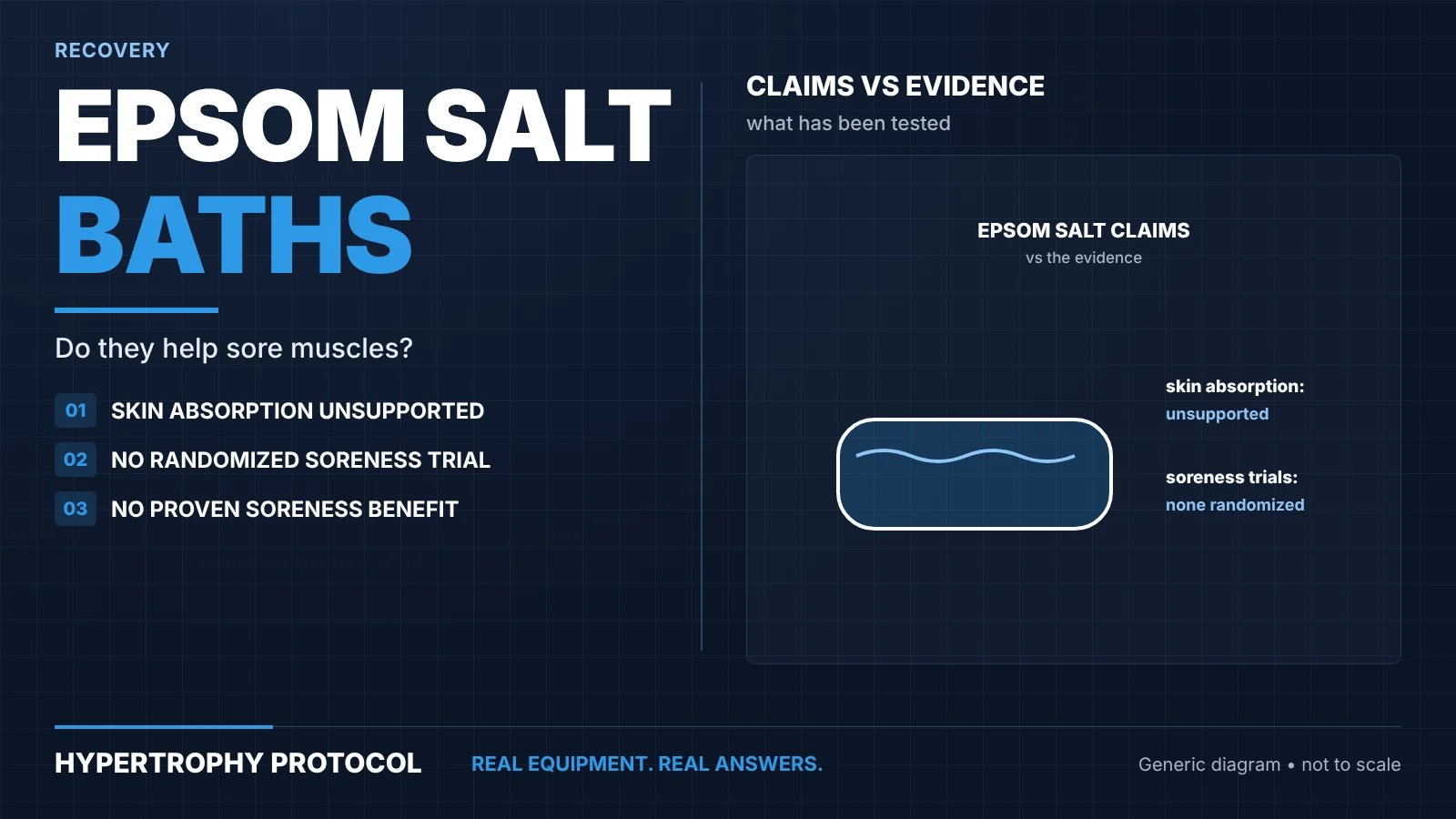
An Epsom salt bath is one of the oldest home remedies for sore muscles. The usual explanation is that magnesium from the salt soaks through your skin and relaxes your muscles. The research doesn’t back that up. There’s no good evidence that meaningful magnesium gets through the skin, and no trial has shown that adding Epsom salt to a bath reduces muscle soreness. A warm bath can still feel good after a hard session, and that’s a fine reason to take one. This guide covers what the studies show, how to use Epsom salt if you like it, and what actually helps sore muscles more.
Short answer
- Magnesium through the skin: a 2017 review called it scientifically unsupported. The only bath study often quoted was small, uncontrolled and never published in a journal.
- Soreness: no randomized trial has tested an Epsom salt bath for muscle soreness. The closest studies, an Epsom flotation tank and a magnesium gel, found no difference in soreness or strength.
- Warm water itself: pooled studies of warm or thermoneutral water found no clear effect on soreness, unlike cold water.
- Still worth it? If a warm bath helps you relax, enjoy it. Just don’t expect the salt to speed up recovery.
- Never drink Epsom salt unless a doctor tells you to. It’s a strong laxative, and an overdose can be dangerous.
What is Epsom salt?
Epsom salt is magnesium sulfate, a mineral compound that dissolves in water. It isn’t the same as table salt. Pharmacies sell it as a bath soak and, in a separate grade, as a laxative to take by mouth. Bath products are for external use only. A “USP” label describes purity; it doesn’t mean a bath product is safe to swallow.
Does magnesium absorb through your skin?
Probably not in any meaningful amount. A 2017 review by Gröber and colleagues concluded that transdermal magnesium is “scientifically unsupported.” The outer layer of skin is designed to keep water and dissolved minerals out, and magnesium ions are poor at crossing it. The review describes a study where people sat in magnesium-rich spa water for two hours with no change in blood magnesium, and a trial of a magnesium sulfate lotion that didn’t raise blood levels more than a placebo.
The study most often quoted in favour of Epsom baths was a pilot at the University of Birmingham around 2004. Nineteen people took hot Epsom baths daily for a week, and their blood magnesium rose. But it had no control group, was never published in a peer-reviewed journal and was released by an industry group. The 2017 review described its quality as questionable.
A 2017 trial of a magnesium cream found blood magnesium rose slightly more than with a placebo cream, but the difference wasn’t statistically significant overall. That was a cream used daily for two weeks, not a 20-minute bath.
Do Epsom salt baths help sore muscles?
There’s no direct evidence that they do. No randomized trial has compared an Epsom salt bath with a plain bath for muscle soreness after exercise. The nearest studies:
- Epsom flotation tank: in a 2013 crossover study (Morgan and colleagues), 24 people spent an hour floating in a tank of Epsom salt water after exercise or sat quietly instead. Muscle soreness and strength recovery were no different. Blood lactate and perceived pain were lower after floating.
- Magnesium gel: in a 2025 double-blind trial (Coates and colleagues), 35 active people used a topical magnesium gel or a placebo gel around a downhill run designed to cause muscle damage. There was no difference in soreness, muscle damage markers or strength.
- Hot bath with or without salt: a 2022 study of mixed martial arts athletes found adding Epsom salt to a hot bath made no difference to how much fluid they lost. It wasn’t a recovery study, but it’s another case where the salt added nothing measurable.
Does a warm bath help on its own?
Not much, as far as studies can tell. A 2024 network meta-analysis of 57 trials (Chen and colleagues) found warm or thermoneutral water immersion had no clear effect on muscle soreness or muscle damage markers, while cold water reduced both. Only seven of those trials tested warm water, so the evidence is thin.
That doesn’t make a warm bath pointless. It’s relaxing, and if it helps you unwind and sleep, that’s useful in its own right. If you want relief that’s better supported, see our guide to DOMS and what actually helps sore muscles. Massage, compression garments and light exercise have the most evidence.
How to take an Epsom salt bath
If you enjoy them, there’s little harm in Epsom baths for most healthy people.
- Amount: most product labels suggest about 1 to 2 cups in a standard bathtub. Guidance varies, and more doesn’t do more.
- Temperature: warm, not scalding. Harvard Health suggests about 100°F to 105°F is reasonable for most people. If you have diabetes, keep it at or below 104°F and test the water with a thermometer or your elbow, not your feet.
- Time: 10 to 20 minutes is plenty. Drink some water, and stand up slowly when you get out.
- Unscented is fine. Fragrances and essential oils add cost and can irritate sensitive skin.
Who should be careful
- Don’t drink it. Oral magnesium sulfate is a laxative, and the University of Michigan Health notes that an overdose can be fatal. If someone swallows a large amount, call Poison Help at 1-800-222-1222.
- Diabetes and nerve damage: reduced feeling in your feet can hide a burn. Check the temperature with your hand or a thermometer.
- Blood pressure and heart conditions: hot water widens blood vessels and can lower blood pressure, so people with low blood pressure, unstable angina or poorly controlled high blood pressure should check with a doctor first.
- Broken skin: skip the bath if you have open wounds, burns or a skin infection.
- Kidney disease: ask your doctor before using magnesium products of any kind.
Epsom salt or magnesium flakes?
Some brands sell magnesium chloride “bath flakes” as a better-absorbed alternative to Epsom salt. There’s no good evidence that either one raises magnesium levels from a bath, so the cheaper option is fine. If you’re trying to get more magnesium, food or an oral supplement works; see our guide to magnesium for sleep for forms and doses.
Epsom salt options
Prices were checked on Amazon on October 20, 2026, and change often. All of these are plain magnesium sulfate; we haven’t tested them.
| Product | Size | Price | Notes |
|---|---|---|---|
| Dr Teal’s Epsom Salt Soak, Fragrance Free (affiliate) | 4 lb | About $5 | Cheap and unscented. |
| Amazon Basics Epsom Salt Soak, Unscented (affiliate) | Bag | About $7 | USP-grade magnesium sulfate. |
| Epsoak Epsom Salt (affiliate) | 5 lb, resealable | About $18 | Resealable bag keeps it from clumping in a humid bathroom. |
The bottom line
Epsom salt baths are cheap and relaxing, but the idea that magnesium soaks through your skin and speeds up muscle recovery isn’t supported by good evidence, and no trial has shown they reduce soreness. Take one because it feels good, keep the water warm rather than hot, and never drink the salt. For recovery that’s better supported, focus on sleep, protein and sensible training volume, and see our guides to sauna after a workout and cold plunges.
Sources
- Gröber U, Werner T, Vormann J, Kisters K. Myth or reality – transdermal magnesium? Nutrients. 2017;9(8):813. doi:10.3390/nu9080813
- Kass L, Rosanoff A, Tanner A, Sullivan K, McAuley W, Plesset M. Effect of transdermal magnesium cream on serum and urinary magnesium levels in humans: a pilot study. PLoS One. 2017;12(4):e0174817. doi:10.1371/journal.pone.0174817
- Morgan PM, Salacinski AJ, Stults-Kolehmainen MA. The acute effects of flotation restricted environmental stimulation technique on recovery from maximal eccentric exercise. J Strength Cond Res. 2013;27(12):3467-3474. doi:10.1519/JSC.0b013e31828f277e
- Coates AM, Patel DV, Binet ER, Gibala MJ. No effect of topical application of a commercial magnesium gel on exercise recovery in active individuals. Int J Sport Nutr Exerc Metab. 2025;35(5):416-423. doi:10.1123/ijsnem.2025-0034
- Connor J, Germaine M, Gibson C, Clarke P, Egan B. Effect of rapid weight loss incorporating hot salt water immersion on changes in body mass, blood markers, and indices of performance in male mixed martial arts athletes. Eur J Appl Physiol. 2022;122(10):2243-2257. doi:10.1007/s00421-022-05000-7
- Chen R, Ma X, Ma X, Cui C. The effects of hydrotherapy and cryotherapy on recovery from acute post-exercise induced muscle damage: a network meta-analysis. BMC Musculoskelet Disord. 2024;25(1):749. doi:10.1186/s12891-024-07315-2