
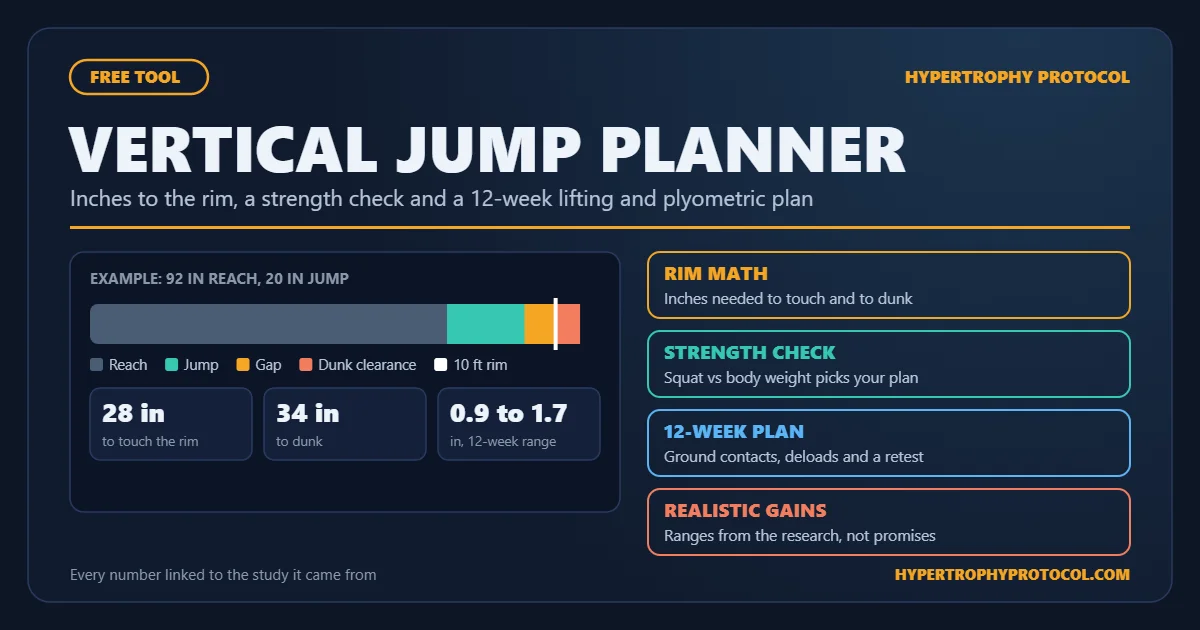
Enter your reach, jump and squat. The planner shows how many inches you need to touch or dunk on a 10 ft rim, whether to build strength first, a 12-week lifting and plyometric plan, and a realistic gain range from the research.
3. Inches to the rim
4. Strength check
5. Realistic 12-week gain Estimate
6. Your 12-week plan
7. Why this plan
- Plyometric training raised jump height in trained adults: countermovement jump SMD 0.69 (Sun et al., 2025).
- Programs longer than 10 weeks, with more than 20 sessions and more than 50 jumps per session, were the most likely to produce larger gains (de Villarreal et al., 2009).
- Deep front and back squats raised jump height; quarter squats did not (Hartmann et al., 2012). Full squats beat parallel and half squats for strength and functional results, including the countermovement jump (Pallarés et al., 2020).
- Olympic lift variations improved jump height more than control and regular lifting (Hackett et al., 2016; Zhang, 2026).
- Heavy lifting paired with jumps (complex training) added 2.50 cm (95% CI 0.85 to 4.10) of countermovement jump height over lifting alone (Zhao et al., 2026).
- Weaker lifters should build strength before emphasizing power (Suchomel et al., 2018).
Our programming choices, not research findings: the exact contact counts, box height, the 1.5x strength cutoff, deload timing and the dunk clearance. This is training information, not medical advice.
How to measure your reach and vertical jump at home
You need a wall, something to mark it with (chalk on your fingertips works) and a tape measure.
- Stand side-on to the wall with your feet flat. Reach straight up with the arm closest to the wall and mark the highest point your fingertips touch. That height is your standing reach.
- From the same spot, dip and jump as high as you can without a step, touching the wall at the top. Do three jumps with a full minute of rest between them.
- Measure your highest mark and subtract your standing reach. That number is your standing vertical jump.
Jump apps and jump mats estimate height from how long you are in the air, so their numbers can differ from a wall mark. Whatever you use, use the same method every time you retest.
How the planner builds your plan
The plan runs 12 weeks in three blocks. Block 1 builds a base with basic jumps and full-depth squats. Block 2 makes the squats heavier, adds an Olympic lift variation and raises the number of jumps. Block 3 pairs heavy squat sets with jumps (complex training) and adds low depth jumps. Weeks 4 and 8 are lighter deload weeks, and week 12 ends with a retest.
Ground contacts are the jumps and landings in a session. Every contact count in the plan comes from the sets and reps shown, so you can see exactly how much jumping you are doing. If your squat is under 1.5 times your body weight, the planner switches to a strength-first version with a 6-week first block and fewer jumps. That cutoff is our rule of thumb; the research says weaker lifters should build strength first but does not give a single number.
The upper-body days are optional. They keep your upper body growing while your legs get the jump work, and their weekly sets line up with the Weekly Sets Planner.
What the research says
The short version is below. For the full breakdown, see How to Jump Higher: What the Research Says.
- Plyometric training raises jump height. In a 2025 meta-analysis of 70 studies in trained adults, it improved countermovement jumps by a standardized mean difference of 0.69 (Sun et al., 2025).
- Longer programs did better. Programs of more than 10 weeks and more than 20 sessions, with more than 50 jumps per session, were the most likely to produce larger gains (de Villarreal et al., 2009).
- Squat deep. In a 10-week trial, deep front and back squats raised jump height while quarter squats did not (Hartmann et al., 2012).
- Combine lifting and jumping. Pairing heavy lifting with jumps added 2.50 cm (95% CI 0.85 to 4.10) of countermovement jump height over lifting alone (Zhao et al., 2026).
- Olympic lift variations help. In recreationally trained adults they added 2.21 to 2.54 cm more jump height than control, plyometrics alone or regular lifting over 6 to 10 weeks (Zhang, 2026).
Vertical Jump Planner FAQ
How many inches can I add in 12 weeks?
Studies of plyometric training found average gains of about 4.7% to 8.7% depending on the jump tested (Markovic, 2007). On a 20 in jump that is about 0.9 to 1.7 in. People new to jump training tend to land higher in the range; people who already train jumps tend to land lower. Treat it as an average, not a promise.
Should I jump before or after lifting?
Before. Jumps and Olympic lifts go first in each session, while you are fresh, then the heavy squat, then the muscle work. The exception is complex training in Block 3, where you do a heavy squat set and then jump after 60 to 90 seconds of rest.
Do I need depth jumps?
No. They show up only in Block 3, from a low box, and only if the first two blocks went fine with no pain. Regular jumps already work well, and the planner swaps depth jumps out if you have no box or report pain.
Will building muscle hurt my vertical?
No trial has tested a muscle-building block on its own against jump height, so this is our take: it should not hurt as long as the heavy, fast and jump work stays in your program and body fat stays in check. Muscle work by itself is a weak jump stimulus, which is why the plan pairs it with jumps and heavy squats instead of replacing them.
How much clearance do I need above the rim to dunk?
There is no measured standard. It depends mostly on hand size and grip. The planner starts at 6 in as a rough rule of thumb and lets you change it.
Sources checked against PubMed on November 10, 2026. This page is training information, not medical advice. If you have pain or an injury, see a clinician before starting jump training.