Skip to content
Hypertrophy Protocol
  • Lifting Protocols
  • Recovery Protocols
  • Glute Protocols
  • Tools
    • Home Gym
      • Rack Attachment Fit Checker
      • Bulletproof Attachment Checker
      • Power Rack Comparison
      • Upright Stiffness Calculator
      • Home Gym Room Planner
      • Flooring Calculator
      • Squat Machine Finder
      • Plate Calculator
    • Hypertrophy
      • Weekly Sets Planner
      • Cable Pulley Ratio Calculator
      • VOLTRA Setup Guide
    • Recovery
      • Garage Sauna Cost Calculator
    • Nutrition
      • Protein Calculator
    • All tools
  • About
    • Contact
    • Affiliate Disclosure
    • Brands We Work With
    • Privacy Policy

Anthony

Anthony writes Hypertrophy Protocol from his garage gym on the Southern California coast, built around a Rogue Monster Lite rack, Bulletproof Fitness cable and lever systems, and a Beyond Power Voltra 1. He covers rack attachments, cable machines, and home hypertrophy training: what fits which rack, what the research actually shows, and where the evidence is weak. Every guide says whether it comes from his own use or from manufacturer specs and published studies, and posts are corrected when he finds an error.

Cable Pulley Ratios Explained: 1:1 vs 2:1 Systems

November 1, 2026May 16, 2026 by Anthony
Cable Pulley Ratios Explained: 1:1 vs 2:1 Systems: key numbers graphic

On a 1:1 cable the handle feels roughly what the stack says; on a 2:1 it feels about half, with twice the cable travel. How each ratio changes load ceiling, progression steps and which suits your training.

Categories Lifting Protocols

Plate-Loaded vs Weight Stack Cable Machines: Which Is Better?

October 30, 2026May 14, 2026 by Anthony
Plate-Loaded vs Weight Stack Cable Machines: Which Is Better?: key numbers graphic

Neither plate-loaded nor weight stack cable machines are better across the board. See where each wins, and why pulley ratio and resistance curve matter more than the loading type.

Categories Lifting Protocols

How to Prevent Rust on Home Gym Equipment (Coastal Guide)

November 1, 2026May 13, 2026 by Anthony
How to Prevent Rust on Home Gym Equipment (Coastal Guide): key numbers graphic

Rust comes down to moisture and salt. Learn which finishes hold up in humid and coastal gyms, how to control humidity and condensation, and a maintenance routine that fits real life.

Categories Lifting Protocols

Power Rack Hole Size: 5/8 vs 1 Inch Hardware Compatibility

November 1, 2026May 9, 2026 by Anthony
Power Rack Hole Size: 5/8 vs 1 Inch Hardware Compatibility: key numbers graphic

Hole size decides which attachments fit your rack, not how much weight it holds. See which racks use 5/8-inch or 1-inch hardware, why hole spacing matters, and when adapters make sense.

Categories Lifting Protocols

PEMF Therapy for Bodybuilders: Does it Actually Work?

October 30, 2026May 8, 2026 by Anthony
PEMF Therapy for Bodybuilders: Does it Actually Work?: key numbers graphic

The human research doesn’t yet justify buying a PEMF device to recover faster or add muscle. See what each small trial measured, where soreness eased, and who might still try it.

Categories Recovery Protocols

How to Set Up a Home Gym in a 10×10 Space

November 1, 2026May 7, 2026 by Anthony
How to Set Up a Home Gym in a 10x10 Space: key numbers graphic

A practical layout for a 10×10 home gym: which rack fits under your ceiling, how to split 100 square feet into three zones, vertical storage, and how to rearrange the room as your training changes.

Categories Lifting Protocols

Mechanical Tension and Muscle Growth: What Drives Hypertrophy

October 30, 2026May 6, 2026 by Anthony
Mechanical Tension and Muscle Growth: What Drives Hypertrophy: key numbers graphic

Mechanical tension is the best-supported primary driver of muscle growth. See what the evidence says about metabolic stress and muscle damage, and what it means for load, failure and volume.

Categories Lifting Protocols 1 Comment

11-Gauge vs 14-Gauge Steel Racks: Does It Matter?

November 1, 2026May 5, 2026 by Anthony
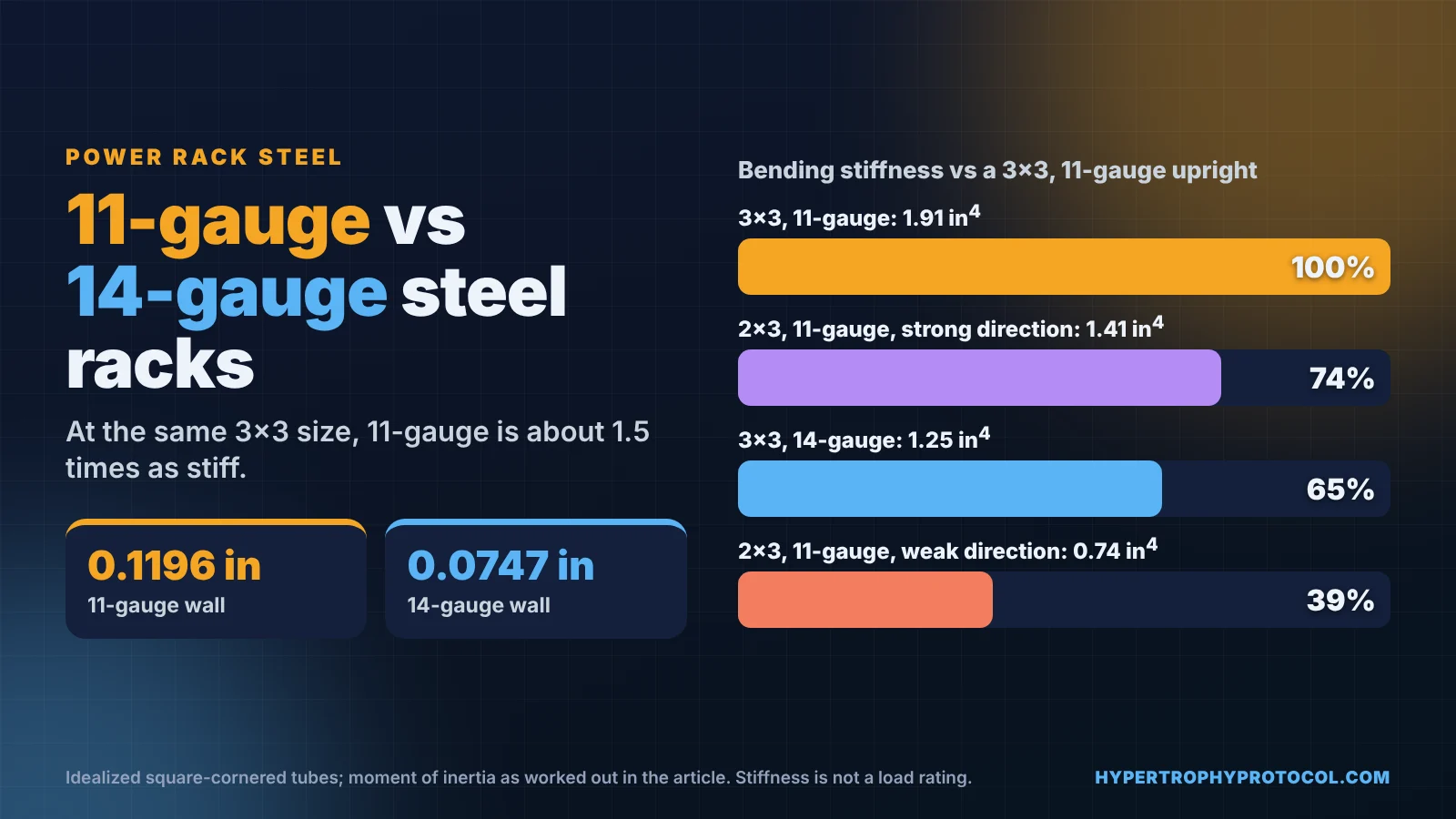
11-Gauge vs 14-Gauge Steel Racks: Does It Matter?: key numbers graphic

For heavy barbell training, gauge matters: at the same 3×3 size, 11-gauge uprights are about 1.5 times as stiff as 14-gauge. Learn why tube size matters as much and how to read spec sheets.

Categories Lifting Protocols

Why 3×3 Steel Racks Are the Standard for Serious Training

November 1, 2026May 4, 2026 by Anthony
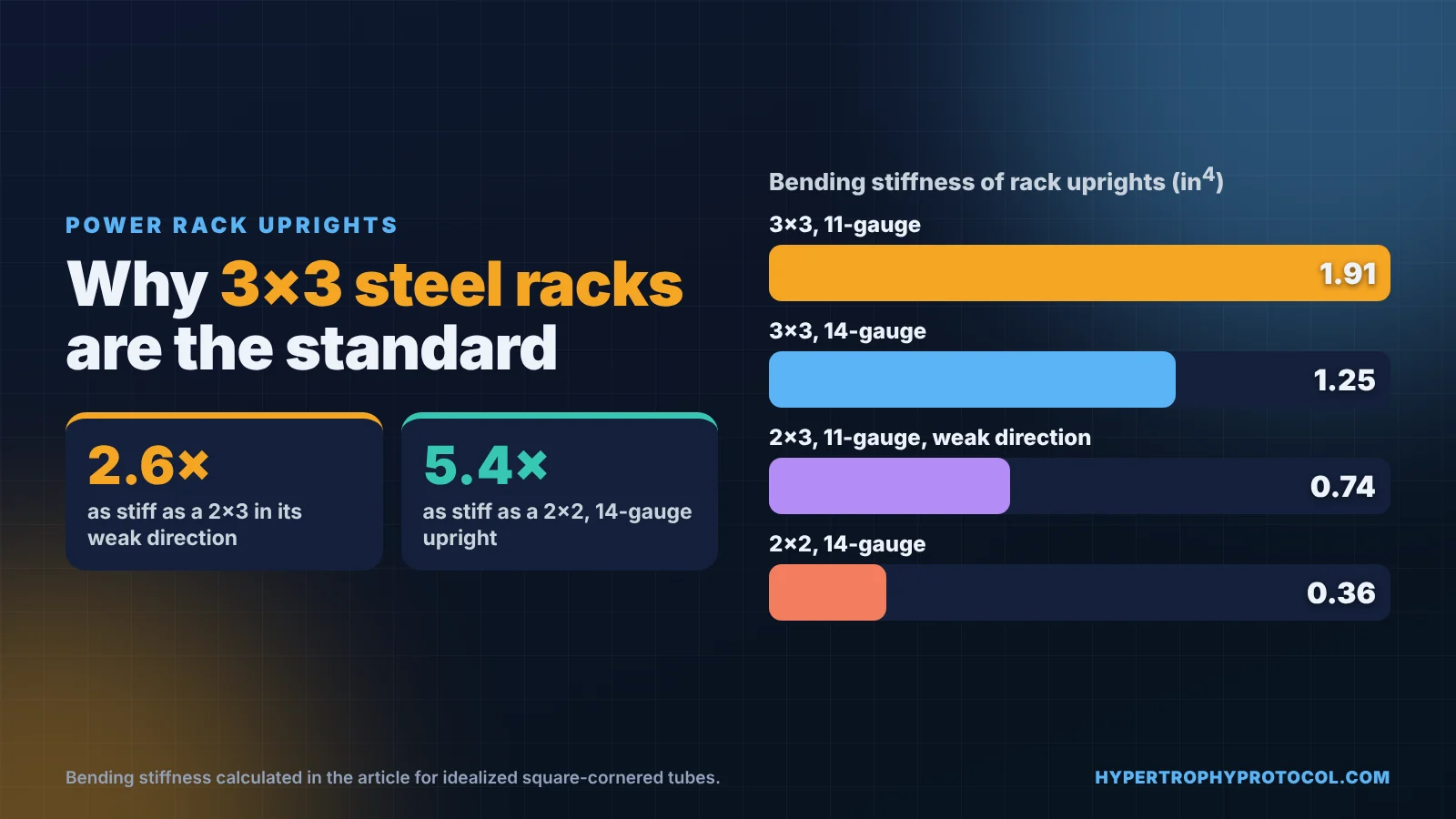
Why 3x3 Steel Racks Are the Standard for Serious Training: key numbers graphic

3×3 uprights became the standard for serious racks because they’re stiff in every direction and most attachments are built for them. See the stiffness math and what 3×3 doesn’t guarantee.

Categories Lifting Protocols
Newer posts
← Previous Page1 … Page8 Page9

Recent Posts

  • Landmine Attachment for Power Rack vs Standalone Base
  • Strength Training for Longevity: How Much Lifting Is Enough?
  • Belt Squat Machines: How to Choose One for a Home Gym
  • Eccentric Overload for Hypertrophy: Evidence & Home Options
  • Protein Powder Quality Explained: PDCAAS, DIAAS and Label Claims

Start Here: Tools

  • Rack Attachment Fit Checker
  • Power Rack Comparison Tool
  • Bulletproof Attachment Checker
  • Cable Pulley Ratio Calculator
  • Home Gym Room Planner
  • Plate Calculator
  • Protein Calculator
  • Squat Machine Finder
  • Weekly Sets Planner
  • Upright Stiffness Calculator
  • Flooring Calculator
  • Garage Sauna Cost Calculator
  • My Gym
  • All free tools
  • Contact
  • Pulley Calculator
  • Affiliate Disclosure
  • About Hypertrophy Protocol
  • Opt-out preferences
Follow Hypertrophy Protocol: Pinterest · TikTok · YouTube · Facebook · X
© 2026 Hypertrophy Protocol • Built with GeneratePress
Manage Consent
To provide the best experiences, we use technologies like cookies to store and/or access device information. Consenting to these technologies will allow us to process data such as browsing behavior or unique IDs on this site. Not consenting or withdrawing consent, may adversely affect certain features and functions.
Functional Always active
The technical storage or access is strictly necessary for the legitimate purpose of enabling the use of a specific service explicitly requested by the subscriber or user, or for the sole purpose of carrying out the transmission of a communication over an electronic communications network.
Preferences
The technical storage or access is necessary for the legitimate purpose of storing preferences that are not requested by the subscriber or user.
Statistics
The technical storage or access that is used exclusively for statistical purposes. The technical storage or access that is used exclusively for anonymous statistical purposes. Without a subpoena, voluntary compliance on the part of your Internet Service Provider, or additional records from a third party, information stored or retrieved for this purpose alone cannot usually be used to identify you.
Marketing
The technical storage or access is required to create user profiles to send advertising, or to track the user on a website or across several websites for similar marketing purposes.

  • Manage options
  • Manage services
  • Manage {vendor_count} vendors
  • Read more about these purposes
View preferences
  • {title}
  • {title}
  • {title}