
Belt squats are popular in home gyms because they load the legs through a belt at the hips instead of a bar on the back. The question here is narrower: are they a good glute exercise? The short answer is that they train the glutes, especially when you squat deep, but the research shows less glute activation than a back squat. They’re a back-friendly squat, not a glute isolation tool.
This guide covers what the research shows, how to set up a belt squat to get more glute work out of it, and where it fits in a glute program.
At a glance
| Verdict | A good squat for people who want to take load off the spine. For glutes, use full depth and pair it with a hip extension exercise. |
|---|---|
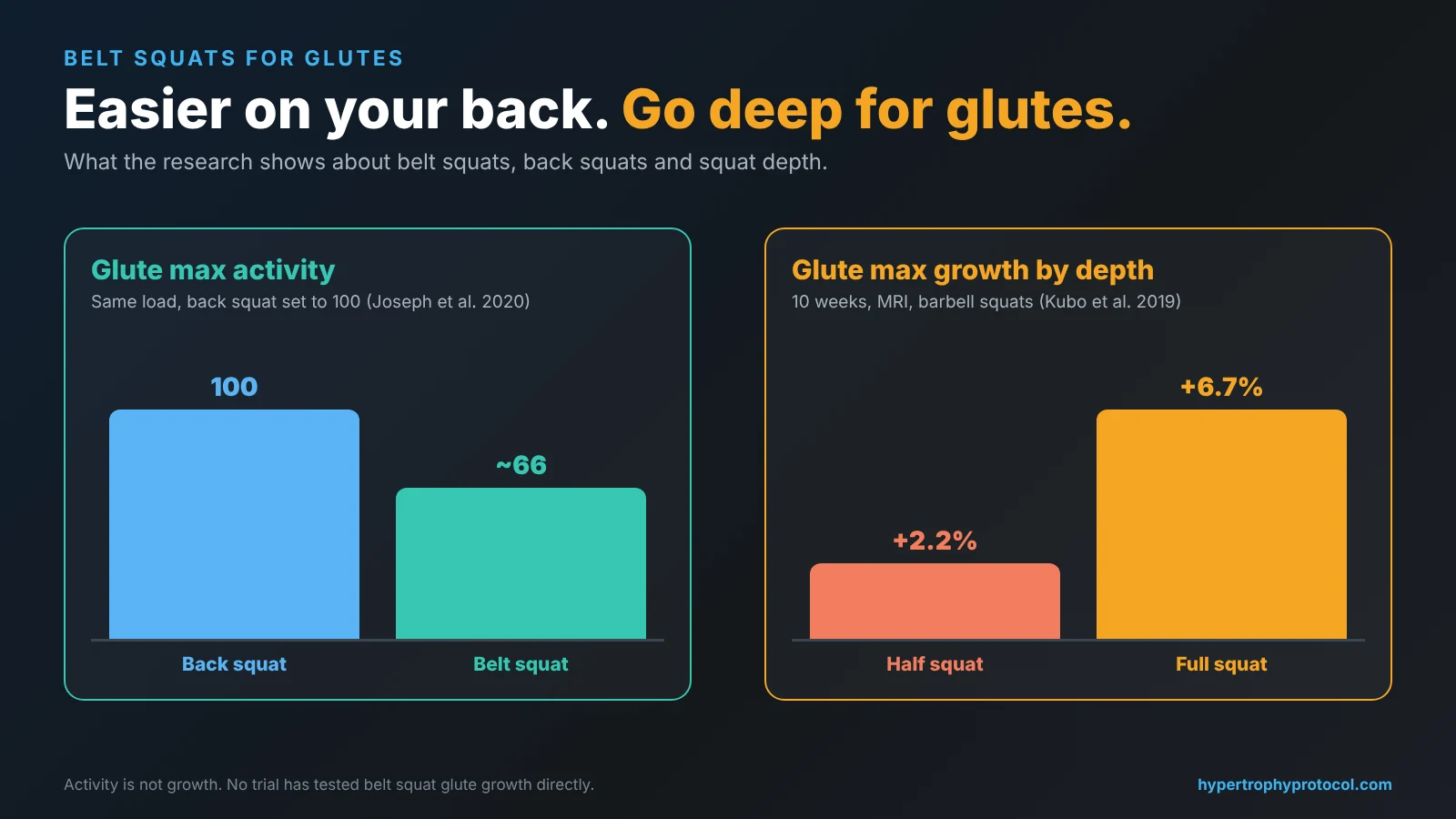
| Key numbers | One study found about 32 to 35% lower gluteus maximus activity than a back squat at the same load. A depth trial found full squats grew the glute max 6.7% vs 2.2% for half squats. |
| Evidence strength | Two small activation studies compare belt and back squats. No growth trial has tested the belt squat itself. |
| What to do | Squat as deep as you can control, use a slightly wider stance if it suits you, and keep hip thrusts or kickbacks in the program. |
| Main caveat | Activation is not growth. Lower activation suggests, but doesn’t prove, less glute growth than a back squat. |
Research checked October 29, 2026.
What the research shows

Belt squats vs back squats
Two studies compared the two directly:
- Joseph and colleagues (2020) tested 10 lifters who trained both lifts, at 100% of bodyweight for sets of 5. The belt squat cut lumbar erector activity about in half. Quad, hamstring and calf activity was similar, but gluteus maximus activity was about 32 to 35% lower and gluteus medius about 54 to 55% lower.
- Evans and colleagues (2019) tested 31 men and women at their 5-rep max on each lift. Gluteus maximus activity was again lower in the belt squat.
A systematic review by Neto and colleagues (2020) still listed the belt squat among exercises with very high glute max activation, above 60% of a maximal contraction. So the glutes are working hard, just less than in a back squat.
Depth matters most
The clearest growth data on squats and glutes is about depth. In a 10-week MRI trial by Kubo and colleagues (2019), full squats grew the gluteus maximus 6.7% and the adductors 6.2%. Half squats grew them only 2.2% and 2.7%. Quad growth was similar for both. That trial used barbell squats, but the lesson carries over: the glutes do most of their work in the bottom half of a squat, so a shallow belt squat gives up much of the glute benefit.
Squats in general are a solid glute builder. In the Plotkin 2023 trial, back squats grew the glutes about as much as hip thrusts. No trial has run the same test with belt squats.
How to set up a belt squat for more glute work
- Go deep. Squat as low as you can while keeping your pelvis from tucking under. This is the single biggest lever for glute work.
- Try a slightly wider stance with toes turned out. Many lifters find it lets them sit deeper between the hips. Use what feels strong and controlled.
- Stand on platforms if needed. Most belt squat setups need you raised so the plates or lever don’t hit the floor before you reach depth.
- Let the hips travel back a little. Being held by the belt makes it easy to stay very upright, which shifts work toward the quads. A small hip hinge adds glute involvement.
- Control the bottom. A short pause or slow descent keeps tension in the stretched position, where the research on training at long muscle lengths suggests growth may be favored.
Types of belt squat setups for home
- Dedicated belt squat machines: a lever or sled with a belt hook. These are the most stable and easiest to load, and they take the most floor space.
- Rack-mounted belt squat attachments: these use your rack’s uprights and a lever arm. Fit depends on your rack’s upright size and hole spacing.
- Dip belt and platforms: the cheapest option. You hang plates from a dip belt and stand on two boxes. It works, but it’s harder to load heavily and balance.
- Squat harnesses: a different tool. A harness changes how the bar sits on your upper body, but it doesn’t move the load to your hips the way a belt does. See our Squat Harness V4 review.
The squat machine finder matches squat machines to your back, rack and space. Types of squat machines compared explains how each loading style changes what your legs train.
Where belt squats fit in a glute program
- As your main squat, if your back limits barbell squats. Go deep and progress it like any squat.
- As a second squat after barbell squats, to add leg volume without more spinal loading.
- Not as your only glute exercise. Pair it with a hip extension movement like the hip thrust or cable kickback, plus some abduction. The small home gym glute setup shows how to cover each pattern.
Count belt squat sets toward both quads and glutes in your weekly total. The weekly sets planner keeps track.
Bottom line
Belt squats train the glutes, but less than back squats in the studies so far. Their real advantage is taking load off the spine and trunk. Squat deep, let the hips travel back a little, and pair belt squats with a hip extension exercise. Done that way, they’re a useful part of a glute program, just not the centerpiece.
Research checked October 29, 2026. This is general training information, not medical advice. If you have back pain, get assessed before choosing exercises around it.
Sources
- Joseph L, et al. Activity of trunk and lower extremity musculature: comparison between parallel back squats and belt squats. J Hum Kinet. 2020. doi:10.2478/hukin-2019-0126
- Evans TW, et al. Comparison of muscle activation between back squats and belt squats. J Strength Cond Res. 2019. doi:10.1519/JSC.0000000000002052
- Neto WK, et al. Gluteus maximus activation during common strength and hypertrophy exercises: a systematic review. J Sports Sci Med. 2020. PubMed 32132843
- Kubo K, Ikebukuro T, Yata H. Effects of squat training with different depths on lower limb muscle volumes. Eur J Appl Physiol. 2019. doi:10.1007/s00421-019-04181-y
- Plotkin DL, et al. Hip thrust and back squat training elicit similar gluteus muscle hypertrophy and transfer similarly to the deadlift. Front Physiol. 2023. doi:10.3389/fphys.2023.1279170