
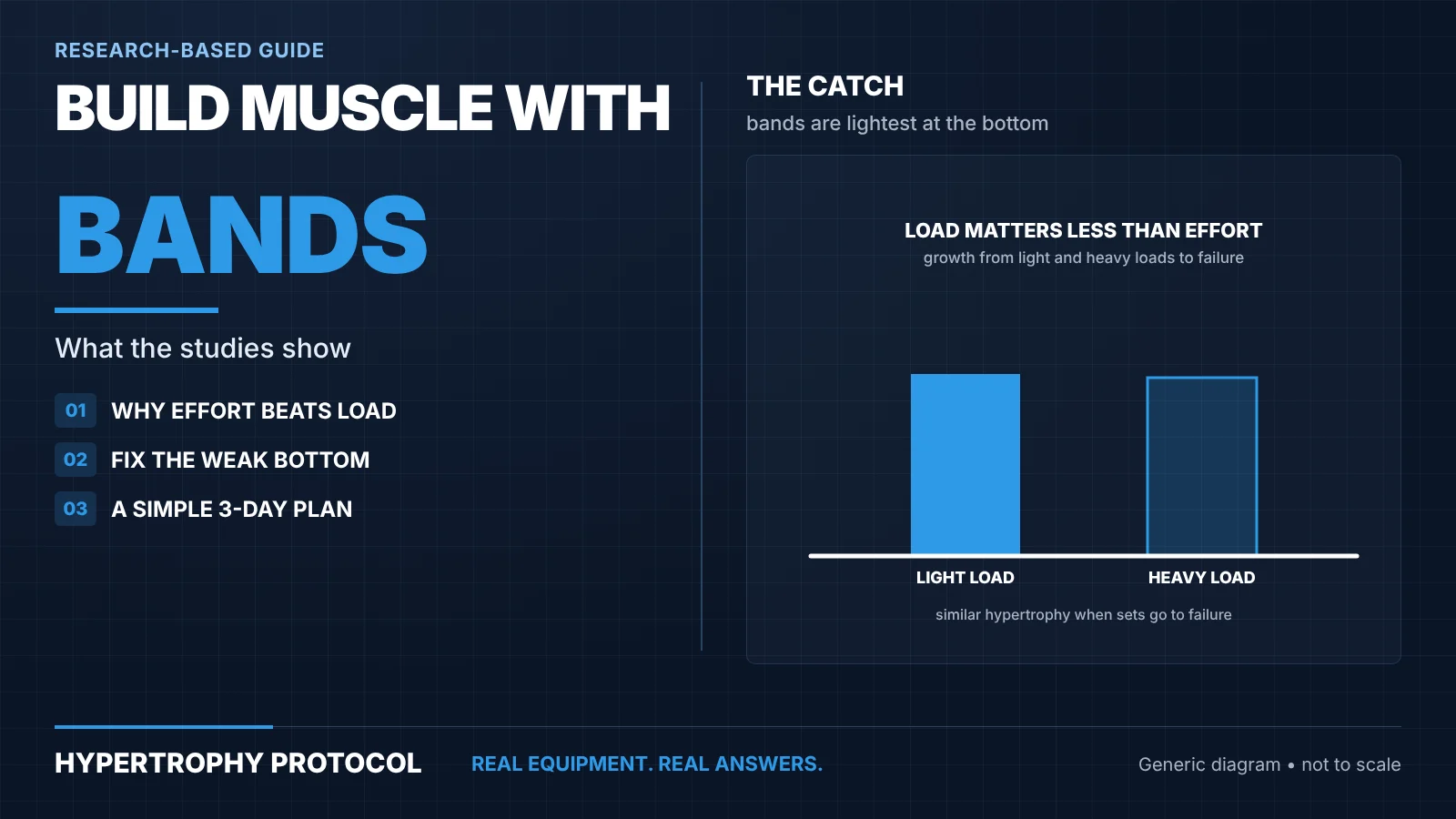
Yes, you can build muscle with resistance bands. The research on muscle growth points to effort more than to the kind of resistance: sets taken close to failure grow muscle across a wide range of loads. Bands have one real quirk, the pull is lightest where your muscle is most stretched, and the setup tips below fix most of it.
What the research says
- Load matters less than effort for growth. A meta-analysis of 21 studies found similar muscle growth from light loads (60% of max or less) and heavy loads when every set went to failure, while heavy loads built more maximal strength (Schoenfeld and others, 2017).
- Bands match weights for strength. A meta-analysis of eight studies comparing elastic bands and tubing with machines and dumbbells found neither was superior for strength gains (Lopes and others, 2019).
- Bands have grown muscle in trials. Adults aged 57 to 75 who trained twice a week with body weight and elastic bands for 12 weeks increased muscle thickness in the arms and thighs, with bigger gains in the fully supervised group (Ozaki and others, 2020).
- Pre-stretch closes the gap. Shortening elastic tubing by 30% before a knee extension gave muscle activation similar to a weight machine through the middle and end of the rep, though the machine was still higher at the start (Aboodarda and others, 2011).
Most band studies are in beginners and older adults, so there’s less direct evidence for trained lifters. The principle carries over: if a band set gets you close to failure in a sensible rep range, it’s a growth stimulus.
The catch: bands are lightest where muscles are longest
A band pulls harder the more it stretches, so the load peaks near lockout and drops off at the bottom of a squat, press or row, which is where the muscle is at its longest. Run your own setup through the band tension calculator and you’ll often see the top pull at several times the bottom pull. Ways to even it out:
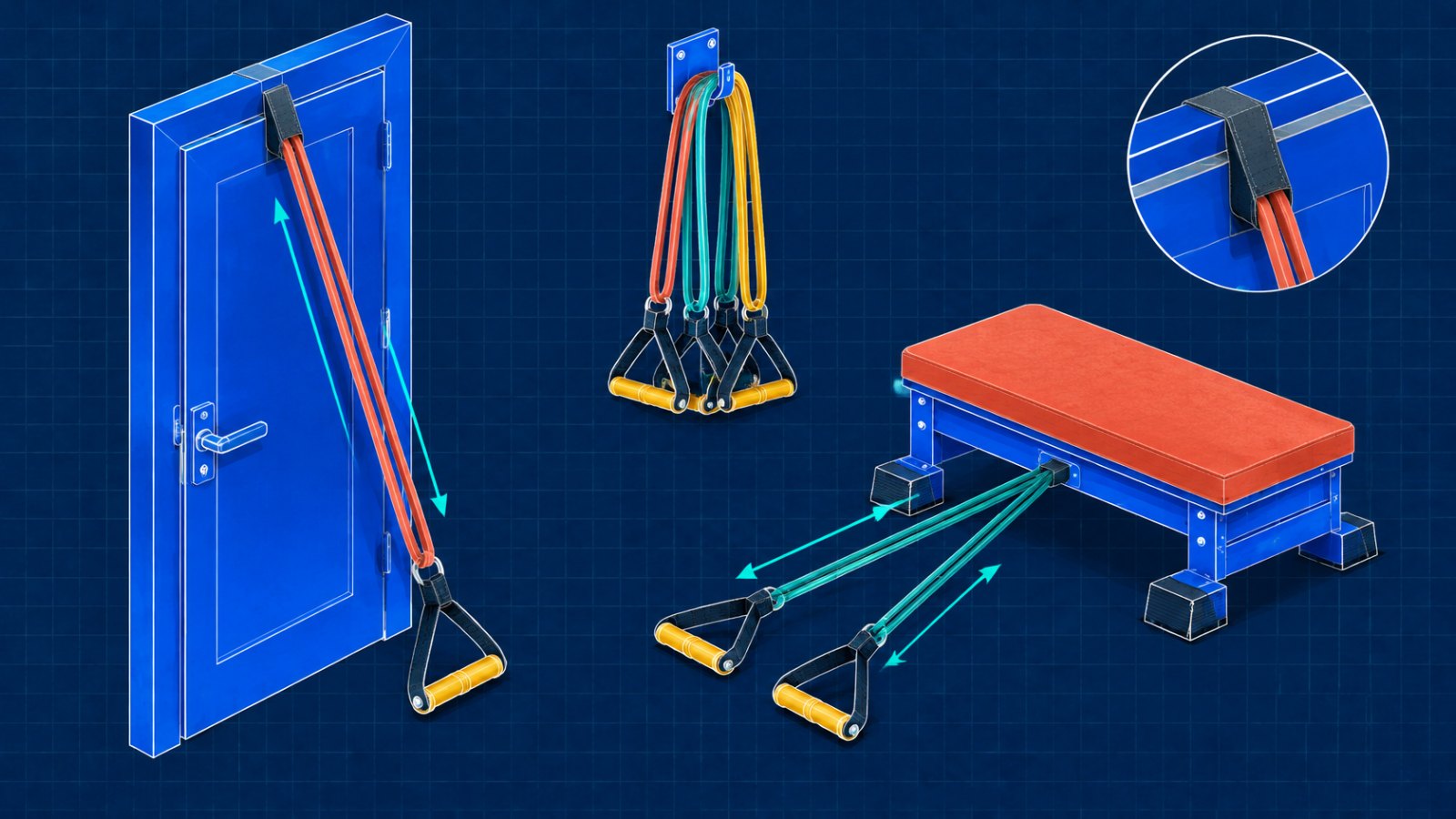
- Pre-stretch the band. Choke it around the anchor, step farther away, or anchor it lower so it’s already under tension at the start.
- Use two lighter bands instead of one heavy one, set up so both stay tight through the whole rep.
- Pause at the bottom. A one or two second pause in the stretched position keeps the muscle working where the band is weakest.
- Pick exercises whose hardest point matches the band. Pull-aparts, face pulls, lateral raises, triceps pushdowns and hip thrusts are hardest near the end of the rep, which suits bands well.
How strong a band do you need?
Choose a band that takes you within one to three reps of failure somewhere between about 8 and 30 reps. Colors aren’t standard between brands: a “medium” from one brand can be heavier than another’s “heavy”, and some makers rate bands at a set stretch while others give only a range. The resistance band database lists each brand’s material and how it rates its bands, so you can compare like with like.
| Muscle group | Typical band setup | Where it’s hardest |
|---|---|---|
| Legs | Heavy loop bands for squats, split squats, deadlifts | Near lockout |
| Back | Medium to heavy bands for rows, pulldowns, pull-aparts | Fully contracted |
| Chest | Medium bands for presses and flyes from a door or rack anchor | Arms extended |
| Shoulders | Light bands for lateral raises, face pulls | Top of the raise |
| Arms | Light to medium bands for curls and pushdowns | End of the rep |
How to progress with bands
Muscle grows when the work gets harder over time. With bands, you can add load without buying a heavier band right away. See progressive overload in a small home gym for more options.
- Add reps until you reach the top of your range, then make it harder.
- Increase the pre-stretch: choke the band shorter or stand farther from the anchor.
- Add a second band, or move up a band.
- Slow the lowering phase to three seconds, or add a pause at the bottom.
- Add sets. The weekly sets planner helps you spread sets across the week.
A simple three-day band program
Three full-body sessions a week, 2 to 4 sets per exercise, each set ending one to three reps short of failure. Rest about 1 to 2 minutes between sets.
| Day | Exercises |
|---|---|
| Day 1 | Banded squat, band row, band chest press, lateral raise, band curl |
| Day 2 | Banded Romanian deadlift, band pulldown or assisted pull-up, overhead press, face pull, triceps pushdown |
| Day 3 | Split squat with band, single-arm row, push-up with band across the back, pull-apart, hip thrust with band |
Adding bands to a barbell with band pegs
If you own a rack, bands don’t have to replace your barbell. Band pegs mounted low on the rack let you hook a band over each end of the bar, so squats, bench presses and rack pulls get heavier toward lockout, where you’re strongest.
- Put the pegs directly under the bar path so the bands pull straight down.
- Loop or choke the band over the peg, loop the top over the sleeve next to the plates, and lock a collar outside it.
- Use the same band and setup on both sides, and measure each band at the bottom and top in the band tension calculator.
The band pegs guide covers which pegs fit 5/8 inch and 1 inch rack holes, the full setup for squat, bench and deadlift, and what the research says about bands on a barbell.
Safety checks
- Check bands for nicks, thin spots and sticky or chalky patches before each session, and replace any that look worn.
- TheraBand’s instructions warn against stretching past three times the rest length.
- Anchor to something solid: a rack, a band peg or a door anchor on the hinge side of a closed door.
- If you have a latex allergy, choose TPE or fabric bands and check the listing, since some fabric bands have a latex core.
Building muscle with resistance bands FAQ
Can you build muscle with only resistance bands?
Yes. Studies show muscle growth with light and heavy loads alike when sets go close to failure, and band training has increased muscle thickness in trials. Pick bands that bring you near failure in about 8 to 30 reps and make them harder over time.
Are resistance bands as good as weights?
For strength, a meta-analysis found no clear winner between elastic bands and machines or dumbbells. Weights are easier to load precisely and heavier at the bottom of a lift, so many lifters combine both.
How many reps should I do with resistance bands?
Somewhere between about 8 and 30 reps, finishing each set one to three reps short of failure. If you can do far more than 30, move to a heavier band or add pre-stretch.
Which resistance bands are best for building muscle?
Layered latex loop bands cover the widest range, from light pull-aparts to heavy squats. TPE bands are the latex-free option but top out lighter, and fabric bands suit hip and glute work.
Related: Band tension calculator · Resistance band database · Weekly sets planner · Progressive overload in a small home gym