
Disclosure: As an Amazon Associate, Hypertrophy Protocol earns from qualifying purchases made through Amazon links on this page, which are marked affiliate.
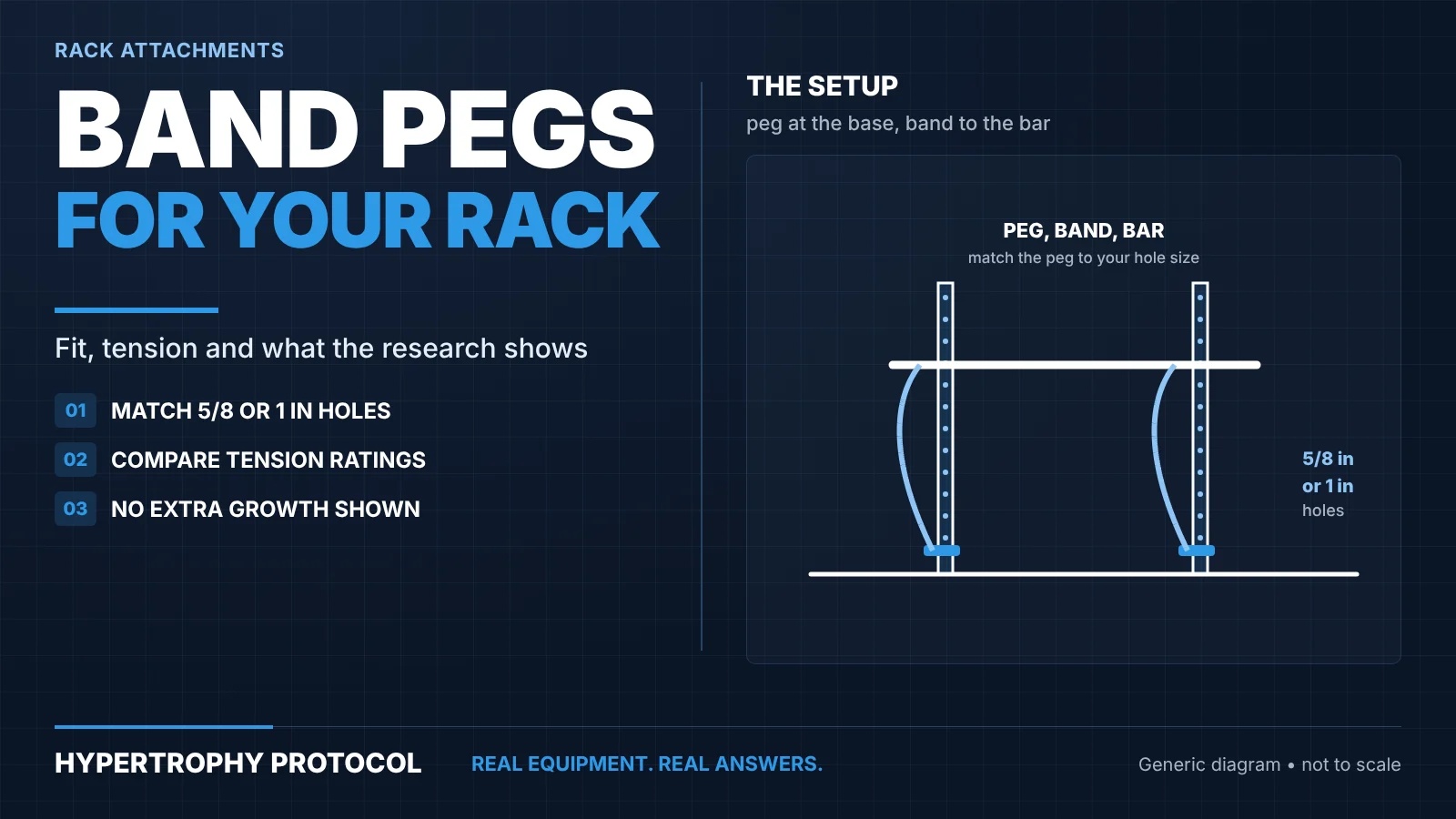
Most band pegs for power rack uprights are simple steel rods, so fit comes down to one match: peg diameter against your hole size. Pick the 5/8-inch or 1-inch version your maker sells for your series, and use a set of bands with published tension ratings. That is the setup if you already squat and bench in a rack and want bands pulling the bar down harder near lockout.
What bands do for your results is a separate question. The research on accommodating resistance is mostly about strength and power, and even there the meta-analyses disagree. The few trials that measured muscle size show no extra growth. Every maker page and study below was checked on September 28, 2026.
At a glance
| If you have or want | What to get | Main catch |
|---|---|---|
| 5/8-inch hole rack | Your maker’s 5/8-inch pegs (Rogue Monster Lite/Infinity, REP 4000, Titan T-3/X-3, Bells of Steel Hydra) | Rogue rules out its 1-inch Monster pegs on Monster Lite and Infinity |
| 1-inch hole rack | The 1-inch version (Rogue Monster, REP 5000, Bells of Steel Manticore) | Pick longer usable length if you plan to stack bands |
| Bands | One brand’s set with published tension ratings | Makers rate tension differently; compare bands within one brand |
| Strength goal | Bands have the most support here | Meta-analyses split on whether bands beat plain weights |
| Muscle size goal | Bands are optional | No trial here showed extra growth from bands |
Specs from the makers’ pages, checked September 28, 2026. Confirm before ordering.
Which band pegs for power rack uprights match your hole size?
Start with the hole, because that is the dimension every maker below sorts its pegs by. Rogue, REP and Bells of Steel sell separate 5/8-inch and 1-inch pegs, while the Titan pegs checked here come in 5/8-inch only. Rogue’s page also rules out its 1-inch Monster pegs on its Monster Lite, Infinity and Econ lines.
| Peg | Maker’s fit | Diameter | Length | How it stays in | Source |
|---|---|---|---|---|---|
| Rogue Monster Lite/Infinity Band Pegs (4) | Monster Lite and Infinity rigs and racks, wall mounts, Abrams GHD | 5/8″ | 10″ | Not given | Rogue |
| Rogue Monster Band Peg 2.0 (4) | Monster racks, rigs and wall mounts only | 1″ | 11″ overall; 7-3/8″ sticks out of a 3″ tube | Not given | Rogue |
| REP Band Pegs (4) | PR-4000, PR-5000, SR-4000, Omni, Apollo | 5/8″ (4000 Series); 1″ (5000 Series) | 8.6″ usable (4000); 12″ usable (5000) | T-shape holds it in place | REP |
| REP Band Pegs 2.0 (pair) | PR-4000, PR-5000, Omni, Apollo | Not published | 8.5″ end to end; 4.5″ usable past a welded washer | Cotter pin | REP |
| Titan Band Pegs (4) | T-3 and X-3 Series racks; not the Titan GHD | 5/8″ | 10″ T-shaped | Slides into any hole | Titan |
| Bells of Steel Standard Band Pegs | 5/8″ version: Hydra and 2.3 x 2.3 racks; 1″ version: Manticore | Sold by hole size | Not published | Not given | Bells of Steel |
| Bells of Steel Band Pegs with Carabiners (pair) | Same two hole-size versions | Sold by hole size | Not published | Stainless carabiners and collars | Bells of Steel |
REP is the only maker here that publishes both diameter and usable length for each hole size, and it adds that fit on non-REP racks cannot be guaranteed. Usable length matters if you double a thick band or stack two on one peg, and REP’s 2.0 design gives up length for a pinned, washer-backed peg.
Placement matters as much as fit. REP’s band peg guide tells you to keep the bands directly in the bar path so they do not pull you out of position. Before you load a band, check whether your rack needs anchoring: the guide to bolting a power rack to the floor covers the tools you need.
How to use band pegs: setup step by step
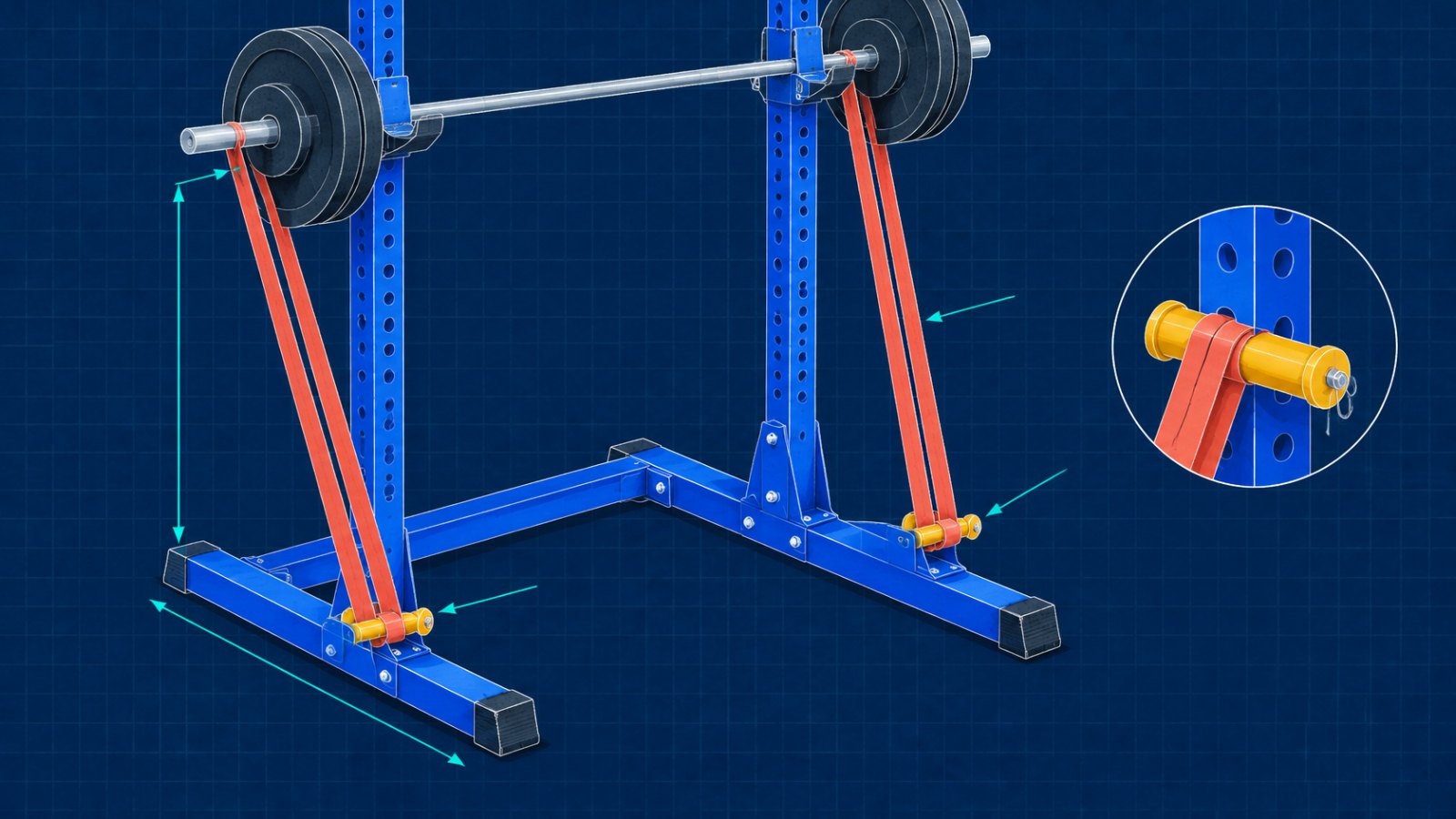
The setup is the same for squats, bench press and rack pulls: anchor a band low on each side, loop it over the bar and make both sides match. Here is the order that keeps it safe and even.
- Put the pegs directly under the bar path. Mount them in the base or the lowest upright holes, as close as you can to where the bar travels. A peg in front of or behind the bar pulls it forward or back as well as down.
- Seat and lock each peg. Push it all the way through the hole and fit its pin, bolt or nut as the maker intends, then pull on it by hand before you load a band.
- Anchor the band. Loop it over the peg, or choke it (pass one end around the peg and through the other end) to shorten it and add tension at the bottom.
- Loop the top over the sleeve. Put the band on the sleeve next to the plates and lock a collar outside it so it can’t slide off. Use the same band and the same spot on both sides.
- Set your safeties. Set spotter arms or straps just below the lowest point of the lift, the same as without bands.
- Check both sides. Measure the band length on each side at lockout. If one side is longer, move the peg or re-choke the band until they match.
- Start light and measure. Measure each band at the bottom and at lockout and put the numbers into the band tension calculator to see how much the bands add at each point. Many lifters start with bands as a modest share of the top load.
Squat, bench and deadlift setups
- Squat: bands from the base pegs to the sleeves. They add the most at lockout and the least in the hole.
- Bench press: same base pegs, bench centered between them. With the bar higher off the floor, a band that’s slack for squats can be tight for bench, so re-measure.
- Deadlift or rack pull: pegs in the base or a platform with band pegs, with the band pulling straight down over the bar. Short pulls need a short or choked band to have any tension at the floor.
- Reverse bands: hang the bands from the top of the rack instead. They help most at the bottom and least at lockout, the opposite of bands from the pegs.
Before each session, check bands for nicks or thin spots, and don’t stretch one past three times its rest length, which TheraBand’s instructions warn against. The resistance band database lists what each brand’s bands are made of and how they’re rated, and building muscle with resistance bands covers band-only training.
How much tension do the bands add?
Once the peg fits, the band sets the load, and makers rate bands in ways that do not line up. Rogue gives one number per band at a stated stretch, while REP and EliteFTS give ranges with no stated test method.
| Band set | Length | Published tension, lightest to heaviest | How it is rated | Source |
|---|---|---|---|---|
| Rogue Monster Bands (#0 to #7) | 41″ | 9, 18, 30, 40, 65, 95, 115, 225 lb | “Calculated at a 100% stretched length”; figures are “reasonable estimates” | Rogue |
| REP Resistance Bands 2.0 (XX-Light to XX-Heavy) | 41″ | 5-15, 5-35, 20-60, 30-80, 40-110, 60-150, 70-175 lb | Test method not given | REP |
| EliteFTS Pro Resistance Band Pack (Mini, Light, Average, Strong) | 41″ (single-band pages) | 10-35, 30-75, 50-120, 70-175 lb | Test method not given; the single Light band page shows 40-80 lb | EliteFTS |
Treat these numbers as a way to rank bands within one brand. A range tells you tension climbs as the band stretches, and the figure you feel depends on how far your peg sits below the bar and whether you double the band. Two bands with the same rating from different makers may not pull the same at your setup.
EliteFTS shows why caution pays. Its pack page and its single Light band page give different widths and tension ranges for what is sold as the same band, so confirm with the maker if an exact figure matters to your programming.
How does accommodating resistance change the strength curve?
That stretch-dependent tension is the whole point of accommodating resistance. Anchored below the bar, the band is slackest at the bottom of a squat or bench and tightest near lockout. REP’s band peg guide makes the same point: resistance is lower where the band is looser and higher where it is tighter.
Saeterbakken 2016: total squat resistance with bands, relative to free weight alone
In that squat study, the bar moved faster low in the rep with bands and slower near the top, yet muscle activity did not rise, and the authors suggested more band tension or chains. A follow-up in 19 trained women used bands supplying about 39% or 73% of the load and saw higher EMG in the upper range. EMG is a proxy for effort, not a measure of growth.
Do bands build more strength than plain weights?
A different curve within one set does not guarantee better gains over weeks of training. The pooled evidence tests that for strength and power, and the analyses do not agree.
| Study | Who | Outcome | Result (bands or chains vs constant load) |
|---|---|---|---|
| Lin 2022 (meta-analysis) | 14 studies, trained and untrained | Maximum strength | ES 0.80 (95% CI 0.42-1.19); trained 0.57 (0.22-0.93); untrained 1.34 (0.28-2.40) |
| Andersen 2022 (meta-analysis) | 17 studies, 491 healthy adults aged 18-37 | Maximum strength and power | No difference: strength SMD −0.10 lower body, −0.17 upper; power 0.21 and 0.05 (CIs not in abstract) |
| Li 2026 (meta-analysis) | Not given in abstract | Long-term strength and jump distance | Favored bands or chains, SMD 0.28-0.37 (CIs not in abstract) |
| Bao 2026 (network meta-analysis) | 27 RCTs, 694 healthy and active people | Back squat 1RM; countermovement jump | Squat SMD 0.62 (0.29-0.95) vs percentage-based training; jump 0.27 (−0.14 to 0.69), not significant |
| Pan 2025 | 45 male college students, about 3 years’ training; 6 weeks of squats | 1RM, jumps, rectus femoris cross-section | Equivalent long-term strength; no difference in muscle cross-section |
| Walker 2013 | 23 men, 20 weeks, variable-resistance leg press machine | 1RM, lean mass, vastus lateralis cross-section | Similar strength and hypertrophy; only the variable group improved reps to failure |
| Scott 2022 | 24 university rugby league players, 6 weeks of complex training; loads and rest differed between groups | Vastus lateralis thickness | Both grew vs control; within-group d 0.91 ± 1.0 traditional vs 0.44 ± 0.99 bands; difference unclear |
Lin and Andersen, both from 2022, reach opposite conclusions. Lin’s subgroups suggest the benefit depends on training status and load, with trained lifters gaining more only when band training ran at 80% of 1RM or higher. The 2026 analyses lean positive, with modest effects in Li and a clearer squat result in Bao.
One study you will still see cited is the 2015 Soria-Gila meta-analysis. PubMed marks it as a retracted publication, so leave its pooled 5 kg figure out of your decision.
Will bands on your rack build more muscle?
If the strength evidence is mixed, the muscle evidence is thinner still. Most of this research is about strength and power, and only three trials above measured muscle size in healthy adults. None showed extra growth from variable resistance, and Walker’s version used a machine rather than bands.
For growth, bands are a way to make sets harder near lockout. How much load you need for hypertrophy is covered in the best rep range for hypertrophy guide. If band work keeps you training hard and progressing, it earns its place, but no trial here shows bands beating a plain barbell for size.
Which band setup fits the way you train?
With the fit and the evidence in hand, the choice depends on your rack and your goal. Find the line that matches your setup.
- You have a 5/8-inch hole rack (Rogue Monster Lite or Infinity, REP 4000 Series, Titan T-3 or X-3, Bells of Steel Hydra): buy your maker’s 5/8-inch pegs. Rogue rules out its 1-inch Monster pegs on Monster Lite and Infinity.
- You have a 1-inch hole rack (Rogue Monster, REP 5000 Series, Bells of Steel Manticore): buy the 1-inch version, and favor a longer usable length if you plan to stack bands.
- You train mainly for strength: bands have the most support here, though the meta-analyses split. Start with light bands from one brand so the ratings stay comparable.
- You train mainly for muscle size: bands are optional. Spend first on anything that lets you add load and sets across your lifts.
- You want band tension without a bar: the VOLTRA squat harness guide covers band hooks for harness squats.
Your next step: run your rack through the Rack Attachment Fit Checker to confirm its upright and hole standard before you order pegs. That check comes first whichever goal you train for.
Sources checked September 28, 2026. Manufacturers change specs; confirm on the product page before ordering. Research summaries describe the cited studies; individual results vary.
Titan sells a 4-pack of band pegs for T-3 or X-3 racks (affiliate) through its Amazon store. Listings and options change, so check the size and fit on the product page before you order.
Frequently asked questions
Do Rogue Monster band pegs fit a Monster Lite rack?
No. Rogue’s page rules out its 1-inch Monster pegs on its Monster Lite, Infinity and Econ lines.
Where should band pegs go on a power rack?
Mount them in the base or the lowest upright holes, as close as you can to where the bar travels. A peg in front of or behind the bar pulls it forward or back as well as down.
What are reverse bands?
Reverse bands hang from the top of the rack instead of the pegs. They help most at the bottom and least at lockout, the opposite of bands from the pegs.
How far can you stretch a resistance band?
Don’t stretch a band past three times its rest length, which TheraBand’s instructions warn against. Check bands for nicks or thin spots before each session.