
If your lifts have stalled and you feel flat every session, it is easy to assume you are overtrained. Most of the time you are not. Real overtraining syndrome is rare, it is hard to diagnose, and the research in lifters is thin. This guide covers what overtraining actually means, the signs worth taking seriously, how long recovery takes, and how to keep hard training from tipping over. It is general information, not medical advice.
Short answer
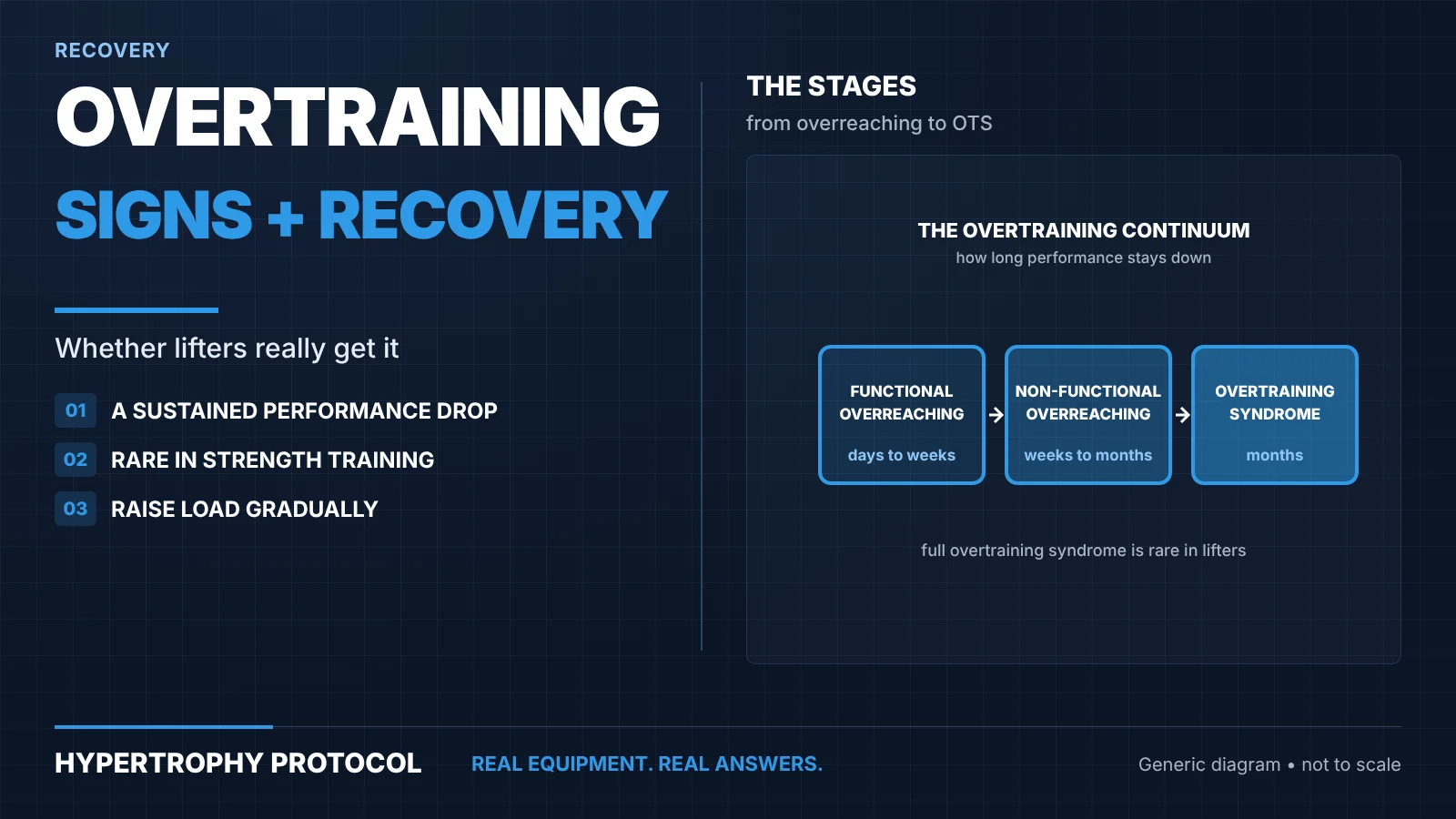
- What it is: overtraining is the far end of a continuum. A short dip after hard training is normal overreaching. Overtraining syndrome means performance stays down for months.
- Lifters: a scoping review found minimal evidence that true overtraining syndrome has occurred from strength training. Months of very high volume or intensity can still leave you stuck for weeks.
- The main sign: performance that keeps falling for weeks despite rest, usually with heavy fatigue and mood changes. No blood test confirms it.
- Recovery: days to weeks for overreaching, weeks to months for the next stage, months or longer for overtraining syndrome.
- Prevention: raise training load gradually, plan lighter weeks, and watch your sleep, food and life stress.
What is overtraining?
Sports scientists describe a continuum rather than a single condition. The 2013 joint consensus statement from the European College of Sport Science and the American College of Sports Medicine separates three stages:
| Stage | What happens | Performance down for | Outcome |
|---|---|---|---|
| Functional overreaching | A block of hard training causes a temporary dip | Days to weeks | Performance improves after rest |
| Non-functional overreaching | Longer dip with more fatigue and mood or hormonal symptoms | Weeks to months | Full recovery after enough rest, but training time is lost |
| Overtraining syndrome | Longer decline, more severe symptoms, and other causes ruled out | Months (more than 2) | Can end an athletic career |
Based on Table 1 in Kreher and Schwartz, 2012 and the ECSS and ACSM consensus.
The catch is that the last two stages look alike. The consensus says telling non-functional overreaching apart from overtraining syndrome is very difficult and often only possible in hindsight, once you see how long recovery takes and other causes have been ruled out.
Can you overtrain from lifting weights?
Overreaching, yes. Full overtraining syndrome, rarely if ever. A 2020 scoping review of 47 studies in strength sports and resistance training found that short blocks of high volume or high intensity produced functional overreaching, and that chronic high-volume or high-intensity training could lead to non-functional overreaching. It found minimal evidence that true overtraining syndrome had occurred in these populations.
A 2020 systematic review of 22 resistance training studies reached a similar place. Few studies managed to establish overreaching or overtraining properly, and the authors linked overtraining to frequent, high-intensity, monotonous training. Their most important finding for home lifters: no marker other than a sustained drop in performance has been established as a reliable sign.
Signs of overtraining
The signs overlap with a bad week, a cold or a stressful month, which is why one rough session means very little. What matters is the pattern over weeks:
- Performance keeps falling for weeks even after a few easier days. This is the one sign the research supports most clearly.
- Persistent, heavy fatigue. In a survey of 605 strength athletes, general fatigue was the most common symptom of training maladaptation.
- Aches and pains that linger, which the same survey linked to shorter episodes lasting under a month.
- Mood changes such as low motivation, irritability or flatness, which the consensus lists alongside fatigue and performance decline.
Daily readiness checks can help you spot a downward trend early. Our readiness markers checklist covers which ones have evidence behind them.
What causes it?
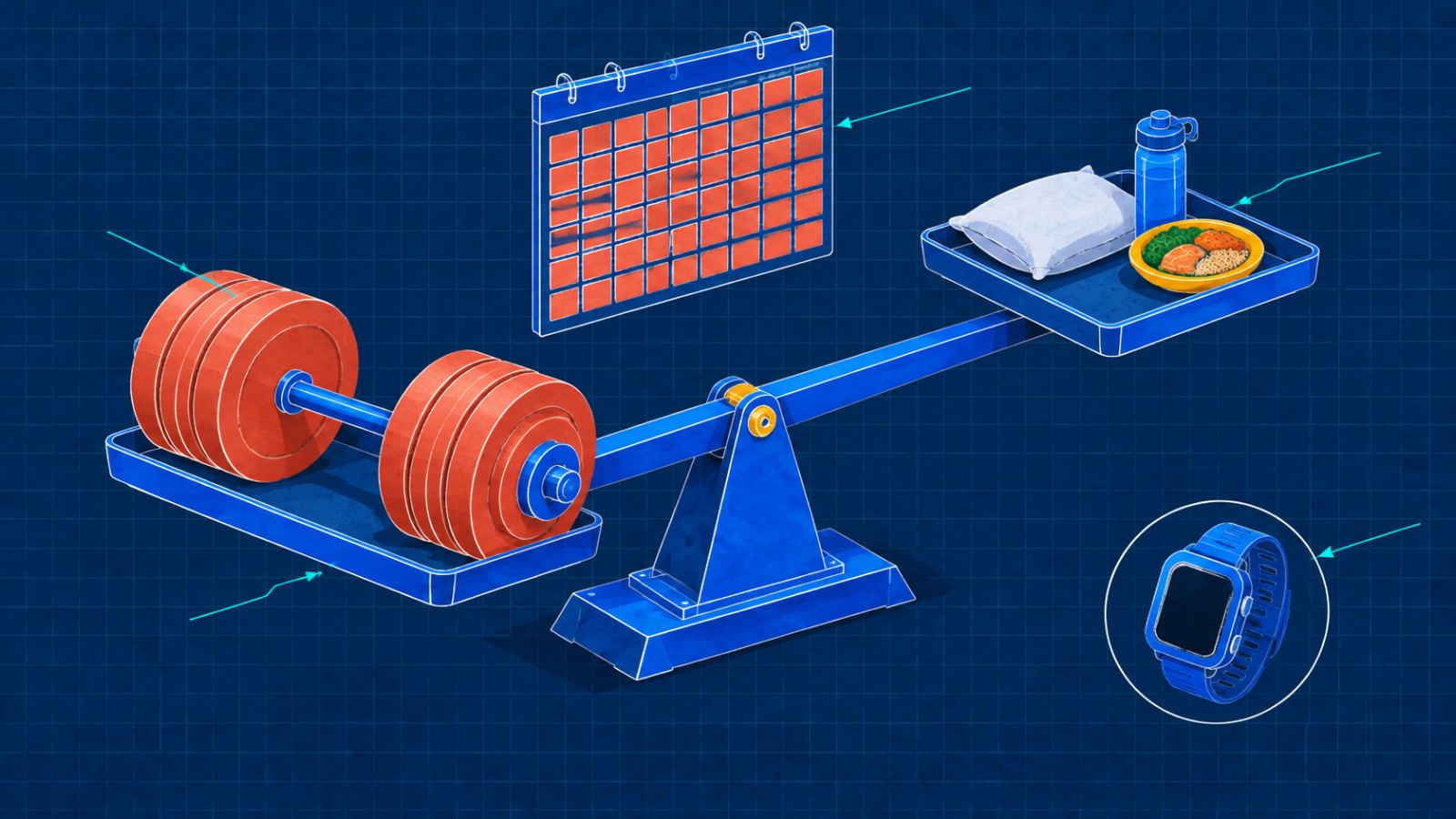
The consensus describes the problem as excessive overload combined with inadequate recovery. Training is rarely the only factor:
- Life stress: in the strength athlete survey, 92.5% of people who had a period of maladaptation reported other, non-training stressors at the same time.
- Too little food: the consensus lists calorie restriction and too little carbohydrate or protein among the factors to rule out.
- Health problems: infections, iron or magnesium deficiency, allergies and other illnesses can mimic overtraining and must be excluded first.
- Training style: in the survey, a larger share of people with severe, long-lasting maladaptation were training to muscle failure. That is an association, not proof that failure training causes it.
How long does it take to recover from overtraining?
It depends on the stage. Using the definitions in Kreher and Schwartz, functional overreaching resolves in days to weeks, non-functional overreaching in weeks to months, and overtraining syndrome takes months, with performance down for more than two months by definition. That is the strongest argument for catching it early: a lighter week now is far cheaper than a lost season.
How to avoid overtraining as a lifter
- Add volume gradually. In the studies, short blocks of very high volume reliably produced overreaching, so add sets a little at a time. Our weekly sets planner helps you see your current load before you add more.
- Plan lighter weeks. A deliberate easier week after a hard block lets the fatigue clear so the fitness shows.
- Vary the work. The resistance training review tied overtraining to monotonous, high-intensity training, so change exercises, rep ranges and intensity across blocks. See our rep range guide for how much flexibility you have.
- Keep some reps in reserve on most sets. Save all-out sets to failure for the last set or for short blocks.
- Protect sleep, food and stress. The recovery and performance consensus treats the balance between all stress and recovery, not training alone, as what keeps performance moving.
- Log your lifts. A sustained drop in performance is the most reliable sign, and you can only see it if you write things down.
What to do if you think you are overtrained
- Cut back first. Drop volume and intensity for a week or two, keep moving with easy sessions, and see whether performance and energy return.
- Fix the basics. Eat enough, sleep more, and deal with the non-training stress you can control.
- See a doctor if it lasts. If fatigue, poor performance or mood changes persist for more than a few weeks, get checked. Overtraining syndrome is diagnosed only after other causes such as infection, anemia or other illness have been ruled out.
The bottom line
Feeling beaten up after a hard block is normal and usually clears with a lighter week. True overtraining syndrome is rare in lifters and is defined by months of lost performance. Raise training load gradually, plan easier weeks, take care of sleep, food and stress, and treat a performance drop that lasts for weeks as a signal to back off and, if it persists, to see a doctor.
Frequently asked questions
Is there a blood test for overtraining?
No blood test confirms it. A 2020 systematic review of 22 resistance training studies found that no marker other than a sustained drop in performance has been established as a reliable sign.
What is the difference between overreaching and overtraining?
Overtraining is the far end of a continuum. A short dip after hard training is normal overreaching, while overtraining syndrome means performance stays down for months.
Does training to failure cause overtraining?
That has not been shown. In the survey of strength athletes cited above, a larger share of people with severe, long-lasting maladaptation were training to muscle failure, but that is an association, not proof that failure training causes it.
Can stress outside the gym contribute to overtraining?
Training is rarely the only factor. In the strength athlete survey cited above, 92.5% of people who had a period of maladaptation reported other, non-training stressors at the same time.
Sources
- Meeusen R, Duclos M, Foster C, et al. Prevention, diagnosis, and treatment of the overtraining syndrome: joint consensus statement of the European College of Sport Science and the American College of Sports Medicine. Med Sci Sports Exerc. 2013;45(1):186-205. doi:10.1249/MSS.0b013e318279a10a
- Kreher JB, Schwartz JB. Overtraining syndrome: a practical guide. Sports Health. 2012;4(2):128-138. doi:10.1177/1941738111434406
- Bell L, Ruddock A, Maden-Wilkinson T, Rogerson D. Overreaching and overtraining in strength sports and resistance training: a scoping review. J Sports Sci. 2020;38(16):1897-1912. doi:10.1080/02640414.2020.1763077
- Grandou C, Wallace L, Impellizzeri FM, Allen NG, Coutts AJ. Overtraining in resistance exercise: an exploratory systematic review and methodological appraisal of the literature. Sports Med. 2020;50(4):815-828. doi:10.1007/s40279-019-01242-2
- Grandou C, Wallace L, Coutts AJ, Bell L, Impellizzeri FM. Symptoms of overtraining in resistance exercise: international cross-sectional survey. Int J Sports Physiol Perform. 2021;16(1):80-89. doi:10.1123/ijspp.2019-0825
- Kellmann M, Bertollo M, Bosquet L, et al. Recovery and performance in sport: consensus statement. Int J Sports Physiol Perform. 2018;13(2):240-245. doi:10.1123/ijspp.2017-0759
Last checked November 7, 2026.