
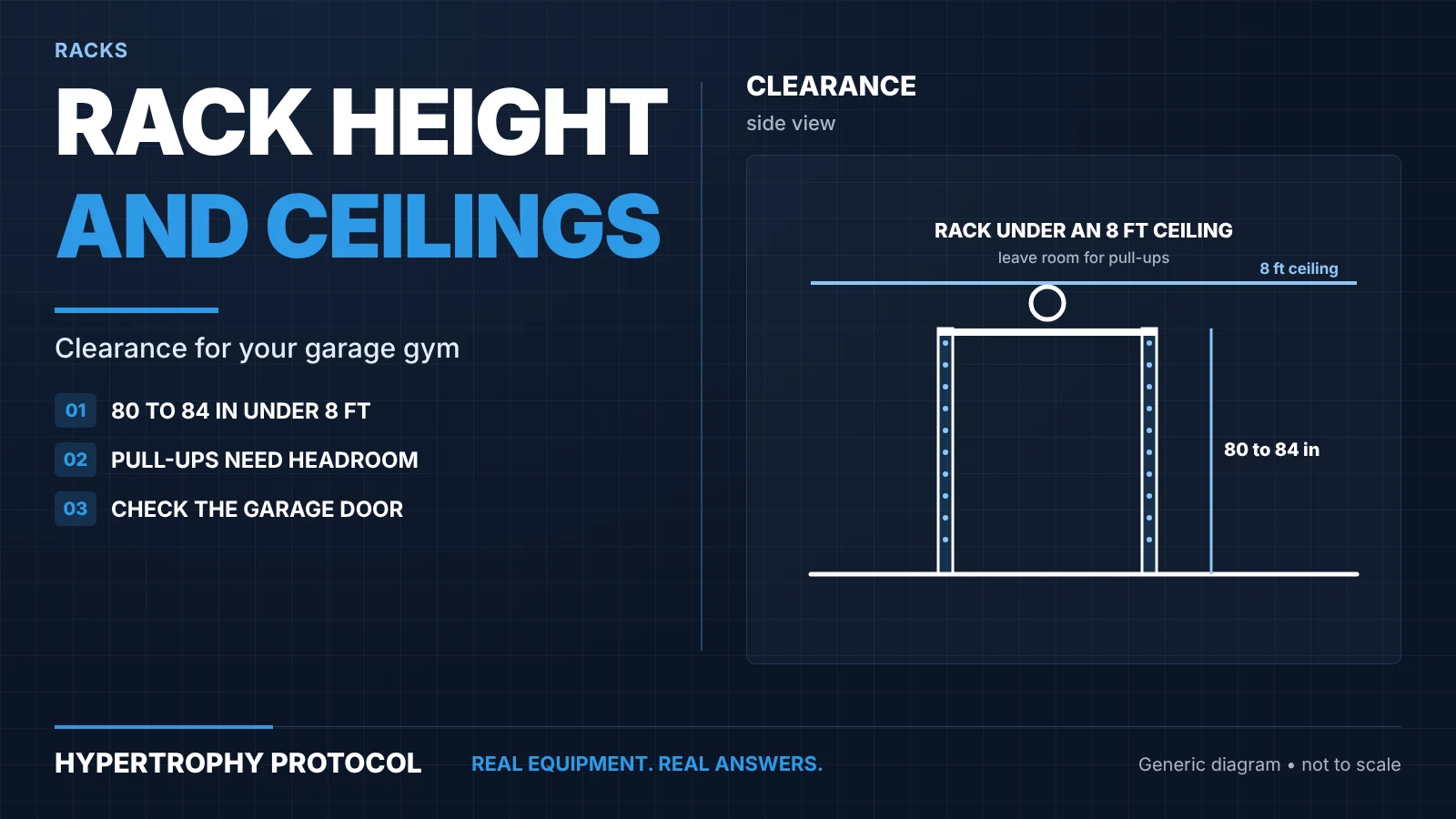
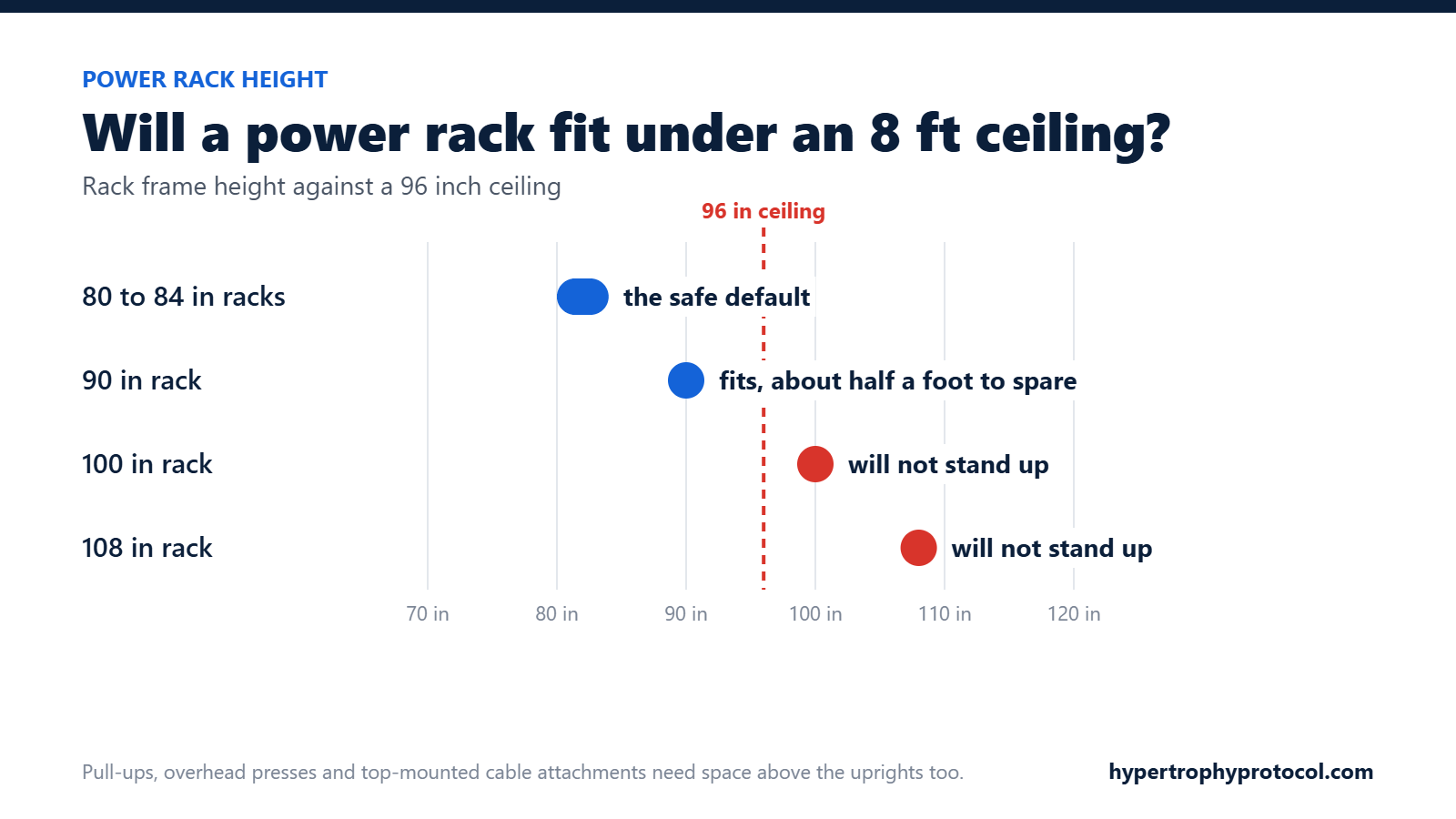
Under a standard 8-foot (96-inch) ceiling, 80 to 84 inch power racks are the safe default. A 90-inch rack fits with about half a foot to spare, while 100 and 108 inch frames will not stand up. If you have a garage with a door track running overhead and a power rack waiting in your cart, those numbers decide whether that rack stands up at all.
What you do on the rack matters as much as the frame. Pull-ups, overhead presses and top-mounted cable attachments all use the space above the uprights, and an open garage door can take that space away. Every spec below was checked at its source on September 28, 2026.
At a glance
| Check | Key number | What it means |
|---|---|---|
| Standard ceiling | About 96 in (8 ft) | 80 to 84 in racks are the safe default |
| 90 to 91 in rack | 5 to 6 in to spare under 96 in | Fits if your pull-up head travel fits too |
| 100 and 108 in racks | 4 in and 12 in too tall under 96 in | Need a taller room |
| Top-mounted Slinger | Adds about 7 in above the upright | A 90.375 in RML-390C plus Slinger is 1.375 in too tall |
| Pull-ups | Bar height plus your collarbone-to-crown distance | The bar sits 3 to 6 in below the frame top (Titan T-3, Rogue RM-3) |
| Overhead press | Your lockout height plus about 8.86 in for full-size plates | Check where plates pass under the frame or ceiling |
| Garage door strip | Door height plus 16 in: 100 in back for a 7 ft door | Inside that strip, the open door is your ceiling |
Specs checked at the source, September 28, 2026. Mats, a platform or a low light fixture reduce every margin. Confirm before ordering.
Which power rack heights can you actually buy?
That half-foot margin depends on the rack you pick, because makers share no standard height. Most lines come in a short and a tall version, and a few go to 100 or 108 inches for tall rooms.
| Rack line | Heights offered | Pull-up bar and top attachment notes | Source |
|---|---|---|---|
| Rogue Monster Lite RML-390C 3.0 | 80.375″ or 90.375″ | Must be bolted to the floor; Slinger fits after moving the crossmember and Fat/Skinny pull-up bar | Rogue |
| Rogue RML-390 Bolt Together | 90.375″ | 43″ Fat/Skinny pull-up bar included | Rogue |
| Rogue RML-390F Flat Foot | 92.25″ | No floor bolting; not compatible with the Slinger | Rogue |
| Rogue Monster RM-3 | 80″, 90″, 100″ or 108″ | Max pull-up bar height 74″, 84″, 94″ or 102″ | Rogue |
| Rogue Infinity R-3 (bolt-together) | 90 3/8″ | Pull-up bar at 7′ 6″ | Rogue |
| Rogue Infinity R-4 | 90.375″ | Max pull-up bar height 78.87″ (Fat/Skinny) or 86.37″ (Single Skinny) | Rogue |
| REP PR-4000 and PR-5000 | 80″ or 93″ | No pull-up bar height published | REP |
| REP PR-1050 | 72″ | Dual pull-up bars; built for low ceilings; product page now redirects, so confirm it is still sold | REP |
| Titan T-2 | 71″ or 83″ | No pull-up bar height checked | Titan |
| Titan T-3 | 82″ or 91″ | Max pull-up bar height 78″ or 88″ | Titan 82″, Titan 91″ |
| Titan X-3 | 80″ or 90″ bolt-down; 82″ or 91″ flat foot | No pull-up bar height checked | Titan |
| Titan TITAN Series | 90″ or 100″ bolt-down; 90″ flat foot | No pull-up bar height checked | Titan |
| Bells of Steel Hydra | 72″, 84″, 90″ or 108″ | Maker flags pull-ups and kipping as the thing to measure for | Bells of Steel |
| Bells of Steel Manticore | 72″, 84″, 90″ or 108″ | 84″ is the most common home pick | Bells of Steel |
Short versions cluster between 80 and 84 inches, and most tall versions sit between 90 and 93. The pull-up bar also sits below the top of the frame, by 3 to 4 inches on Titan’s T-3 and 6 inches on Rogue’s RM-3, so the bar you hang from is lower than the rack height on the box.
Height is one spec among several. The power rack buying guide covers steel, hole spacing and the other specs that shape your training.
How much room does each power rack height leave under an 8-foot ceiling?
Once you know the heights on offer, the fit check is one subtraction: ceiling minus rack height. Bells of Steel puts the standard ceiling at around 96 inches, and most of its home gym buyers pick the 84-inch Manticore for that reason. Under 96 inches, the common heights leave this much room.
Room left under a 96-inch ceiling, by rack height
Red rows will not stand up. Mats, a platform or a low light fixture reduce every number here.
Anything at 93 inches or below will stand up, but the margin shrinks fast. Three inches leaves little room for a sloped slab, stall mats or a platform under the rack. A 9-foot ceiling is exactly 108 inches, so the tallest frames need an even taller room.
The drywall is rarely the lowest point. Lights, joists, beams, sprinkler heads and door hardware all hang lower, and the lowest object above the rack’s footprint is the number that counts.
Will a top-mounted cable attachment still fit?
A rack that clears the ceiling can still fail once something is bolted to its top. Rogue’s Monster Lite Slinger, a pulley that mounts above the uprights, extends approximately 7 inches above the top of the upright it sits on and approximately 7 inches out from its face.
That changes the math for the RML-390C. The 80.375-inch version with a Slinger tops out at 87.375 inches and leaves 8.625 inches under a 96-inch ceiling. The 90.375-inch version reaches 97.375 inches, which is 1.375 inches too tall for the same room.
The Slinger also narrows your rack choice. It needs a rack fastened to the floor, Rogue marks it incompatible with the RML-390F Flat Foot, RML-3, HR-2 half rack and all wall-mounted and fold-back racks, and on the RML-390 you rearrange the crossmember and Fat/Skinny pull-up bar to fit it.
For other brands’ top-mounted lat and cable attachments, find the height the attachment adds above the upright before you choose a rack height. The power rack upright sizes guide covers the other half of that fit: whether the attachment matches your tube size.
How much headroom do your pull-ups need?
Top attachments add a fixed number, but pull-ups add one that depends on your body. At the top of a chest-to-bar pull-up, your head rises above the bar by roughly the distance from your collarbone to the top of your head. In the support position of a muscle-up, with the bar near your hips, it rises by roughly the distance from your hip crease to the top of your head.
Measure your own number instead of trusting an average. All it takes is a flat book and a tape measure.
- Stand against a wall, set a flat book on your head and mark the wall under it.
- Mark your collarbone height for pull-ups, or your hip crease for muscle-ups.
- Measure between the marks, add that to the pull-up bar height, and compare the total with the lowest object above the bar.
Here is how it plays out under 96 inches. Titan’s 82-inch T-3 puts its highest pull-up bar at 78 inches, leaving 18 inches of headroom, while the 91-inch version at 88 inches leaves 8. Rogue’s R-3 bar sits at 7 feet 6 inches, or 90 inches, which leaves 6. If your measurement is bigger than the gap, your head reaches the ceiling before your chest reaches the bar.
Kipping adds swing on top of height. Your head travels in front of and behind the bar, so a beam, light or door track just outside the rack counts too. Bells of Steel singles out pull-ups, “especially if you kip,” as the movement to plan your rack height around.
Where can you overhead press without hitting the ceiling or the door?
Pressing raises a different object: the barbell and its plates. Hold a broomstick at your pressing grip, lock your arms overhead in the shoes you train in, and measure from the floor to the top of the stick. Add the thickness of any platform you stand on.
Plates reach higher than the bar. A full-size plate is 450 mm across, so its rim sits about 8.86 inches above the bar’s center, and that goes on top of your lockout number wherever the plates pass under something. If you press inside the rack, compare the same lockout figure with whatever crosses the top of the frame, and step out in front of the rack when the frame is lower.
The garage door is the obstacle most buyers miss. Seven feet is the standard residential door height, with 8-foot doors widely available. On a standard-radius track, the open door lies flat along the ceiling over a strip of garage equal to the door height plus 16 inches, and it needs at least 12 inches of headroom above the opening on a 12-inch radius (Clopay).
For a 7-foot door, that strip runs 100 inches, about 8 feet 4 inches, back from the door. For an 8-foot door it runs 112 inches. Inside that strip, your real ceiling is the underside of the open door, and a ceiling-mounted opener’s header bracket goes just 2 inches above the door’s highest point of travel in Chamberlain’s installation manual. Measure with the door fully open, or keep the rack out of that strip.
What should you measure before you order a rack?
All of those limits come down to a tape measure and a few minutes. REP’s rack collection page gives the same instruction: measure ceiling height and floor area, and leave clearance for pull-ups and overhead presses. Work through this list before you pick a height.
- Ceiling: measure at each corner of the rack’s footprint to the lowest object above it, including lights and joists.
- Garage door: open it fully and measure floor to the lowest point of the door, track and opener rail if the rack sits in the door’s strip.
- Floor build-up: add the thickness of mats or a platform to the rack height.
- Top attachments: add the attachment’s rise above the upright, such as 7 inches for the Slinger.
- Pull-ups: add your collarbone-to-crown number, or hip-to-crown for muscle-ups, to the pull-up bar height.
- Pressing: take your broomstick lockout height and add about 8.86 inches where full-size plates pass under something.
- Assembly: if you plan to build a side frame on the floor and tilt it up, its diagonal has to clear the ceiling as it swings, so ask the maker whether the rack can be assembled standing.
- Floor plan: height is one axis of three, and the 10×10 home gym guide covers width, depth and walkways.
Which power rack height should you buy for your garage?
If you have an 8-foot ceiling and want a top-mounted pulley, buy the short version. The 80.375-inch RML-390C with a Slinger leaves more than 8 inches, and the 90.375-inch version does not fit at all.
If you have an 8-foot ceiling and do strict pull-ups with no top attachment, a 90 to 91 inch rack works when your measured head travel fits between the pull-up bar and the ceiling. If it does not, an 80 to 84 inch rack takes 6 to 11 inches off the frame.
If you kip or do muscle-ups under an 8-foot ceiling, pick the shortest rack in your line or plan to do those movements on a bar outside the rack. If your ceiling sits below 8 feet, look at the 71 and 72 inch options from Titan, Bells of Steel and REP.
If your ceiling is 9 feet or more, a 93 or 100 inch rack stands up with 8 to 15 inches to spare, though the pull-up and pressing checks still apply. If the rack must sit inside the garage door’s strip, the open door sets your height limit, not the ceiling.
Once you have picked a height, run your rack and the attachments you plan to add through the Rack Attachment Fit Checker to confirm they match its uprights. A rack that fits the room still has to fit the parts you bolt to it.
Sources checked September 28, 2026. Manufacturers change specs; confirm on the product page before ordering.
To check a specific rack against your own room, the Home Gym Room Planner shows whether it fits your floor space and ceiling.
Frequently asked questions
Will a 90-inch power rack fit under an 8-foot ceiling?
Yes. A 90-inch rack leaves 6 inches under a 96-inch ceiling. Mats, a platform or a low light fixture reduce that margin, and pull-ups need their own check.
What is the tallest power rack that fits under an 8-foot ceiling?
Of the heights in this guide, 93 inches, which leaves 3 inches under a 96-inch ceiling. That leaves little room for a sloped slab, stall mats or a platform. 100 and 108 inch racks will not stand up.
What power rack fits a ceiling lower than 8 feet?
Look at the 71 and 72 inch options: Titan’s T-2 at 71 inches, the Bells of Steel Hydra and Manticore at 72 inches, and REP’s PR-1050 at 72 inches. Confirm the PR-1050 is still sold, because its product page now redirects.
Can I put a power rack under a garage door track?
Only if it clears the open door. On a standard-radius track, the open door lies along the ceiling over a strip equal to the door height plus 16 inches, which is 100 inches back from a 7-foot door. Inside that strip the underside of the open door is your real ceiling, so measure with the door fully open.