
Short answer: tendons get stiffer when you load them heavily, and in one 14-week trial, about 3 seconds of hard tension per rep raised Achilles stiffness more than 12-second holds did. Heavy holds and slow, heavy lifts raised stiffness more than jumping did in head-to-head trials. Tendons also change slowly: about 3 months in one study, compared with weeks for strength. This guide is for healthy tendons. If a tendon hurts, see a clinician; that’s rehab, and it’s a different question.
Why tendons matter for jumping
Your Achilles and patellar tendons connect the calf and thigh muscles to bone. They pass force from the muscle to the bone, and they stretch and spring back during a jump.
- Stiffer tendons went with faster force production (r = 0.55) and higher squat jumps and countermovement jumps (r = 0.64 and 0.55) (Bojsen-Møller et al., 2005).
- But stiffer isn’t simply better. In another study, more compliant tendons went with a bigger boost from the countermovement, and stiffness wasn’t related to absolute jump height (Kubo et al., 1999).
- In a 12-week trial (10 people, one leg trained each way, one-leg ankle jumps on a sled), plyometrics raised jump height more than weight training without changing tendon stiffness, while weight training raised tendon stiffness (Kubo et al., 2007).
- In another 12-week trial with eight subjects, the tendon and aponeurosis of the knee extensors were stiffer as a unit after isometric squat training (the patellar tendon alone did not change), and squat jump height rose, but countermovement jump height did not rise significantly (Kubo et al., 2006).
Read: jump height comes mainly from jump training and strength. Tendon training is a support piece: it raises tendon stiffness, and stiffer tendons went with faster force production in one study.
What makes tendons adapt
1. Heavy load
- A meta-analysis of 27 studies found training raised tendon stiffness (SMD 0.70), driven by how heavy the loading was, not the type of muscle contraction. Programs of 12 weeks or more had a slightly higher average, but the difference was not significant (Bohm et al., 2015).
- A larger meta-analysis of lower limb tendons (61 studies) found training at high tendon strain gave large stiffness gains (SMD 1.04, from three training groups), significantly more than low-strain training, which gave no significant change (Lazarczuk et al., 2022).
- In 11 men who trained each leg at a different tendon strain with similar volume for 14 weeks, only the high-strain leg’s Achilles got stiffer (Arampatzis et al., 2010).
2. About 3 seconds of tension per rep
- Over 14 weeks, 3 seconds of loading and 3 seconds of rest raised Achilles stiffness 57%. 12-second holds raised it 25%. Fast one-legged jumps gave only a trend (Bohm et al., 2014).
- In 12 weeks of isometric knee extensions with equal total work, 20-second holds raised tendon stiffness and 1-second contractions didn’t (Kubo et al., 2001).
- Resting 10 seconds vs 3 seconds between 3-second holds gave the same tendon gains, but collagen structure on ultrasound got worse with the 3-second rest and not with the 10-second rest (Waugh et al., 2017).
3. Holds and slow lifts beat jumps for stiffness
- In 6 weeks, isometric training raised tendon stiffness 61.6% and plyometric training 29.4%. Jump height improved about the same in both (Burgess et al., 2007).
- Tendon stiffness rose with isometric training but not plyometric training, while plyometrics changed how the muscle and tendon behave in fast movements (Kubo et al., 2017).
- A network meta-analysis of 31 trials (23 of them on stiffness) ranked isometric calf training lasting more than 12 weeks highest for Achilles stiffness, but the authors noted the trials were small and used varied protocols, so the ranking is not firm (Fu et al., 2026).
How long it takes
In 3 months of isometric training, strength rose by 2 months, but tendon stiffness only changed by 3 months. After training stopped, stiffness was back to baseline within 2 months (Kubo et al., 2010). Over 1 year, 12 adolescent elite athletes showed less even changes in tendon force and tendon stiffness than 8 non-athletes, and their tendons reached higher strain (Mersmann et al., 2016).
Read: build jump volume gradually, especially in your first 3 months and after a layoff, because strength can rise before tendon stiffness does.
Tendon exercises for a home gym
This is our take, built from the trial protocols above. The trials used lab machines to set the effort, so at home you go by how hard you push.
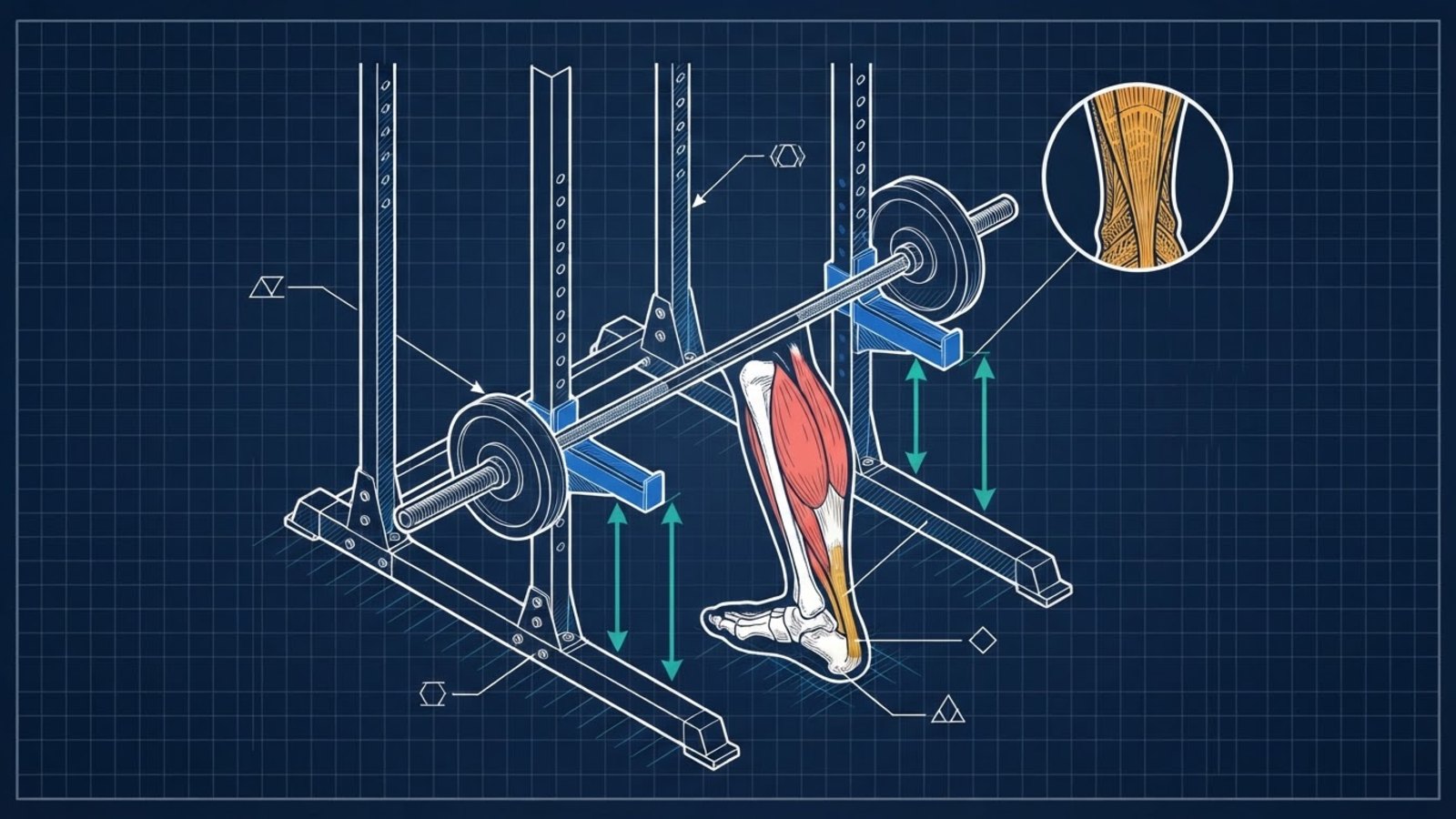
- Calf isometric (Achilles): stand in a rack with the bar on your back, set the safety pins so the bar stops you partway up a calf raise, and push up into the pins. A strap anchored to the floor works too.
- Squat isometric (patellar tendon): set the pins so the bar stops with your knees bent about 90 degrees, and push up into them.
- No rack: slow heavy single-leg calf raises (3 seconds up, 3 seconds down) and heavy split squats with a 3-second pause at the bottom.
Dose: 4 to 5 sets of 4 reps, each a hard push of about 3 seconds, with about 10 seconds of rest between reps. Build up to a hard push over the first two weeks. Twice a week fits inside normal leg days. The trials above trained 2 to 4 times a week, and one 16-week trial in men found similar Achilles stiffness gains from 2.5 to 5 sessions a week (Tsai et al., 2024).
The Vertical Jump Planner now adds these holds to both lower days and swaps in the slow versions if you don’t have a rack.
What about stretching?
- In eight men, five minutes of static calf stretching cut the stiffness of the calf’s tendon structures 8% right away (Kubo et al., 2002), and in a 16-person trial, contract-relax calf stretching in a warm-up lowered drop jump performance, though countermovement jumps didn’t change (Konrad et al., 2022). Skip long calf stretches right before you jump.
- Over 3 to 8 weeks, stretching programs had a trivial effect on tendon stiffness (Freitas et al., 2017), so stretching at other times won’t undo your tendon work.
Does collagen help?
The trials are small and the results are mixed. Several trials found collagen taken with lifting gave extra gains in tendon size or stiffness (for example Nulty et al., 2025), but one 15 g trial found no added benefit (Balshaw et al., 2023). A 2026 review of eight trials rated the evidence for bigger, stiffer tendons as strong, but found no added strength, and jump height didn’t improve in the two trials that measured it (Buchalski et al., 2026). Training is what drives the change. This is not a recommendation to take a supplement.
What we don’t know yet
- No trial has added tendon holds to a jump and strength program and measured jump height.
- Weekly frequency has barely been tested: one trial found 2.5 to 5 sessions a week worked about the same for stiffness, and it didn’t measure jump height.
- Most trials are small and mostly in young men, and tendon strain can’t be measured at home.
Frequently asked questions
Do isometrics strengthen tendons?
In healthy adults, heavy isometric holds raised tendon stiffness in several trials. In one, 20-second holds raised stiffness and 1-second contractions didn’t; in another, 3-second holds raised it more than 12-second holds. Most trials measured stiffness, not tendon strength directly.
Are plyometrics good for tendons?
They help jump height and raised tendon stiffness in a meta-analysis (Ramírez-delaCruz et al., 2022), but heavy holds and slow lifts raised stiffness more in head-to-head trials. Do both.
How long does it take to strengthen a tendon?
About 3 months for a measurable change in one study, slower than strength. In another, most of the stiffness change came in the first 8 weeks (Tsai et al., 2024).
Should I train through tendon pain?
This guide doesn’t cover that. Tendon pain is a rehab question; see a clinician.
For the rest of the jump picture, see How to Jump Higher: What the Research Says.
Sources checked against PubMed on November 10, 12 and 18, 2026. This is training information, not medical advice.