

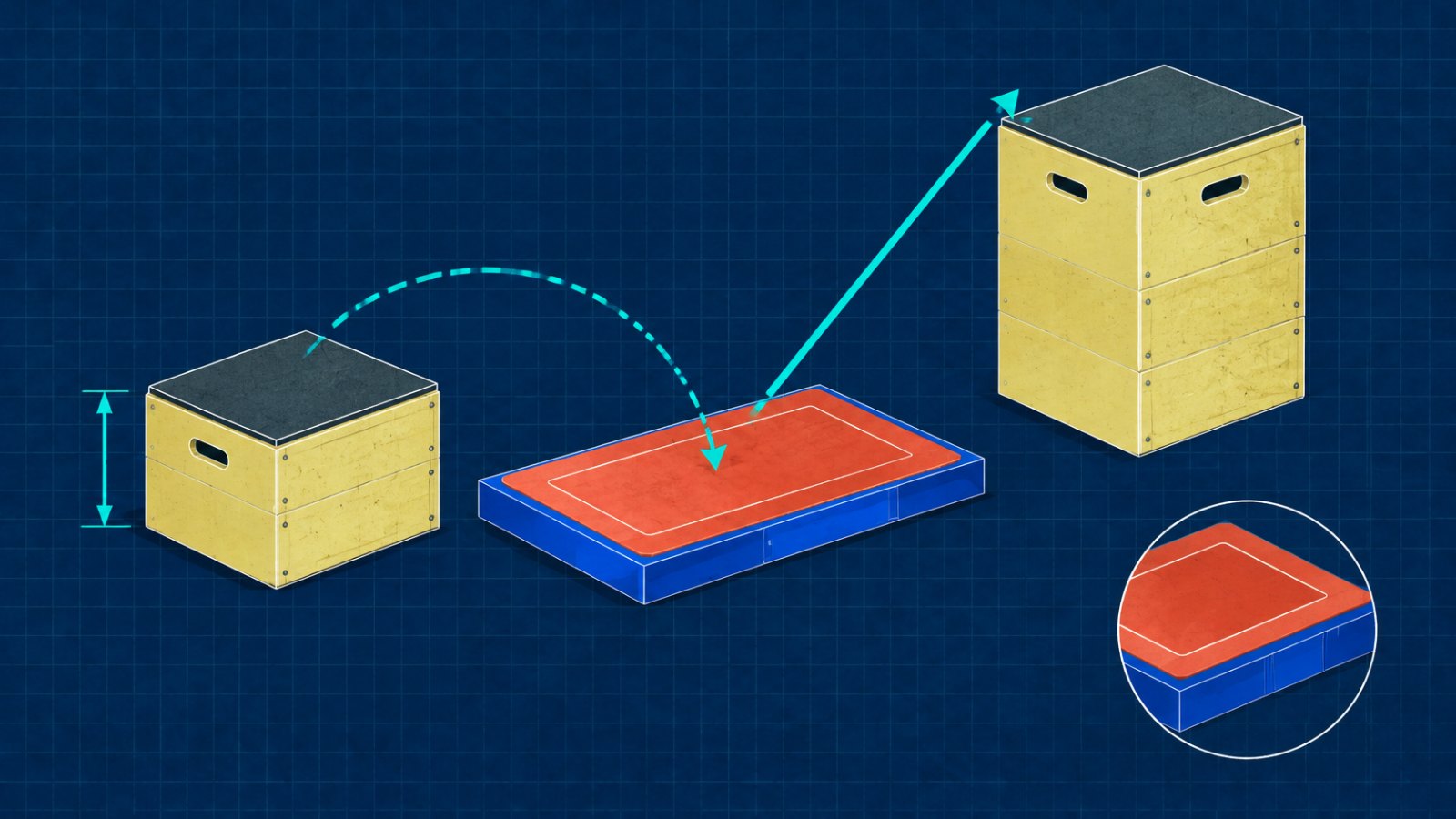
Short answer: a depth jump (also called a drop jump) means stepping off a low box and jumping as high as you can the moment you land. They train you to absorb and reuse force fast, and they improve reactive strength. But they aren’t magic: regular jumps raised jump height as much or more in the studies that compared them, so depth jumps belong later in a program, after a base of regular jumps and squats.
What the research says
- Regular jumps can beat them for jump height. In a 6-week trial, training mostly with countermovement jumps raised jump height more than training mostly with drop jumps, about 17% vs 7% (Ruffieux et al., 2020). It was one small study of 26 players, so treat it as a hint, not a rule.
- Older review, same message. A review of drop jump training found it improves jumping, but regular jumps can be just as helpful. It suggested regular jumps first, then weight training, then drop jumps (Bobbert, 1990; an older narrative review).
- Mixing jump types works best. Combining squat jumps, countermovement jumps and drop jumps beat using only one type (de Villarreal et al., 2009).
- Plyometrics raise reactive strength. Reactive strength index (jump height divided by ground contact time) improved with plyometric training, SMD 0.80 (Sun et al., 2025). Plyometric training also raised drop jump height by 4.7% on average (Markovic, 2007).
- Reactive strength tracks athletic qualities. Higher reactive strength index was moderately linked with strength (r = 0.34) and more strongly with change-of-direction speed (r = -0.57) (Jarvis et al., 2022). These are correlations, not proof that raising it causes the rest.
- Box height isn’t the same as intensity. A systematic review of drop jump programs concluded that drop height should not be treated as the measure of intensity; intensity depends on ground reaction forces, power output and jump height, among other things (Montoro-Bombú et al., 2023).
How to do a depth jump
These cues are coaching practice, not research findings:
- Stand on a low, stable box or step. Step off with one foot; don’t jump off it.
- Land on both feet at the same time, on the balls of your feet with heels just kissing the ground.
- Jump straight up as fast and high as you can. Think “the ground is hot.”
- Land softly, reset fully, and take a full rest before the next rep.
Older biomechanics work describes two styles: a “bounce” drop jump with a quick, short reversal, and a “countermovement” drop jump with a deeper dip. The bounce style may target power output more, but whether the style changes training results hasn’t been settled (Bobbert, 1990).
How high should the box be?
There’s no tested rule. Common coaching advice is a low box, around 20 to 30 cm (8 to 12 in), raised only while your jumps stay high and your ground contact stays short. That fits the review finding that a higher box doesn’t automatically mean harder or better training (Montoro-Bombú et al., 2023). If you can measure reactive strength with a jump mat or app, stop raising the box when the number drops.
When to add depth jumps
Our take: after at least 4 weeks of regular jumps and squatting, and only if your knees, ankles and back feel fine. Start with 3 to 4 sets of 5 from a low box, once a week, inside your normal jump volume. The Vertical Jump Planner adds them in the final block and leaves them out if you have no box or report pain.
FAQ
Are depth jumps better than box jumps?
Not for jump height on their own. In the one direct comparison, mostly countermovement jumps beat mostly drop jumps. Use both; mixing jump types did best in the larger analysis.
Depth jump vs drop jump: what’s the difference?
The terms are used interchangeably in most research. Some coaches use “depth jump” for the version with a maximal jump after landing, and “drop jump” for a quick rebound; the studies cited here don’t draw a firm line.
How many depth jumps per session?
There’s no research-tested number. Our take is 15 to 20 contacts, counted inside your total jump volume for the day.
Are depth jumps bad for your knees?
They put high load through the knees and ankles, which is why the research-backed approach is to build up with regular jumps and strength first. If they hurt, stop and see a clinician.
For the full picture of what raises your vertical, see How to Jump Higher: What the Research Says and Plyometrics for Vertical Jump.
Sources checked against PubMed on November 10, 2026. This is training information, not medical advice.