
Short answer: yes, squats raise your vertical jump, but depth matters. Deep squats raised jump height in controlled trials and quarter squats didn’t. Heavy squats and light jump squats improved jumping about equally in weaker lifters, and heavy squats added far more strength. Squats alone aren’t the whole answer, though: pairing them with jumps beat lifting alone.
Why squat strength matters for jumping
- In 17 international soccer players, maximal half squat strength was strongly correlated with vertical jump height and sprint speed (Wisløff et al., 2004).
- In professional soccer players, peak force in an isometric mid-thigh pull was linked with countermovement jump height (r = 0.54 relative to body weight, r = 0.55 absolute) (Mason et al., 2020).
- These are correlations, not proof that squatting more raises your jump. The training studies below test that directly.
How deep should you squat?
All the way down, if your hips, knees and back allow it.
- In a 10-week trial, deep front squats and deep back squats raised squat jump and countermovement jump height. Quarter squats didn’t, even though the quarter-squat group got stronger at quarter squats (Hartmann et al., 2012).
- In trained men, full squats were the only depth that raised strength at all three squat depths and gave the best results on tests that included the countermovement jump. Parallel squats came second. Half squats gave no gains and more knee and back pain (Pallarés et al., 2020).
- Over 12 weeks, deep squats (0 to 120 degrees of knee bend) beat shallow squats (0 to 60 degrees) for front thigh muscle size and squat jump performance, which rose 15% (Bloomquist et al., 2013).
- A meta-analysis of 16 studies found full range of motion beat partial range for strength (ES 0.56) and leg muscle growth (ES 0.88). Performance tests also leaned toward full range (ES 0.44), but that difference wasn’t statistically significant (Pallarés et al., 2021).
Heavy squats or light, fast jump squats?
- In relatively weak men, 10 weeks of heavy back squats (75% to 90% of 1RM) and 10 weeks of maximal-effort jump squats (0% to 30% of 1RM) raised jump peak power by the same amount (17.7% vs 17.6%). The heavy group’s squat 1RM rose 31.2% vs 4.5%, so the authors favored strength training for weaker lifters (Cormie et al., 2010).
- When stronger men (squatting about 2 times body weight) and weaker men (about 1.3 times) did the same jump squat training, the stronger group tended to gain more jump height (effect size 1.46 vs 0.95), though the difference wasn’t statistically significant (Cormie et al., 2010).
- In 64 trained adults, weighted squat jumps at the load that maximized power output beat both heavy squats and depth jumps on the jump tests over 10 weeks (Wilson et al., 1993).
- Reviews of strength research recommend that weaker lifters build strength before emphasizing power work (Suchomel et al., 2018).
Read: if your squat is still light for your body weight, heavy squats give you jump gains plus strength you’ll keep using. Once you’re strong, light jump squats become more useful.
Squats alone aren’t enough
- In one 12-week trial on the calf muscles, weight training at 80% of 1RM improved only the squat jump, while plyometric training improved all three jump types tested (Kubo et al., 2007).
- A 2026 network meta-analysis found that complex training (a heavy lift set, rest, then a jump set) added 2.50 cm (95% CI 0.85 to 4.10) of countermovement jump height over lifting alone (Zhao et al., 2026).
- Another 2026 meta-analysis compared complex training with ballistic training alone (jumps and other explosive moves): complex training did better for squat jumps, while countermovement jumps improved similarly with both. Certainty of the evidence was low to very low (Thapa et al., 2026).
Should you squat right before you jump?
A heavy set before jumping can give a small, short-lived boost, sometimes called post-activation potentiation. A meta-analysis found small effects on jumps. Stronger lifters responded better to a single heavy set with a shorter rest, weaker lifters to lighter, multiple sets with a longer rest, and both responded more after shallower squats than deep ones (Seitz & Haff, 2016). The boost is small, so the main reason to pair squats with jumps is the training effect over weeks, not the extra inch on one jump.
Bands and chains
A 2026 meta-analysis found variable resistance training (bands or chains on the bar) improved countermovement jumps in athletes (SMD 1.01), but the studies varied a lot and showed possible publication bias (Xu et al., 2026). If you own bands, they’re a reasonable option, not a requirement.
How to program squats for your vertical
This is our take, built from the studies above, not a tested program:
- Jump first, then squat. Do your jumps fresh at the start of the session, then the heavy squat.
- Heavy day: back or front squat to full depth, 3 to 5 sets of 3 to 6 reps around 75% to 90% of your 1RM, stopping a rep or two before failure.
- Complex pairs: after a few weeks, pair a heavy squat set with a set of 3 to 5 jumps after a few minutes of rest.
- Light jump squats: once your squat is around 1.5 times body weight, add jump squats with a light load (the trials used 0% to 30% of 1RM). Land softly and reset between reps.
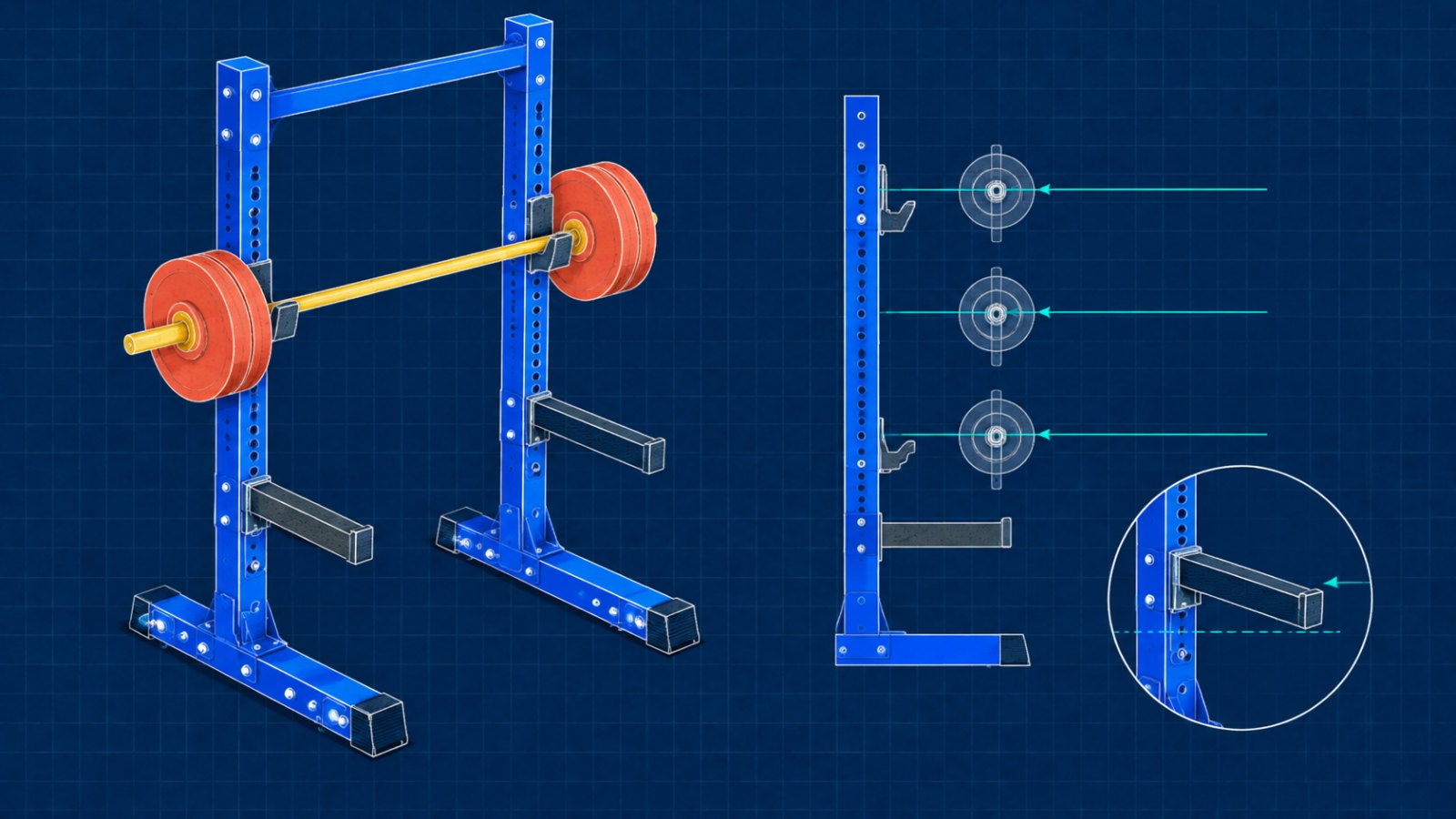
- Front or back: both worked when squatted deep. Pick the one you can do deep with good form; front squats are easier to bail from in a home gym with no spotter. Set safety pins either way.
The Vertical Jump Planner checks your squat against your body weight and shifts the plan toward strength if you need it, then builds out the sets, reps and jump contacts week by week.
FAQ
Do squats increase vertical jump?
Yes, when you squat deep. Deep front and back squats raised jump height in controlled trials; quarter squats did not.
Are half or quarter squats better for jumping?
Not in the research. Quarter squats didn’t raise jump height in one trial, and half squats gave no gains and more pain in another. Full and parallel squats did best.
How heavy should I squat for vertical jump?
The heavy-squat trials used about 75% to 90% of 1RM. Light jump squats (0% to 30% of 1RM) raised jump power just as much in weaker men over 10 weeks, but heavy squats built much more strength.
Should I do jump squats with weight?
They work, especially once you’re strong. Keep the load light; the trials used up to 30% of 1RM.
How strong do I need to be?
There’s no tested cutoff. In one study, men squatting about 2 times body weight tended to gain more from jump training than men squatting about 1.3 times. Our planner uses 1.5 times body weight as the point to start shifting toward power work.
Need something to squat out of at home? See Best Squat Stands for a Home Gym.
For the full picture, see How to Jump Higher: What the Research Says, Plyometrics for Vertical Jump and our depth jump guide.
Sources checked against PubMed on November 10, 2026. This is training information, not medical advice. If you have knee, hip or back pain, see a clinician before squatting heavy.