

Short answer: plyometric training raises vertical jump height reliably, by about 4.7% to 8.7% on average depending on the jump tested (Markovic, 2007). The programs that did best ran longer than 10 weeks, used more than 20 sessions and more than 50 jumps per session, and mixed several jump types (de Villarreal et al., 2009). Adding weight didn’t make plyometrics work better.
What the research found
- It works in trained adults. A 2025 meta-analysis of 70 randomized trials (1,703 trained adults) found plyometric training improved countermovement jump height (SMD 0.69, 95% CI 0.48 to 0.89), countermovement jump with arm swing (SMD 0.83) and reactive strength index (SMD 0.80) compared with control groups (Sun et al., 2025).
- Longer programs did better. In female athletes, plyometric programs shorter than 10 weeks had a small effect on countermovement jump height (ES 0.58), while programs longer than 10 weeks had a large effect (ES 1.87) (Stojanović et al., 2017).
- Dose. More than 10 weeks, more than 20 sessions and more than 50 jumps per session were the strategies most likely to produce larger gains. Combining squat jumps, countermovement jumps and drop jumps beat using only one type (de Villarreal et al., 2009).
- Frequency. In team-sport athletes, 2 to 3 sessions per week for 4 to 16 weeks improved jump height (Slimani et al., 2016).
- Adding weight doesn’t add much. Weighted plyometrics gave no extra benefit in the large dose analysis (de Villarreal et al., 2009). A later meta-analysis found traditional, assisted (band-supported) and resisted (weighted) plyometrics all raised jump height, with no significant difference between them; the resisted versions had the smallest effect versus control (SMD 0.48 vs 0.68 for traditional) (Makaruk et al., 2020).
- A caution on the numbers. An umbrella review of 29 meta-analyses found most of them compared before-and-after results without a control group, so some reported effects may be larger than reality (Kons et al., 2023).
The best plyometric exercises for a home gym
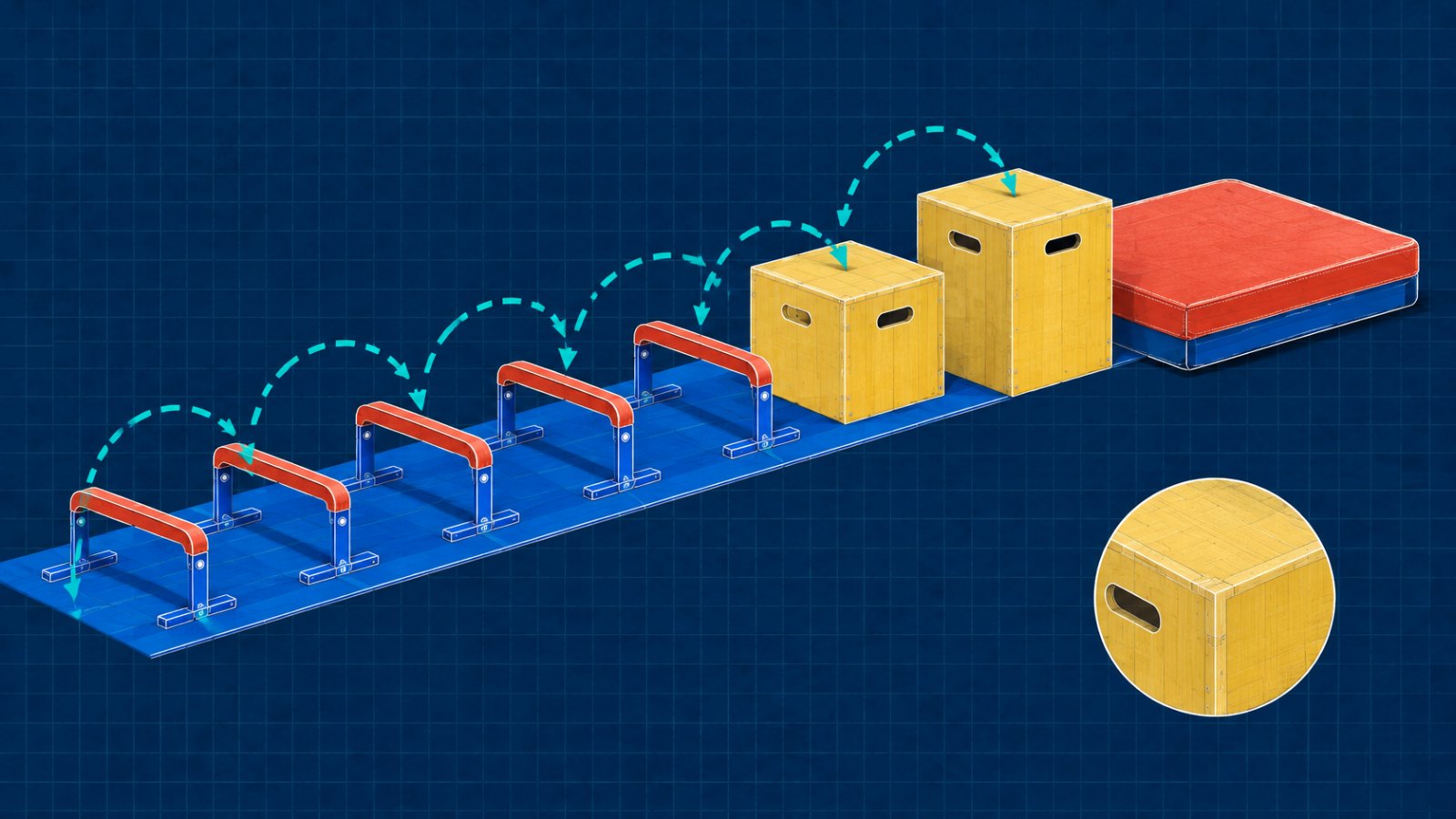
The research says to mix jump types. These cover slow and fast jumps, two legs and one, and need nothing more than a box or a sturdy step. The coaching cues are our take, not research findings.
- Pogo hops. Small, quick bounces off the balls of your feet with stiff ankles. A low-stress way to start and a good warm-up.
- Squat jump. Pause at the bottom of a quarter-to-half squat, then jump as high as you can with no dip. Trains the push without the bounce.
- Countermovement jump (box jump with step down). Dip and jump straight up onto a box, then step down rather than jumping down. The box limits landing stress.
- Broad jump. Jump forward as far as you can and stick the landing.
- Tuck or hurdle jumps. Repeated jumps with short ground contact. Add these after a few weeks.
- Single-leg bounds. Long, springy strides from one leg to the other. More demanding; save for the second block.
- Depth jumps. Step off a low box and jump the moment you land. The most intense option; see our depth jump guide before adding them.
How many jumps per session?
Every foot strike counts as a ground contact. The research points to more than 50 jumps per session as a target for larger gains (de Villarreal et al., 2009). Exact beginner and advanced ranges, like 80 to 100 contacts for beginners, come from coaching textbooks, not from controlled trials.
Our take: start around 40 to 60 contacts per session, two sessions a week, and build to roughly 80 to 100 over 8 to 12 weeks. Take a lighter week about every fourth week. Stop a set when your height or landings get sloppy, because tired jumps train the wrong thing.
A sample 12-week progression
This is our programming, built from the findings above, not a tested protocol:
- Weeks 1 to 4: pogo hops, squat jumps, box jumps with step down, broad jumps. About 40 to 60 contacts per session.
- Weeks 5 to 8: add tuck or hurdle jumps and single-leg bounds. About 60 to 80 contacts.
- Weeks 9 to 12: pair a heavy squat set with jumps (complex training) and add low depth jumps if everything has felt fine. About 80 to 100 contacts. Retest your jump at the end.
The Vertical Jump Planner builds this out with exact sets, reps and contact counts for your equipment, and pairs it with the lifting that goes with it.
Plyometrics plus lifting
Plyometrics work on their own, but you’ll likely get more by keeping heavy squats in. A 2026 network meta-analysis found pairing heavy lifting with jumps (complex training) added 2.50 cm of countermovement jump height over lifting alone (Zhao et al., 2026). Full guide: How to Jump Higher: What the Research Says.
FAQ
How often should I do plyometrics for vertical jump?
Two to three sessions a week is what most studies used (Slimani et al., 2016). Two is plenty if you also lift legs.
How long until I see results?
Plan on at least 10 weeks. Programs longer than 10 weeks showed clearly larger effects than shorter ones.
Should I wear a weighted vest for jumps?
Not for jump height. Weighted plyometrics didn’t beat regular plyometrics in the research.
Are plyometrics safe at home?
Use a non-slip surface with some give, such as rubber gym flooring, start with low-impact jumps, and step down from boxes rather than jumping down. If you have knee, ankle or back pain, see a clinician first.
Sources checked against PubMed on November 10, 2026. This is training information, not medical advice.