
This guide is researched from manufacturer spec pages and manuals, retail prices and published cost guides, checked October 13, 2026. Disclosure: this guide contains affiliate links, and Hypertrophy Protocol may earn a commission at no extra cost to you.
A cold plunge chiller usually beats ice on cost once you plunge more than a couple of times a week, but the gap depends almost entirely on how you use ice. If you dump and refill the tub and re-ice it from tap temperature every time, ice gets very expensive fast: about 77 lb per plunge for a 100-gallon tub going from 65°F to 50°F. If you keep the water, lid it and only top up ice, ice stays cheap for occasional use. The calculator below runs both sides with real chiller wattages and your own electricity rate.
At a glance
| Option | Best for | Key numbers | Up front | Main catch |
|---|---|---|---|---|
| Ice, re-iced from tap each time | Trying the habit, once or twice a week | About 77 lb per plunge (100 gal, 65°F to 50°F); about $84/month at once a week | A tub, if you don’t own one | About $252/month at three plunges a week |
| Ice, lidded reused water | Occasional plunges | About 26 lb per plunge (55°F to 50°F) | A tub and lid | Physics estimate; real tubs gain heat, so expect more ice |
| Chiller (Penguin Cold Therapy, 450 W) | Three or more plunges a week, same temp every time | About $18/month at an assumed 30% run time, 18.3¢/kWh; pays back in about 9 months at three plunges a week | $1,949.99, chiller only | Run time is an assumption; a dedicated circuit costs about $570–$1,000 |
Prices from makers’ and retailers’ pages, checked October 13, 2026. Ice amounts are calculated, not measured. Confirm before ordering.
1. Your tub and how often you plunge
2. The ice route
3. The chiller route
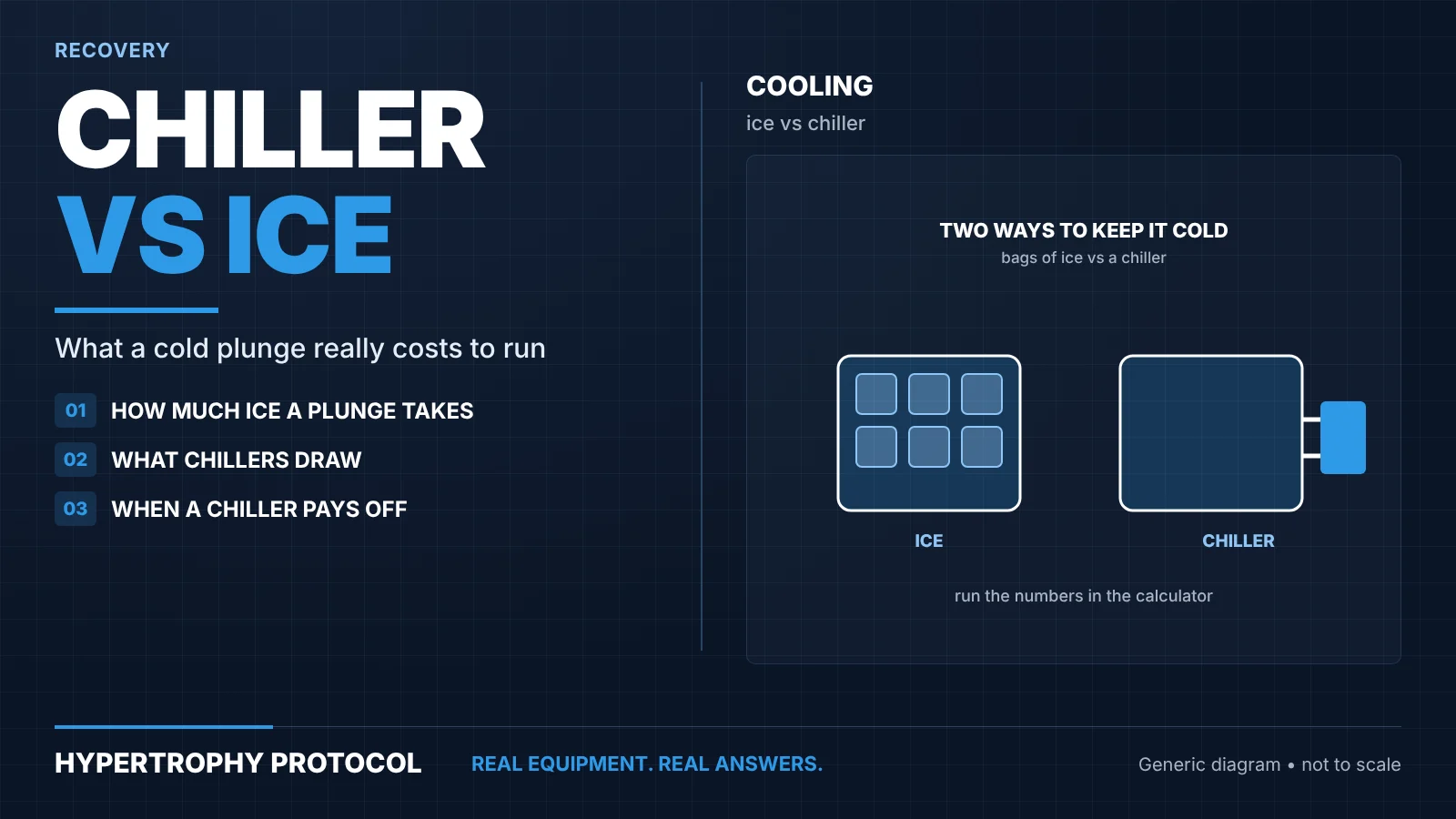
Featured image: AI-generated concept illustration, not a photograph of a specific product or an actual installation.
What does a cold plunge chiller cost to buy?
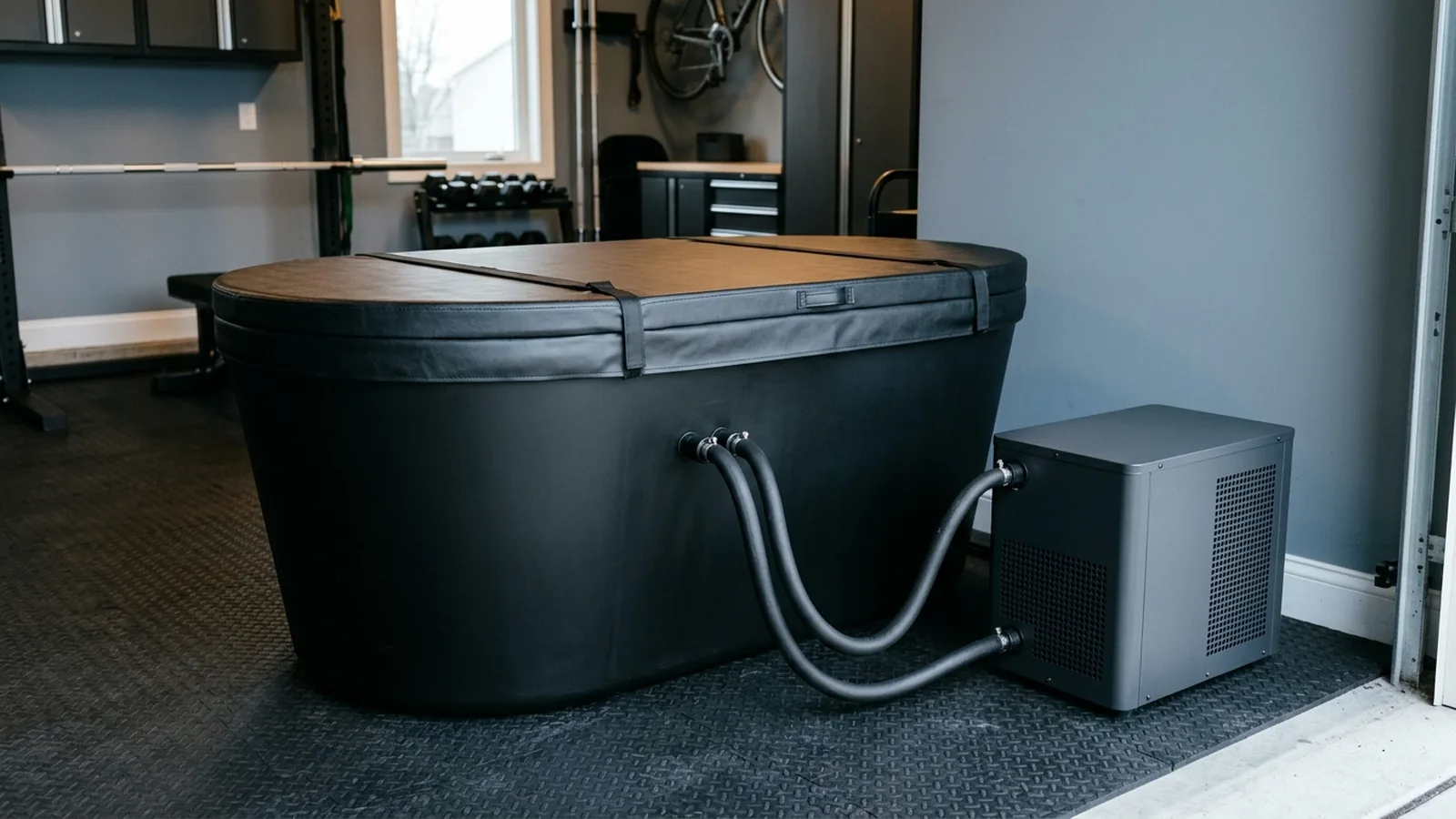
Chillers range from repurposed hydroponics units to all-in-one tubs. Here are five real setups, with the electrical input kept separate from the cooling rating, because the horsepower or BTU number on the box tells you how much heat the unit moves, not how much electricity it uses.
| Setup | Price (Oct 2026) | Cooling rating | Electrical input | Where it can go |
|---|---|---|---|---|
| Active Aqua 1/2 HP (AACH50HP) | $986.53 | 4,020 BTU/h; 92–172 gal | 510 W / 5.4 A rated on Hydrofarm's product listing; manual cooling-test footnote uses 600 W / 5.8 A. Calculator uses the 600 W scenario; confirm your unit or meter total use. | Indoor only |
| Penguin Chillers Cold Therapy Chiller | $1,949.99 (chiller only) | 7,500 BTU/h; 37–100°F | 450 W / 3.9 A, 110–120 V | Outdoor-rated above 32°F; 56 dBA |
| PlungeBox 1/2 HP Water Chiller Pro | $1,799 list; sold out on October 17, 2026, with a $1,299 waitlist price after a $250 deposit | 1/2 HP; to 35°F | 500 W, 110 V | Not stated |
| Ice Barrel 500 + Ice Barrel Chiller | $1,749.99 + $3,999.99 (+$300 shipping) | 1/2 HP; 94 gal tub | 115 V, 15 A fuse; running watts not published | Indoor or outdoor |
| Plunge All-In | $7,990 | 0.75 HP; 105 gal | 120 V; watts not published; dedicated 20 A circuit per manual (product page says 15 A) | Indoor or outdoor; winterize below 32°F |
Manufacturer and retailer pages and manuals, checked October 13, 2026. Ice Barrel’s chiller warranty shows as 1 year on its product page but “limited lifetime” in the cart, and its tub is listed at 94 gal by Ice Barrel and up to 105 gal by Rogue; confirm before buying.
Standalone chillers like the Penguin, Active Aqua and PlungeBox need a tub, and the Penguin and Active Aqua need plumbing to it. If you’re buying a tub anyway, add it to the chiller side in the calculator.
What does a chiller cost to run?
Estimate electricity cost from total system kWh per day × days used × your electricity rate. Compressor cycling, a continuously running pump and standby electronics can all contribute. A plug-in energy meter measures them together; the calculator accepts that measured daily total.
Penguin advertises operating costs as low as $18 a month at $0.12/kWh. That corresponds to 150 kWh a month, but it does not establish a compressor duty cycle. Its manufacturer requires the pump to run continuously. Do not use the calculator’s run-time percentage as a timer setting.
Without a meter reading, the calculator multiplies the selected wattage by an assumed cooling run time of 15%, 30%, 46% or 100%. At 450 W and 30%, that gives 3.24 kWh/day, or about $18/month at $0.183/kWh. This is a simplified scenario that excludes pump and standby use while cooling is off; actual total costs can be higher. At a constant 450 W the same calculation gives about $60/month. Neither estimate is a guaranteed maximum or a prediction for your tub.
Add filters and sanitizer. Plunge lists its 30-micron replacement filters from $46, in 6, 12 and 24 packs; its maintenance guide covers how often to change them. Penguin’s optional kit uses a reusable 150-micron filter. Ozone, UV or chemical sanitizing all have their own running costs; enter yours in the calculator.
How much ice does a cold plunge take?
No one publishes a measured figure, so we calculated it from physics. Each kilogram of ice absorbs 334 kJ as it melts, plus a little more as its meltwater warms to your target. Water gives up 4.186 kJ per kilogram for every degree Celsius it cools. Ignoring heat the tub picks up from the air:
| Tub | Start temp | Target | Ice needed | At $0.25/lb |
|---|---|---|---|---|
| 100 gal | 70°F | 50°F | About 103 lb | About $26 |
| 100 gal | 65°F | 50°F | About 77 lb | About $19 |
| 100 gal | 55°F (lidded, reused water) | 50°F | About 26 lb | About $6 |
Calculated, not measured; checked in Wolfram|Alpha. Real tubs gain heat from the air and your body, so expect to need more. Meltwater also adds about 12 gallons per 100 lb of ice, so leave room in the tub.
Ice prices vary a lot by store. On October 13, 2026 Walmart.com listed a 10 lb bag at $2.00 and a 16–22 lb bag at $4.97; a 2025 price survey found 20 lb bags from $4.49 to $8.11. We use $0.25 a pound as a middle default.
When does a chiller pay for itself?
Using the calculator’s defaults (a 100-gallon tub, 65°F water re-iced to 50°F every plunge, ice at $0.25/lb, a $1,949.99 Penguin chiller at moderate run time):
- Once a week: ice costs about $84 a month, and the chiller pays for itself in about 2.5 years.
- Three times a week: ice costs about $252 a month, and the chiller pays back in about 9 months.
- Every day: ice costs about $587 a month, and the chiller pays back in about 4 months.
Those numbers flip if you reuse lidded water. Starting from 55°F instead of 65°F cuts the ice to about 26 lb a plunge, so at once a week ice may never be worth replacing. Run your own numbers rather than trusting a rule of thumb, including ours.
What changes the answer
Here’s how the three-times-a-week example moves when you change one input at a time (100-gallon tub, $1,949.99 Penguin chiller, 18.3¢/kWh):
| What changes | Ice per month | Chiller per month | Break-even |
|---|---|---|---|
| Defaults: 65°F to 50°F, ice $0.25/lb, moderate run time | $252 | $18 | About 9 months |
| Light chiller run time (15%) | $252 | $9 | About 9 months |
| Heavy chiller run time (46%) | $252 | $28 | About 9 months |
| Ice at $0.40/lb | $403 | $18 | About 6 months |
| Ice at $0.20/lb | $201 | $18 | About 11 months |
| Lidded water, starting at 55°F | $84 | $18 | About 2.5 years |
| Once a week instead of three times | $84 | $18 | About 2.5 years |
At three plunges a week, the chiller’s run time barely matters, because its electricity is small next to the ice bill. How you use ice decides it: the price you pay and whether you re-ice from tap temperature or keep cold, lidded water. These are scenarios from our physics estimate, not measured results, and they leave out the tub, filters and any new circuit, which the calculator lets you add.
The hidden costs on both sides
- Power: Plunge’s manual requires a dedicated 120 V, 20 A circuit, and other makers warn against extension cords. A new circuit typically costs about $570–$1,000 installed (HomeAdvisor, June 2026); the calculator itemizes wire, breaker, labor and permit. Have a licensed electrician confirm the circuit against your chiller’s manual.
- Cold weather: Penguin says to disconnect and drain if temperatures drop to freezing, and Plunge says to winterize below 32°F for 12 hours. A garage that freezes needs a plan.
- Noise and airflow: Penguin rates its chiller at 56 dBA. Chillers dump heat into the room, so leave the clearances the manual lists (Plunge: 16 in on the fan side, 12 in in front).
- Water: both routes need draining and refilling. Ice adds trips to the store and the meltwater volume.
Should you plunge right after lifting?
If muscle growth is the goal, timing matters more than the equipment. A 2024 meta-analysis of eight studies found that cold-water immersion after resistance training may blunt hypertrophy (standardized mean difference about −0.22, with a credible interval that crosses zero and fair-to-poor study quality). A 2026 network meta-analysis of 87 studies found passive recovery ranked best for strength after resistance training. Our cold plunge and muscle growth guide covers timing in detail.
Cold water is also a real stress on the heart. Harvard’s Heart Letter (2025) says cold plunging isn’t advisable for anyone who’s had cardiovascular disease, and that people with heart rhythm disorders or circulation problems should avoid it. Ask your doctor first if any of that applies.
Chiller or ice: which should you choose?
Choose ice if you plunge once or twice a week, can keep lidded water between sessions, or want to find out whether you’ll stick with the habit before spending $1,000 or more.
Choose a chiller if you plunge three or more times a week, hate store runs, or want the same temperature every time. Pick by electrical input and published run-time claims, not horsepower.
Budget for the circuit if your plunge goes in a garage without a free outlet on its own circuit. That can add more than the first year of electricity.
If you’re building out a recovery corner, the garage sauna guide covers the hot side, wiring included.
Sources
- Chillers: Penguin Cold Therapy Chiller and Penguin 1/2 HP HE specifications; Active Aqua manual, Hydrofarm rated specifications and listing; PlungeBox; Ice Barrel 500 and chiller; Plunge All-In, manual, filters.
- Ice: Walmart.com; Hip2Save 2025 survey.
- EIA Electric Power Monthly; HomeAdvisor dedicated circuit cost.
- Research: Piñero et al., European Journal of Sport Science (2024); Yu et al., BMC Sports Science, Medicine and Rehabilitation (2026); Harvard Heart Letter (2025).
1 thought on “Cold Plunge Chiller vs Ice: What Each Really Costs to Run”
Comments are closed.