
Disclosure: As an Amazon Associate, Hypertrophy Protocol earns from qualifying purchases made through Amazon links on this page, which are marked affiliate.
Massage guns are sold as recovery tools, but the research says they’re better at loosening you up than at making you less sore. A massage gun can increase range of motion for a short time without costing you strength, and it may help explosive performance bounce back after hard training. The pooled evidence doesn’t show that it clearly reduces muscle soreness. This guide covers what the studies found, how to use one around lifting, where not to use it, and how much you need to spend.
Short answer
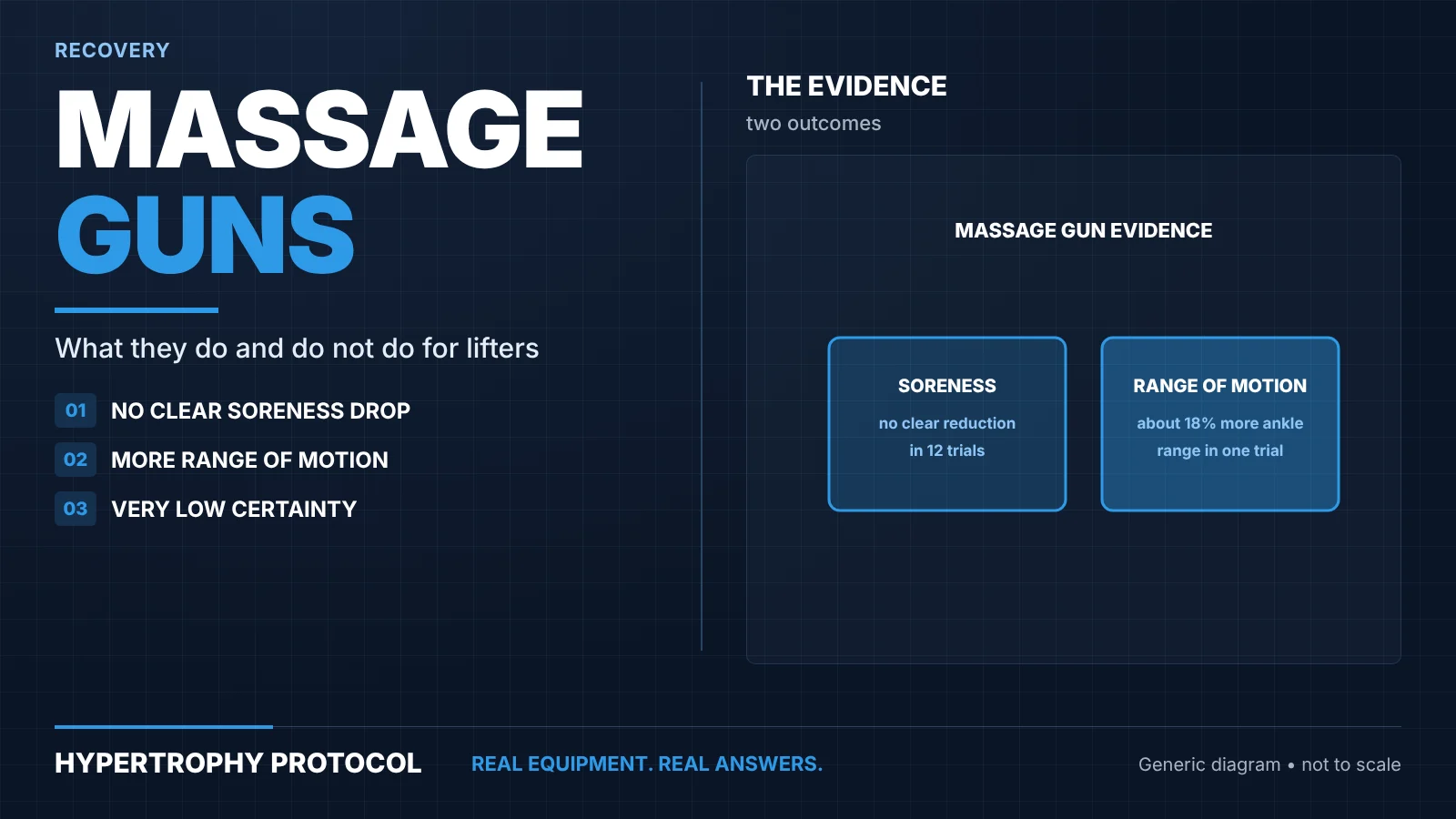
- Soreness: a 2026 meta-analysis of 12 trials found no clear reduction in muscle soreness, and the evidence was very low certainty.
- Range of motion: five minutes on the calves increased ankle range of motion by about 18% in one trial, with no loss of strength.
- Performance: it may help jump performance recover after hard exercise, but it didn’t clearly help maximal strength recover.
- Safety: keep it off the front and sides of your neck, bones, joints and any injury.
- What to buy: a budget gun around $40 to $90 covers what the research supports. Expensive models are quieter and sturdier, not more effective in studies.
At a glance
| Verdict | Good for short-term range of motion; no clear reduction in soreness. |
|---|---|
| Effect size / key numbers | Soreness ES 0.14 (interval crossed zero). Jump recovery ES 0.78. Ankle range +5.4° (about 18%) in one trial. |
| Evidence strength | Low to very low: 12 trials pooled; soreness result very low certainty, jump result low. |
| What to do | Use a minute or two on a tight area before warm-up sets. A budget gun covers what the research supports. |
| Main caveat | Keep it off the front and sides of the neck, bones, joints and injuries. Some studies are industry-funded. |
See the full sections below for sources.
Do massage guns help sore muscles?
Not clearly. The most complete analysis so far is a 2026 meta-analysis of 12 randomised trials by Zhu and colleagues. Percussive therapy did not clearly reduce delayed onset muscle soreness (DOMS) compared with control (effect size 0.14, with a confidence interval that crossed zero), and the certainty of that evidence was rated very low. It also didn’t clearly help maximal strength recover (effect size 0.12, moderate certainty).
Single trials point the same way. In a 2025 study by Ye and colleagues, people did a hard eccentric biceps workout and then had five minutes of percussion massage right after, at 24 hours and at 48 hours. Their soreness, range of motion, arm swelling and strength recovered no faster than in a group that had no treatment.
That may seem odd, because manual massage is the best-supported option for soreness. A 2018 meta-analysis of 99 studies (Dupuy and colleagues) ranked massage first for reducing DOMS and perceived fatigue. A massage gun is a different stimulus: short, fast taps on a small area rather than several minutes of a therapist’s hands. The research so far doesn’t show it delivers the same benefit.
What massage guns do well
Short-term range of motion
In a 2020 trial (Konrad and colleagues), five minutes of percussive massage on the calves with a Hypervolt increased ankle dorsiflexion by 5.4 degrees, about 18%, while a sitting control group didn’t change. Calf strength stayed the same. A 2025 crossover study (Bartik and Pacholek) found percussive massage increased hamstring flexibility more than foam rolling or no treatment, again without improving or harming jump, leg press or hop performance.
That makes a massage gun a reasonable warm-up tool if a tight area limits your position, for example tight calves limiting squat depth. The gain is temporary, so use it shortly before you train.
Recovering explosive performance
The 2026 meta-analysis found percussive therapy improved recovery of countermovement jump height compared with control (effect size 0.78), although the certainty of evidence was low. It also lowered creatine kinase, a blood marker of muscle damage, with very low certainty. The authors’ summary: it “may improve explosive performance recovery” but doesn’t clearly help strength recovery or soreness.
One trial worth knowing about found that 30 seconds of percussion massage on the calf reduced muscle activation during heel raises by about 10% to 12% (Hank and colleagues, 2025). Nobody has shown that this hurts lifting performance, but it’s a reason not to hammer the muscle you’re about to load right before a heavy set.
A note on industry-funded research
Some massage gun studies are funded or co-written by manufacturers. A 2026 trial on youth soccer players that found benefits at half-time, for example, included Therabody employees among its authors. That doesn’t make the results wrong, but it’s one reason to lean on independent meta-analyses rather than single positive studies.
Can a massage gun get rid of muscle knots?
“Knots” usually means a tender, tight spot in a muscle that feels like a lump under the head of the gun. The honest answer is that no trial has tested massage guns on knots specifically. The studies in this guide measured soreness, range of motion and performance after hard exercise, and the best-supported effect is a short-term increase in range of motion, as in the Konrad study on the calves. A knot often feels better for a while after a minute or two of percussion for the same reason a stretch does: the muscle tolerates length better for the next hour or so.
What that means in practice:
- Use a lower speed and a soft or flat head, and work around the spot as well as on it, for one to two minutes. Pressing the hardest head into a tender point at full speed is more likely to leave a bruise than fix anything.
- Expect relief that lasts hours, not days. If the same spot keeps coming back, the cause is usually load, posture or a training imbalance, which the gun does not address.
- A knot that is hot, swollen, numb, or that appeared after an injury is not a job for a massage gun. See the “where not to use” section below and get it checked.
How to use a massage gun around lifting
These are practical suggestions, not tested protocols. The meta-analysis found that longer and shorter treatments were linked to different outcomes, but the authors said those dose findings are preliminary and shouldn’t be treated as prescriptions.
- Before training: spend a minute or two on a tight area that limits your range of motion, then do your normal warm-up sets. Keep it brief on the main muscle you’re about to lift with.
- After training or on sore days: use it if it feels good. Keep the head moving, use moderate pressure, and don’t expect it to speed up recovery much.
- Start on the lowest speed and the softest head, especially on sore or sensitive areas.
Where not to use a massage gun
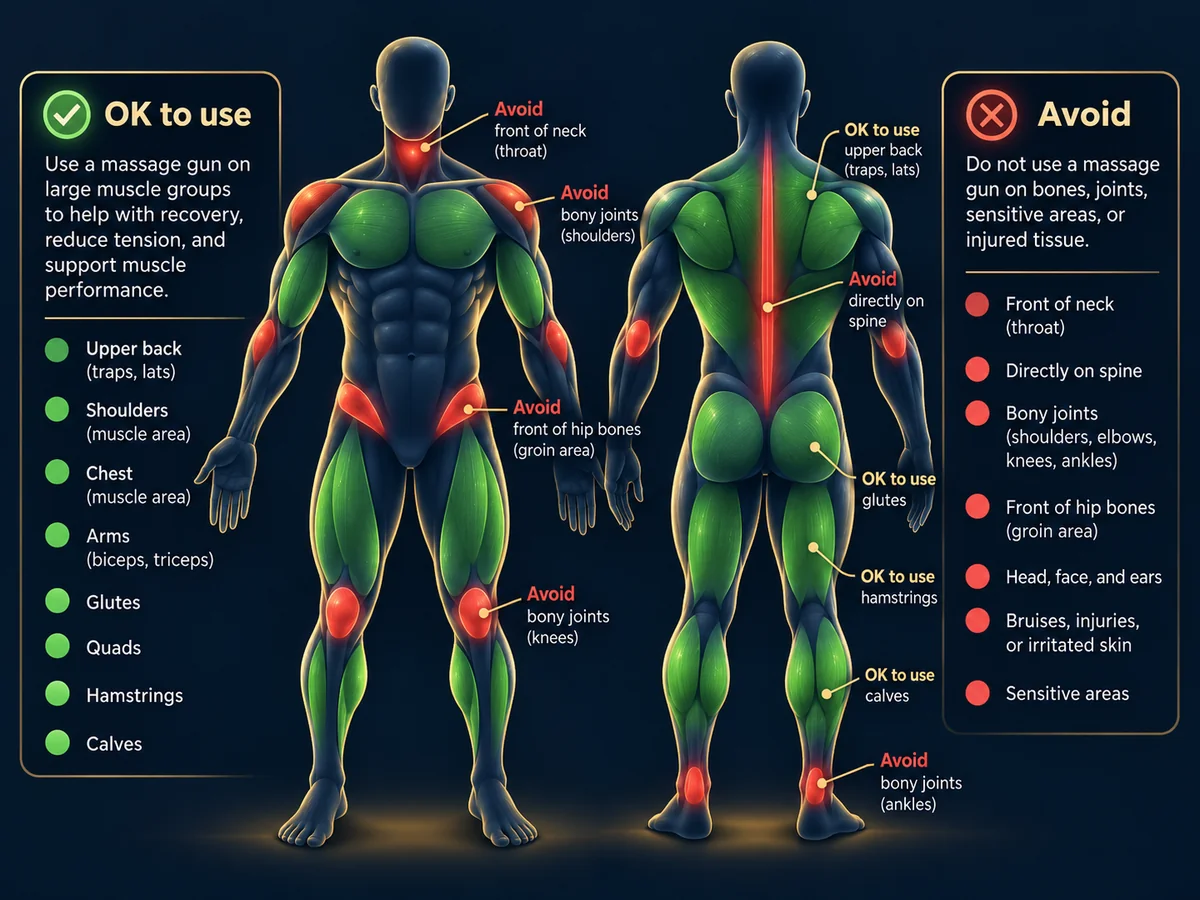
- The front and sides of your neck. In 2025, neurosurgeons reported a man who developed a tear in a vertebral artery and a stroke after using an electric massage device on his neck (Romiyo and colleagues). It was an older device and a single case, but the arteries in the neck are close to the surface. Keep the gun on the muscles of your upper back and shoulders instead.
- Directly on bones, joints or the spine.
- On an injury, bruise, swelling or numb area, or if you have a blood clotting disorder, take blood thinners, or have had recent surgery, unless your clinician says it’s fine.
Which massage gun should you buy?
No study has shown that a more expensive massage gun produces better results. The Konrad trial used a Hypervolt and the meta-analysis included various devices. I own a first-generation Hyperice Hypervolt myself, the same line as the device in that trial.What you get for more money is usually a quieter motor, better build quality, a better grip and a motor that doesn’t stall when you press harder. If you just want something that does what the research supports, a budget gun is enough.
Prices below were checked on Amazon on October 20, 2026, and change often.
| Massage gun | Price | Notes |
|---|---|---|
| TOLOCO Massage Gun (affiliate) | About $40 | Budget pick. Listed at 12 mm amplitude with 10 heads and USB charging. Fine for warm-ups and occasional use. |
| Hyperice Hypervolt Go 3 (affiliate) | About $149 | Compact, 1.6 lb, five speeds and two heads. From the brand whose device was used in the Konrad calf trial (an earlier model). |
| Theragun Relief (affiliate) | About $160 | Theragun’s gentlest model, with three speeds. Good if you want light pressure and a grip that reaches your back. |
| Theragun Prime (6th gen) (affiliate) | About $330 | Rugged build, five speeds, a motor designed not to stall under pressure. Worth it only if you’ll use it daily and want it to last. |
If you’re choosing between a massage gun and a foam roller for recovery, the roller is cheaper and has slightly better support for easing soreness. See our foam rolling guide, and our guide to DOMS and what actually helps sore muscles for how every option compares.
The bottom line
A massage gun is a convenient way to loosen a tight area before training, and in studies so far it hasn’t clearly reduced strength, although protocols varied. It may help explosive performance recover, but it hasn’t been shown to clearly reduce soreness, and it isn’t a substitute for sleep, sensible volume or a real massage. Buy a cheap one if you’ll use it for warm-ups; spend more only for comfort and durability.
Sources
- Zhu Y, Yang L, Liu T, Yao F, Wang Q, Yi Z. Effects of percussive therapy dosages on recovery from acute exercise-induced muscle damage: a systematic review and meta-analysis. Chiropr Man Therap. 2026;34(1). doi:10.1186/s12998-026-00657-9
- Ye X, Hale C, Brown E, et al. Effects of percussion massage therapy on neuromuscular recovery from eccentric exercise-induced muscle damage. J Strength Cond Res. 2025;39(7):745-752. doi:10.1519/JSC.0000000000005110
- Dupuy O, Douzi W, Theurot D, Bosquet L, Dugué B. An evidence-based approach for choosing post-exercise recovery techniques to reduce markers of muscle damage, soreness, fatigue, and inflammation: a systematic review with meta-analysis. Front Physiol. 2018;9:403. doi:10.3389/fphys.2018.00403
- Konrad A, Glashüttner C, Reiner MM, Bernsteiner D, Tilp M. The acute effects of a percussive massage treatment with a Hypervolt device on plantar flexor muscles’ range of motion and performance. J Sports Sci Med. 2020;19(4):690-694. PMC7675623
- Bartik P, Pacholek M. Acute effect of percussion and foam roller massage on flexibility, reactive and explosive strength, and muscular endurance in young adult males: a crossover pilot study. PeerJ. 2025;13:e20304. doi:10.7717/peerj.20304
- Hank M, Michal L, Sugimoto D, et al. Percussion massage therapy reduced EMG activity during standing heel raise. J Musculoskelet Neuronal Interact. 2025;25(3):307-315. doi:10.22540/JMNI-25-307
- Skinner B, Munn EE, Roberts T, Reed RA, Thorpe RT. The effectiveness of passive half-time interventions on simulated second-half performance in elite youth soccer players. J Sports Sci Med. 2026;25(3):617-626. doi:10.52082/jssm.2026.617
- Romiyo P, Furst T, George DD, Ellens N, Bender MT, Harrigan MR. Vertebral artery dissection with cerebellar stroke after use of a percussive massage device: illustrative case. J Neurosurg Case Lessons. 2025;9(21). doi:10.3171/CASE24812