
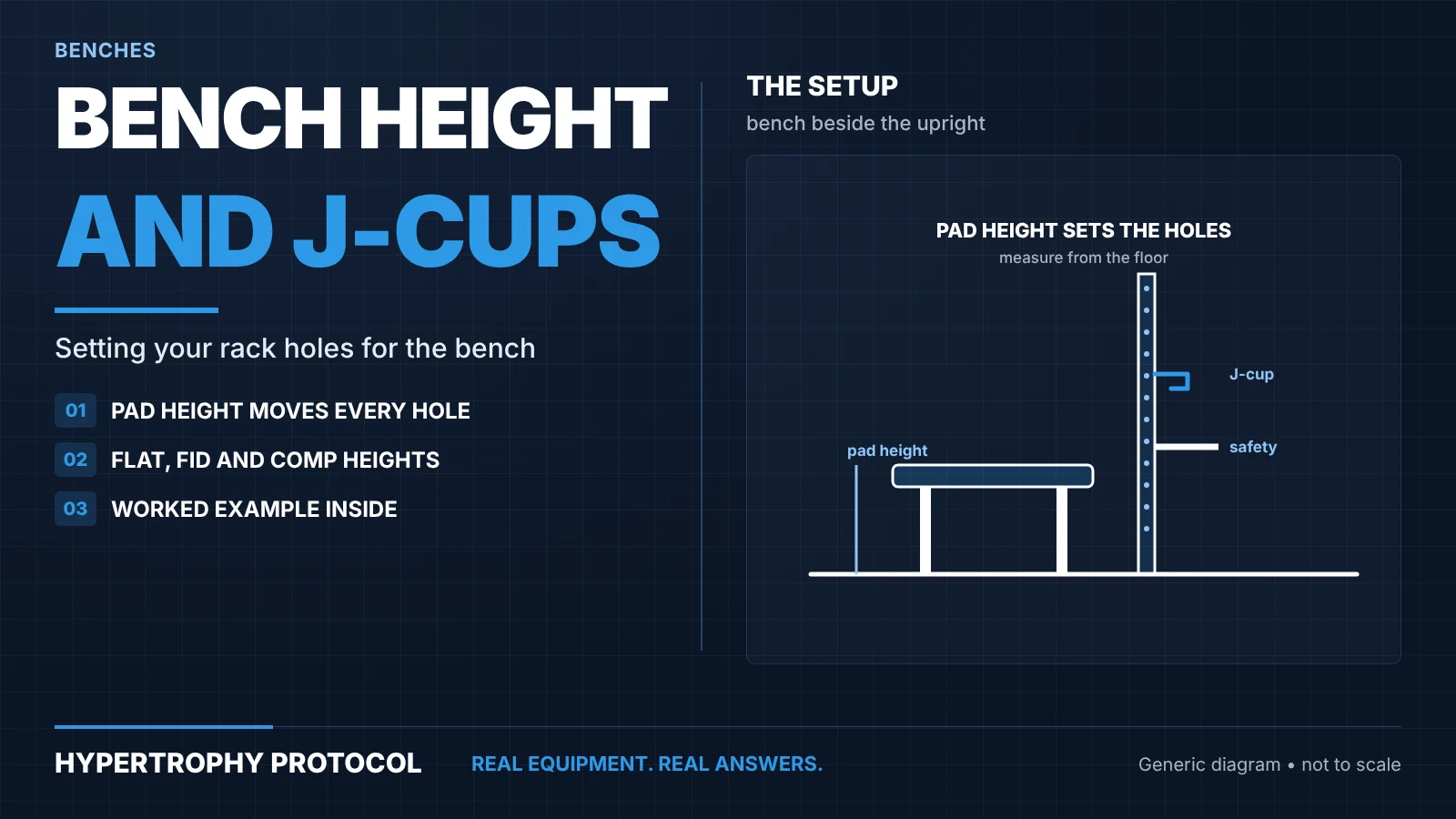
Your rack is set up, and a new flat or FID bench is about to slide into it. Weight bench height decides where your J-cups and safeties land, because every height you measure lying on the pad rises or falls with it. Most flat and adjustable benches checked here sit between 16.9 and 18 inches, and on a rack with 2-inch hole spacing that one-inch spread can decide whether any safety hole fits your bench press.
The fix is to measure your own chest and lockout heights on the bench, then read them against the holes. Every spec below was checked on September 28, 2026, on the maker’s product page or in the IPF rulebook.
What weight bench height do flat, FID and competition benches publish?
That one-inch spread shows up as soon as the numbers sit side by side. Most makers give one height for the flat position, and a few add pad options that change it. Titan labels its figure overall height without saying where it is taken.
| Bench | Type | Published height | In cm | Pad and adjustment | Source |
|---|---|---|---|---|---|
| REP FB-5000 Competition Flat Bench | Competition flat | 16.9″ | 42.93 | 4″ pad; designed to meet IPF height standards | REP |
| TITAN Series Single Post Flat Bench | Flat | 17″ (overall height) | 43.18 | 4″ pad, 14″ wide | Titan |
| Rogue Monster Utility Bench 2.0 | Flat | 17″ standard pad; 19.25″ with Fat Pad; Shorty 15″ or 17.25″ | 43.18; 48.90; Shorty 38.10 | 2.25″ standard pad or 4.5″ Fat Pad | Rogue |
| Rogue Flat Utility Bench 2.0 | Flat | 18″ pad height | 45.72 | 2.5″ pad, 12″ wide | Rogue |
| REP AB-3000 2.0 FID | FID | 17.1″ | 43.43 | Back pad -12 to 85 degrees | REP |
| TITAN Series Adjustable FID Bench | FID | 17.25″ (overall height; reference point not given) | 43.82 | Declines to -20 degrees | Titan |
| Rogue Adjustable Bench 3.0 | Flat to incline | 17.5″ flat | 44.45 | Back pad 0 to 85 degrees, no decline | Rogue |
| Bells of Steel Buzz-Saw Bench | FID | “around 18 in” | 45.7 (maker’s figure) | Back pad 88 to -10 degrees; “slightly above IPF competition bench height” | Bells of Steel |
| Bells of Steel Converter Bench (flat) | Competition flat | “IPF height”, no number given | Not published | Same height standalone or in Hydra and Manticore uprights | Bells of Steel |
The competition rule gives you a reference point. Section 2.6 of the IPF Technical Rulebook sets the bench at “not less than 42 cm and not exceeding 45 cm measured from the floor to the top of the padded surface of the bench without it being depressed or compacted.” That is 16.54 to 17.72 inches, so every published height from 16.9 to 17.5 inches falls inside it, while the 18-inch benches and the Fat Pad option sit above and the standard-pad Shorty sits below.
Look at the last clause of that rule. The reference height is the pad before anyone lies on it, and your body sinks into the foam, so the number that counts for your rack is the one you measure lying down.
Why does an inch of bench height move your J-cup and safety holes?
An inch matters because the bench sets the base for everything you measure on it. Lower the pad and your chest and locked-out arms drop with it, while the holes in the uprights stay put.
Those holes move in fixed steps. Rogue’s RML-390C and Titan’s T-3 have 1-inch spacing through the bench and pull zone and 2 inches elsewhere. REP’s rack guide gives the PR-4000 “2” & 1″ within bench zone” and the PR-5000 a flat 2 inches, so on the PR-5000 a 1.1-inch change in bench height can push your target past one hole without reaching the next.
Safeties are where this bites hardest. Bells of Steel sets bench safeties “just below your chest level while lying on the bench,” and its strap guide has you touch your chest with a normal arch and a big breath, then flatten your arch on a failed rep so the bar comes to rest on the straps. That gives the safety a window with two edges: above your chest with your back flat, and below it with your arch set.
A window narrower than your hole spacing may contain no hole at all. Any stretch at least as long as the spacing always holds one, so a 1.5-inch window is certain to catch a hole on 1-inch spacing and only sometimes on 2-inch. The power rack safeties comparison covers how straps, pins and arms behave once the bar lands.
What should you measure on your own bench before picking a hole?
Because that window belongs to your body, averages will not find it. Set the bench where you press and lie in your normal setup while a helper runs a tape from the floor.
- Arched chest height. Floor to the highest point of your chest with your arch set and a full breath. This is the top of the safety window.
- Flat chest height. The same point with your back flattened against the pad. This is the bottom of the window.
- Lockout height. Floor to the underside of a broomstick held on locked arms where the J-cups sit, not straight above your chest. This stands in for arm length, taken in the position where you unrack.
- Cup lip. On your own J-cups, the rise from where the bar rests to the top of the front lip. The bar has to clear it at lockout to come out.
- Two rack readings. Floor to the top of a safety in one hole, and floor to the bar-resting point of a J-cup in one hole. Add or subtract your hole spacing to get the rest.
Take the rack readings from the rack itself. None of the rack pages checked here gives hole heights from the floor, and where a cup’s cradle sits relative to its pin differs between designs. REP’s Lowered J-Cups 2.0 sit 1 inch below its standard 5000 Series cups in the same hole, and the J-cups guide covers when that pairing earns its place.
Worked example: which holes fit an 18-inch bench and a 16.9-inch competition bench?
Here is how those readings turn into hole choices. The body numbers below are example tape readings, not averages, for a lifter measuring on the Rogue Flat Utility Bench 2.0 and weighing a switch to the REP FB-5000. The rack has 2-inch spacing, with one safety reading at 26.0 inches, one J-cup reading at 43.0 inches and a 1.5-inch cup lip.
| Reading (example) | On the 18″ bench, measured | On the 16.9″ bench, predicted (minus 1.1″) |
|---|---|---|
| Arched chest height | 27.5″ | 26.4″ |
| Flat chest height | 26.0″ | 24.9″ |
| Lockout height at the cups | 46.0″ | 44.9″ |
| Highest usable cradle (lockout minus lip) | 44.5″ | 43.4″ |
On the 18-inch bench, no safety hole works. The window runs from 26.0 to 27.5 inches. The 26-inch hole sits level with the flattened chest, so the bar would land on chest and safeties together, and the 28-inch hole sits above the arched chest, so the bar would never reach you.
The lower bench fixes this by moving you instead of the safety. The window drops to 24.9 to 26.4 inches, and the 26-inch hole now sits 1.1 inches above the flattened chest and 0.4 inches below the arched one. The J-cups stay at 43 inches on both benches, with 1.5 inches of clearance on the taller bench and 0.4 on the lower one.
Safety holes against the window (example readings)
18″ bench, 2″ spacing, window 26.0 to 27.5″:
24″ too low26″ at the flat chest28″ above the arch
16.9″ bench, 2″ spacing, window 24.9 to 26.4″:
24″ too low26″ fits28″ above the arch
18″ bench, 1″ spacing, window 26.0 to 27.5″:
26″ at the flat chest27″ fits28″ above the arch
Treat the right-hand column as a forecast. The two benches carry 2.5-inch and 4-inch pads that may compress differently under you, so repeat the chest and lockout readings once the new bench is in place before you trust a 0.4-inch margin.
When does Westside hole spacing solve it without a new bench?
A lower bench is one fix, and finer holes are the other. Put the same 18-inch bench in a rack with 1-inch spacing through the bench zone and a safety hole appears at 27 inches, 1 inch above the flattened chest and 0.5 below the arched one. The J-cups gain a 44-inch option too, half an inch under the lockout limit.
That only helps if your heights land inside the 1-inch section. Rogue and Titan place it in the bench and pull zone without a height from the floor, and REP’s PR-4000 pages give no range either. The Westside hole spacing guide covers which racks have it and what to ask the maker if your numbers sit near the edge.
Competition gear works in similar steps. The same IPF section requires safety racks “having 10 holes in increments of 2.5 cm,” which is 0.98 inches, so a meet setup gives you close to Westside resolution at the safeties.
Do FID benches and pad upgrades need their own measurements?
The same arithmetic applies to anything that changes what sits under your back, and pad options are the easiest change to miss. Rogue’s Monster Utility Bench 2.0 goes from 17 inches with its standard pad to 19.25 inches with the Fat Pad, a 2.25-inch jump that moves you more than one full hole on 2-inch spacing.
FID and adjustable benches publish only their flat height. REP’s AB-3000 2.0 back pad runs from -12 to 85 degrees, Titan’s FID reaches a 20-degree decline and the Buzz-Saw goes to -10, yet none of those pages gives a pad height at an angle. If you press on an incline or decline inside the rack, take the full set of readings at each angle you use.
Which bench height should you buy for your rack?
With the readings in hand, the choice depends on your rack and how you press. Find the line that matches your setup.
- Your rack has 2-inch spacing and no safety hole fits your window: a bench about an inch taller or shorter moves the window without touching the rack. Predict the new heights from the published figure, then confirm them on the new bench.
- Your rack has Westside spacing: bench height matters less, as long as your safety and J-cup heights fall inside the 1-inch section. Ask the maker where that section starts and stops.
- You want to train on a meet-height bench: pick one published between 16.54 and 17.72 inches, such as the FB-5000 or the TITAN Series flat, and remember the IPF measures the pad uncompressed.
- You press on inclines or declines in the rack: treat flat height as a minor factor and measure every angle you plan to use.
Once you know the holes you need, run your rack through the Rack Attachment Fit Checker to confirm the J-cups and safeties you plan to set there fit your uprights and pin size. If a maker leaves out a height you need, ask for it before you order.
Sources checked September 28, 2026. Manufacturers change specs; confirm on the product page before ordering.