
Last reviewed October 20, 2026. This guide is based on published research, and every number below comes from the study linked beside it. This is general training information, not medical advice.
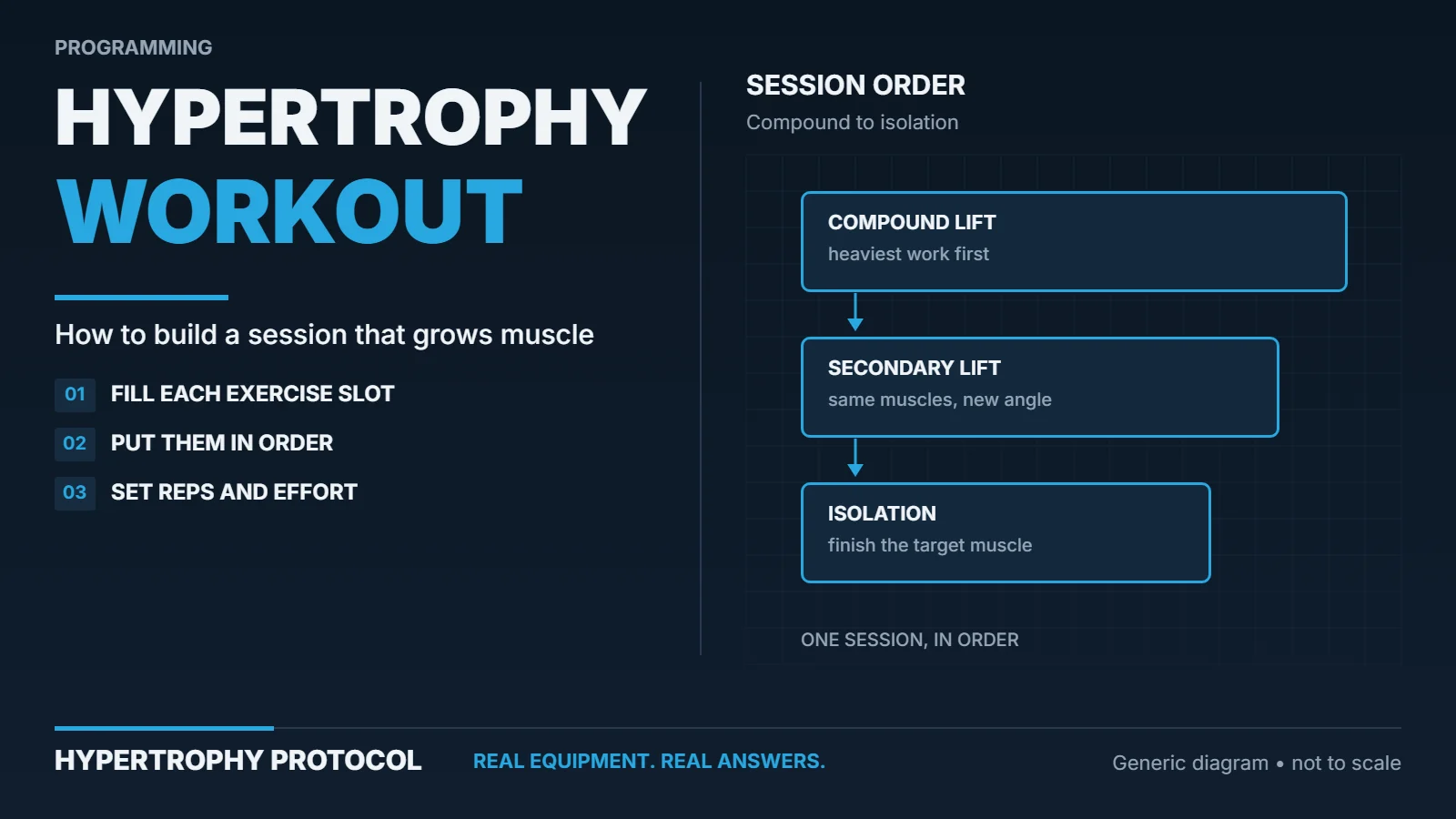
A hypertrophy workout that grows muscle has four to seven exercises and about 12 to 20 hard working sets. Put the lift you most want to get stronger at first, use 6 to 12 reps on compound lifts and 10 to 20 on isolation lifts, end most sets 0 to 3 reps short of failure, and rest about 2 to 3 minutes on big lifts and 1.5 to 2 minutes on small ones. Ramp-up sets go on the first lift only and don’t count as work.
That structure holds for any style of hypertrophy training, full body or split, and none of it needs a commercial gym. This guide covers how to build one session. For a full 12 weeks of sessions laid out for you, see the hypertrophy training program for a home gym.
What does a hypertrophy workout look like, slot by slot?
Most good muscle building workouts follow the same shape: big lifts first while you’re fresh, then smaller lifts that target what the big ones miss. Fill the slots below with exercises for whichever muscles the day covers.
| Slot | What goes there | Sets | Reps | Reps in reserve | Rest |
|---|---|---|---|---|---|
| 1 | Main compound lift (squat, bench press, Romanian deadlift, pull-up) | 3 | 6–10 | 1–3 | 2–3 min |
| 2 | Second compound for a different movement (after a squat, a press or a pull) | 3 | 8–12 | 1–2 | 2–3 min |
| 3 | Third compound or a one-side lift (split squat, one-arm row, incline dumbbell press) | 2–3 | 8–12 | 1–2 | 2 min |
| 4 | Isolation lift that stretches the muscle (fly, incline curl, overhead triceps extension, leg curl) | 2–3 | 10–15 | 0–2 | 1.5–2 min |
| 5–6 | Small muscles: side delts, arms, calves; supersets are fine here | 2–3 each | 12–20 | 0–1 | 1.5 min after each pair |
That template lands at about 12 to 18 working sets. The numbers aren’t magic. They are where the research on effort, load and rest points, and they fit a session of about an hour.
What order should the exercises go in?
For muscle growth, order matters less than most people think. For strength on a given lift, it matters a lot. A 2021 meta-analysis of 11 studies found no effect of exercise order on hypertrophy (effect size 0.03, p = 0.862). Strength gains were largest in whichever exercises came first in the session: compound-lift strength rose more when compound lifts came first (effect size 0.32), and isolation-lift strength rose more when isolation lifts came first (0.58) (Nunes et al., 2021).
So put first whatever you most want to progress. For most people that is a heavy compound lift, for two practical reasons. It is the lift fatigue hurts most, and it is the one where a sloppy rep late in a session carries the most risk. If a lagging muscle is your priority, such as side delts or calves, opening with it is a fair choice, and the order research says growth elsewhere won’t suffer.
How many exercises and sets should one session have?
Four to seven exercises and roughly 12 to 20 working sets cover most sessions. The real target is weekly sets per muscle: growth keeps rising as weekly sets rise, with diminishing returns, and indirect sets such as presses for the triceps count best at about half value (Pelland et al., 2026). The hypertrophy training program covers the weekly volume research and how many sets each muscle gets per week.
A session is your weekly sets divided by how many times you train each muscle. If you want about 12 sets a week for your chest and you train it twice, each session needs about 6. A practical ceiling many lifters use is about 8 hard sets for one muscle in one session, because sets past that are done tired. That is a rule of thumb, not a tested cutoff. Spreading the work over more days is the easy fix.
One or two exercises per muscle per session is enough. A compound lift plus one isolation lift, chosen to load the muscle in a different position, covers most muscles well.
What rep range should you use?
Almost any range from about 6 to 20 or more will grow muscle if the set is hard enough. A 2017 meta-analysis of 21 studies, with every set taken to failure, found similar growth with loads at or below 60% of a one-rep max as with heavier loads; heavier loads won only for max strength (Schoenfeld et al., 2017).
Effort is the condition attached to that finding. In an 8-week trial in 25 untrained men, a 30% load grew the quads 7.8% when sets went to failure but only 2.8% when they stopped short, while an 80% load grew them about 8% either way (Lasevicius et al., 2022). Light sets have to be pushed much closer to failure to count.
In practice, use 6 to 12 reps on compound lifts and 10 to 20 on isolation lifts. Long sets of squats tend to end from breathing and general fatigue before your legs are near failure. Very heavy curls and lateral raises are hard to do with clean form.
How hard should each set be?
Most working sets should end 0 to 3 reps short of failure. That gap is called reps in reserve: two in reserve means you could have done two more clean reps.
The research supports getting close without needing to hit failure every time. A 2023 meta-analysis of 15 studies found a trivial edge for training to failure (effect size 0.19, 95% CI 0.00 to 0.37), and no clear edge when only true momentary failure was compared with non-failure (Refalo et al., 2023). A 2024 series of meta-regressions found muscle growth improved as sets ended closer to failure, while strength gains didn’t depend on it (Robinson et al., 2024). Its authors call that analysis exploratory, since reps in reserve had to be estimated.
Use the lift to decide how close to go. Keep barbell squats, bench presses and Romanian deadlifts 1 to 3 reps short, especially if you train alone. Take isolation lifts to 0 or 1 in reserve, often on the last set, where a missed rep just means putting the weight down. Why hard sets matter at the fiber level is covered in mechanical tension and muscle growth.
How long should you rest between sets?
Rest long enough that the next set isn’t cut short by fatigue from the last one: about 2 to 3 minutes on compound lifts and 1.5 to 2 minutes on isolation lifts.
In an 8-week trial, 21 trained men did the same full-body program with either 1-minute or 3-minute rests. The 3-minute group gained more quad thickness, with a trend for the triceps (p = 0.06), and more squat and bench strength (Schoenfeld et al., 2016). A 2024 meta-analysis of 9 studies found a small benefit to resting longer than 60 seconds, and no appreciable difference beyond 90 seconds (Singer et al., 2024). Its estimates leaned toward longer rest for the arms (0.13) and thighs (0.17), but both ranges included zero.
The practical reading: resting under a minute may cost a little growth, and resting longer than 90 seconds doesn’t appear to add any by itself. Big lifts still get 2 to 3 minutes, because that is what it takes to repeat your reps on a heavy squat or press. Time your rests so your rep numbers mean the same thing from week to week.
How should you warm up?
Warm up with a few lighter ramp-up sets on the first lift of the session, then one lighter set before the first exercise for each new muscle. Keep them easy. Their job is to rehearse the movement and confirm the day’s weight, not to add fatigue.
For a bench press with a working weight of 185 lb, a ramp-up might look like this:
| Ramp-up set | Weight | Reps | Share of working weight |
|---|---|---|---|
| 1 | Empty 45 lb bar | 10 | 24% |
| 2 | 95 lb | 5 | 51% |
| 3 | 135 lb | 3 | 73% |
| 4 | 165 lb | 1–2 | 89% |
| Working sets | 185 lb | 6–10 | 100% |
No trial has tested warm-up schemes for muscle growth, so this is a practical pattern rather than an evidence-backed one. Warm-up sets don’t count toward your working sets. If you’re unsure of a plate setup, the Barbell Plate Capacity Calculator shows plates per side for each jump.
Which exercises earn a place in the session?
Pick exercises that let you load the muscle hard, add weight or reps over time, and reach a stretched position. In a 12-week trial in 21 adults, overhead triceps extensions grew the whole triceps 19.9%, against 13.9% for the same movement with the arm at the side (Maeo et al., 2023). Seated leg curls beat lying leg curls for hamstring growth in a similar 12-week trial, 14% against 9% (Maeo et al., 2021).
Those are single, small studies, so use them as tie-breakers. When two exercises are otherwise equal, choose the one that loads the muscle in its stretched position. The guide to training at long muscle lengths covers the rest of that research.
Cables are a convenience, not a requirement; the research comparing machines and free weights is covered in machines vs free weights for muscle growth. One-side lifts like split squats and one-arm rows work well in a home gym because they need less weight (unilateral training for muscle growth). For incline presses, set the bench between 30 and 45 degrees, as the incline bench angle guide explains.
Can supersets save time without costing growth?
Pair muscles that don’t work together, such as curls with triceps extensions or lateral raises with calf raises. Do one set of each back to back, then rest. Each muscle still gets a full rest before its next set, so the effort and rest rules above still hold.
Keep heavy barbell lifts as straight sets. Breathing, setup and safety all suffer when a hard squat or bench set follows another hard set without a break.
What are three sample hypertrophy workouts?
Each sample uses a rack, barbell, plates, an adjustable bench and adjustable dumbbells, with a cable swap noted where it helps. Weights are yours to fill in. Pick reps in reserve from the ranges above, starting at the easy end.
Sample 1: Full-body session (about 50 minutes)
| # | Exercise | Sets × reps | Reps in reserve | Rest |
|---|---|---|---|---|
| 1 | Barbell back squat | 3 × 6–10 | 1–3 | 3 min |
| 2 | Barbell bench press | 3 × 6–10 | 1–3 | 2–3 min |
| 3 | Chest-supported dumbbell row (cable: seated row) | 3 × 8–12 | 1–2 | 2 min |
| 4 | Barbell Romanian deadlift | 2 × 8–12 | 1–2 | 2–3 min |
| 5a | Dumbbell lateral raise | 2 × 12–20 | 0–1 | Superset with 5b |
| 5b | Overhead dumbbell triceps extension | 2 × 10–15 | 0–1 | 1.5 min after each pair |
Sample 2: Upper-body session (about 60 minutes)
| # | Exercise | Sets × reps | Reps in reserve | Rest |
|---|---|---|---|---|
| 1 | Incline dumbbell press, 30–45° | 3 × 8–12 | 1–2 | 2–3 min |
| 2 | Pull-up or chin-up (cable: lat pulldown) | 3 × 6–12 | 1–2 | 2–3 min |
| 3 | One-arm dumbbell row | 3 × 8–12 each side | 1–2 | 2 min |
| 4 | Flat dumbbell fly (cable: cable fly) | 2 × 10–15 | 0–2 | 1.5–2 min |
| 5 | Dumbbell lateral raise | 3 × 12–20 | 0–1 | 1.5 min |
| 6a | Incline dumbbell curl | 2 × 10–15 | 0–1 | Superset with 6b |
| 6b | Lying dumbbell triceps extension | 2 × 10–15 | 0–1 | 1.5 min after each pair |
Sample 3: Lower-body session (about 50 minutes)
| # | Exercise | Sets × reps | Reps in reserve | Rest |
|---|---|---|---|---|
| 1 | Barbell back squat or belt squat | 3 × 8–12 | 1–3 | 3 min |
| 2 | Barbell Romanian deadlift | 3 × 8–12 | 1–2 | 2–3 min |
| 3 | Dumbbell Bulgarian split squat | 3 × 8–12 each leg | 1–2 | 2 min |
| 4 | Nordic curl (cable: seated leg curl) | 3 × 6–12 | 0–2 | 2 min |
| 5 | Standing calf raise, dumbbell in hand | 3 × 10–15 | 0–1 | 1.5 min |
In my own garage, the squat slot in that lower session is a belt squat. I moved from barbell squats to belt squats to reduce spinal loading as I get older, and I do them with a Beyond Power VOLTRA I while standing on plyo boxes. Either works in the slot at the same sets, reps and effort.
How long should a hypertrophy workout take?
Most sessions built this way run about 45 to 75 minutes. The arithmetic is simple: 18 working sets at roughly 40 seconds of work and 2 minutes of rest each comes to about 48 minutes, plus 5 to 10 minutes of ramp-up sets. Supersets on the small muscles trim that further.
If you’re regularly past 90 minutes, you probably have too many sets for one muscle in one session or too many exercises. Move some sets to another day rather than cutting rest below a minute.
How do you make the next workout better than this one?
Log every working set, then beat it. Add a rep at the same weight and effort, and once all sets reach the top of the rep range, add the smallest weight jump you have. That is double progression, and progressive overload in a small home gym shows how to keep it going when your dumbbells top out. The 12-week hypertrophy training program builds this into a week-by-week plan.
Recovery between sessions decides whether that progression shows up. Set your daily protein with the Protein Calculator.
FAQ
Is a full-body or a split workout better for hypertrophy?
Neither, as long as weekly sets are equal. A 2019 meta-analysis of 25 studies found no significant difference in growth between training frequencies when volume was matched (Schoenfeld et al., 2019). Choose the layout that fits your week.
Do warm-up sets count toward my sets?
No. Count only working sets that end within about 3 reps of failure. Ramp-up sets are deliberately easy, far from the effort the studies above tie to growth.
How many exercises per muscle should one workout have?
One or two. A compound lift plus an isolation lift that loads the muscle in a stretched position covers most muscles. Add a third only if you can’t reach your set target any other way.
Should every set go to failure?
No. Growth improves as sets get closer to failure, but true failure adds little over stopping just short of it. Save failure for the last set of isolation lifts.
Related guides
- Hypertrophy training program for a home gym
- Progressive overload in a small home gym
- Training at long muscle lengths
- Mechanical tension and muscle growth
- Machines vs free weights for muscle growth
- Unilateral training for muscle growth
- Incline bench angle for upper chest
- Barbell Plate Capacity Calculator
- Protein Calculator