
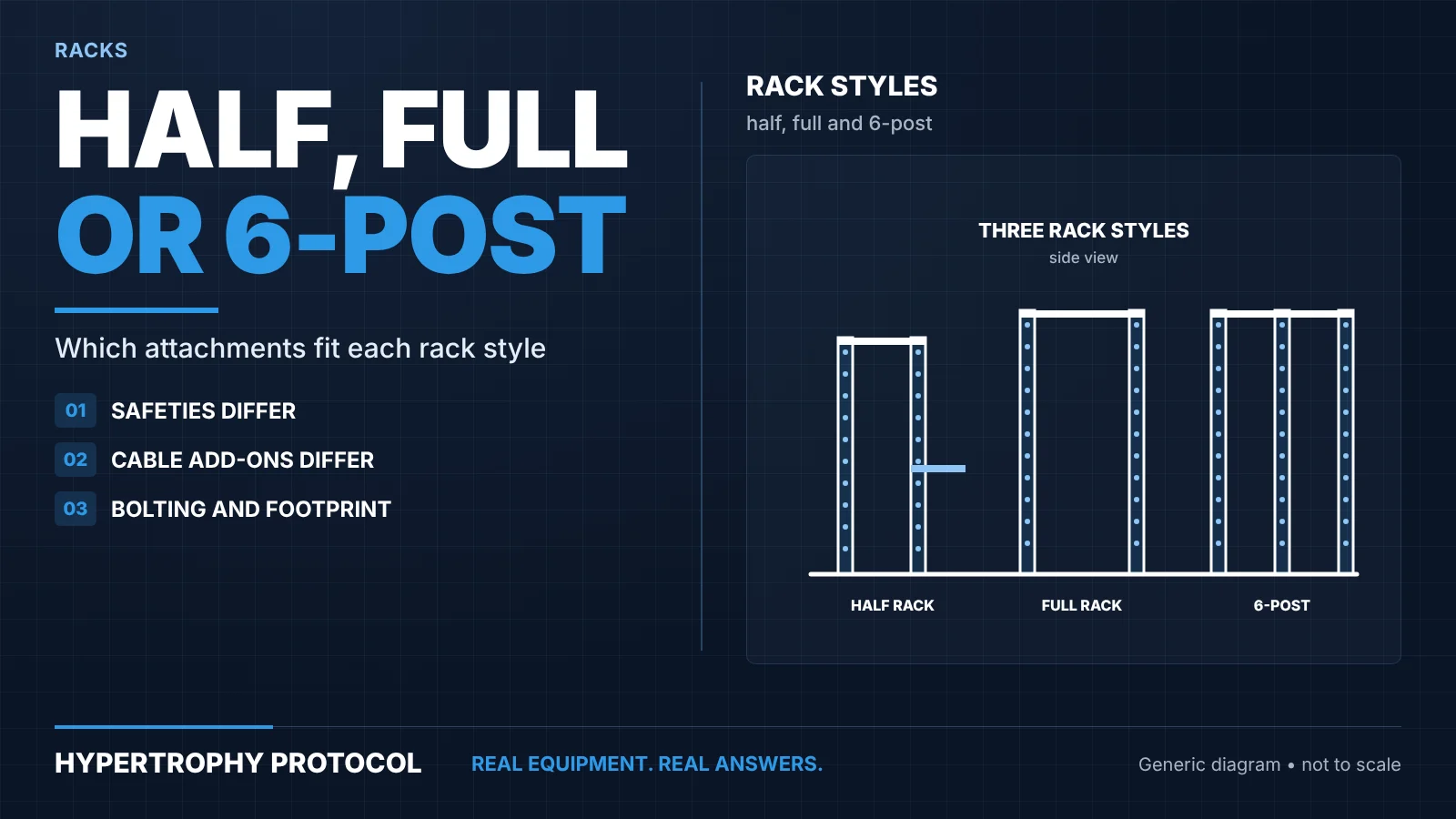
You have floor space picked out and a list of attachments, and the frame style decides how much of that list works. In the half rack vs full rack choice, a half rack leaves the front of the frame open and Rogue’s needs no floor bolts, but Rogue and Titan build their rack-mounted cable towers for bigger frames. A full 4-post rack puts the safeties inside the frame, and a 6-post adds a rear bay for a weight stack or storage, which Rogue and Titan pair with floor bolts.
The comparison below uses one family from each maker that sells all three styles: Rogue’s Monster Lite line, REP’s PR-5000 and Titan’s X-3. Every spec was checked on September 28, 2026, on the maker’s own product, builder or support pages.
At a glance
| Style | Best for | Safeties | Rack-mounted cables | Floor bolts |
|---|---|---|---|---|
| Half rack | The smallest frame for squats, presses and pulls | Spotter arms off the front; the bar lands outside the frame | Narrowest: Rogue’s Slinger says No; REP’s plate-loaded lat and row names half racks | Rogue HR-2 does not need bolting |
| 4-post | Safeties inside the frame and the widest attachment catalog | Pin-and-pipe inside the cage | Rogue Slinger fits; Titan Lat Tower on Bolt Down only; REP Ares 2.0 at 16″ depth | RML-490: bolt unless a stabilizer is added; Titan Flat Foot: no-bolt |
| 6-post | A weight stack or storage in a rear bay | Inside the rack | Rogue weight-stack Slinger in the rear bay (90″ only); REP Ares 2.0 in three builds | RML-690 must be bolted; REP says it “isn’t entirely necessary” with arms inside |
Specs from Rogue, REP and Titan product, builder and support pages, checked September 28, 2026. Confirm before ordering.
What actually changes between a half rack vs full rack?
Those differences come from where you stand and where the uprights sit. On a half rack you lift in front of the frame, so J-cups, spotter arms and most add-ons hang off the front pair of uprights. Rogue’s HR-2 puts a second pair of 3×3 uprights and 17-inch crossmembers behind the front pair, which gives it plate storage and almost a foot and a half of inside depth for benching and rack pulls.
A full 4-post rack puts you inside a cage. Safeties run between the front and rear uprights, and the outside faces of all four uprights stay free for attachments. A 6-post adds a third pair of uprights behind the cage, and that rear bay is where makers put weight stacks and plate storage.
Attachments are still sold by rack series first and style second. A Monster Lite part is built for Monster Lite uprights whether the frame is a half rack or a 6-post, so check the power rack upright sizes guide before you shop by style. For gauge, hole size and the other specs that sit above style, the power rack buying guide covers the rest.
How do the three rack styles compare on paper?
With that layout in mind, the maker pages show how each style handles footprint, floor fixing, safeties and cables. The table keeps each maker’s own wording where it matters.
| Rack | Style | Footprint | Floor fixing | Safeties | Rack-mounted cable option | Source |
|---|---|---|---|---|---|---|
| Rogue HR-2 | Half rack | 48″ x 49″ | Does not need to be bolted | Optional 16″ pin/pipe set or Monster Lite spotter arms | Monster Lite Slinger: No | Rogue |
| Rogue RML-490 | 4-post | 53″ x 53″ | Bolt down unless a stabilizer is added | Pin/pipe safeties included | Slinger: Yes | Rogue |
| Rogue RML-690 | 6-post | 80″ x 53″ | Must be bolted | 43″ pin and pipe included | Slinger: Yes; weight stack version sits in the 24″ rear section, 90″ height only | Rogue |
| REP PR-5000 | Half rack build | 50.8″ wide; full footprint not published | Not given | Not given per build | Ares 2.0: not in its fit list. Lat Pulldown & Low Row: names PR-5000 and the Omni and Apollo half racks | REP |
| REP PR-5000 | 4-post | 50.8″ wide; 16″, 30″ or 41″ crossmembers | Front foot extensions at minimum when spotter arms go outside a free-standing rack | Spotter Arms 2.0 sold separately | Ares 2.0: 16″ depth only, with Mini Front Foot Extensions front and back | REP |
| REP PR-5000 | 6-post | 50.8″ wide; full footprint not published | Bolting or foot extensions “isn’t entirely necessary” with arms inside | Spotter Arms 2.0 inside the rack | Ares 2.0: 16:16, 30:16 or 41:16 builds | REP |
| Titan X-3 Half Rack | Half rack | 48″ x 48″ base | Not given | X-3 Spotter Arms sold separately | Lat Tower: not named | Titan |
| Titan X-3 Flat Foot | 4-post | 50″ x 48″ | No-bolt design | 30″ pin and pipe | Lat Tower: does not fit | Titan |
| Titan X-3 Bolt Down | 4-post | 54″ wide, 30″ or 39″ deep (support article) | Bolt-down uprights | 24″ or 36″ pin and pipe | Lat Tower: fits | Titan |
| Titan X-3 Bolt Down + Extension Kit | 6-upright | Not published; kit adds 24″ or 36″ side bracing | Built on the Bolt Down rack | Not given for the kit | Not given for the 6-upright build | Titan |
Two patterns run through the table. Each maker’s rack-mounted cable option is tied to a 4-post or 6-post frame, with REP’s plate-loaded lat and row the one exception that names half racks. On Rogue and Titan, those cable options also come with a floor-bolt requirement, so the frame that stands free is the one that gives them up.
REP gives a 50.8-inch width and three crossmember depths but no footprint per build, and Titan gives none for the 6-upright extension. Get those numbers from the builder or the maker before you mark out the floor.
Where do the safeties go on each rack style?
Safeties follow the same inside-or-outside split as the uprights. Rogue offers the HR-2 with an optional 16-inch pin-and-pipe set or Monster Lite spotter arms 24.625 inches long, and Titan sells the X-3 half rack with its spotter arms as a separate add-on. Spotter arms reach forward from the front uprights, so the bar lands outside the frame, where a half rack has you squatting.
Arms loaded outside the base also lever the frame forward. REP’s Spotter Arms 2.0 FAQ puts it in practical terms: on the outside of a free-standing 4-post PR-5000, including racks with cable attachments, “at a bare minimum, REP recommends using front foot extensions.”
Inside safeties keep the load within the base. The RML-490 ships with pin-and-pipe safeties “for Squats, Bench & Rack Pulls from any height,” and Titan’s pin-and-pipe set comes in 24- and 36-inch lengths for Bolt-Down racks and a 30-inch length for the Flat Foot. The power rack safeties comparison covers straps, arms and pin-and-pipe in more detail.
Which rack styles can take a cable or pulley add-on?
Cable add-ons are where rack style narrows your options the most. The compatibility chart for Rogue’s Monster Lite Slinger marks the HR-2 Half Rack “No” and both the RML-490 and RML-690 “Yes.” The SLML-6 weight stack version sits in “the smaller 24″ back section” of a 6-post Monster Lite rack and fits the 90-inch height only.
REP spreads its options differently. The Ares 2.0 fits the PR-5000 6-post in 16:16, 30:16 and 41:16 builds and the 4-post only at a 16-inch depth, where it needs Mini Front Foot Extensions on the front and back. The Plate-Loaded Lat Pulldown & Low Row “attaches to a PR-4000, PR-5000, Omni, or Apollo half rack,” and it needs a series-specific Rear Base Stabilizer.
Titan’s Lat Tower mounts between the uprights of T-3 and X-3 Bolt-Down racks. Its product page is blunt: “The Lat Tower does NOT fit within the X-3 Series Flat Foot Power Rack, only the Bolt-Down Series.” It also excludes T-3 and X-3 racks bought before October 2021.
Height matters as much as style for these add-ons. REP’s lat and row must match an 80- or 93-inch rack, and Rogue’s rack-mount lat pulldown seat excludes 108-inch Monster Lite uprights. Check the rack height and ceiling clearance guide before you pick an upright height.
Do you need to bolt the rack to the floor?
The bolt question follows the same line as the cable options. Rogue is the most direct: the HR-2 “does not need to be bolted to the floor,” the RML-490 must be bolted “unless stabilizer is added,” and the RML-690 “must be bolted to the floor before use.” Any Monster Lite rack running a Slinger “must be securely fastened to the floor for use,” whatever its style.
Titan splits the X-3 4-post in two. The Flat Foot is built for “a stable, no-bolt setup,” while the Extension Kit turns the Bolt Down rack into “a 6-upright cage.” The X-3 half rack page gives no bolting instruction either way.
REP leaves more to you. Inside a 6-post, bolting down or adding foot extensions “will increase rack stability, but isn’t entirely necessary,” and REP’s flat-foot half racks, the Omni and Apollo, need no front foot extensions. Of the three makers, REP is the only one whose cable attachments here ask for foot extensions or a base stabilizer rather than floor bolts.
How much floor does each rack style take up?
Footprint is the last trade-off, and it grows with each pair of uprights. In Rogue’s Monster Lite line, stepping from the HR-2 to the RML-490 adds 4 to 5 inches in each direction, while the RML-690 runs 27 inches longer than the RML-490. Titan’s half rack and Flat Foot differ by only 2 inches, so on the X-3 the 4-post costs you almost no extra floor.
Storage can widen any of these. REP’s 6-post in-rack shelves add 5.4 inches of depth, off-rack shelves add 46 inches of width per side, and the wing add-on adds 63.3 inches per side. The plate storage guide covers what each approach does to your floor plan.
A half rack also saves less space than its base suggests. You lift in front of it, so leave room ahead of the uprights for the bar, the plates and the spotter arms.
Which rack style fits your attachment plans?
Put together, the choice turns on the one attachment you won’t give up. Find the line that matches your plans.
- You can’t drill the floor: a Rogue HR-2, a Titan X-3 Flat Foot or a REP build with foot extensions. REP’s cable pages ask for foot extensions or a base stabilizer, not floor bolts; on Rogue and Titan, you give up the rack-mounted cable tower.
- You want safeties inside the frame and the widest attachment catalog: a 4-post. Bolt it down, or add the maker’s stabilizer or foot extensions, if you plan to hang spotter arms or a cable attachment off it.
- You want a weight stack or lat tower built into the rack: a 6-post or a bolt-down 4-post. On Rogue and Titan, that means anchoring to the floor.
- You mostly squat, press and pull and want the smallest frame: a half rack with spotter arms, keeping in mind that its cable choices are the narrowest here.
Next, put your short list into the Power Rack Comparison Tool and compare the frames side by side before you order. Confirm any footprint the maker doesn’t publish with the maker directly.
Sources checked September 28, 2026. Manufacturers change specs; confirm on the product page before ordering.