
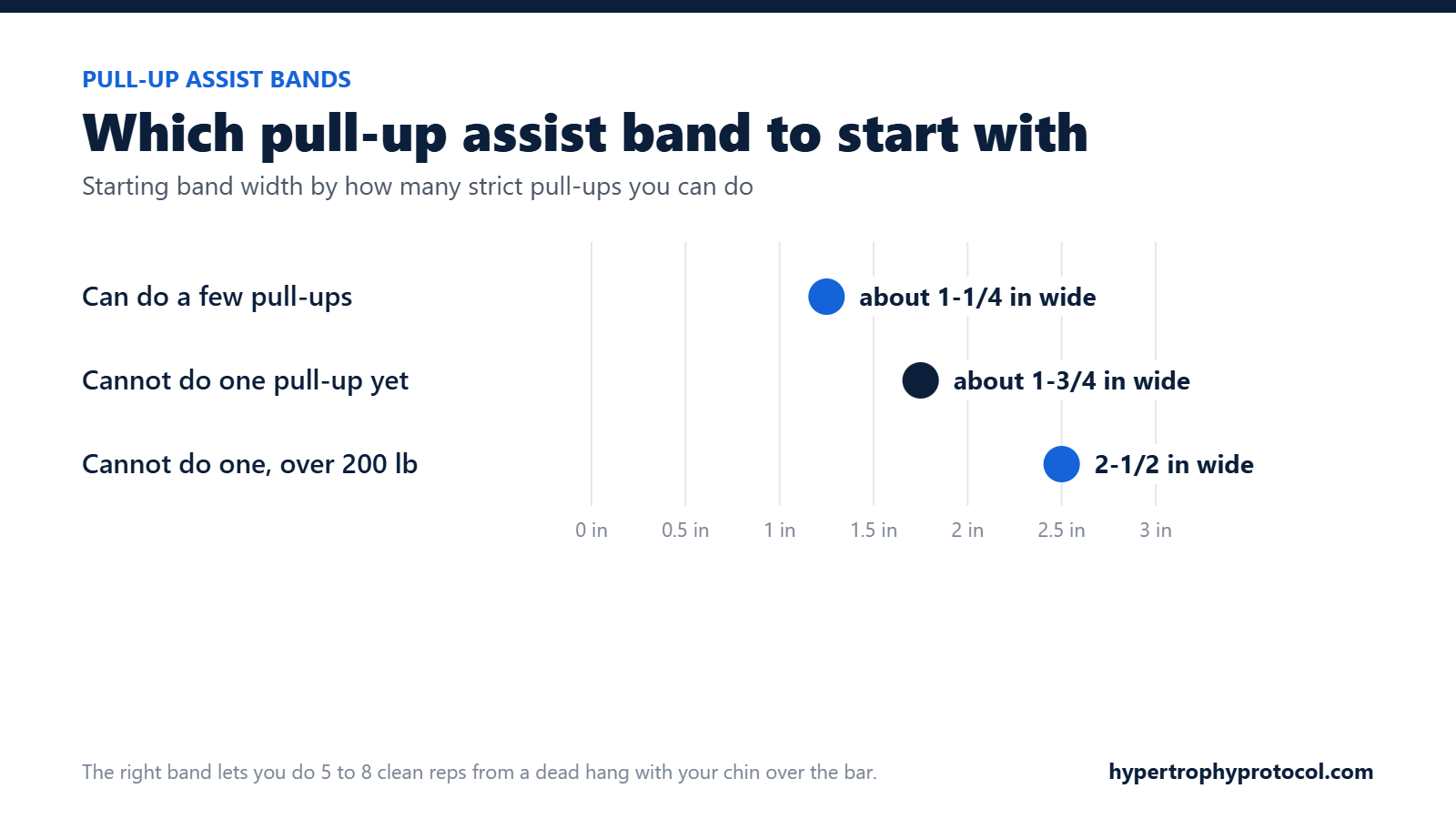
Pick a pull-up assist band by how many strict pull-ups you can do and how much you weigh, not by its color. If you cannot do one pull-up, start with a band about 1-3/4 inches wide, or 2-1/2 inches if you weigh over 200 lb. If you can do a few, start with a band about 1-1/4 inches wide. The right band is the one that lets you do 5 to 8 clean reps from a dead hang with your chin over the bar.
Band specs checked on each maker’s page on November 7 and November 9, 2026. Pound ranges are the makers’ own figures.
Starting band by bodyweight and reps
This is a starting point, built on the band widths each brand publishes and on REP’s own descriptions of which band suits which lifter. Bodyweight, arm length and how you set up the band all change the help you get, so test the band before you buy the next one.
| Where you are now | Band width to start with | Rogue Monster | Serious Steel 41 in | REP (38 in) | Titan |
|---|---|---|---|---|---|
| No pull-ups yet, over about 200 lb | About 2-1/2 in | #5 purple, 95 lb | #5 black, 60 to 150 lb | Heavy blue, 60 to 150 lb | Blue, 60 to 150 lb |
| No pull-ups yet, under about 200 lb | About 1-3/4 in | #4 black, 65 lb | #4 green, 50 to 120 lb | Medium green, 40 to 110 lb | Green, 50 to 120 lb |
| 1 to 4 strict pull-ups | About 1-1/8 to 1-1/4 in | #3 green, 40 lb | #3 blue, 25 to 80 lb | Light purple, 30 to 80 lb | Purple, 25 to 80 lb |
| 5 or more, adding sets and volume | About 1/2 to 0.85 in | #1 red, 18 lb or #2 blue, 30 lb | #2 red, 10 to 50 lb | X-Light black, 20 to 60 lb | Black, 10 to 50 lb |
REP describes its Light purple band as light pull-up assistance, its Medium green band for intermediate and lightweight beginners, and its Heavy blue band for beginner pull-ups and people who weigh over 200 lb. Serious Steel tells buyers to choose by bodyweight and the number of unassisted reps they can already do. Colors do not match between brands, so order by width; the band brand comparison lines every width up side by side.
How a band helps, and where it does not
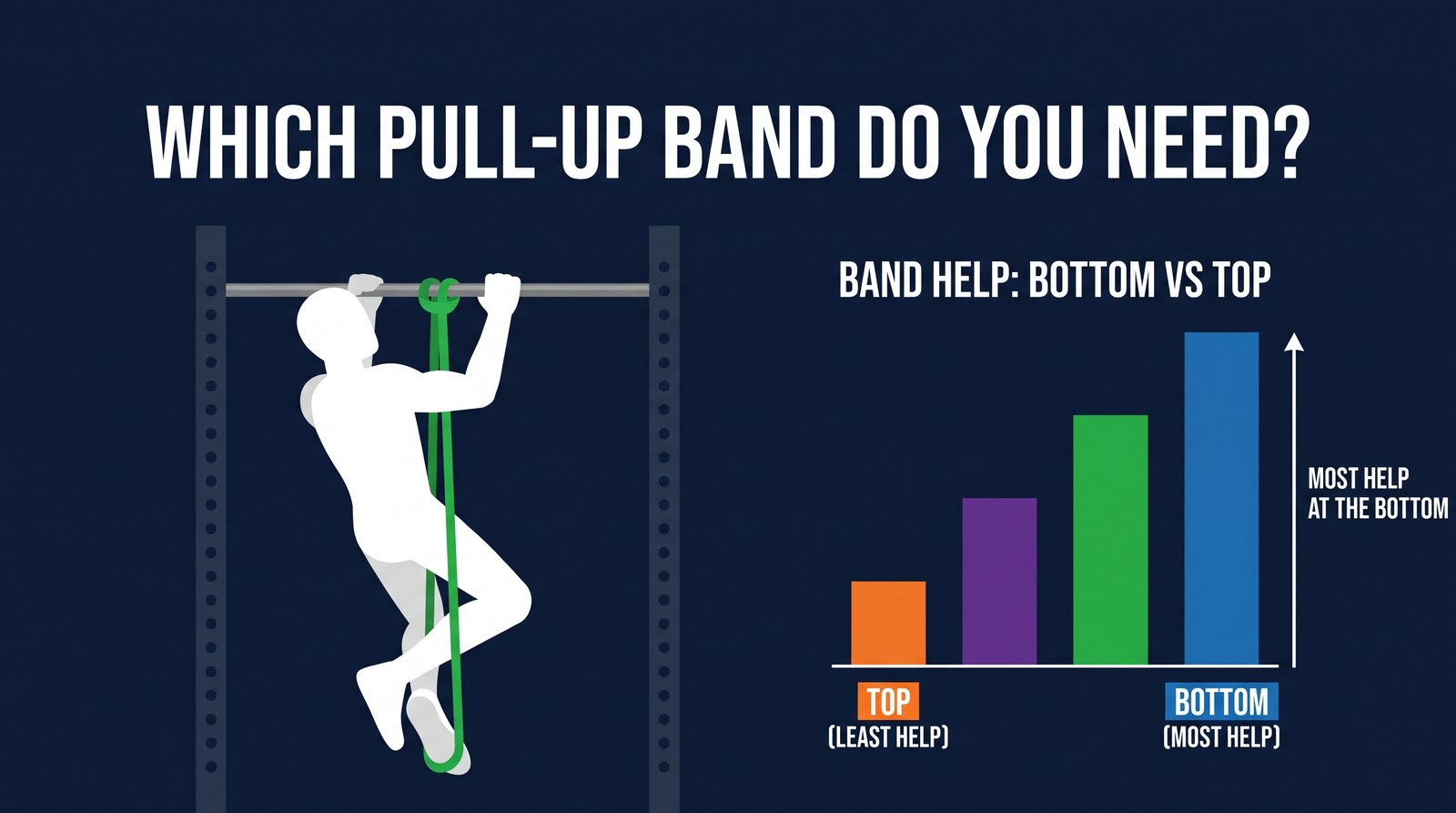
A band pulls harder the further it stretches. At the bottom of a pull-up, hanging with straight arms, the band is stretched the most and gives the most help. As you pull up, it shortens and the help fades, so it gives the least help near the top, which is where many people stall. That is why a band that makes the first half easy can still leave you stuck below the bar.
- Foot or knee. A foot in the loop stretches the band further than a knee, so it gives more help. Knee is a step toward less assistance with the same band.
- Your height matters. The band stretches from the bar to your foot or knee, so a taller lifter stretches the same band further at the bottom and gets more help from it than a shorter lifter does.
- Estimate it. Measure the band’s length at the bottom and the top of your rep and run both through the band tension calculator to see roughly how much it is lifting at each point.
How to test a band
- Choke the band around the bar: loop it over, pull one end through the other and tighten it in the middle of the bar.
- Step into the loop with one foot, or kneel into it, while holding the bar. Use a box rather than jumping.
- From a dead hang, do as many full reps as you can with your chin clearing the bar and no kipping.
- If you get 5 to 8 clean reps, keep the band. Fewer than 3, go one width heavier or switch from knee to foot. More than 12, go one width lighter.
A simple plan from banded to strict
Practice pull-ups two or three times a week, with a day off between sessions. Each session, do 3 or 4 sets of 5 to 8 reps with the band, stopping each set a rep or two short of failure. Rest about 2 minutes between sets.
- Add reps first. When you can do 4 sets of 8, switch from foot to knee, or drop to the next lighter band.
- Combine two thin bands for a step between widths, then remove one.
- Add slow negatives without the band at the end of a session: jump or step to the top and lower yourself over 3 to 5 seconds, for 2 or 3 sets of 2 or 3 reps.
- Test a strict rep every couple of weeks, fresh, at the start of a session.
The same bands help with dips and muscle-ups, and they double as resistance for rows, presses and squats; see how to build muscle with resistance bands.
Safety checks
- Inspect the band before every session for nicks, thin spots and sticky or chalky patches. A band that snaps under load can whip back toward your face.
- Choke the band tight on a smooth part of the bar, away from sharp knurling or welds, and use a band guard if your bar has rough edges.
- Step in from a box and keep your foot centered in the loop so it cannot slip off at the bottom.
- TheraBand’s instructions warn against stretching a band past three times its resting length.
- Latex allergy: REP sells latex-free TPE loop bands from 5 to 20 lb up to 20 to 85 lb; the resistance band database lists materials for each brand.
Pull-up assist band FAQ
What resistance band should I use for pull-ups?
If you cannot do a pull-up, start with a band about 1-3/4 inches wide (about 2-1/2 inches if you weigh over 200 lb). If you can do 1 to 4 pull-ups, start with about 1-1/8 to 1-1/4 inches. Keep the band that gives you 5 to 8 clean reps.
Which color pull-up band is the strongest?
There is no standard. Black is a 1-3/4 inch band at Rogue, a 2-1/2 inch band at Serious Steel, a 0.85 inch band at REP and a light band at Titan. Go by width and the maker’s pound range.
Are band-assisted pull-ups worth doing?
Yes, as a way to practice the full movement for more reps than you can do strict. Because the band helps least near the top, add slow negatives and strict attempts so the hardest part of the rep gets trained too.
Foot or knee in the band?
A foot stretches the band further, so it gives more help. Moving from foot to knee is a simple way to reduce assistance before you buy a lighter band.
Related: band brand comparison · band tension calculator · resistance band database · Progressive overload in a small home gym