
Disclosure: this guide contains a Beyond Power referral link, and Hypertrophy Protocol may receive referral credit if you buy through it.
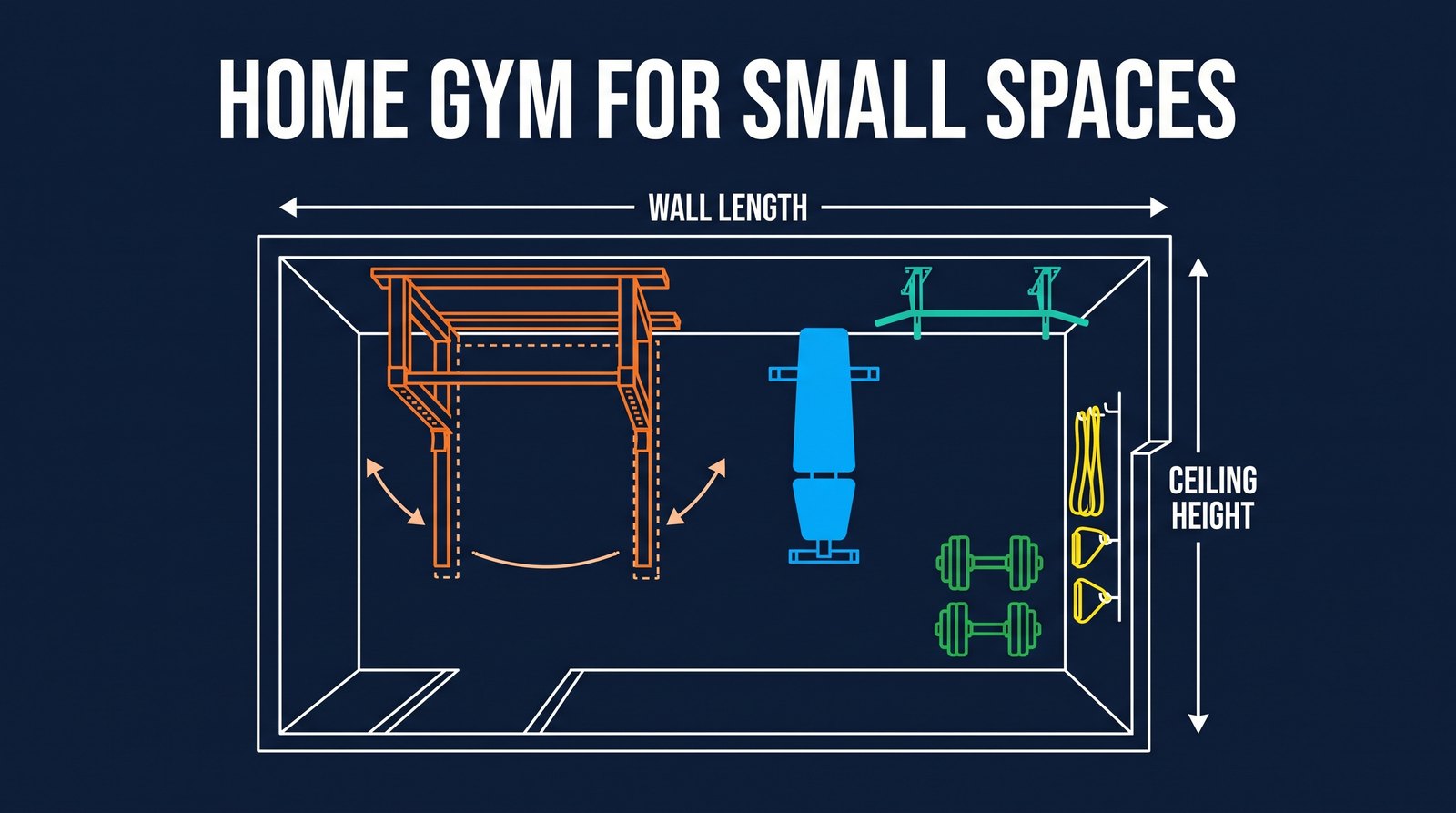
The best home gym equipment for a small space is the gear that either folds against a wall or does several jobs from one spot: a folding wall rack or a squat stand, an adjustable bench that stores upright, adjustable dumbbells or a compact digital cable, and a set of resistance bands. What decides which of those you can use is not the floor area but two measurements: the length of your longest wall and your ceiling height.
At a glance
| Equipment | Space it needs | Source |
|---|---|---|
| Folding wall-mounted squat rack | Folds to 2 to 6 in off the wall; swings out about 21 or 41 in | Our folding squat rack comparison |
| Squat stand | About 4 sq ft; connected stands sit in about 48 x 48 in | Our squat stand comparison |
| Four-post power rack | Example: Rogue RM-3 at 40 x 53 in, about 14.7 sq ft | Our 10×10 home gym guide |
| Olympic barbell | 86.6 in (2.2 m) long; a 10 ft wall leaves about 16.7 in at each end | Our 10×10 home gym guide |
| Rack height under an 8 ft ceiling | 84 in rack leaves about 12 in; 90 in rack about 6 in | Our 10×10 home gym guide |
| Digital cable trainer (VOLTRA I) | 12.71 x 5.49 x 3.94 in, 12.78 lb, up to 230 lb per unit | Our VOLTRA I guide |
Measure your own room before buying. The Home Gym Room Planner checks a room’s walls, ceiling and door against real rack dimensions.
Measure two things before you buy anything
- Your longest clear wall. A standard Olympic bar is about 86.6 inches long. On a 10 foot (120 inch) wall, a centered bar leaves about 16.7 inches at each end: enough to slide plates on, not enough to walk around. If your longest wall is shorter than about 10 feet, plan a gym around dumbbells, bands or a digital cable instead of a barbell.
- Your ceiling, at its lowest point. Under a standard 8 foot ceiling, an 84 inch rack leaves about 12 inches of clearance and a 90 inch rack about 6 inches. Measure to the lowest light, beam or garage door track, and leave room above the bar if you want to do pull-ups. PRx, for example, publishes recommended ceiling heights of 99, 107 and 113 inches for its three folding rack heights.
Pick one main station
In a small room, one station does most of the work. Choose the one your space allows, then add small gear around it.
1. A folding rack and barbell: the most capable small gym
A folding squat rack bolts to the wall, swings out to about 21 or 41 inches when you lift and folds back to 2 to 6 inches when you are done. It gives you squats, presses, bench work and pull-ups in a room that still has to hold a car or a guest bed. It needs wood studs or a stringer board, a 10 foot wall for the bar, and spotter arms, which most makers sell separately. The folding squat rack comparison lists twelve racks by folded depth, mount and rating.
2. A squat stand: a barbell without bolting to the wall
A squat stand is the smallest piece of steel that lets you squat and press a loaded bar. Independent stands store against a wall; connected stands share a base and take spotter arms. If you train to failure alone on squats, a full rack is the safer buy. See the squat stand comparison and power racks under $500.
3. No barbell: dumbbells, a bench, bands and a cable
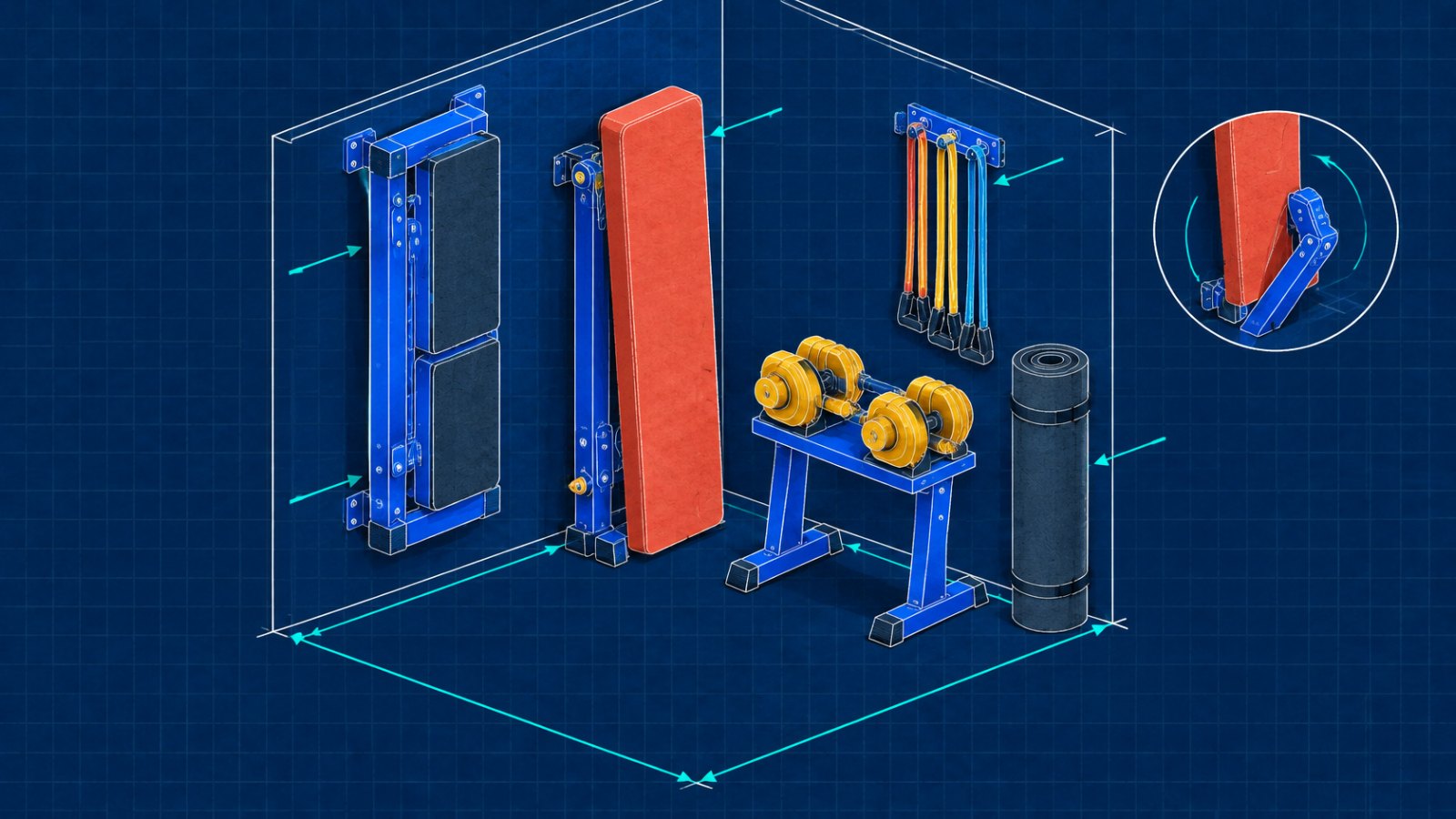
For an apartment, a spare corner or a wall shorter than 10 feet, skip the barbell. Adjustable dumbbells replace a full rack of fixed pairs, an adjustable bench stands upright against the wall, and resistance bands or a compact digital cable add pulling and cable work. A VOLTRA I unit is about the size of a shoebox and gives up to 230 lb per unit, though it needs a solid anchor point.
Equipment that earns its space
- Adjustable bench. Flat and incline pressing, rows and step-ups. Store it upright; check that it stands on its own and has a handle and wheels.
- Adjustable dumbbells. One pair covers the weights of a full rack. Check the heaviest setting against your strongest dumbbell lift before you buy.
- Resistance bands. Hang on a hook and cover rows, pulldowns, presses and pull-up assistance. See the band brand comparison and how to build muscle with bands.
- A pull-up bar. On the rack, the wall or a doorframe. It is the cheapest way to train your back hard in a small room.
- Rack attachments instead of machines. If you have a rack, a lat pulldown, dip arms or a landmine attachment adds lifts without adding floor space. See the best rack attachments for building muscle.
- Flooring for the lifting spot only. Rubber mats or tiles under the rack or dumbbell area. The flooring calculator works out how many you need.
What to skip in a small room
- Single-purpose machines such as a standalone leg extension or a full-size cable crossover, unless the room is built around them.
- A rack of fixed dumbbells. It takes a wall and still tops out at your heaviest pair.
- Full-size cardio. If you need cardio, a folding or compact unit keeps the floor clear; our 10×10 guide suggests keeping it under about 20 sq ft.
- Anything you cannot store. If it cannot fold, stand upright or hang on a wall, it will take floor space every day.
Small gym setups by space
| Space | Main station | Add |
|---|---|---|
| Apartment or rented room | Adjustable dumbbells and bench | Bands with a door anchor, a doorframe pull-up bar, rubber tiles for noise |
| Corner of a spare room | Adjustable dumbbells and bench, or a digital cable | Bands, a wall-mounted pull-up bar, wall hooks |
| Room with a 10 ft wall | Folding rack or squat stand with a barbell | Plates on the wall, bench stored upright, bands |
| One-car garage bay | Folding rack, so the car still fits | See the garage gym layout guide for door tracks and beams |
| 10 x 10 ft room | Four-post or half rack against the back wall | See the 10×10 home gym layout |
Store up, not out
- Hang bands, handles and ropes on wall hooks instead of a bin on the floor.
- Put plates on wall-mounted horns or the rack’s storage pegs.
- Stand the bench upright when you are not using it.
- Keep one corner clear for mobility work and warm-ups.
In a rental, ask before drilling into walls or ceilings. Floor-standing equipment and door anchors avoid the question.
Small home gym FAQ
What is the smallest space for a home gym?
A dumbbell, bench and band gym fits in a corner with room to lie on the bench and press. For a barbell, plan on a wall of about 10 feet so the 86.6 inch bar fits with room at each end, and check your ceiling against the rack height.
What is the best equipment for a small home gym?
A folding rack or squat stand with a barbell if your wall and ceiling allow it; otherwise adjustable dumbbells, an adjustable bench and a set of resistance bands, with a pull-up bar and a compact digital cable as upgrades.
Can you build muscle in a small home gym?
Yes. Muscle growth comes from hard sets close to failure and from making the work harder over time, not from the size of the room. See progressive overload in a small home gym for ways to keep progressing with limited weight.
Do I need a power rack in a small home gym?
Not always. If you squat heavy alone, a rack or a stand with spotter arms is the safe way to do it. If you train with dumbbells, bands or a digital cable, you can skip the rack and keep the floor clear.
Related: Home Gym Room Planner · 10×10 home gym layout · Best folding squat racks · Glute setup in a small home gym