
You lift a few times a week, you want bigger muscles, and every feed hands you a new rule about rep ranges, pumps, soreness and tempo. Muscle hypertrophy comes down to a short list: your muscle fibers grow when they work against high tension for enough hard sets, repeated over months. Weekly volume and effort close to failure move the needle, while load, frequency and most gym lore matter far less than they are sold.
This guide ties each piece of the biology to one training decision, so you know where effort pays and where it is wasted. Every study cited here was checked on PubMed on September 28, 2026, and where the evidence is thin or contested, the text says so.
At a glance
| Verdict | Fibers grow from high tension over enough hard sets, repeated for months; weekly volume and effort matter most |
|---|---|
| Effect size / key numbers | Each added weekly set: about +0.37% growth (ES +0.023). Failure vs non-failure: ES 0.19, trivial. Light vs heavy loads to failure: similar growth |
| Evidence strength | Strongest for volume (meta-regressions of 15 and 67 studies); sarcoplasmic vs myofibrillar growth is unsettled |
| What to do | Log weekly hard sets per muscle (indirect sets count as half), end sets close to failure, use any load and split you’ll keep |
| Main caveat | Each extra set buys a little less; early size gains include swelling, so judge a program over months |
Studies checked on PubMed, September 28, 2026.
What actually grows when a muscle gets bigger?
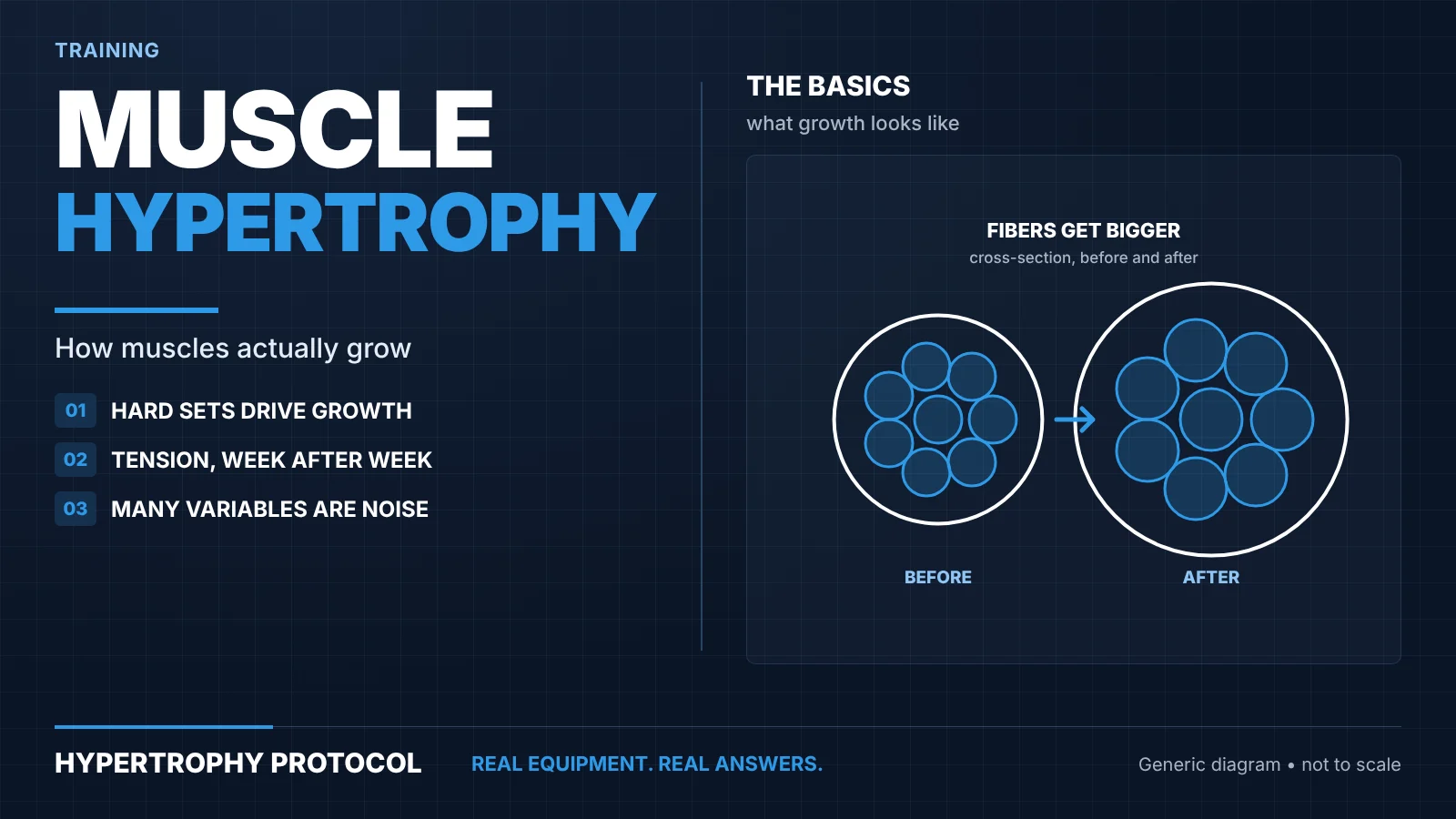
That short list starts with the fiber itself. Load-driven growth comes mainly from existing fibers getting wider, an increase in fiber cross-sectional area, according to a 2020 scoping review by Jorgenson, Phillips and Hornberger. The same review stressed that even basic questions remain open, such as whether fibers widen by enlarging existing myofibrils or by adding new ones.
What fills that extra width is the live debate. Myofibrils are the contractile machinery, and the sarcoplasm is the fluid and other material around them. In a 2019 study of 30 trained young men doing six weeks of very high-volume training, the 15 who grew most gained 23% in fiber area while their actin and myosin concentrations fell by about 30%, which the authors read as sarcoplasmic expansion.
Other work points the other way. In 15 untrained men training twice a week for 10 weeks, the share of each fiber occupied by myofibrils did not change, which suggests the contractile machinery grew in step with the fiber. A 2020 review from the same research group concluded that select evidence supports sarcoplasmic hypertrophy alongside proportional growth, and asked for better methods to separate the two.
The training decision: the question is unsettled, so do not choose rep ranges to target one type of growth. Treat both as parts of one growth process and put your planning into the variables below, which have outcome data behind them.
What signal tells a muscle fiber to grow?
Whatever ends up filling the fiber, something has to trigger the build. A 2019 review by Wackerhage and colleagues judged mechanical signals the prime candidates, with the sensors that detect them only partly mapped. The mechanical tension guide covers that idea in more depth, so this section sticks to what it means for your sets.
Metabolic stress and muscle damage, the other two parts of the old three-factor model, are contested. The Wackerhage review concluded that damage is probably not essential for growth and that the case for metabolites rests on indirect evidence from blood flow restriction and low-load training. A 2018 review by Damas and colleagues went further, concluding that damage neither mediates nor boosts training-induced hypertrophy.
That makes two popular gym signals weak guides. Soreness reflects damage, and in a 10-week trial in 10 young men damage was highest after the first session and minimal by week 10. The pump is a metabolite effect, and its role in growth is unproven.
Lab proxies need the same caution. Muscle protein synthesis (MPS) measured after a first session did not predict how much untrained men grew over 16 weeks (see the table below), and surface EMG amplitude has not been validated as a predictor of hypertrophy. In the 10-man trial above, MPS tracked growth closely only once damage had eased, at weeks 3 and 10 (r of about 0.9).
The training decision: judge a set by the tension it puts on the target muscle and how hard it is, and ignore soreness and pump as scorecards. Exercises that keep tension high while the muscle is stretched are one tested way to raise that tension, covered in the long muscle lengths guide.
How fast does muscle hypertrophy show up, and how do you know it is real?
Judging tension and effort only helps if you can tell whether growth followed. Research leans on three tools, and each sees a different slice. MRI is considered the gold standard for a muscle’s area or volume, ultrasound measures thickness at one spot and depends on the operator’s skill, and DXA estimates lean mass for a whole limb but cannot tell muscle tissue from the fluid inside it, per a 2019 methods review by Haun and colleagues.
These tools do not always agree. In that team’s high-volume study, the ten biggest responders showed very different gains depending on the measure.
Top 10 responders after 6 weeks of high-volume training: gain by measurement method
Early swelling is the second trap. In 10 untrained men, thigh cross-sectional area rose 2.7% by week 3, but ultrasound signs of edema were elevated relative to muscle size at that point, and only the 10.4% gain at week 10 was free of that excess. The authors concluded that early increases should not be labeled hypertrophy without a check for swelling.
Real growth can still begin within the first month. In 25 sedentary men scanned every week, thigh area jumped 3.46% after two sessions, which may partly reflect edema, and the researchers placed true hypertrophy at around weeks 3 to 4, with a 9.60% gain by week 8. Responses also vary widely: in the MPS trial in the table below, some men lost a little quadriceps volume over 16 weeks while others gained nearly a quarter.
The training decision: do not judge a new program by its first few weeks, since early size changes include fluid. Judge it over months by performance and by a consistent measurement taken the same way each time.
How much weekly volume does growth need?
Once you trust the measurement, the first variable to check is how much hard work each muscle gets. The table gathers the meta-analyses and trials behind every training variable in this guide, with who was studied.
| Variable | Study | Who | Result |
|---|---|---|---|
| Weekly sets | Schoenfeld 2017 (meta-regression) | 15 studies, 34 treatment groups | Each added weekly set: effect size +0.023, about +0.37% growth |
| Weekly sets and frequency | Pelland 2025 (meta-regressions) | 67 studies, 2,058 participants (79.1% men, average age 25.16) | Growth rose with volume (posterior probability of a positive slope: 100%) with diminishing returns; frequency effect on growth compatible with negligible |
| Load | Schoenfeld 2017 (meta-analysis) | 21 studies, all sets to failure, 6+ weeks | ≤60% vs >60% of 1RM: similar growth; 1RM strength favored heavy loads |
| Load | Lopez 2021 (network meta-analysis) | 28 studies, 747 healthy adults | Low, moderate and high loads to failure: no difference in growth; strength higher with high vs low loads (SMD 0.60–0.63) |
| Load and hormones | Morton 2016 (RCT) | 49 trained men, 12 wk | 30–50% (20–25 reps) vs 75–90% of 1RM (8–12 reps), all to failure: similar fiber area and lean mass gains; post-exercise hormone rises did not correlate with growth |
| Proximity to failure | Refalo 2023 (meta-analysis) | 15 studies, healthy adults | Set failure vs non-failure: effect size 0.19 (95% CI 0.00 to 0.37), trivial; momentary failure vs non-failure: 0.12 (95% CI −0.13 to 0.37) |
| Proximity to failure | Robinson 2024 (meta-regressions) | Studies with reps in reserve estimated from their descriptions | Growth increased as sets ended closer to failure; strength gains similar across a wide range |
| Frequency, volume equated | Schoenfeld 2019 (meta-analysis) | 25 studies | No significant difference, including in trained lifters |
| Acute MPS (proxy) | Mitchell 2014 | 23 untrained men, 16 wk, MRI | Quadriceps volume +7.9% on average (range −1.9% to +24.7%); no correlation with MPS after the first session (r = 0.02 to 0.16) |
Volume has the clearest dose-response of any variable here. Both meta-regressions agree that more weekly hard sets per muscle produced more growth, and the larger 2025 analysis shows the gains flattening as volume climbs.
One detail from that analysis matters for how you log training. The Pelland team got the best predictions when sets that work a muscle indirectly counted as half a set, so a bench press counts fully for the chest and as half a set for the triceps. Counting that way gives you a truer picture of each muscle’s weekly dose.
The training decision: weekly volume is your main dial. When a muscle stalls and your recovery allows it, adding hard sets for that muscle is the change with the strongest evidence, though each extra set buys a little less than the one before.
Do heavy loads or sets to failure grow more muscle?
Volume only counts if the sets are hard, which brings in load and effort. Across load studies where every set went to failure, light and heavy loads grew muscle about equally, including in trained men in the Morton trial. Heavy loads kept their edge for one-rep-max strength.
Effort is where the two failure analyses need to be read together. Taking sets to outright failure gave only a trivial edge over stopping short, with a confidence interval that touched zero, yet the Robinson meta-regressions estimated that growth rose as sets ended closer to failure. Those authors cautioned that the reps-in-reserve values were estimated, so the exact curve is unclear.
In practice, sets need to be hard, but the last grinding rep may add little. Light loads carry a time cost, since the 30–50% group in the Morton trial needed 20 to 25 reps per set to reach failure.
The training decision: choose loads that suit the exercise and your equipment, then take sets close to failure. If your plates or cable stack cap the weight, higher reps taken near failure are a tested way to keep growing.
Does training a muscle more often help?
If load is flexible, scheduling is even more so. With weekly volume equated, the 25-study frequency meta-analysis saw no meaningful difference in growth, and the Pelland models judged frequency’s effect on growth compatible with a negligible one, while strength did rise with it.
Frequency is mostly a way to fit your volume into the week. Spreading a muscle’s sets over more sessions is a scheduling tool, and the growth data give it no bonus of its own.
Several other popular levers sit in the same low-priority group. Machines and free weights produced similar growth in the trials covered in the machines vs free weights guide, and the rest between sets guide shows that rest length matters mainly through the reps you complete. Heavier or slower lowering has not reliably beaten ordinary sets either, as the eccentric overload guide explains.
Hormones belong on that list too. Post-exercise rises in hormones did not track growth in the 49 trained men of the Morton trial, so building sessions around a testosterone spike is not worth your planning time.
The training decision: pick a split and equipment you will keep showing up for. Then make sure each muscle still gets its weekly hard sets, however you divide them.
Where should you spend your training effort?
With every variable weighed, your priorities sort themselves by the strength of the evidence. Find the line that matches where you are now.
- You are in your first months of lifting: run a simple plan with hard sets for each muscle and give it a few months before judging it. Early size changes include fluid, and real growth in the weekly-scan trial began around weeks 3 to 4.
- You have trained for a while and progress has stalled: add hard sets for the lagging muscle, count indirect sets as half, and check that most sets end close to failure.
- You train at home with limited weight: use higher reps taken near failure and exercise variations that load the stretched position. Load range made no difference to growth in the pooled data.
- You chase the pump, soreness or a hormone boost: drop them as targets and keep the sets hard. None of them has held up as a reliable sign of growth.
- You are weighing sarcoplasmic vs myofibrillar programs: the biology is unsettled, so the choice does not change your plan. Pick exercises and rep ranges you can push hard and progress.
- You want to support growth outside the gym: your daily protein total matters more than how you split it, as the protein per meal guide explains. A planned deload kept muscle in both direct trials covered in the deload guide, so an easier week need not cost you size.
Your next step: set up a log that tracks weekly hard sets per muscle and adds reps or load over time, using the progressive overload guide. Keep it running for a full training block before you change the plan.
Sources
- Jorgenson KW, Phillips SM, Hornberger TA. Identifying the structural adaptations that drive the mechanical load-induced growth of skeletal muscle: a scoping review. Cells. 2020. doi:10.3390/cells9071658
- Haun CT, et al. Muscle fiber hypertrophy in response to 6 weeks of high-volume resistance training in trained young men is largely attributed to sarcoplasmic hypertrophy. PLoS One. 2019. doi:10.1371/journal.pone.0215267
- Ruple BA, et al. Myofibril and mitochondrial area changes in type I and II fibers following 10 weeks of resistance training in previously untrained men. Front Physiol. 2021. doi:10.3389/fphys.2021.728683
- Roberts MD, Haun CT, Vann CG, Osburn SC, Young KC. Sarcoplasmic hypertrophy in skeletal muscle: a scientific “unicorn” or resistance training adaptation? Front Physiol. 2020. doi:10.3389/fphys.2020.00816
- Wackerhage H, Schoenfeld BJ, Hamilton DL, Lehti M, Hulmi JJ. Stimuli and sensors that initiate skeletal muscle hypertrophy following resistance exercise. J Appl Physiol. 2019. doi:10.1152/japplphysiol.00685.2018
- Damas F, Libardi CA, Ugrinowitsch C. The development of skeletal muscle hypertrophy through resistance training: the role of muscle damage and muscle protein synthesis. Eur J Appl Physiol. 2018. doi:10.1007/s00421-017-3792-9
- Damas F, et al. Resistance training-induced changes in integrated myofibrillar protein synthesis are related to hypertrophy only after attenuation of muscle damage. J Physiol. 2016. doi:10.1113/JP272472
- Vigotsky AD, Halperin I, Trajano GS, Vieira TM. Longing for a longitudinal proxy: acutely measured surface EMG amplitude is not a validated predictor of muscle hypertrophy. Sports Med. 2022. doi:10.1007/s40279-021-01619-2
- Mitchell CJ, et al. Acute post-exercise myofibrillar protein synthesis is not correlated with resistance training-induced muscle hypertrophy in young men. PLoS One. 2014. doi:10.1371/journal.pone.0089431
- Haun CT, et al. A critical evaluation of the biological construct skeletal muscle hypertrophy: size matters but so does the measurement. Front Physiol. 2019. doi:10.3389/fphys.2019.00247
- Damas F, et al. Early resistance training-induced increases in muscle cross-sectional area are concomitant with edema-induced muscle swelling. Eur J Appl Physiol. 2016. doi:10.1007/s00421-015-3243-4
- DeFreitas JM, et al. An examination of the time course of training-induced skeletal muscle hypertrophy. Eur J Appl Physiol. 2011. doi:10.1007/s00421-011-1905-4
- Schoenfeld BJ, Ogborn D, Krieger JW. Dose-response relationship between weekly resistance training volume and increases in muscle mass: a systematic review and meta-analysis. J Sports Sci. 2017. doi:10.1080/02640414.2016.1210197
- Pelland JC, Remmert JF, Robinson ZP, Hinson SR, Zourdos MC. The resistance training dose response: meta-regressions exploring the effects of weekly volume and frequency on muscle hypertrophy and strength gains. Sports Med. 2025. doi:10.1007/s40279-025-02344-w
- Schoenfeld BJ, Grgic J, Ogborn D, Krieger JW. Strength and hypertrophy adaptations between low- vs. high-load resistance training: a systematic review and meta-analysis. J Strength Cond Res. 2017. doi:10.1519/JSC.0000000000002200
- Lopez P, et al. Resistance training load effects on muscle hypertrophy and strength gain: systematic review and network meta-analysis. Med Sci Sports Exerc. 2021. doi:10.1249/MSS.0000000000002585
- Morton RW, et al. Neither load nor systemic hormones determine resistance training-mediated hypertrophy or strength gains in resistance-trained young men. J Appl Physiol. 2016. doi:10.1152/japplphysiol.00154.2016
- Refalo MC, Helms ER, Trexler ET, Hamilton DL, Fyfe JJ. Influence of resistance training proximity-to-failure on skeletal muscle hypertrophy: a systematic review with meta-analysis. Sports Med. 2023. doi:10.1007/s40279-022-01784-y
- Robinson ZP, et al. Exploring the dose-response relationship between estimated resistance training proximity to failure, strength gain, and muscle hypertrophy: a series of meta-regressions. Sports Med. 2024. doi:10.1007/s40279-024-02069-2
- Schoenfeld BJ, Grgic J, Krieger J. How many times per week should a muscle be trained to maximize muscle hypertrophy? A systematic review and meta-analysis of studies examining the effects of resistance training frequency. J Sports Sci. 2019. doi:10.1080/02640414.2018.1555906
Sources checked September 28, 2026. Research summaries describe the cited studies; individual results vary.