
Disclosure: As an Amazon Associate, Hypertrophy Protocol earns from qualifying purchases made through Amazon links on this page, which are marked affiliate.
A cold plunge tub can be as simple as a portable tub for about $64 (Amazon price checked October 20, 2026) that you fill with ice, or a $1,500 insulated tub with its own chiller. Before you choose one, it’s worth knowing what the research says, because for lifters the timing matters more than the tub. Cold water reduces soreness, but regular plunges straight after lifting can reduce how much muscle you build. This guide covers when a cold plunge helps, how cold and how long to go, and which type of tub makes sense for a home gym.
Short answer
- Soreness: cold water immersion reduces muscle soreness after hard exercise in pooled studies, although results vary a lot between studies.
- Muscle growth: plunging right after lifting, session after session, reduced muscle and strength gains in a 12-week trial. Keep plunges away from your lifting sessions if growth is the goal.
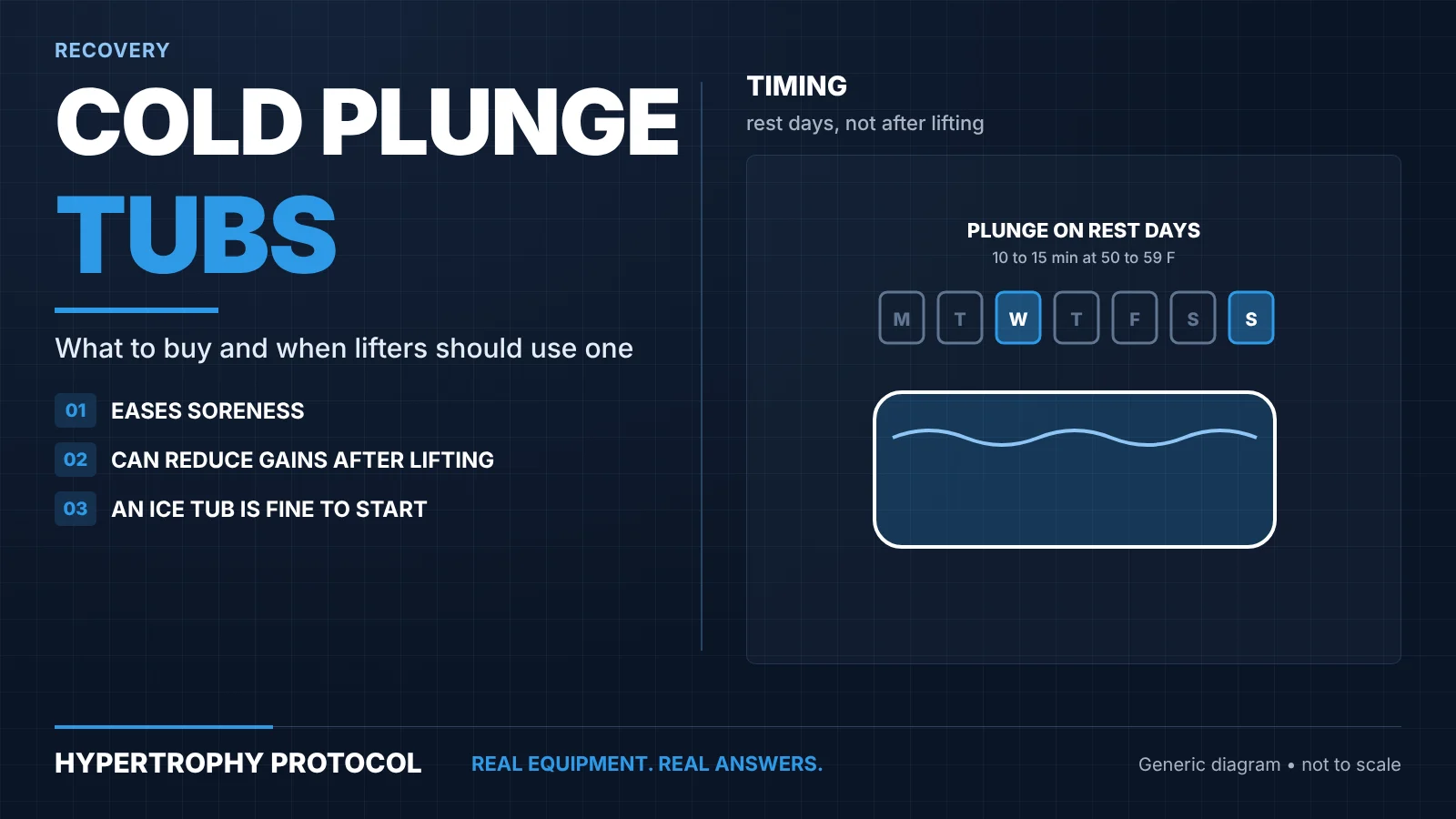
- Dose: about 10 to 15 minutes at 50°F to 59°F (10°C to 15°C) is the range most studies support. Colder hasn’t been shown to work better.
- Which tub: an inflatable tub and bags of ice is fine for occasional use. If you’ll plunge several times a week, a tub with a chiller saves a lot of ice.
- Safety: the first minute is the riskiest. Ask a doctor first if you have heart disease, high blood pressure or Raynaud’s.
At a glance
| Option | Best for | Price | Main catch |
|---|---|---|---|
| Portable tub with ice | Plunging once or twice a week | About $64 to $150 | About 100 lb of ice to cool 100 gallons from 70°F to 50°F |
| Chiller-compatible inflatable tub | Adding a chiller later | About $220 (216 gallons) | A full 216-gallon tub weighs about 1,800 lb; check floor load |
| Add-on 1/3 HP chiller | Plunging most days | About $350 to $600 | Plus electricity; use a GFCI-protected outlet |
| All-in-one tub with chiller | Most convenience | About $1,000 to several thousand | Highest cost; the $1,500 kit listed takes about a night to cool |
| DIY stock tank or bathtub with ice | An occasional plunge | Not stated | Avoid chest freezer conversions: water and mains electricity |
Product prices from Amazon, checked October 20, 2026. Confirm before ordering. For growth, keep plunges off lifting days.
Should lifters use a cold plunge?
It depends on what you’re training for and when you plunge.
For soreness, it helps. A 2026 meta-analysis of 52 studies (Jeon and Yeo) found a single cold water session after exercise reduced muscle soreness (standardised mean difference −0.81) and markers of muscle damage. The authors cautioned that results varied widely and may not hold in every setting. Another 2026 meta-analysis of 22 trials (Zhu and colleagues) found that cold water didn’t help maximal strength recover, and briefly reduced jump performance right after the plunge.
For muscle growth, timing matters. In a 2015 trial by Roberts and colleagues, 21 men strength trained twice a week for 12 weeks. One group sat in cold water (10°C, or 50°F) for 10 minutes after every session; the other did 10 minutes of light cycling instead. Strength and muscle mass increased more in the active recovery group. Type II muscle fibres, the ones that grow most with lifting, got 17% larger in the active recovery group but didn’t grow significantly in the cold water group. A 2026 umbrella review of 15 meta-analyses (Berjisian and colleagues) reached the same conclusion: cold water after exercise helps some recovery measures, but regular use after resistance training impaired strength and size gains.
The likely reason is that cold blunts some of the signals muscle uses to grow after training. For more on the mechanism, see our article on how cold exposure affects muscle growth.
When to plunge if you lift
- Not straight after a hypertrophy session. That’s the timing that reduced gains in the research.
- On rest days, after conditioning or sport, or when you need to feel fresh quickly, such as between two competition days.
- How long to wait after lifting is unknown. No study has found a gap after lifting that avoids the effect, so spacing them out is a precaution, not a proven fix. If growth is your priority, keep plunges and lifting on different days.
If you want something after lifting, a sauna after a workout hasn’t shown the same muscle-blunting effect in research, although no long-term trial has compared the two directly.
How cold and how long?
The 2026 umbrella review found that protocols of about 10 to 15 minutes at 10°C to 15°C (50°F to 59°F), or at 5°C to 10°C (41°F to 50°F), were the most effective for recovery. The 2026 Jeon meta-analysis found no water temperature was clearly better than another. In other words, you don’t need the coldest possible water, and a chiller that reaches 50°F is cold enough.
You also don’t need to go in up to your neck. A 2026 meta-analysis comparing partial immersion (legs and hips) with whole-body immersion found no difference in recovery (Zhu and colleagues). Keeping your chest out of the water also makes the plunge easier to tolerate.
If you’re new to it, start warmer and shorter, such as around 59°F for 2 to 5 minutes, and build up gradually. Read the safety section first and check with a doctor if any of it applies to you.
Ice or chiller?
A chiller is a small refrigeration unit that pumps water out of the tub, cools it and sends it back. It costs more up front but keeps the water cold all the time. Without one, you cool the water with ice before each session, and it takes more ice than most people expect.
Cooling 100 gallons of tap water from 70°F to 50°F takes roughly 100 pounds of ice, before counting any heat the tub picks up from the air. That’s about ten 10-pound bags. Keeping the water between sessions under an insulated lid cuts that a lot, since you only need to top up the cold. As a rule of thumb, ice is fine if you plunge once or twice a week, and a chiller usually makes more sense if you plunge most days.
- Ice only: cheapest to start and no electrics, but you’ll buy and haul ice, and standing water needs changing more often.
- Chiller: cold water on demand, and most units include filtration. A basic 1/3 horsepower unit costs about $350 to $600, plus electricity.
To run the numbers for your own tub, use our cold plunge chiller vs ice cost calculator.
Types of cold plunge tub
Inflatable or portable tubs
Upright or oval tubs made from layered PVC with a foam or air-filled wall. They’re cheap, fold away and suit ice. Most hold 80 to 110 gallons. Look for an insulated lid; without one, the water warms quickly.
Chiller-compatible tubs
Larger inflatable tubs made from drop-stitch fabric, the stiff material used in inflatable paddle boards, with threaded ports for a chiller’s hoses. Buy one of these if you might add a chiller later.
All-in-one tubs with a chiller
A tub and chiller sold as a set, usually with filtration and app or panel control. They’re the most convenient and range from about $1,000 for inflatable kits to several thousand dollars for rigid units.
DIY options
A galvanised stock tank or chest freezer conversion is popular, but freezer conversions mix water and mains electricity in a way the appliance wasn’t designed for. If you go DIY, a stock tank with ice or a purpose-built chiller is the safer route. A bathtub with ice works for an occasional plunge.
What to look for
- Size: check the height limit and whether you can sit with your legs fully in. Upright barrels suit tall lifters less well than oval tubs.
- Weight on the floor: water weighs about 8.3 pounds per gallon, so 100 gallons is roughly 830 pounds and a full 216-gallon tub is about 1,800 pounds. A ground-level concrete slab usually handles that. For an upstairs room, raised floor or deck, check the load rating or ask a contractor before you fill it.
- Lid and insulation: the biggest factor in how long ice lasts and how hard a chiller works.
- Drain: a hose-connected drain valve makes changing the water much easier.
- Water care: standing water grows bacteria. Use a lid, rinse before you get in, and either change the water often or use a filter and a sanitiser made for plunge tubs or spas.
- Electrics: plug any chiller or pump into a GFCI-protected outlet and follow the manufacturer’s instructions. Don’t use extension cords near the tub.
- Outdoors: sun warms the water and degrades vinyl. Choose a UV-resistant cover and shade the tub if you can.
Cold plunge tubs and gear
Prices were checked on Amazon on October 20, 2026, and change often. These are options in each category rather than tested picks; we haven’t run them side by side.
| Product | Type | Price | Notes |
|---|---|---|---|
| Bubplay 105-Gallon Ice Bath Tub with Cover (affiliate) | Portable, ice | About $64 | Cheapest way to try cold plunging. Insulated cover included. |
| The Cold Pod 85-Gallon Round Tub with Insulated Cover (affiliate) | Portable, ice | About $150 | Over 1,000 reviews. UV-reflective cover suits outdoor use. |
| VEVOR 216-Gallon Inflatable Cold Plunge Tub (affiliate) | Chiller-compatible | About $220 | Drop-stitch oval tub with chiller ports. Large, so check floor load. |
| AS ColdPlunge 1/3 HP Water Chiller (affiliate) | Chiller | About $399 | Rated to 42°F, with a pump and washable filter. Pairs with a chiller-compatible tub. |
| JUGRFIT 121-Gallon Tub with 1050W Chiller (affiliate) | All-in-one | About $1,500 | Tub, chiller and filtration in one kit. Takes about a night to cool from room temperature. |
| TempPro Wireless Floating Thermometer (affiliate) | Thermometer | About $30 | Worth having with any tub, since ice tubs have no temperature readout. |
Cold plunge safety
During a short plunge, the most immediate danger is usually the first minute rather than hypothermia, which takes much longer to develop. Sudden cold causes a gasp, fast breathing and a jump in heart rate and blood pressure, called the cold shock response. Researchers have linked it, along with the diving reflex triggered by cold water on the face, to dangerous heart rhythms in susceptible people (Shattock and Tipton, 2012; Leuci and colleagues, 2026).
- Get in slowly and control your breathing until the gasp passes.
- Keep your face out of the water and don’t hold your breath under it.
- Don’t plunge alone while you’re new to it, and never after drinking alcohol.
- Get out if you feel dizzy, confused, numb in your hands or feet, or chest pain, and warm up gradually afterwards.
- Talk to a doctor first if you have heart disease or an irregular heartbeat, high blood pressure, Raynaud’s, a history of fainting, or are pregnant.
- Cover and lock the tub when not in use if children or pets are around. A small amount of water is still a drowning risk.
The bottom line
A cold plunge tub is a good tool for soreness and feeling fresh, but regular plunges right after lifting can cost you some muscle. If growth is your main goal, plunge on rest days or after conditioning, aim for about 10 to 15 minutes at 50°F to 59°F, and don’t chase colder water. An ice tub is enough to start; buy a chiller once you know you’ll use it several times a week.
Sources
- Roberts LA, Raastad T, Markworth JF, et al. Post-exercise cold water immersion attenuates acute anabolic signalling and long-term adaptations in muscle to strength training. J Physiol. 2015;593(18):4285-4301. doi:10.1113/JP270570
- Berjisian E, Miraftabi H, Ihsan M, et al. Strategic application of post-exercise cold-water immersion to enhance performance recovery and adaptation: an umbrella review of 15 published systematic reviews with meta-analysis. Sports Med Open. 2026;12(1). doi:10.1186/s40798-026-01116-8
- Jeon Y, Yeo HS. Temperature-dependent effects of post-exercise cold-water immersion on recovery: a systematic review and meta-analysis. BMC Sports Sci Med Rehabil. 2026;18(1). doi:10.1186/s13102-026-01912-5
- Zhu Y, Yang L, Liu T, et al. Temporal dynamics of muscle strength recovery following acute cold-water immersion: a systematic review and meta-analysis. PeerJ. 2026;14:e21537. doi:10.7717/peerj.21537
- Zhu Y, Yang L, Liu T, et al. Effects of cold-water immersion at different body regions on post-exercise muscle damage recovery: a systematic review and meta-analysis. Front Sports Act Living. 2026;8:1738075. doi:10.3389/fspor.2026.1738075
- Leuci L, Melau J, Messina A, Tipton M, Carenzo L. Beyond hypothermia: mechanisms of death, rescue, and prevention in cold water immersion. J Appl Physiol. 2026;141(3):760-769. doi:10.1152/japplphysiol.00578.2026
- Shattock MJ, Tipton MJ. ‘Autonomic conflict’: a different way to die during cold water immersion? J Physiol. 2012;590(14):3219-3230. doi:10.1113/jphysiol.2012.229864