
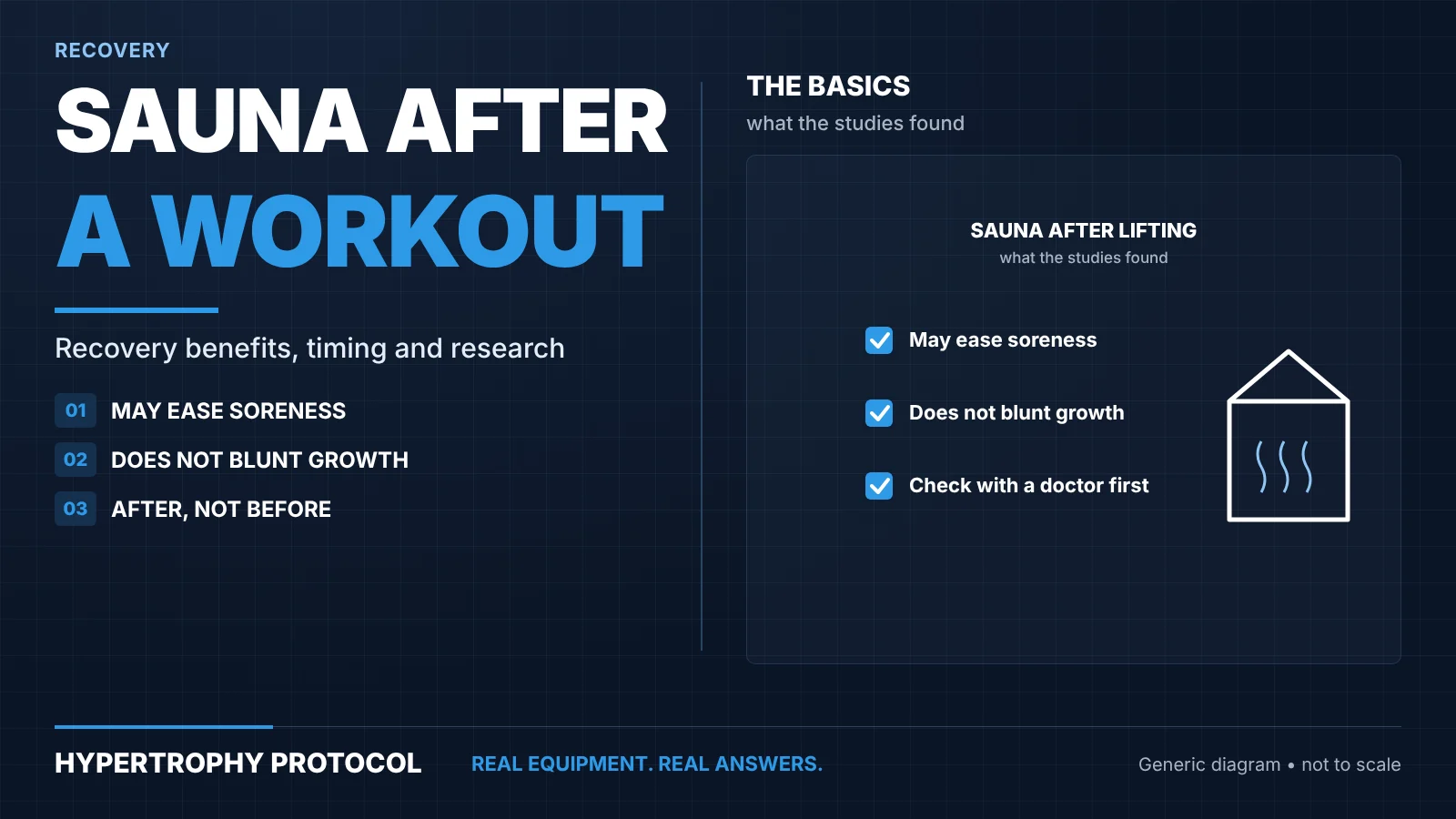
A sauna after lifting won’t build more muscle by itself, but the research suggests it may help you feel less sore and recover explosive performance a little faster. Unlike cold plunges, there’s no sign that heat after training blunts muscle growth. This guide covers what the studies found, whether to sauna before or after a workout, how long to stay in, and who should check with a doctor first. It’s general information, not medical advice.
Disclosure: this guide contains affiliate links, and Hypertrophy Protocol may earn a commission at no extra cost to you.
Short answer
- Soreness and recovery: in one crossover trial, 20 minutes in an infrared sauna after resistance training reduced soreness and the drop in jump performance the next morning.
- Muscle growth: no study shows a post-workout sauna adds muscle in healthy lifters. Local heat plus light training helped in small trials, but that’s a different situation.
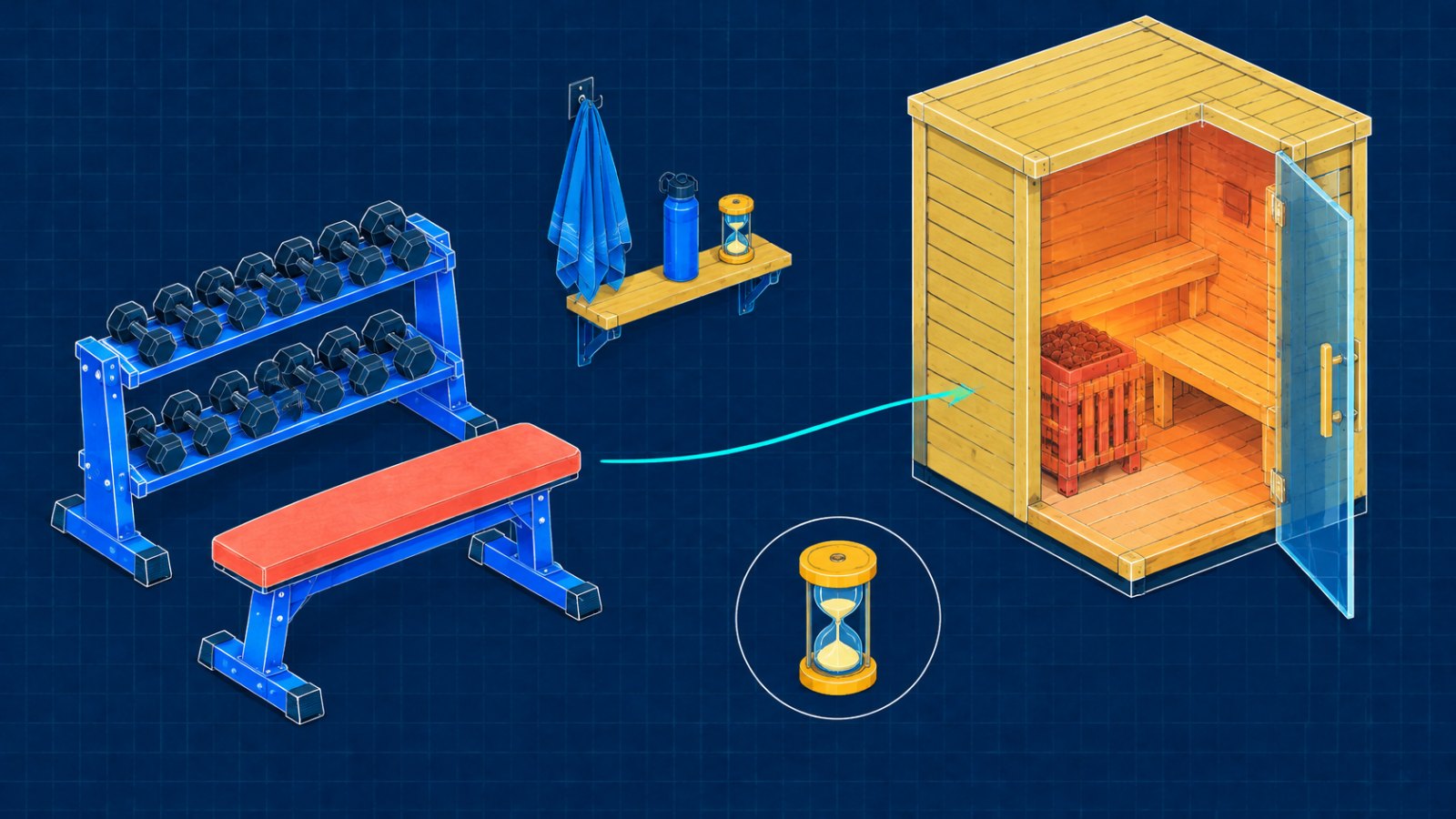
- Before or after: after is the safer, better-studied choice. A hot sauna before lifting adds heat stress and fluid loss you don’t need.
- How long: studies used about 20 to 30 minutes at moderate temperatures. Start shorter, drink water and get out if you feel dizzy.
- Who should ask first: anyone with heart disease, low or uncontrolled blood pressure, who is pregnant, or who takes medication that affects heat tolerance.
At a glance
| Verdict | May ease soreness after lifting, with no sign it blunts growth. It won’t add muscle on its own. |
|---|---|
| Effect size / key numbers | 20 minutes of infrared at about 43°C (109°F) reduced soreness and jump loss 14 hours later (16 players). |
| Evidence strength | Low: two small trials with mixed results, and no long-term training studies. |
| What to do | Use it after training, start with 10 to 15 minutes, drink water and get out if you feel dizzy. |
| Main caveat | Ask a doctor first if you have heart disease, blood pressure problems, are pregnant or take heat-affecting medication. |
See the full sections below for sources. General information, not medical advice.
Does a sauna help muscle recovery after lifting?
There’s limited but encouraging evidence. The best direct test is a 2023 crossover trial by Ahokas and colleagues. Sixteen male basketball players did a demanding session of maximal strength work and plyometrics, then either sat for 20 minutes or used an infrared sauna at about 43°C (109°F). Tested 14 hours later, the drop in countermovement jump height was smaller after the sauna, muscle soreness was less severe and the players rated their recovery higher. The sauna session didn’t disturb overnight heart rate or heart rate variability.
An earlier study by Mero and colleagues (2015) found something more modest. After a 60-minute hypertrophy-style strength session, 30 minutes in a far-infrared sauna made no difference to recovery of bench press, leg press or jump performance compared with no sauna. After a maximal endurance session, though, jump height 30 minutes later was slightly higher with the sauna.
Put together: a sauna after training may help you feel less sore and bounce back a little better, but the effects are small, the studies are small, and nobody has tested it over months of training.
Will a sauna after lifting help you build muscle?
There’s no direct evidence that it does. Heat does affect muscle: a 2024 review by Normand-Gravier and colleagues describes heat treatments, including sauna bathing, as promising for limiting muscle loss during immobilisation, such as after an injury. The same review says their effects on healthy, uninjured muscle “remain controversial.”
Some small trials have combined heat with light training. A 2019 trial (Nakamura and colleagues) found that applying a hot pack to the triceps for 20 minutes before light training (30% of one-rep max) increased muscle thickness and strength over six weeks, while light training alone didn’t. A 2017 trial in older women (Yoon and colleagues) found something similar with heating sheets on the thighs. Those studies used local heat before low-load training, so they don’t tell you much about a whole-body sauna after a normal lifting session.
The one trial that tested heat during normal training found no extra growth. Ten untrained people trained both legs with knee extensions for 12 weeks, with one thigh heated by a pad during and for 20 minutes after each session. Both thighs gained the same muscle (+15% each) and similar strength (Stadnyk et al., 2018). Heat looks more useful when you can’t train: in 23 people with one leg immobilized for 10 days, 2 hours a day of deep heating cut the loss of whole-muscle size from 7.6% to 4.5% (Hafen et al., 2019).
The useful contrast is with cold. The same 2024 review concluded that cold interventions can blunt molecular adaptations after resistance exercise and reduce long-term hypertrophy. No long-term trial has compared the two directly, but there’s evidence that regular cold plunges after lifting can reduce muscle growth and no similar evidence for sauna. If muscle growth is your priority, a sauna after lifting looks like the lower-risk choice. See our guide to cold plunges and muscle growth for the details.
Sauna before or after a workout?
No trial has directly compared a sauna before lifting with a sauna after it. What we know points toward after:
- The recovery studies all used the sauna after training, so that’s where the evidence is.
- A hot sauna is a stress in its own right. In a 2019 study (Cernych and colleagues), a Finnish sauna raised core temperature to between 38.5°C and 39.6°C (101.3°F to 103.3°F). Two hours later muscle contraction was faster but less steady, although fatigue during a sustained contraction wasn’t worse. Lifting while still heated and partly dehydrated isn’t ideal, especially for heavy or technical sets.
- Sweat loss costs a little strength. A review of dehydration studies found that being under-hydrated reduced strength by about 2% and power by about 3% (Judelson et al., 2007).
- A warm-up does the job better. If you want warm muscles before lifting, a few minutes of light cardio and ramp-up sets raise muscle temperature without the fluid loss.
If you do use a sauna before training, keep it short and mild, drink water and treat it as part of a warm-up rather than a full session.
How long and how hot?
The lifting studies used 20 to 30 minutes at fairly mild temperatures: about 43°C (109°F) in the infrared trial and 35°C to 50°C (95°F to 122°F) in the Mero study. Traditional Finnish saunas run much hotter, often 80°C (176°F) or more, so sessions are usually shorter and broken into rounds.
- Start with 10 to 15 minutes and build up as you get used to it.
- Drink water before and after, since you’ll sweat on top of what you lost training.
- Skip alcohol before and during a sauna.
- Get out straight away if you feel dizzy, sick, confused or your heart races, and cool down gradually.
What about contrast therapy (hot and cold)?
Alternating hot and cold helps soreness compared with doing nothing, but it doesn’t clearly beat simpler options. A meta-analysis of 18 trials found contrast water therapy reduced soreness and strength loss more than passive rest, with “little evidence” it beat cold water, warm water, compression or active recovery (Bieuzen et al., 2013). A 2023 meta-analysis found cold water alone was more effective than contrast therapy for most recovery outcomes (Moore et al., 2023).
The cold half is the part to time carefully. In 21 active men who trained twice a week for 12 weeks, 10 minutes of cold water after each session led to smaller gains in strength and muscle than active recovery (Roberts et al., 2015). No trial has tested whether a hot-cold routine has the same effect, so if muscle is the goal, do contrast sessions on rest days or several hours after lifting.
Wider health effects
Most of what you’ve heard about sauna and health comes from Finland. A 2018 review in Mayo Clinic Proceedings (Laukkanen and colleagues) linked regular sauna bathing with lower risk of high blood pressure, cardiovascular disease and death. Most of that evidence is observational, though, meaning it shows associations in people who chose to use saunas. It suggests sauna is safe and possibly beneficial for healthy people, not that it caused those outcomes. For what the long-term studies do and don’t show, see our guide to sauna and longevity.
Who should check with a doctor first
Talk to your doctor before using a sauna if you have heart disease or chest pain, very low or poorly controlled blood pressure, a history of fainting, or kidney disease, if you’re pregnant, or if you take medication that affects blood pressure, sweating or heat tolerance.
Infrared, traditional or portable?
The recovery studies above used infrared saunas, which run cooler and are easier to sit in for 20 to 30 minutes. Traditional saunas run hotter with more humidity. Either works for relaxation and heat exposure. For a home gym, the practical questions are space, ventilation and wiring. Many full-size saunas need a dedicated 240-volt circuit, which our guide to putting a sauna in a garage covers in detail. If you want infrared sessions without any wiring or construction, a portable far-infrared tent sauna such as Momentum98’s Relax sauna is the simplest route; the maker says it breaks down in under five minutes, so it can live in a corner of the gym.
The bottom line
A sauna after lifting is a reasonable, enjoyable recovery habit. It may ease soreness and help you feel ready for your next session, and unlike regular cold plunges it doesn’t appear to interfere with muscle growth. It won’t build muscle on its own, and the evidence is still small. Use it after training rather than before, keep sessions moderate, and drink plenty of water.
Frequently asked questions
Does a sauna after lifting hurt muscle gains?
There is no sign that heat after training blunts muscle growth. No long-term trial has compared sauna and cold directly, but there is evidence that regular cold plunges after lifting can reduce muscle growth and no similar evidence for sauna.
Does sweating in a sauna before lifting make you weaker?
It can cost a little strength. A review of dehydration studies found that being under-hydrated reduced strength by about 2% and power by about 3%.
Can heat help prevent muscle loss when you can’t train?
It may. In a study of 23 people with one leg immobilized for 10 days, 2 hours a day of deep heating cut the loss of whole-muscle size from 7.6% to 4.5%.
Does a post-workout sauna affect overnight heart rate or HRV?
Not in the trial cited above. In a 2023 crossover trial of sixteen male basketball players, a 20 minute infrared sauna session after training did not disturb overnight heart rate or heart rate variability.
Sources
- Ahokas EK, Ihalainen JK, Hanstock HG, Savolainen E, Kyröläinen H. A post-exercise infrared sauna session improves recovery of neuromuscular performance and muscle soreness after resistance exercise training. Biol Sport. 2023;40(3):681-689. doi:10.5114/biolsport.2023.119289
- Mero A, Tornberg J, Mäntykoski M, Puurtinen R. Effects of far-infrared sauna bathing on recovery from strength and endurance training sessions in men. SpringerPlus. 2015;4:321. doi:10.1186/s40064-015-1093-5
- Normand-Gravier T, Solsona R, Dablainville V, et al. Effects of thermal interventions on skeletal muscle adaptations and regeneration: perspectives on epigenetics: a narrative review. Eur J Appl Physiol. 2025;125(2):277-301 (published online 2024). doi:10.1007/s00421-024-05642-9
- Nakamura M, Yoshida T, Kiyono R, Sato S, Takahashi N. The effect of low-intensity resistance training after heat stress on muscle size and strength of triceps brachii: a randomized controlled trial. BMC Musculoskelet Disord. 2019;20(1):603. doi:10.1186/s12891-019-2991-4
- Yoon SJ, Lee MJ, Lee HM, Lee JS. Effect of low-intensity resistance training with heat stress on the HSP72, anabolic hormones, muscle size, and strength in elderly women. Aging Clin Exp Res. 2017;29(5):977-984. doi:10.1007/s40520-016-0685-4
- Cernych M, Baranauskiene N, Vitkauskiene A, Satas A, Brazaitis M. Accelerated muscle contractility and decreased muscle steadiness following sauna recovery do not induce greater neuromuscular fatigability during sustained submaximal contractions. Hum Mov Sci. 2019;63:10-19. doi:10.1016/j.humov.2018.11.009
- Laukkanen JA, Laukkanen T, Kunutsor SK. Cardiovascular and other health benefits of sauna bathing: a review of the evidence. Mayo Clin Proc. 2018;93(8):1111-1121. doi:10.1016/j.mayocp.2018.04.008
- Stadnyk AMJ, et al. Temperature (Austin). 2018;5(2):175-183. doi:10.1080/23328940.2017.1391366
- Hafen PS, et al. J Appl Physiol. 2019;127(1):47-57. doi:10.1152/japplphysiol.01098.2018
- Judelson DA, et al. Sports Med. 2007;37(10). doi:10.2165/00007256-200737100-00006
- Bieuzen F, et al. PLoS One. 2013. doi:10.1371/journal.pone.0062356
- Moore E, et al. Sports Med. 2023. doi:10.1007/s40279-022-01800-1
- Roberts LA, et al. J Physiol. 2015;593(18):4285-4301. doi:10.1113/JP270570