
Disclosure: As an Amazon Associate, Hypertrophy Protocol earns from qualifying purchases made through Amazon links on this page, which are marked affiliate.
Compression boots feel great, and pro athletes use them, but the research on whether they speed up recovery is underwhelming. Pooled studies show trivial to small benefits at best, and a 2025 review found moderate-certainty evidence that they don’t reduce soreness a day later. Plain compression garments, which cost a fraction as much, have stronger evidence for lifters. This guide covers what the studies found, who might still want boots, and the cheaper options.
Short answer
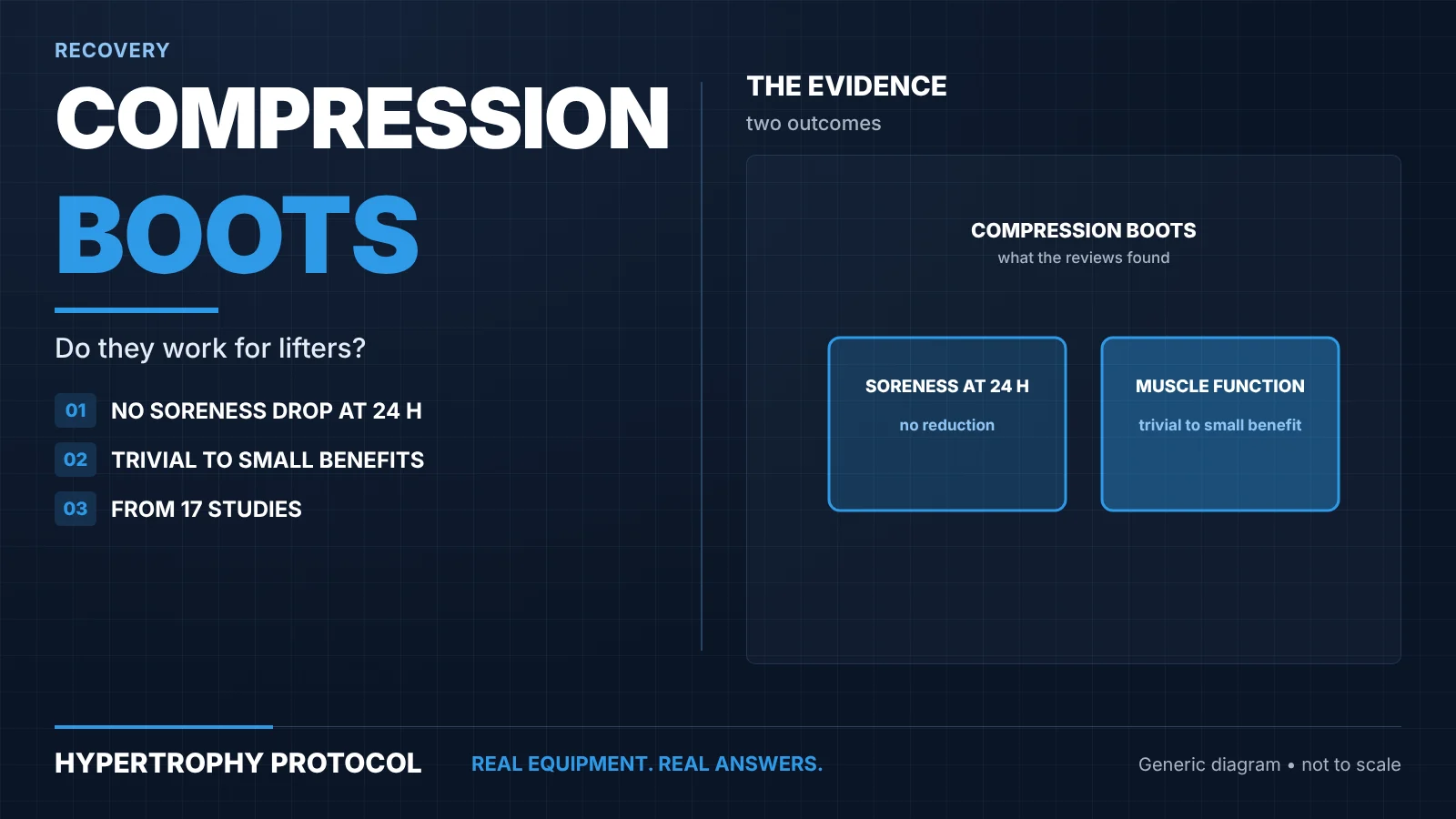
- Soreness: moderate-certainty evidence that pneumatic compression boots don’t reduce muscle soreness 24 hours after exercise.
- Performance: a 2024 meta-analysis of 17 studies found trivial to small benefits for muscle function and highly variable effects on damage markers.
- Better value: compression garments improved strength recovery after resistance exercise in a 2017 meta-analysis (effect size 0.49), for about $100 or less.
- Who might still want boots: people who train legs hard several times a week, enjoy the sessions, and don’t mind paying $280 to $1,099 for comfort.
- Ask a doctor first if you have blood clots, circulation problems, nerve damage in your legs, or leg wounds.
At a glance
| Verdict | Boots feel good but show trivial to small benefits; compression garments have better evidence for less. |
|---|---|
| Effect size / key numbers | Boots: no clear drop in 24-hour soreness. Garments: ES 0.49 for recovery after resistance exercise. |
| Evidence strength | Moderate certainty of no 24-hour soreness benefit; boot studies are small and short. |
| What to do | Start with recovery tights (about $100). Buy boots ($280 to $1,099) only for comfort. |
| Main caveat | Ask a doctor first with blood clots, circulation problems, leg nerve damage or leg wounds. |
Prices from Amazon, checked October 20, 2026. Confirm before ordering.
What compression boots do
Compression boots, sold as Normatec, RecoveryAir and many cheaper brands, are inflatable sleeves that zip over your legs. A pump inflates chambers in sequence from your feet upward, squeezing and releasing, and then repeats. The technical name is intermittent pneumatic compression (IPC). Hospitals have used similar devices for decades to help prevent blood clots in immobile patients. The recovery idea is that the squeezing helps move fluid out of tired, swollen legs.
Do compression boots help recovery?
The evidence is weak. A 2024 meta-analysis of 17 studies with 319 participants (Maia and colleagues) found trivial to small benefits for recovering muscle function, trivial to moderate effects on pain and soreness, and highly variable effects on muscle damage markers. The authors concluded that boots “might” help recovery, mainly by reducing perceived soreness, and that the method still “lacks strong scientific support.”
A 2025 meta-analysis focused on muscle recovery (Canez and colleagues) was more direct. It rated the evidence as moderate certainty that IPC does not reduce muscle soreness 24 hours after exercise compared with control. The mean difference was 2.2 points in favour of the boots, with a confidence interval running from a 10-point benefit to a 6-point disadvantage, which is consistent with no real effect.
The studies that show benefits tend to be small and short. The studies in the 2024 review most often used 20 to 30 minute sessions at about 80 mmHg. That doesn’t make it the right pressure for everyone, so follow the device instructions and start at a lower setting.
A note on industry studies
Some positive studies are run or co-written by manufacturers. A 2026 half-time study on youth soccer players, for example, found boots helped maintain sprint times and perceived recovery, and its authors included employees of the brand that makes the devices tested. That doesn’t make the result wrong, but independent meta-analyses carry more weight.
Compression garments: the cheaper option with better evidence
Wearable compression, such as recovery tights or sleeves, has stronger support for lifters. A 2017 meta-analysis of 23 studies (Brown and colleagues) found compression garments produced small but very likely benefits for recovery overall (effect size 0.38). The benefit was larger for strength (0.62) and largest after resistance exercise (0.49 overall, 1.33 beyond 24 hours). A 2018 meta-analysis of 99 studies (Dupuy and colleagues) also found compression garments reduced soreness and perceived fatigue.
Garments also have a practical edge. You can wear them for hours, including while sleeping or traveling, rather than sitting still for a 30-minute boot session. If you want compression for leg day recovery, start here.
Who might still want compression boots?
- You train legs hard and often and like having a forced 20 to 30 minutes of sitting with your legs up.
- Your legs feel heavy or swollen after long days on your feet, and the boots make them feel better. Feeling better is a legitimate reason, as long as you know that’s what you’re paying for.
- You already have the basics covered: sleep, enough protein and sensible training volume. Boots won’t make up for those.
If you’re deciding between boots and something else for a sore lower body, a foam roller or a massage costs far less and has at least as much support. See our guide to DOMS and what actually helps sore muscles for every option side by side.
Who should check with a doctor first
Don’t use compression boots without medical advice if you have, or might have, a blood clot (deep vein thrombosis), poor circulation or peripheral artery disease, heart failure, nerve damage or numbness in your legs, open wounds or skin infections on your legs, or a recent leg injury or surgery.
Options and prices
Prices below were checked on Amazon on October 20, 2026, and change often. There’s no published research comparing budget boots with premium brands on recovery outcomes. The premium models are generally more refined, with better apps, sizing and build, but don’t assume they work better.
| Product | Type | Price | Notes |
|---|---|---|---|
| 2XU Refresh Recovery Compression Tights (affiliate) | Compression garment | About $100 | Best-supported option for the money. Wear after leg day or overnight. |
| FIT KING Air Compression Recovery System, full leg (affiliate) | Pneumatic boots | About $280 | Budget boots with a large number of reviews. Check the size chart for your leg length. |
| QUINEAR Air Compression Recovery System (affiliate) | Pneumatic boots | About $300 | Another budget option with sequential compression. |
| Hyperice Normatec 3 Legs (affiliate) | Pneumatic boots | About $899 | The best-known brand. You’re paying for polish and build quality, not proven extra benefit. |
| Hyperice Normatec Elite (affiliate) | Pneumatic boots, wireless | About $1,099 | No hoses or separate pump. Only worth it if portability matters to you. |
The bottom line
Compression boots can feel good, but pooled studies haven’t shown a reliable improvement in recovery of strength or performance, and a 2025 analysis found no clear reduction in next-day soreness. If you want compression for recovery, recovery tights have better evidence at a fraction of the price. Buy boots only if you’ll enjoy using them regularly and the cost doesn’t matter.
Sources
- Maia F, Nakamura FY, Sarmento H, Marcelino R, Ribeiro J. Effects of lower-limb intermittent pneumatic compression on sports recovery: a systematic review and meta-analysis. Biol Sport. 2024;41(4):263-275. doi:10.5114/biolsport.2024.133665
- Canez MS, da Silva LI, Ferreira GD, de Araújo FX, Luza LP. Effects of photobiomodulation, intermittent pneumatic compression and neuromuscular electrical stimulation on muscle recovery: systematic review with meta-analysis. J Bodyw Mov Ther. 2025;44:570-584. doi:10.1016/j.jbmt.2025.06.021
- Brown F, Gissane C, Howatson G, van Someren K, Pedlar C, Hill J. Compression garments and recovery from exercise: a meta-analysis. Sports Med. 2017;47(11):2245-2267. doi:10.1007/s40279-017-0728-9
- Dupuy O, Douzi W, Theurot D, Bosquet L, Dugué B. An evidence-based approach for choosing post-exercise recovery techniques to reduce markers of muscle damage, soreness, fatigue, and inflammation: a systematic review with meta-analysis. Front Physiol. 2018;9:403. doi:10.3389/fphys.2018.00403
- Skinner B, Munn EE, Roberts T, Reed RA, Thorpe RT. The effectiveness of passive half-time interventions on simulated second-half performance in elite youth soccer players. J Sports Sci Med. 2026;25(3):617-626. doi:10.52082/jssm.2026.617