
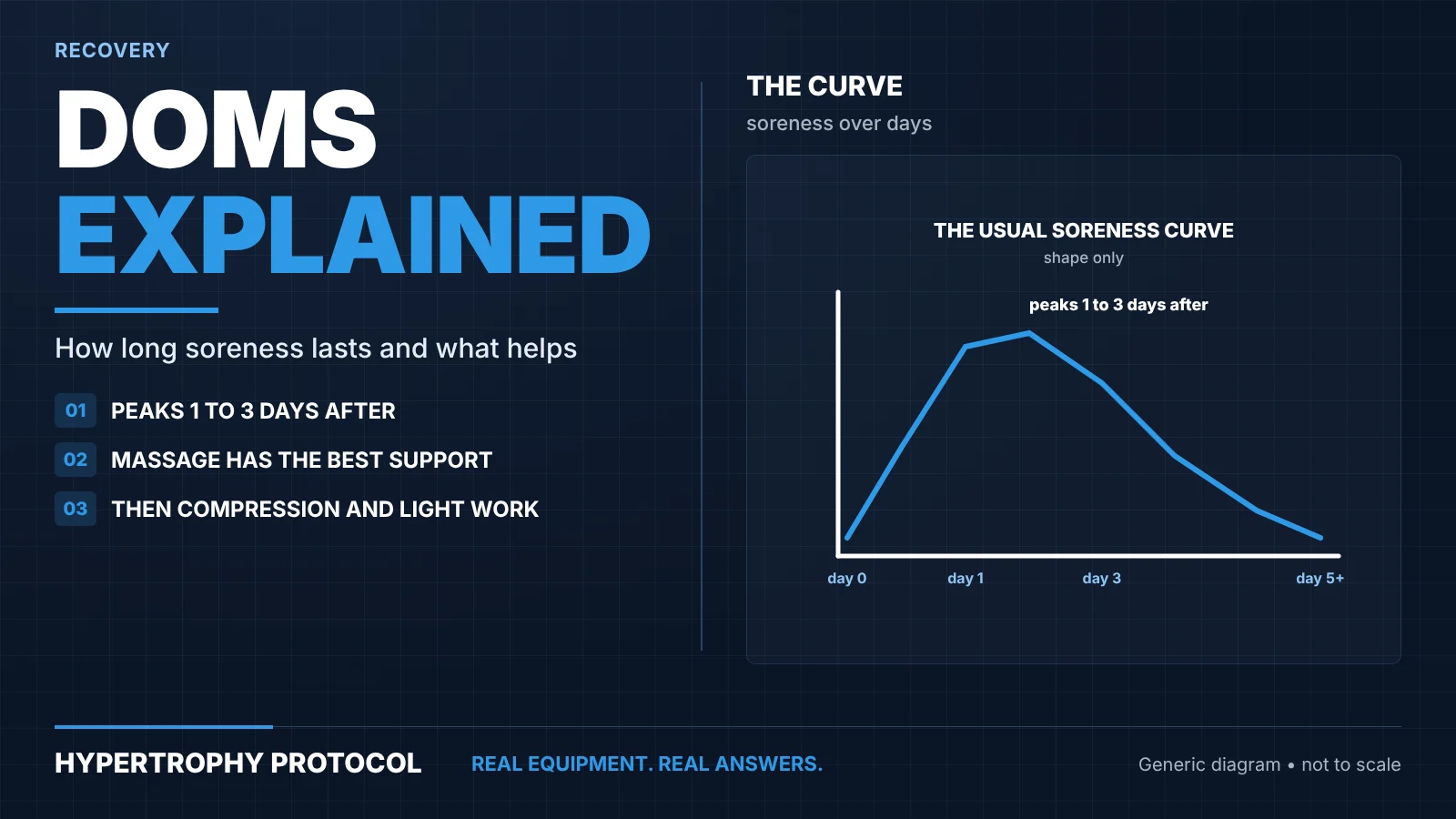
Delayed onset muscle soreness (DOMS) is the stiff, tender feeling that shows up the day after a hard or unfamiliar workout and can make stairs miserable for a few days. It’s normal, it fades on its own, and it isn’t a reliable sign that a workout built muscle. Some things genuinely take the edge off it, and some popular ones barely do. This guide covers how long soreness lasts, what the research says about each recovery method, how to train around it, and when soreness is a warning sign. It’s general information, not medical advice.
Short answer
- How long: soreness usually starts within a day, often peaks one to three days after training and eases over several days.
- Best-supported relief: massage, followed by compression garments and light exercise. Cold water helps soreness but can blunt muscle growth if used after every lifting session.
- Small effects: foam rolling and red light therapy. Little or no effect: compression boots at 24 hours, stretching and whole-body cryotherapy.
- Soreness isn’t growth: it drops quickly as your body adapts to an exercise, even while your muscles keep growing.
- Get checked if pain is far worse than expected, your muscles are unusually weak, or your urine turns tea- or cola-colored.
At a glance
| Verdict | DOMS is normal, fades within about a week, and isn’t a reliable sign a workout built muscle. |
|---|---|
| Effect size / key numbers | Often peaks 24 to 72 hours after training. Foam rolling: about 6% less pain (effect 0.47). Compression garments: about −0.44. |
| Evidence strength | Moderate: a 99-study meta-analysis plus newer reviews; red light and cryotherapy evidence is low or very low quality. |
| What to do | For relief, use massage, compression garments or light exercise. Train as planned when mildly sore. |
| Main caveat | Cold water after lifting can blunt growth, and max OTC ibuprofen roughly halved quad growth (3.7% vs 7.5%) in one trial. |
See the full sections below for sources. General information, not medical advice.
What causes DOMS?
DOMS appears after exercise your muscles aren’t used to, especially exercise with a lot of eccentric (lowering) work, such as slow negatives, Romanian deadlifts, walking lunges or a first leg day back after time off. A classic review by Clarkson and Hubal (2002) describes small-scale disruption inside the muscle fibers followed by inflammation, along with temporary losses of strength. A 2026 systematic review by Jemni and colleagues describes DOMS as a mix of muscle damage, inflammation and sensitised pain nerves rather than one single cause.
The old idea that soreness is lactic acid “building up” doesn’t fit. Lactate produced during exercise clears much sooner than DOMS appears, so it isn’t considered the cause. A 2003 review (Cheung and colleagues) listed it as one of several early theories that didn’t hold up on its own.
How long does muscle soreness last?
DOMS commonly begins about 12 to 24 hours after the session, often peaks around 24 to 72 hours and eases over several days. How long it lasts varies with the exercise and the person. A first session of a new exercise, a big jump in volume or lots of slow eccentrics will push it toward the longer end.
Repeating the same exercise shortens and softens it. After one bout of damaging exercise, the muscle becomes much less vulnerable to the next one. This is called the repeated bout effect, and it’s been shown many times. Researchers think changes in how your nerves recruit the muscle, the muscle’s mechanical properties and the surrounding connective tissue all contribute (Hyldahl and colleagues, 2017).
Does soreness mean the workout worked?
Not reliably. Because of the repeated bout effect, the same workout makes you much less sore the second and third time, even though it keeps producing muscle growth if you train hard enough and progress. Soreness tells you a session was new or more damaging than usual. It doesn’t tell you how much muscle you built. Chasing soreness usually means adding novelty or volume you then have to recover from, which can cut into the quality of your next sessions.
What matters more for growth is training close to failure with enough weekly sets, progressing over time and recovering well enough to keep doing it. Our guide to mechanical tension and muscle growth covers that side.
What actually helps sore muscles?
The largest overview is a 2018 meta-analysis of 99 studies (Dupuy and colleagues). Active recovery, massage, compression garments, cold water immersion, contrast water therapy and cryotherapy all reduced soreness, with effects ranging from small to large. Massage was the most effective method for both soreness and perceived fatigue. Other methods in that analysis didn’t change soreness.
Here’s how the common options compare, based on that analysis and newer reviews.
| Method | Effect on soreness | Notes for lifters |
|---|---|---|
| Massage | Most effective in the 2018 meta-analysis | Professional massage costs the most. Self-massage tools are weaker but cheap. |
| Compression garments | Reduced soreness and fatigue (effect about −0.44 in the 2026 review) | Cheap and passive. Wear them after a hard leg day. |
| Active recovery (light exercise) | Reduced soreness | Exercise eases DOMS pain, but the relief is temporary (Cheung, 2003). Free. |
| Cold water immersion | Reduced soreness | Can blunt muscle growth when used right after lifting. See cold plunges and muscle growth. |
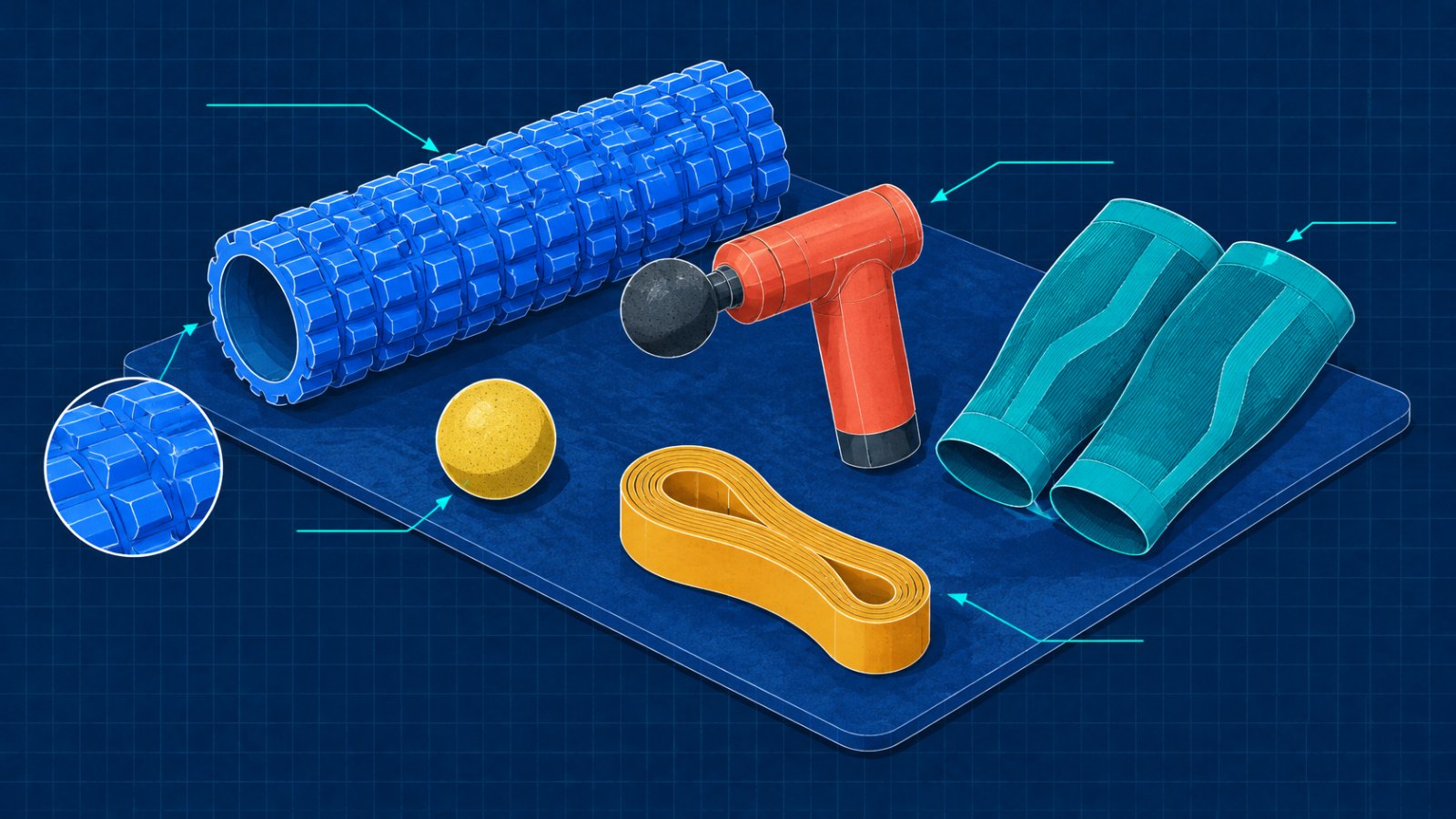
| Foam rolling | Small reduction (about 6% less perceived pain; effect 0.47) | Low cost and won’t hurt strength. See our foam rolling guide. |
| Red light therapy (before exercise) | Reduced soreness, low-certainty evidence | Applied before training, not after. Device quality and dosing vary a lot. |
| Compression boots (pneumatic) | No reduction at 24 hours (moderate certainty); trivial to moderate effects in a separate review | Expensive for a small or uncertain effect. |
| Whole-body cryotherapy | Insufficient evidence (very low quality) | Not worth paying for to treat soreness. |
| Stretching | No effect on soreness in the 2003 review | Fine for flexibility, but don’t expect less soreness. |
What about painkillers?
Anti-inflammatory drugs can ease soreness, but there’s a trade-off for lifters. In an 8-week trial in young adults (Lilja and colleagues, 2018), taking the maximal over-the-counter ibuprofen dose (1,200 mg a day) roughly halved quadriceps growth compared with low-dose aspirin: 3.7% versus 7.5%. A 2023 follow-up by the same group didn’t find a clear explanation in the molecular and cellular markers it measured. Neither study tested occasional use, which is a different situation from taking them around every session. Follow the label, and ask your doctor or pharmacist if you take them regularly or have stomach, kidney or heart concerns.
Sleep and protein
The basics matter more than any gadget. In a small crossover study (Lamon and colleagues, 2021), one night without sleep reduced muscle protein synthesis by 18% the next day, raised cortisol by 21% and lowered testosterone by 24%. That was total sleep deprivation, not a short night, but it shows why sleep belongs at the top of the recovery list. Eating enough protein across the day supports repair too. Our guide to protein per meal covers how much.
Should you train while sore?
Usually, yes, with some adjustments. Light exercise eases DOMS pain for a while, and mild soreness on its own doesn’t necessarily mean you’ll cause more damage by training. If pain changes how you move or is severe, reduce the intensity. The 2003 review by Cheung and colleagues suggested reducing intensity and volume for one to two days after severe soreness, or training muscle groups that aren’t as sore. Soreness can reduce your range of motion and change how you move, so heavy, technical lifts on a very sore muscle are the ones to ease off.
- Mildly sore: train as planned. The warm-up often takes most of the stiffness away.
- Very sore in the muscles you planned to train: swap the day for a different muscle group, or keep the session but use lighter loads and fewer sets.
- Sore for most of every week: your volume jumped too fast or you need a lighter week. See how long to recover after a heavy leg day and our guide to deload weeks.
How to get less sore in the first place
- Add new exercises gradually. Cheung and colleagues suggested introducing new or eccentric-heavy exercises progressively over one to two weeks. Start with one or two sets and build up.
- Increase volume in steps. Big jumps in weekly sets, especially for legs, cause most of the worst soreness.
- Stay consistent. The repeated bout effect means regular training is the most effective soreness reducer there is.
- Coming back after time off: treat your first week back as a ramp-up, not a test of where you left off.
When soreness isn’t normal
Most soreness is harmless, but extreme exercise can cause rhabdomyolysis, where damaged muscle releases enough protein into the blood to threaten the kidneys. It’s rare in normal training but has been reported after unaccustomed high-volume sessions, especially in the heat. NIOSH lists these warning signs:
- Muscle cramps, aches or pain far worse than you’d expect
- Being unusually tired or weak, or unable to finish a workout
- Tea- or cola-colored urine
Symptoms can appear several days after the session. If you notice them, stop exercising and get medical care right away rather than trying to treat it yourself. A blood test for creatine kinase (CK) is used to diagnose it. Sharp pain during a lift, pain in a joint rather than the muscle, or swelling and bruising are signs of an injury rather than DOMS, and are worth getting looked at too.
The bottom line
Soreness is a sign that a workout was new or hard, not that it worked. It fades within a week and gets milder as you keep training. If you want relief, massage, compression garments and light movement have the best support, and a foam roller is a cheap way to get some of the massage effect at home. Sleep, protein and sensible increases in volume do more for recovery than any recovery device.
Frequently asked questions
Is muscle soreness caused by lactic acid?
No. Lactate produced during exercise clears much sooner than DOMS appears, so it is not considered the cause.
Why am I less sore the second time I do the same workout?
This is called the repeated bout effect. After one bout of damaging exercise, the muscle becomes much less vulnerable to the next one, so repeating the same exercise shortens and softens the soreness.
Does ibuprofen for soreness affect muscle growth?
In one 8-week trial in young adults, taking the maximal over-the-counter ibuprofen dose (1,200 mg a day) roughly halved quadriceps growth compared with low-dose aspirin, 3.7% versus 7.5%. That research did not test occasional use, which is a different situation from taking it around every session.
Does stretching reduce muscle soreness?
Stretching had no effect on soreness in the 2003 review cited above. It is fine for flexibility, but do not expect less soreness from it.
Sources
- Dupuy O, Douzi W, Theurot D, Bosquet L, Dugué B. An evidence-based approach for choosing post-exercise recovery techniques to reduce markers of muscle damage, soreness, fatigue, and inflammation: a systematic review with meta-analysis. Front Physiol. 2018;9:403. doi:10.3389/fphys.2018.00403
- Jemni M, Quodling N, Hammami N, et al. Rethinking neurophysiology of delayed onset muscle soreness: updated concepts and mechanisms for mitigation across endurance, resistance, and plyometric exercise. Front Sports Act Living. 2026;8:1709704. doi:10.3389/fspor.2026.1709704
- Clarkson PM, Hubal MJ. Exercise-induced muscle damage in humans. Am J Phys Med Rehabil. 2002;81(11 Suppl):S52-S69. doi:10.1097/00002060-200211001-00007
- Cheung K, Hume P, Maxwell L. Delayed onset muscle soreness: treatment strategies and performance factors. Sports Med. 2003;33(2):145-164. doi:10.2165/00007256-200333020-00005
- Hyldahl RD, Chen TC, Nosaka K. Mechanisms and mediators of the skeletal muscle repeated bout effect. Exerc Sport Sci Rev. 2017;45(1):24-33. doi:10.1249/JES.0000000000000095
- Wiewelhove T, Döweling A, Schneider C, et al. A meta-analysis of the effects of foam rolling on performance and recovery. Front Physiol. 2019;10:376. doi:10.3389/fphys.2019.00376
- Canez MS, da Silva LI, Ferreira GD, de Araújo FX, Luza LP. Effects of photobiomodulation, intermittent pneumatic compression and neuromuscular electrical stimulation on muscle recovery: systematic review with meta-analysis. J Bodyw Mov Ther. 2025;44:570-584. doi:10.1016/j.jbmt.2025.06.021
- Maia F, Nakamura FY, Sarmento H, Marcelino R, Ribeiro J. Effects of lower-limb intermittent pneumatic compression on sports recovery: a systematic review and meta-analysis. Biol Sport. 2024;41(4):263-275. doi:10.5114/biolsport.2024.133665
- Costello JT, Baker PRA, Minett GM, et al. Whole-body cryotherapy (extreme cold air exposure) for preventing and treating muscle soreness after exercise in adults. Cochrane Database Syst Rev. 2015;(9):CD010789. doi:10.1002/14651858.CD010789.pub2
- Lilja M, Mandić M, Apró W, et al. High doses of anti-inflammatory drugs compromise muscle strength and hypertrophic adaptations to resistance training in young adults. Acta Physiol (Oxf). 2018;222(2):e12948. doi:10.1111/apha.12948
- Lilja M, Moberg M, Apró W, et al. Limited effect of over-the-counter doses of ibuprofen on mechanisms regulating muscle hypertrophy during resistance training in young adults. J Appl Physiol. 2023;134(3):753-765. doi:10.1152/japplphysiol.00698.2022
- Lamon S, Morabito A, Arentson-Lantz E, et al. The effect of acute sleep deprivation on skeletal muscle protein synthesis and the hormonal environment. Physiol Rep. 2021;9(1):e14660. doi:10.14814/phy2.14660
- National Institute for Occupational Safety and Health. What wildland fire fighters need to know about rhabdomyolysis. DHHS (NIOSH) Publication No. 2018-131. CDC Stacks