
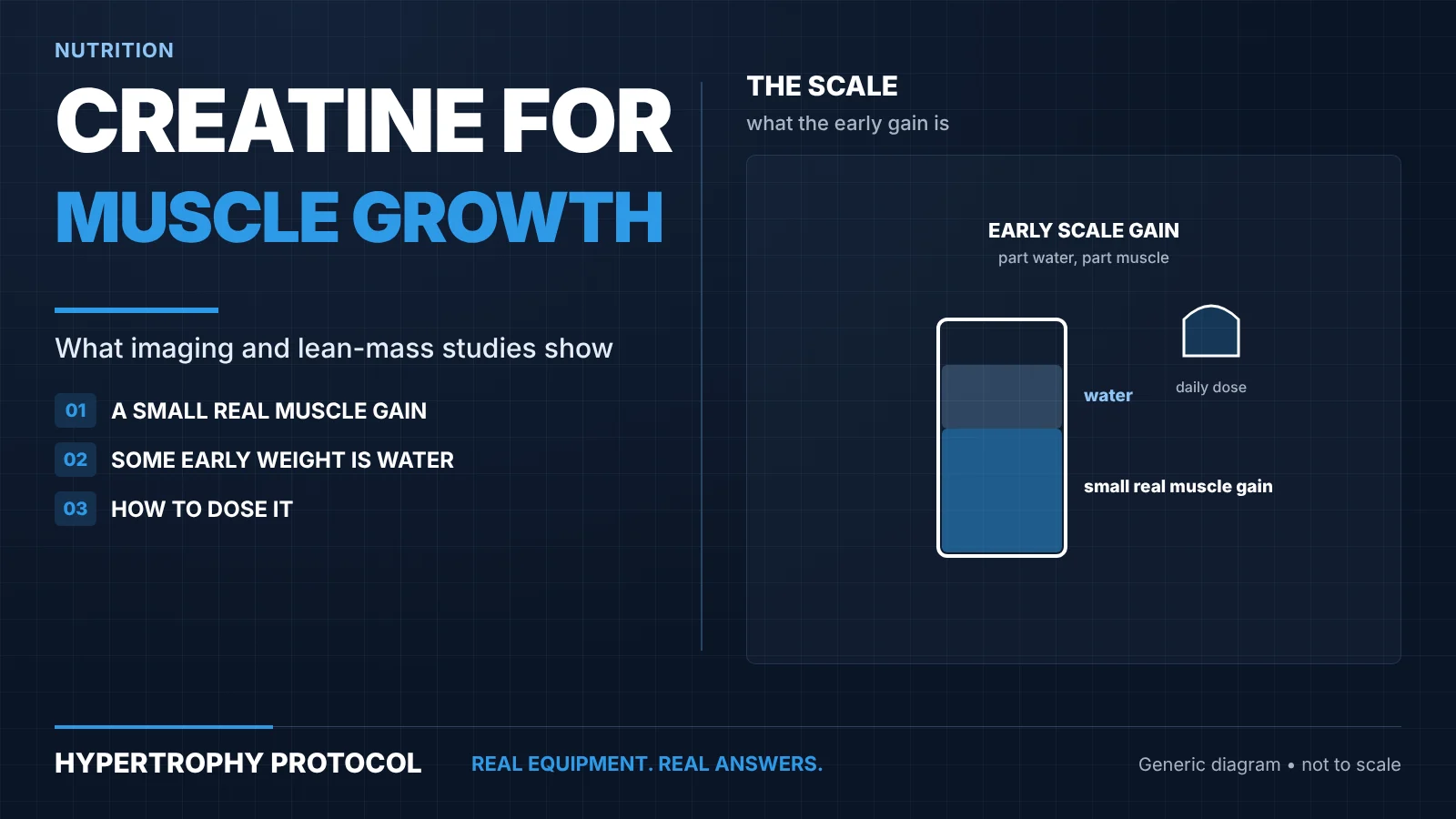
You lift, you are thinking about adding creatine, and a training partner warns that the extra scale weight is only water. The research on creatine muscle growth gives a clear short answer: creatine adds real muscle on top of lifting, but less than the scale suggests. Studies that imaged muscle directly show a small gain, while the kilogram or so of lean mass in body-composition studies includes some water.
How you take it matters less than taking it every day. About 3 g a day fills your muscle stores in roughly four weeks without a loading phase, and the timing trials show no clear winner between before and after training. Every study below was checked on PubMed on September 28, 2026.
At a glance
| Verdict | Creatine adds real muscle on top of lifting, but less than the scale suggests |
|---|---|
| Effect size / key numbers | Imaged muscle: SMD 0.11 (95% CrI −0.02 to 0.25), about 1.0–1.6 mm extra thickness. Lean mass: roughly 0.8–1.4 kg, water included |
| Evidence strength | Lean mass graded high quality (GRADE), but it includes water; muscle imaging rests on 10 trials, only 2 in trained lifters |
| What to do | Take 3–5 g a day, every day, alongside lifting; loading is optional, and timing trials show no clear winner |
| Main caveat | Smaller or less certain gains for women and older lifters; treat lean-mass figures as an upper bound |
Studies checked on PubMed, September 28, 2026.
Where does the “just water” idea come from?
That extra scale weight is where the myth starts. Creatine draws water into muscle, and in the ISSN position stand, early loading studies linked about 0.5 to 1.0 L of short-term fluid retention to the quick weight gain. A 28-day loading trial in resistance-trained men and women saw body mass and total body water rise, with the split between water inside and outside cells unchanged.
The bigger problem is how most studies measure the result. DXA, air displacement and bioimpedance estimate lean or fat-free mass, which counts everything that is not fat, water included. A lean-mass gain in a creatine study cannot, on its own, separate new muscle protein from extra fluid.
That is why the useful test of the myth comes from studies that looked at the muscle itself. Ultrasound, CT and MRI measure the thickness or cross-section of a specific muscle, and a biopsy can size individual fibers. The Burke team treats these site-specific images as the reference standard for muscle size, while whole-body lean mass also counts body water.
What did the creatine muscle growth studies actually measure?
Split by method, the evidence falls into two groups. The first rows measured muscle directly; the rest measured body mass or whole-body lean mass, which includes water. Each result compares creatine with placebo, and the rows show whether lifting was part of the trial.
| Study | Who and how long | What was measured | Creatine vs placebo |
|---|---|---|---|
| Direct muscle measures | |||
| Burke 2023 (meta-analysis) | 10 trials, 44 outcomes, 6 to 52 wk; 6 trials in older adults, 2 in trained lifters | Ultrasound thickness in most trials, CT in one | Pooled SMD 0.11 (95% CrI −0.02 to 0.25); young adults 0.23 (0.01 to 0.44), older adults 0.06 (−0.10 to 0.21); thickness +0.10 to 0.16 cm (chart below) |
| Volek 1999 | 19 trained men, 12 wk; 25 g/day for 1 wk, then 5 g/day | Biopsy fiber cross-sectional area | Type I +35% vs +11%; type IIA +36% vs +15%; type IIAB +35% vs +6% |
| Ribeiro 2020 | 27 trained men, 8 wk | DXA limb lean tissue plus bioimpedance water | Greater gains in skeletal muscle and intracellular water with creatine; muscle-to-intracellular-water ratio unchanged |
| Body mass or whole-body lean mass (includes water) | |||
| Pashayee-Khamene 2024 (meta-analysis) | 143 trials, 3,655 adults, with and without training | Body mass; estimated fat-free mass | Body mass +0.86 kg (95% CI 0.76 to 0.96); fat-free mass +0.82 kg (0.57 to 1.06), significant only with resistance or combined training |
| Ashtary-Larky 2025 (meta-analysis) | 61 trials with resistance training | Fat-free mass; body mass | Fat-free mass +1.39 kg (1.07 to 1.70); body mass +0.89 kg (0.76 to 1.01); trained +1.82 vs untrained +1.23 kg, difference not significant |
| Desai 2024 (meta-analysis) | 12 trials, adults under 50, with resistance training | Lean body mass | +1.14 kg (0.69 to 1.59); no difference by training status |
| Delpino 2022 (meta-analysis) | 35 trials, 1,192 adults | Lean body mass | With resistance training +1.10 kg (0.56 to 1.65); without exercise +0.03 kg (−0.65 to 0.70); men +1.46 kg, women +0.29 kg (not significant) |
| Forbes 2021 (meta-analysis) | 16 trials, 509 adults over 50, with resistance training | Lean tissue mass | +1.32 kg (0.93 to 1.72) |
Burke 2023: extra muscle thickness with creatine vs placebo (ultrasound)
Is creatine muscle gain real, or mostly water?
Read side by side, the two halves of the table point the same way at different sizes. The direct measures show real growth: muscle fibers grew more in trained men taking creatine, and pooled imaging across 10 trials favored creatine for every muscle group. The imaged effect is small, though, amounting to about a millimeter or a little more of extra thickness per muscle group.
The lean-mass meta-analyses land higher, at roughly 0.8 to 1.4 kg beyond training alone. The Burke authors suggested part of that gap may be fluid, though lean mass also counts muscle the ultrasound never scanned. The Ribeiro trial cuts against a pure-water story, since extra intracellular water rose in step with extra muscle and their ratio held steady.
So the myth is half right. Some early scale weight is water, but biopsy and imaging data show added muscle as well. Expect a modest assist and treat the lean-mass figures as an upper bound.
The mechanism also explains why lifting is required. Creatine without exercise showed no lean-mass effect in the Delpino analysis, and the Volek team attributed their result to higher-quality training sessions. Creatine helps you do a bit more work per session, and the work drives growth, as the mechanical tension guide explains.
Who gains the most muscle from creatine?
If better training is the route, the size of the benefit should vary by lifter, and the data hint that it does. Young adults showed a clearer imaged effect than older adults, though the Burke authors judged the difference modest. Trained lifters gained about 0.6 kg more fat-free mass than novices in the Ashtary-Larky analysis, a gap that missed statistical significance.
Sex is the widest split in the lean-mass data, and the least settled. Women showed smaller, non-significant gains in the Delpino analysis, and Pashayee-Khamene saw the same direction. Most trials enrolled men, and only one imaging trial in the Burke review studied women alone, so the estimate for women is the least certain in this article.
Certainty also depends on the outcome. Pashayee-Khamene graded the fat-free-mass evidence as high quality, but that is an estimate that includes water. The imaging evidence rests on 10 trials, only two of them in trained lifters, so the true muscle effect for an experienced lifter remains a wide estimate.
Do you need a creatine loading phase?
Whoever you are, the next question is how to start. Loading changes how fast your muscle stores fill, and slower daily dosing reaches the same level. The table covers the dosing and timing trials.
| Study | Who and how long | Comparison | Result |
|---|---|---|---|
| Hultman 1996 | 31 men | 20 g/day for 6 days vs 3 g/day for 28 days | About 20% more muscle creatine either way; 2 g/day then held the loaded level for 30 days |
| Forbes 2021 (subgroups) | Adults over 50 in trials with resistance training | 5 g/day or less, trials without a loading phase | Lean tissue +1.81 kg vs placebo (1.20 to 2.42); loading mattered only in the strength subgroups |
| Antonio 2013 | 19 recreational male bodybuilders, 4 wk | 5 g right before vs right after training | No significant difference; fat-free mass +0.9 vs +2.0 kg, which a magnitude-based analysis read as possibly favoring after |
| Candow 2014 | 22 untrained older adults, 12 wk | 0.1 g/kg before vs after training | No difference in lean tissue, limb muscle thickness or strength |
| Candow 2015 | 39 adults aged 50 to 71, 32 wk | 0.1 g/kg before vs after training vs placebo | Only the after group beat placebo for DXA lean tissue (+3.0 vs +0.5 kg); before and after did not differ from each other |
| Forbes 2021 (trial) | 10 recreationally active young adults, 8 wk | 0.1 g/kg before training one side of the body vs after training the other | Similar ultrasound thickness and strength gains |
| Dinan 2022 | 34 resistance-trained athletes, 8 wk | 5 g within 1 h before vs within 1 h after vs placebo, all with whey and maltodextrin | Similar fat-free mass gains in all three groups, placebo included |
The ISSN position stand lays out both routes. The fastest way to fill stores is about 20 g a day, split into four 5 g doses (roughly 0.3 g/kg), for 5 to 7 days, followed by 3 to 5 g a day. The slower route is 3 g a day for 28 days, and larger athletes may need 5 to 10 g a day to stay saturated.
No trial in this review compared loading with no loading head to head for muscle size over months. The closest evidence is indirect: in older lifters, trials that skipped loading still produced lean-mass gains. Loading mainly gets you to full stores in about a week instead of about four, along with a quicker early rise in scale weight.
Does it matter when you take creatine?
Once stores are full, timing is the last lever people ask about, and it is a weak one. Across young, older and trained groups, the before-versus-after trials ended with similar muscle gains. The one hint for post-workout dosing came from a 32-week trial in older adults where only the after group beat placebo, while the two creatine groups never differed from each other.
A 2022 narrative review by Candow and colleagues concluded that current research does not support timing creatine around training. Several of its authors disclose creatine-industry ties, which is one more reason to weigh the controlled trials over any review’s framing. Take your dose at whatever time you will remember it, every day, including rest days.
Should you take creatine for muscle growth, and how?
With dose and timing settled, the verdict depends on where you are. Find the line that matches you.
- You are new to lifting or train inconsistently: creatine adds a small increment to a stimulus you have not built yet. Consistent hard sets will do far more, and creatine can wait.
- You train consistently and your protein is covered: creatine is a reasonable, modest add. Take 3 to 5 g a day, and skip loading unless you want full stores within a week; at 3 g a day, stores fill in about four weeks. If protein is still short, fix that first with the protein per meal guide.
- You compete in a weight class: expect the scale to move early, most quickly with a loading phase, and plan the start well away from a weigh-in.
- You are a woman or an older lifter: the dosing advice is the same, but the expected gain is smaller or less certain in the current data.
The trials above enrolled healthy adults for the most part. If you have a medical condition or take prescription medication, talk to your doctor before starting creatine.
Your next step: choose a daily 3 to 5 g dose and pair it with a time you already keep. Then put your attention on adding load or reps week to week with the progressive overload guide.
Sources
- Burke R, et al. The effects of creatine supplementation combined with resistance training on regional measures of muscle hypertrophy: a systematic review with meta-analysis. Nutrients. 2023. doi:10.3390/nu15092116
- Pashayee-Khamene F, et al. Creatine supplementation protocols with or without training interventions on body composition: a GRADE-assessed systematic review and dose-response meta-analysis. J Int Soc Sports Nutr. 2024. doi:10.1080/15502783.2024.2380058
- Ashtary-Larky D, et al. Creatine supplementation and resistance training: a comparison between novice and experienced lifters, a systematic review and dose-response meta-analysis. J Int Soc Sports Nutr. 2025. doi:10.1080/15502783.2025.2586523
- Desai I, et al. The effect of creatine supplementation on resistance training-based changes to body composition: a systematic review and meta-analysis. J Strength Cond Res. 2024. doi:10.1519/JSC.0000000000004862
- Delpino FM, et al. Influence of age, sex, and type of exercise on the efficacy of creatine supplementation on lean body mass: a systematic review and meta-analysis of randomized clinical trials. Nutrition. 2022. doi:10.1016/j.nut.2022.111791
- Forbes SC, et al. Meta-analysis examining the importance of creatine ingestion strategies on lean tissue mass and strength in older adults. Nutrients. 2021. doi:10.3390/nu13061912
- Volek JS, et al. Performance and muscle fiber adaptations to creatine supplementation and heavy resistance training. Med Sci Sports Exerc. 1999. doi:10.1097/00005768-199908000-00011
- Ribeiro AS, et al. Creatine supplementation does not influence the ratio between intracellular water and skeletal muscle mass in resistance-trained men. Int J Sport Nutr Exerc Metab. 2020. doi:10.1123/ijsnem.2020-0080
- Powers ME, et al. Creatine supplementation increases total body water without altering fluid distribution. J Athl Train. 2003. PubMed 12937471
- Kreider RB, et al. International Society of Sports Nutrition position stand: safety and efficacy of creatine supplementation in exercise, sport, and medicine. J Int Soc Sports Nutr. 2017. doi:10.1186/s12970-017-0173-z
- Hultman E, et al. Muscle creatine loading in men. J Appl Physiol. 1996. doi:10.1152/jappl.1996.81.1.232
- Antonio J, Ciccone V. The effects of pre versus post workout supplementation of creatine monohydrate on body composition and strength. J Int Soc Sports Nutr. 2013. doi:10.1186/1550-2783-10-36
- Candow DG, et al. Comparison of creatine supplementation before versus after supervised resistance training in healthy older adults. Res Sports Med. 2014. doi:10.1080/15438627.2013.852088
- Candow DG, et al. Strategic creatine supplementation and resistance training in healthy older adults. Appl Physiol Nutr Metab. 2015. doi:10.1139/apnm-2014-0498
- Forbes SC, et al. Timing of creatine supplementation does not influence gains in unilateral muscle hypertrophy or strength from resistance training in young adults: a within-subject design. J Sports Med Phys Fitness. 2021. doi:10.23736/S0022-4707.20.11668-2
- Dinan NE, et al. Effects of creatine monohydrate timing on resistance training adaptations and body composition after 8 weeks in male and female collegiate athletes. Front Sports Act Living. 2022. doi:10.3389/fspor.2022.1033842
- Candow DG, et al. Creatine O’Clock: does timing of ingestion really influence muscle mass and performance? Front Sports Act Living. 2022. doi:10.3389/fspor.2022.893714
Sources checked September 28, 2026. Research summaries describe the cited studies; individual results vary.