
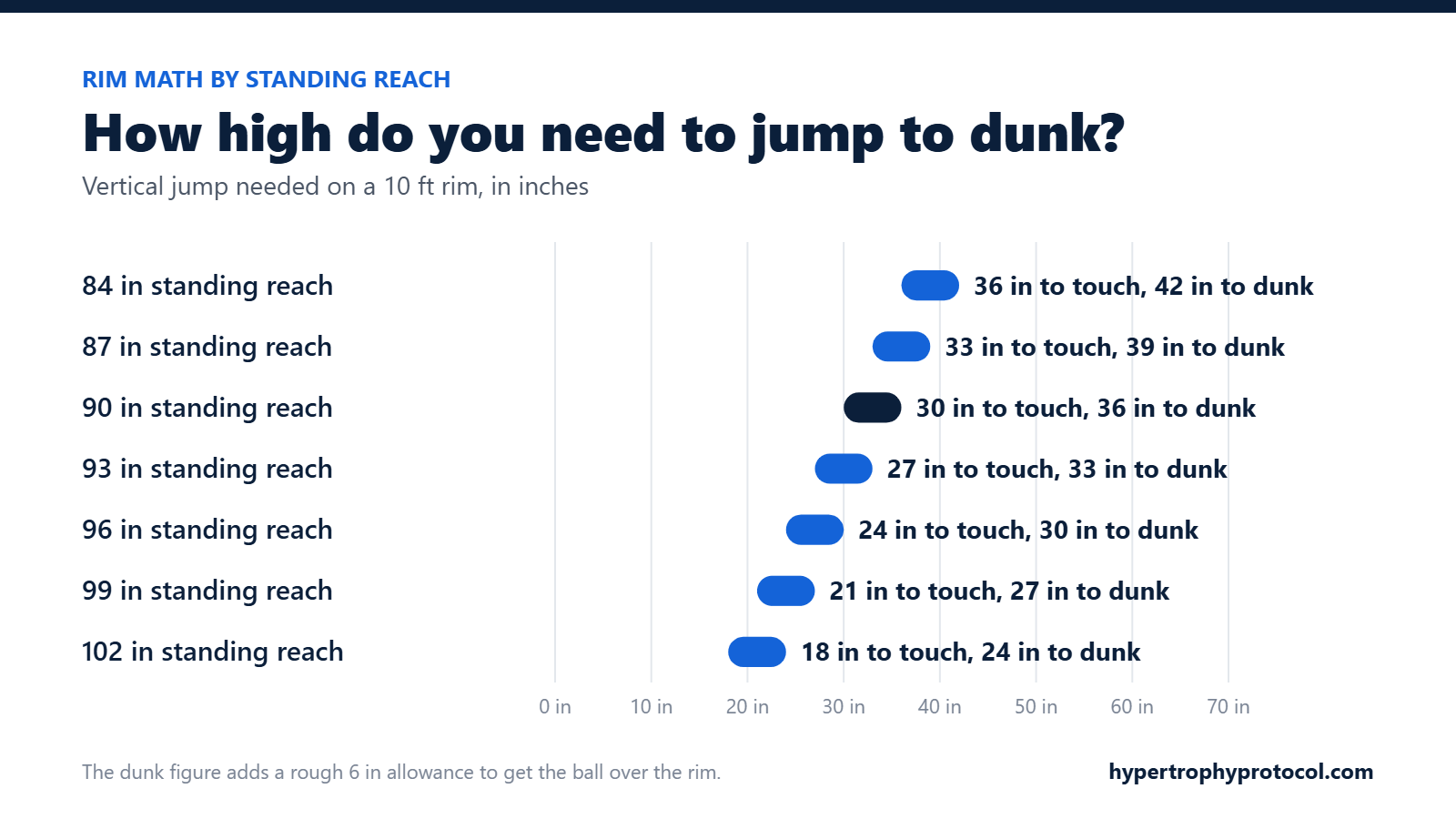
Short answer: it depends almost entirely on your standing reach. A regulation rim is 10 ft (120 in). Subtract your standing reach from 120 to get the vertical you need to touch the rim, then add room to get the ball over it. Our planner uses 6 in as a rough allowance. With a 90 in reach, that’s about 30 in to touch and about 36 in to dunk.
The rim math
- To touch the rim: vertical needed = 120 in minus standing reach.
- To dunk: add clearance for the ball and your hand. There’s no tested number for this; we use 6 in as a working default, and you can change it in the planner.
- In cm: the rim is about 305 cm. Vertical needed = 305 minus standing reach in cm, plus about 15 cm to dunk.
Vertical needed by standing reach
| Standing reach | Vertical to touch rim | Vertical to dunk (+6 in) |
|---|---|---|
| 84 in (213 cm) | 36 in (91 cm) | 42 in (107 cm) |
| 87 in (221 cm) | 33 in (84 cm) | 39 in (99 cm) |
| 90 in (229 cm) | 30 in (76 cm) | 36 in (91 cm) |
| 93 in (236 cm) | 27 in (69 cm) | 33 in (84 cm) |
| 96 in (244 cm) | 24 in (61 cm) | 30 in (76 cm) |
| 99 in (251 cm) | 21 in (53 cm) | 27 in (69 cm) |
| 102 in (259 cm) | 18 in (46 cm) | 24 in (61 cm) |
Standing reach depends on your height and arm length, so measure yours instead of guessing from your height. Our guide to measuring your vertical at home covers how.
Standing jump vs running jump
The table uses a standing vertical, which is what most tests measure. A run-up and arm swing usually add height. In a study of 253 elite volleyball players, men made better use of the arm swing than women, while both sexes used a 3-step approach equally well to add jump height (Sattler et al., 2015). How much a run-up adds varies from person to person, so test your own standing and running jumps against the same wall mark.
How much can training add?
Be realistic about the gap. In the main meta-analysis of plyometric training, jump height rose 8.7% on average for countermovement jumps and 7.5% with an arm swing (Markovic, 2007). Applied to a jump with arm swing:
- A 20 in jump gains about 1.5 in.
- A 24 in jump gains about 1.8 in.
- A 28 in jump gains about 2.1 in.
Those are averages across studies, not a promise. Gains vary a lot between people, and people who already train jumps usually have less left to gain. If you’re 2 in short, one solid training block might close it. If you’re 8 in short, it’s a multi-year project, and some people with a short reach won’t get there.
What closes the gap
- Jump training and heavy, deep squats, run for more than 10 weeks. Programs longer than 10 weeks, with more than 20 sessions, were most likely to produce larger gains (de Villarreal et al., 2009). Details: Plyometrics for Vertical Jump and Squats for Vertical Jump.
- Body fat. In 50 university students, body fat percentage had the strongest link to jump height of anything measured (r = -0.76) (Caia et al., 2016). That’s a correlation, not proof, but extra weight you can’t push with is weight you have to lift off the ground.
- The full plan: How to Jump Higher: What the Research Says.
Do the math for your own numbers
The Vertical Jump Planner takes your standing reach and jump, in inches or cm, shows how far you are from touching and dunking on a 10 ft rim, and gives a research-based range for what 12 weeks of training might add. You can change the clearance if 6 in doesn’t fit you.
FAQ
How high do I need to jump to dunk at 6 ft?
It depends on your reach, not just your height. Arm length varies, so two 6 ft people can have reaches several inches apart. Measure your standing reach, subtract it from 120 in, and add about 6 in to dunk.
How high do I need to jump to touch the rim?
120 in minus your standing reach. With a 90 in reach, that’s 30 in.
Is a running jump higher than a standing jump?
Usually, yes. A run-up and arm swing added height in jump studies, but the amount varies, so test both.
How long does it take to be able to dunk?
It depends on the size of the gap. Plyometric programs added about 7.5% to 8.7% to jump height on average. A small gap might close in one block of 10 to 12 weeks; a large one can take years or may not close.
Sources checked against PubMed on November 10, 2026. This is training information, not medical advice.