

Short answer: the standing broad jump (also called the standing long jump) is a two-footed jump forward for distance from a standstill. It’s one of the most widely used tests of leg power, and in adults it was a valid measure of lower-body explosive strength. Practice it a few times before you test, because people jumped noticeably farther on the second session. Jump training aimed forward improves it more than training aimed straight up.
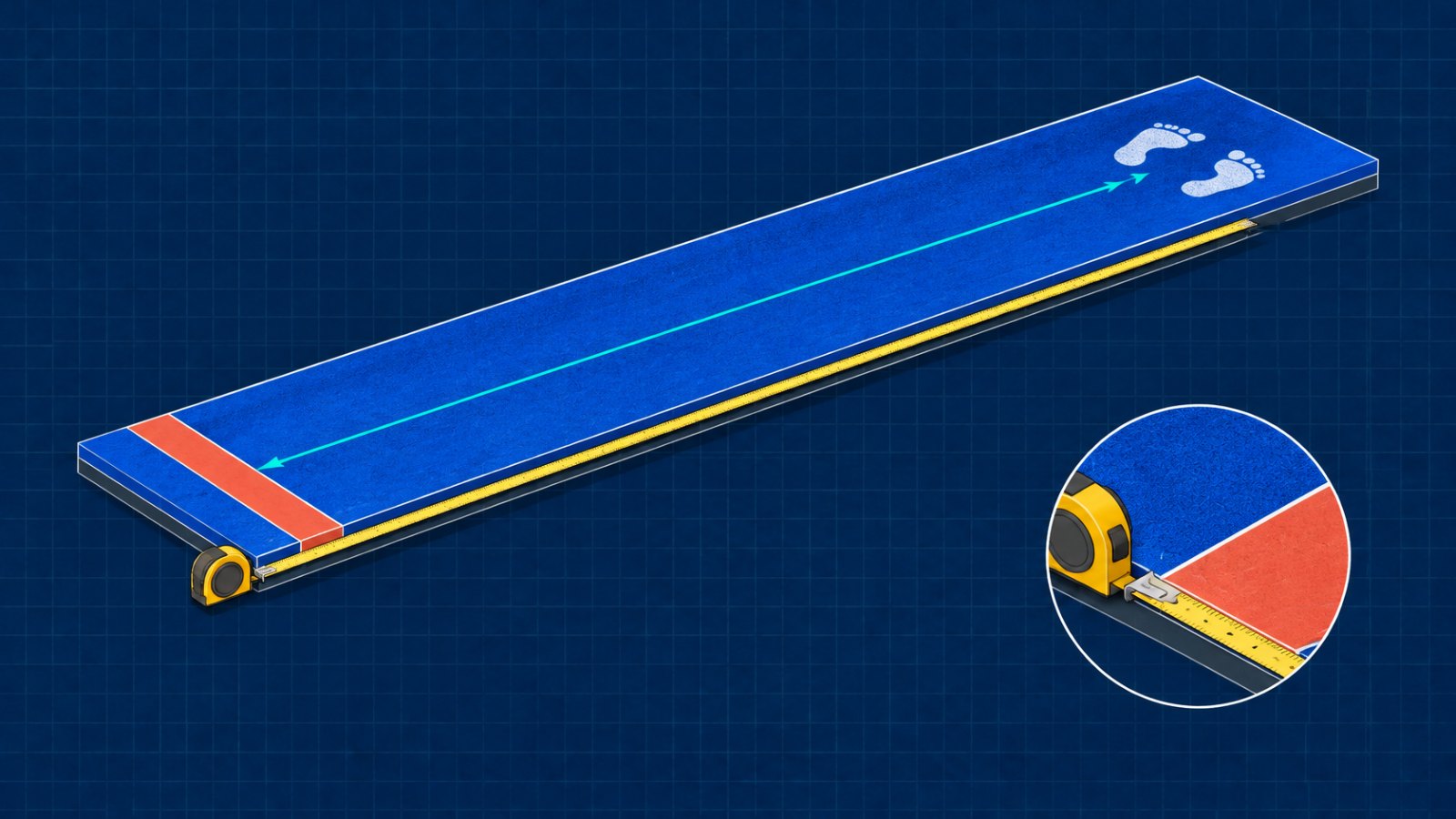
How to do a broad jump
These cues are coaching practice, not research findings:
- Stand with your feet about hip width apart, toes behind a line.
- Swing your arms back as you dip into a quarter squat.
- Swing your arms forward and drive out, jumping forward and slightly up.
- Bring your feet through and land on both feet, sinking into the landing.
- Stick the landing without falling back or stepping. A jump you can’t hold isn’t a good rep.
How to test your broad jump
- Measure from the start line to the back of the heel closest to the line. That’s the common way to score it.
- Practice first. In 410 adults, the second test session came out about 12 cm farther than the first on average. After a learning period, retests became almost identical (ICC 1.00, minimal detectable change 1 cm) (Marín-Jiménez et al., 2024).
- Take the best of 2 or 3 jumps with a short rest, on the same surface and in the same shoes each time.
What the broad jump tells you
- In adults, broad jump distance was explained by horizontal power and force, sex, body fat and lean mass (R = 0.78), which supports it as a measure of lower-body explosive strength (Marín-Jiménez et al., 2024).
- It’s one of the two muscular strength tests in the European youth fitness battery, chosen for its reliability and validity, and that project published percentile charts for ages 6 to 18 from almost 8 million test results (Ortega et al., 2023).
- Its feasibility was well supported in children and adolescents, but evidence for its safety and feasibility in adults is still limited (Cruz-León et al., 2025). Warm up and land on a non-slip surface.
How to improve your broad jump
- Jump forward, not just up. In 100 untrained teenage boys, 8 weeks of horizontal plyometrics improved the standing long jump more than vertical plyometrics, and also did better for a 50 m sprint and a change-of-direction test. Vertical jump gains were similar between the two (Zhao et al., 2026).
- Give it enough time. In adolescent soccer players, 6 weeks of either horizontal or vertical plyometrics added to soccer training didn’t improve the broad jump or vertical jump at all (Kurt et al., 2023). Programs longer than 10 weeks did best for jump height in the largest analysis (de Villarreal et al., 2009).
- Get stronger. Deep squats raised jump performance in controlled trials; see Squats for Vertical Jump.
A simple way to train it
This is our take, not a tested program:
- 2 lower-body sessions a week, jumps first while you’re fresh.
- Broad jumps: 3 to 4 sets of 3 to 4, stick every landing, full rest between sets.
- Add bounds (long, springy strides) and single-leg hops forward after the first few weeks.
- Keep a heavy squat or hip hinge in the same session.
- Retest every 4 weeks with the same setup.
The Vertical Jump Planner already includes broad jumps and bounds alongside vertical jumps, if you want a full 12-week plan.
FAQ
What’s the difference between a broad jump and a standing long jump?
Nothing. They’re two names for the same test: a two-footed jump forward for distance from a standstill.
Does the broad jump help your vertical jump?
In one trial, horizontal jump training improved the vertical jump about as much as vertical jump training did, and improved the broad jump more. Mixing jump directions is a reasonable approach.
How do you measure a broad jump at home?
Tape a start line, jump, and measure to the back of the heel closest to the line. Do a few practice jumps first.
Is a broad jump a good test of leg power?
Yes. In adults it tracked lab measures of horizontal force and power, and after a little practice it was very repeatable.
See also: Plyometrics for Vertical Jump and How to Measure Your Vertical Jump.
Sources checked against PubMed on November 10, 2026. This is training information, not medical advice.