
Disclosure: Hypertrophy Protocol may earn a commission if you buy through some links on this page, at no extra cost to you.
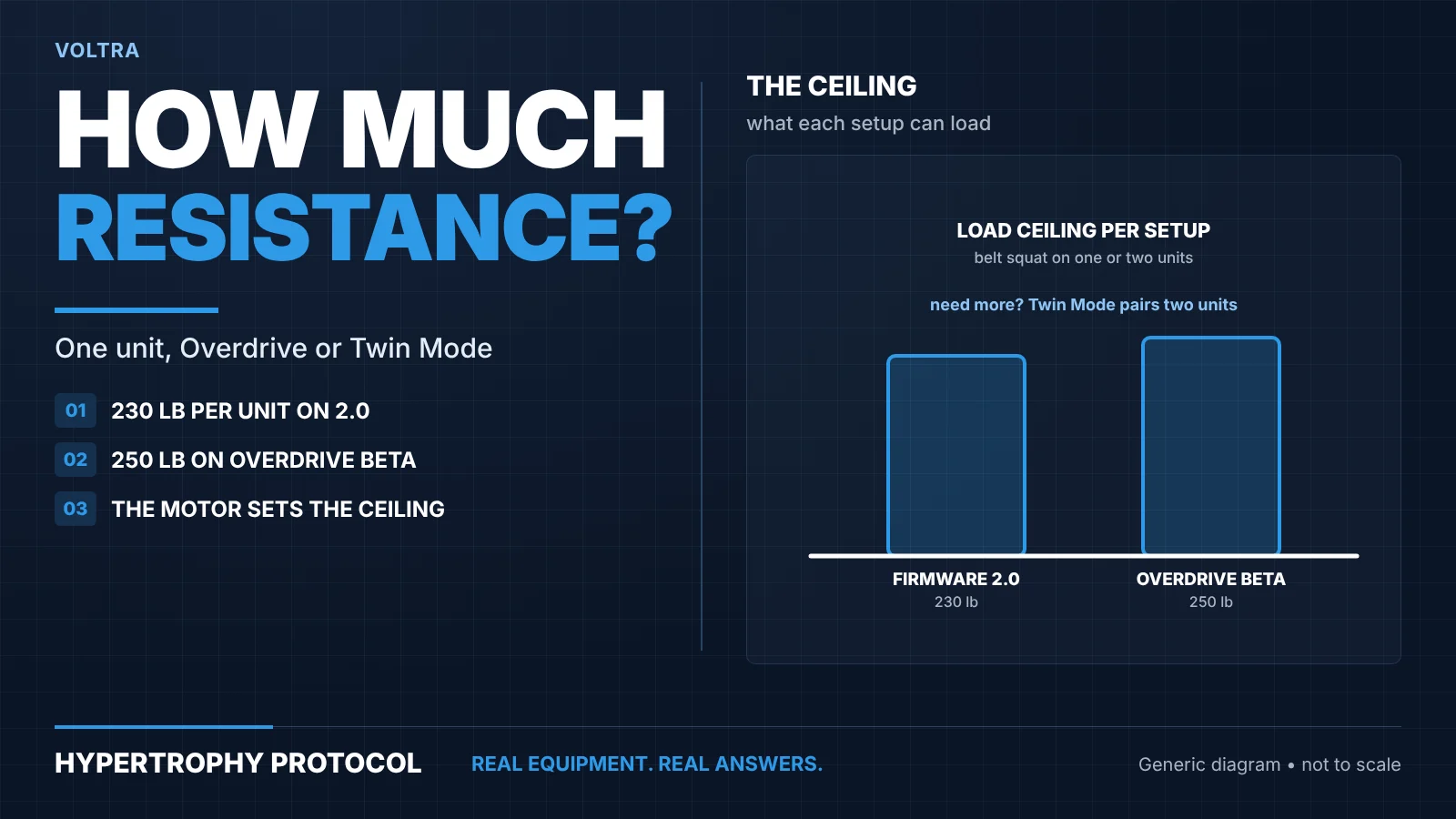
Whether one VOLTRA I is enough for a VOLTRA belt squat with a Squat Harness comes down to a single number: the load you would use for hard sets of 8 to 15 on a barbell or belt squat. One unit tops out at 230 lb on Firmware 2.0, or 250 lb if you join Beyond Power’s Overdrive beta. At about 210 lb or less (230 lb on the Overdrive beta), one unit covers you with room for cable lean; above the ceiling you need a second unit or a plan built on higher reps. That is the check to make if you own a VOLTRA I or plan to, and a Squat Harness looks like the simplest way to turn it into a belt squat.
This is a worked estimate from published numbers, not a load test. Every spec and study below was checked on October 26, 2026, on Beyond Power’s and Squat Harness’s own pages or on PubMed.
At a glance
| Check | Key number | What it means |
|---|---|---|
| Load ceiling | One unit: 230 lb on Firmware 2.0; 250 lb on the Overdrive beta | The motor sets the limit; the harness is rated far higher |
| One unit is enough | Working sets of 8 to 15 at about 210 lb or less (230 lb on the Overdrive beta) | Leaves room for cable lean and progress |
| Cable lean | At 20°, a 230 lb setting pulls 216 lb down (235 lb from 250 lb on Overdrive) | Keep the cable close to straight under your hips |
| Above the ceiling | Twin Mode: 400 lb combined (Beyond Power) | Two units on one harness isn’t documented by either maker |
| Capped load for growth | Lighter loads to failure grew muscle similarly (Schoenfeld 2017) | Add reps and push closer to failure; heavy loads still win for 1RM |
| Back squat conversion | No published ratio | Find your harness load in your first two sessions |
A worked estimate from published figures, not a load test. Specs and studies checked October 26, 2026. Confirm before ordering.
Which part of a VOLTRA squat harness setup sets the limit?
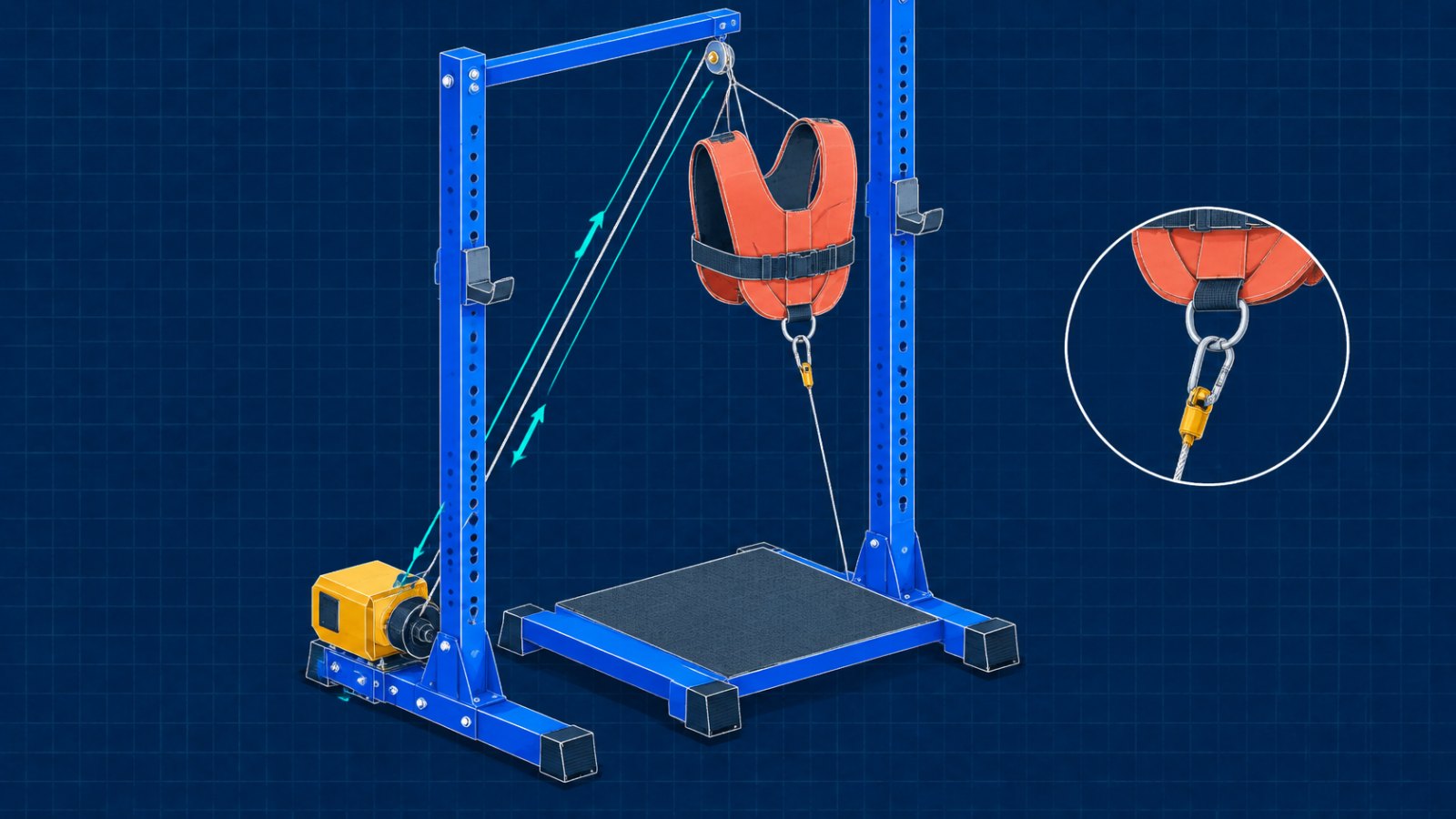
Start with the hardware, because the estimate only works if you know which piece caps the load. The harness and the motor are rated very differently.
| Item | Published figure | Source |
|---|---|---|
| VOLTRA I resistance | 5 to 230 lb (2 to 104 kg) on Firmware 2.0; up to 250 lb (113 kg) on the Overdrive beta; 1 lb increments | Beyond Power |
| VOLTRA I cable | 8.5 ft (2.6 m), 0.11 in synthetic fiber | Beyond Power specs |
| Twin Mode (two paired units) | Maximum combined output 400 lb; runs Weight Training, Resistance Band, Damper, Isokinetic and Isometric modes | Beyond Power help center |
| Squat Harness V4 load capacity | Up to 950 lb (an estimate on squatharness.com) | Squat Harness |
| Harness build | 6 lb of webbing, 3 in main straps, D-rings top and bottom, carabiners clip to fabric loops on each side | Squat Harness |
| Band hooks | Band hook straps included on the squatharness.com V4; Beyond Power sells a band-free V4 made with Squat Harness for VOLTRA I, with two strap hooks and no band hooks | Beyond Power harness page |
The harness is rated for more than twice what even two paired units can pull, so the motor is always the ceiling. One unit tops out at 230 lb on Firmware 2.0 (250 lb on the Overdrive beta), and Beyond Power lists two paired units at 400 lb combined. The band hook difference only matters if you plan to add bands later, which comes up again below.
Can you convert your back squat into a harness squat load?
Once the motor is the limit, the next question is what load your legs need, and that starts with where the load sits. In a harness squat the cable pulls down at your hips, and your legs still move your body plus that pull, just as they move your body plus the bar in a back squat. What changes is the path of the load, and the research on belt squats shows what that does.
| Study | Who | What was compared | Measured result |
|---|---|---|---|
| Joseph et al., 2020 | 10 lifters who trained both lifts (9 men, 1 woman), mean body mass 96.2 kg | Barbell back squat vs a pivoting belt squat machine, 3 sets of 5 at 100% of body weight | Quadriceps EMG did not differ; belt squat cut lumbar erector activity by 45.4% and gluteus maximus by 35.2% (integrated EMG) |
| Evans et al., 2019 | 31 adults (16 men, 15 women) | 5RM back squat vs 5RM machine belt squat, with EMG | Gluteus maximus EMG lower on the belt squat; regression equations predicted belt squat load from back squat load, with no conversion figure in the abstract |
| Schoenfeld et al., 2017 | Meta-analysis of 21 studies | Low loads (60% of 1RM or less) vs high loads, every set to failure, 6 weeks or longer | Muscle growth similar; 1RM strength gains favored heavy loads |
In Joseph’s matched-load test, the belt squat demanded about as much from the quads as the back squat, with far less from the trunk and glutes. That makes your barbell working weight a rough starting reference for a harness squat, though no validated conversion predicts the load you will need. EMG is a proxy for effort, though, and neither belt squat study measured muscle growth.
No published ratio converts a back squat into a harness squat. Evans built prediction equations, but the abstract gives no number, and the Joseph machine’s load rotated about a pivot, so its load setting may not equal the force at the belt. Treat any conversion you read online as a guess, and plan to find your harness number in your first two sessions.
How much of the load reaches your hips when the cable leans?
Your working weight is only half the estimate, because in a squat harness cable setup the VOLTRA’s number is the pull along the cable, and only the vertical part of it loads the squat. If the cable leans at an angle from vertical, the downward force equals the setting times the cosine of that angle.
Downward pull from one VOLTRA set to 230 lb (the Firmware 2.0 maximum), by cable lean
Force at the hips = setting × cos(angle). At the 250 lb Overdrive limit, the same leans give 246, 235 and 217 lb. Calculated, not measured.
Small leans cost little. If the cable leaves the unit 6 inches forward of your hips with 30 inches of vertical drop, the angle is about 11 degrees and a 230 lb setting still pulls 226 lb straight down (245 lb from a 250 lb setting). Move the unit 12 inches forward with a 24-inch drop and the angle grows to about 27 degrees, which leaves 206 lb pulling down and about 103 lb pulling you toward the unit (224 lb and 112 lb from a 250 lb setting).
That forward pull matters more than the lost pounds, because you have to resist it to stay balanced. The angle also changes through the rep as your hips drop and rise. Neither Beyond Power’s harness page nor its help center shows a mount position for harness squats, so aim to get the cable leaving the unit as close to straight under your hips as your floor and mounts allow.
When does one unit run out for a VOLTRA belt squat?
Put the working weight and the cable math together and the single-unit limit gets concrete. In my own harness squats on the VOLTRA I, a single unit ran out of resistance quickly; the VOLTRA I guide covers the unit’s other limits.
The Joseph group gives a sense of scale. Their mean body mass works out to about 212 lb, so a 100% body weight setting for the average lifter there sits just under one unit’s 230 lb ceiling on Firmware 2.0, lever effects aside, and those were sets of only five.
The lines below are rules of thumb from the lean math above, not tested cutoffs. On the 230 lb Firmware 2.0 limit, if your barbell working sets for 8 to 15 reps are about 210 lb or less, one unit covers you with room to progress; between about 210 and 230 lb, you are at the ceiling after a few small jumps. On the 250 lb Overdrive beta, the same lines move to about 230 and 250 lb.
Above your unit’s ceiling, one unit still has a use for hypertrophy. In the Schoenfeld meta-analysis, lighter loads taken to failure produced similar muscle growth to heavier ones, so a capped load can keep working if you add reps and push sets closer to failure. The trade-off is longer sets, and heavy loads still won for 1RM strength.
Is a second VOLTRA or a plate add-on the better upgrade?
If you have outgrown one unit and want heavier sets rather than longer ones, you have two routes. Beyond Power documents Twin Mode, which pairs two VOLTRA I units with a maximum combined output of 400 lb. Beyond Power’s Firmware 2.0 page raised the single-unit limit from 200 lb to 230 lb but does not mention Twin Mode, so 400 lb is the only combined figure it publishes. Even at a 20-degree lean, that ceiling still leaves about 376 lb pulling down.
What Beyond Power does not show is two units on one harness. The harness has a fabric loop on each side, so one cable per side is an obvious layout, but no Beyond Power or Squat Harness page checked here describes that setup. Treat a twin-unit harness squat as unverified until one of them documents it.
Plates are the other route. Squat Harness documents loading a barbell or hex bar through the harness with its Loading Straps or Barbell hook straps, sold separately, but neither maker documents mixing plates and a VOLTRA cable on the same harness. Bands work with the band hook straps that come with the squatharness.com version, while Beyond Power’s VOLTRA version ships without band hooks.
If your working loads sit well past 400 lb, a dedicated machine may suit you better than stacking hardware on a harness. The squat machine styles comparison covers eight loading options, and the machines vs free weights research shows that machine training grows muscle about as well as free weights when sets are hard.
Which VOLTRA and harness setup matches your strength level?
Everything above comes down to where your working weight lands against one unit’s ceiling: 230 lb on Firmware 2.0, or 250 lb on the opt-in Overdrive beta. Pick the line that matches your current barbell or belt squat sets of 8 to 15.
If you work at about 210 lb or less (230 lb if you run the 250 lb Overdrive beta), one VOLTRA I and a Squat Harness cover you. Spend your effort on getting the cable close to vertical, and buy the squatharness.com version if you think you will add bands.
If you work above that line and already own one unit, keep it and move to higher reps taken close to failure for hypertrophy. If you want heavier sets, a second unit in Twin Mode is the documented way to go heavier (Beyond Power lists 400 lb combined), but confirm the two-cable harness layout with Beyond Power before you buy.
If you need well over 400 lb, two units may not be enough: Beyond Power lists 400 lb combined and hasn’t published an updated Twin Mode limit since Firmware 2.0. A plate-loaded belt squat is simpler than combining a VOLTRA with plates on one harness, which neither maker documents.
Before you order, read the Squat Harness V4 review to see how the harness itself fits and sets up. It pairs with this estimate, which covers the load side of the decision.
Sources checked October 26, 2026. Manufacturers change specs; confirm on the product page before ordering. Research summaries describe the cited studies; individual results vary.
Frequently asked questions
What is the maximum resistance of one VOLTRA I?
One unit tops out at 230 lb on Firmware 2.0, or 250 lb on the Overdrive beta. Beyond Power lists two paired units at 400 lb combined.
Can you use two VOLTRA units on one squat harness?
That setup is unverified. The harness has a fabric loop on each side, so one cable per side is an obvious layout, but no Beyond Power or Squat Harness page checked for this guide describes it.
Is the Squat Harness strong enough for a VOLTRA?
Yes. The Squat Harness V4 load capacity is listed as up to 950 lb, an estimate on squatharness.com, which is more than twice what even two paired units can pull. The motor is always the ceiling.
Can you still build muscle if your squat is heavier than the VOLTRA limit?
One unit still has a use for hypertrophy above its ceiling. In the Schoenfeld meta-analysis, lighter loads taken to failure produced similar muscle growth to heavier ones, so a capped load can keep working if you add reps and push sets closer to failure. The trade-off is longer sets, and heavy loads still won for 1RM strength.