
Lumber, mat and adhesive prices were checked on October 13, 2026, and Rogue and Titan prices on their product pages on October 15, 2026. This page contains no affiliate links.
Building your own deadlift platform is cheaper than buying one, especially at the full 8 x 8 ft size. A DIY 8 x 8 ft lifting platform of OSB, sanded plywood and two stall mats comes to about $466 in materials before tax at our default prices, against about $976 for a Rogue 8′ x 8′ Oly Platform frame with an 8-pack of rubber tiles plus the plywood center Rogue leaves you to supply. A DIY 8 x 4 ft deadlift-only platform is about $320 before tax, against about $584 for Titan’s $469.97 half kit (the frame and four rubber tiles) plus the plywood center Titan also leaves you to supply, or $729.97 for its full kit. Buy instead if you’d rather not haul and cut 4 x 8 sheets, or if you want a steel frame you can unbolt and move. The calculator prices both builds with your local lumber prices and gives you a cut list.
At a glance
| Option | Size | Price (before tax) | Main plus | Main catch |
|---|---|---|---|---|
| DIY lifting platform | 8 x 8 ft | About $466 in materials | Cheapest at full size | You haul and cut 4 x 8 sheets and 94 lb mats |
| Rogue 8′ x 8′ Oly Platform + 8 tiles | 8’4″ x 8’4″ | About $976 with your plywood center | Steel frame that unbolts; 1.5 in tiles | You supply the plywood center |
| DIY deadlift platform | 8 x 4 ft | About $320 in materials | Cheapest deadlift-only option | Same cutting and hauling |
| Titan Deadlift Platform half kit | 99 x 59.5 in | About $584 ($469.97 kit plus your center) | Band pegs and floor clips | Plywood center not included |
| Titan Deadlift Platform full kit | 99 x 59.5 in | $729.97 | Complete kit, bolt-together frame | Costs more than building |
| Rogue Deadlift Platform + 8 tiles | 4’4″ x 8’4″ | $795 ($495 frame plus $300 tiles) | 1.5 in tiles, long band pegs | Wood inserts are $55 extra |
DIY uses our default prices: $41 base sheets, $114 sanded plywood, $63.99 stall mats, $60 hardware. Lumber, mat and adhesive prices checked October 13, 2026; Rogue and Titan prices October 15, 2026. Excludes tax and shipping. Confirm before ordering.
1. What you’re building
2. Your local prices
| Shopping and cut list | Cost |
|---|
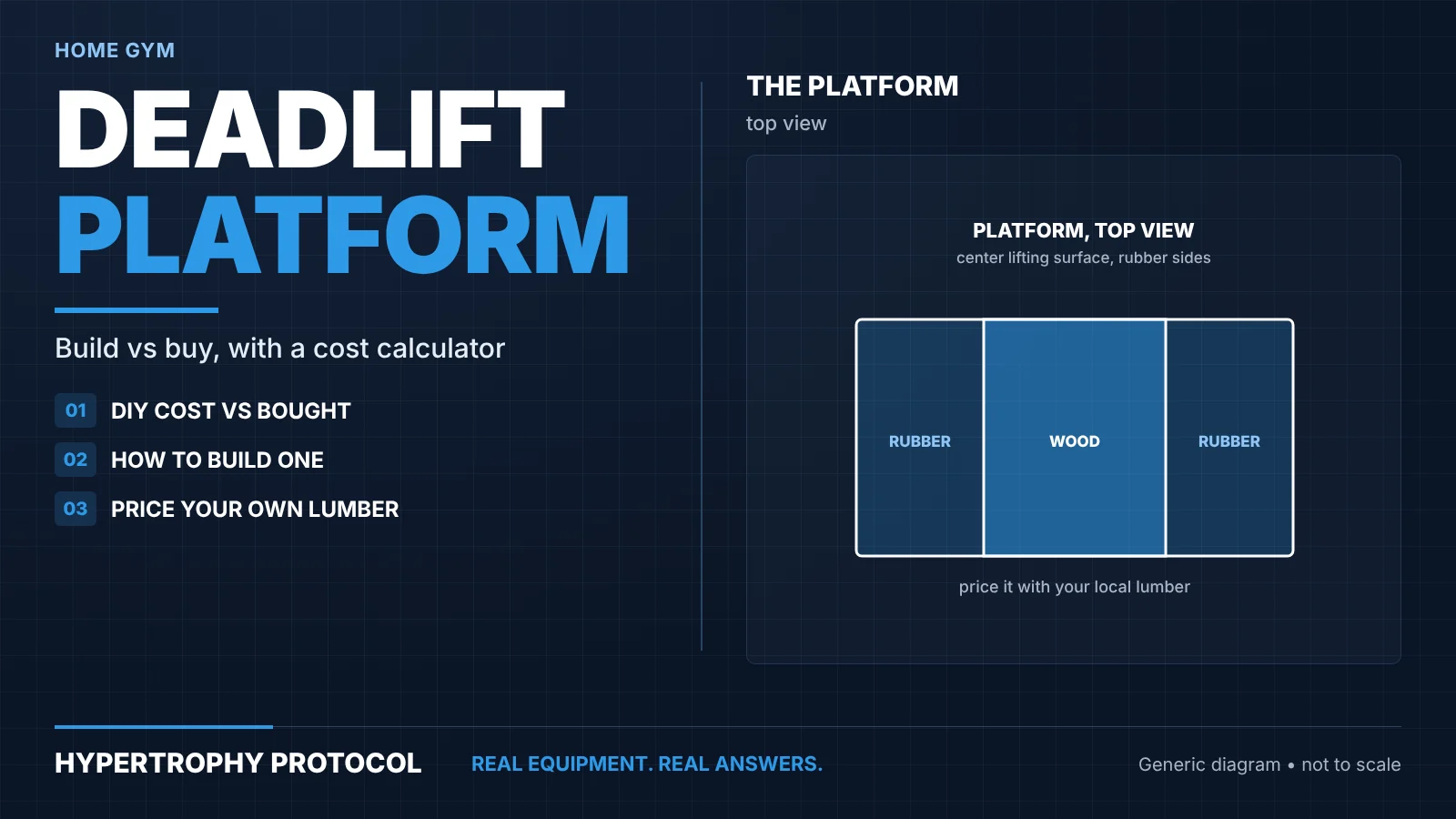
Featured image: AI-generated concept illustration, not a photograph of a specific product or an actual installation.
Do you need a deadlift platform?
If you deadlift heavy or drop the bar, yes. Rubber flooring alone protects the floor from ordinary use, but flooring seller Greatmats recommends 3/4 to 1 inch of rubber for deadlifts, cleans and intentional drops, and a platform adds a layer of wood that spreads each impact over a wider area of the slab. It also gives you a flat, consistent spot to stand that doesn’t shift. If you only lift dumbbells or never let the bar down hard, 3/4-inch stall mats are enough; see our home gym flooring guide. If the platform will sit beside a rack, our guide to flooring under a power rack covers mat counts and anchor depth.
How to build one
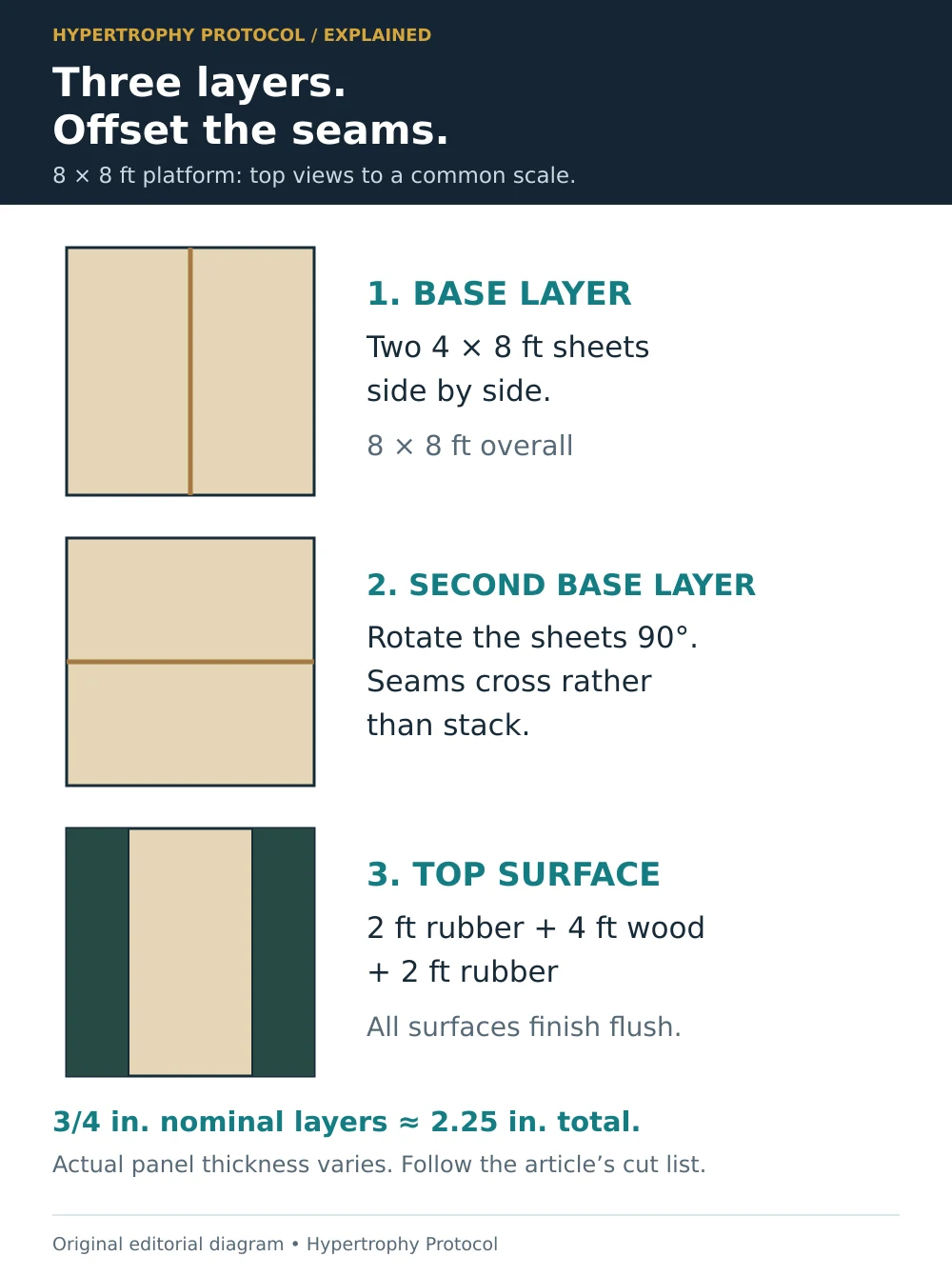
The standard design, which Bells of Steel describes in its DIY guide, is a wood sandwich with rubber where the plates land:
- Base: lay two 4 x 8 ft sheets of 3/4-inch OSB or plywood side by side for an 8 x 8 ft platform (one sheet for 8 x 4). Add a second layer turned 90° so the seams don’t line up, gluing it down with construction adhesive and screwing it to the first layer.
- Center: glue and screw a sheet of sanded plywood down the middle, 4 ft wide and running front to back (a 4 x 4 ft piece for the 8 x 4 version). This is where you stand.
- Sides: cut 3/4-inch stall mats into 2 ft wide strips and fix them on both sides of the center sheet, flush with the wood so there’s nothing to trip on. Each 4 x 6 ft mat gives two 2 x 6 ft strips, so an 8 x 8 platform takes two mats and an 8 x 4 takes one.
- Finish: sand the edges and give the center a coat of polyurethane if you like. Don’t make it glossy; a slick top is slippery in lifting shoes.
Cut rubber with a sharp utility knife and a straightedge, scoring it several times rather than trying to slice through in one pass. Many home centers and lumber yards will cut sheets to size for you, which also makes them easier to fit in a car.
A two-layer DIY platform is about 2.2 inches tall: 2.25 inches if every panel is a true 3/4 inch, closer to 2.16 inches with 23/32-inch panels, which is what most “3/4-inch” OSB and plywood actually measures. That’s not much, but it adds to your height under the ceiling for overhead pressing and pull-ups, so rerun the room check in the flooring guide’s calculator if your ceiling is tight.
Pre-built platforms
| Platform | Size | Price (Oct 2026) | What you get |
|---|---|---|---|
| Titan Deadlift Platform | 99 x 59.5 in (94.5 x 47.5 in inside) | $299.97 frame; $469.97 half kit; $729.97 full kit | Bolt-together 11-gauge steel frame, band pegs, floor clips. The half kit adds four rubber tiles and you supply the plywood center; the full kit adds more tiles |
| Rogue Deadlift Platform | 4’4″ x 8’4″ | $495 frame; $300 for eight 24 x 24 x 1.5 in tiles; $55 wood inserts | 11-gauge steel frame, long band pegs, four floor clips |
| Rogue 8′ x 8′ Oly Platform | 8’4″ x 8’4″ (8 x 8 ft inside) | $562 frame; tiles $85 a pair, $300 for 8, $600 for 16 | Steel frame only. Add eight tiles and your own plywood center ($862 before the plywood), or 16 tiles for full rubber ($1,162) |
The steel-frame platforms have real advantages: they bolt together and come apart, so you can take them with you when you move; they include band pegs for banded deadlifts; and Rogue’s tiles are 1.5 inches thick, twice the thickness of a stall mat. What they don’t save is money.
Build or buy?
- Build if you have a drill, a way to get 4 x 8 sheets home, and an afternoon. You’ll save roughly $260 to $510 before tax at our default prices against a complete pre-built setup, depending on the size, and you can make it any size you want.
- Buy if you rent, move often, want band pegs, or would rather not handle 94 lb stall mats and full sheets of OSB.
- Either way, put it on a flat part of the slab. Garage floors often slope toward the door, and a platform will rock on an uneven floor.
Our DIY totals use $41 base sheets, a $114 sanded plywood center, $63.99 stall mats, $60 for adhesive, screws and finish, and 7% sales tax on the shopping list. Comparisons with pre-built platforms are before tax and shipping on both sides. Lumber prices vary a lot by region: we found 23/32-inch OSB from $33.60 to $48 a sheet, so put your own prices into the calculator.
Frequently asked questions
How thick is a DIY deadlift platform?
A two-layer DIY platform is about 2.2 inches tall. That is 2.25 inches if every panel is a true 3/4 inch, and closer to 2.16 inches with 23/32-inch panels.
How many stall mats do I need for a deadlift platform?
Each 4 x 6 ft mat gives two 2 x 6 ft strips, so an 8 x 8 platform takes two mats and an 8 x 4 takes one.
How do you cut stall mats for a lifting platform?
Cut the rubber with a sharp utility knife and a straightedge. Score it several times rather than trying to slice through in one pass.
Will a deadlift platform level a sloped garage floor?
No. A platform doesn’t level a sloped slab, and it will rock on an uneven floor. Garage floors often slope toward the door, so put the platform on a flat part of the slab.
Sources
- Bells of Steel, How to build your own lifting platform
- Titan Fitness Deadlift Platform
- Rogue Deadlift Platform
- Rogue 8′ x 8′ Oly Platform
- Close Lumber, 23/32 in OSB and Fox (Woodland Park, CO), 23/32 in OSB
- Ring’s End, 3/4 in AC fir plywood
- Liquid Nails Subfloor and Deck adhesive at Walmart
- Tractor Supply 4 x 6 ft x 3/4 in stall mat ($63.99, 94 lb), as priced in our flooring guide