
For most flooring under a power rack, 3/4-inch rubber stall mats are the plain answer. One 4 by 6 foot mat covers the base of a compact rack like Titan’s T-3 or Rogue’s R-3, and two cover a 53-inch-square cage like the R-4. That matters if your power rack is headed for a garage or basement, where the bare floor under it needs covering before the first heavy set.
Interlocking tiles earn their place when you want thicker drop zones, and a full platform makes sense mainly when your rack maker builds one to bolt onto. The detail that trips up a bolt-down rack is anchoring, because a mat under the feet eats into anchor depth. Every spec below was checked on the maker’s or seller’s own product page on September 28, 2026.
At a glance
| Option | Best for | Key spec | Main catch |
|---|---|---|---|
| 3/4″ rubber stall mat (4 x 6 ft) | The default under most racks | One covers a T-3 or R-3 base; two cover a 53″ square R-4 | Under a bolt-down rack it eats anchor depth: a 3″ anchor keeps 2.25″ in concrete |
| Thin interlocking tiles (3/8″ or 10 mm) | Floor protection and noise | 5 to 8 lb tiles, about 20 to 24″ square | No drop rating from any maker |
| Thick rubber tiles (1.5 to 1.6″) | Frequent deadlift drops | 28 lb, 24″ x 24″ (Rogue, Titan) | Titan’s tiles fit only Titan’s lifting platforms |
| TITAN Series Power Rack Lifting Platform | Owners of a Titan bolt-down rack it fits | 120.5″ x 108.75″, 1.575″ thick, 450 lb | Fits only TITAN, X-3 and T-3 bolt-down racks in 36″ depth; costs headroom |
Specs from the makers’ and sellers’ pages, checked September 28, 2026. No page gives a drop height or dropped-load rating. Confirm before ordering.
What does flooring have to do under a power rack?
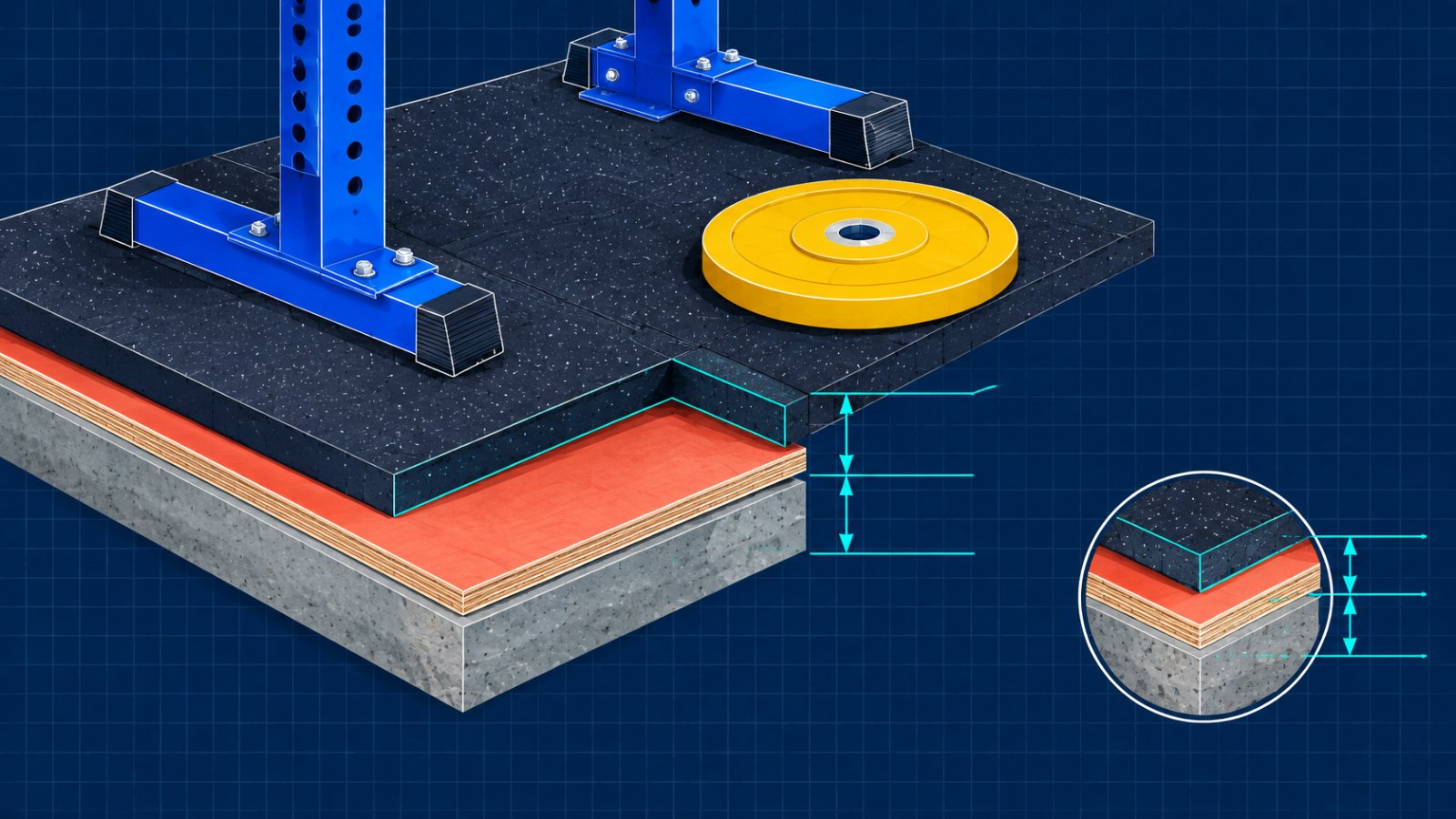
Stall mats win the default slot because the job under a rack is modest. The flooring has to protect the floor and your plates while lying flat enough that the rack sits level. A 3/4-inch stall mat stays put by sheer weight, which is why Rubber-Cal advises against permanent installation and relies on each mat’s own weight to hold it in place.
What changes the choice is the setup around that job. A bolt-down rack needs a plan for its anchors, and frequent deadlift drops push you toward thicker rubber. A basement gym also makes odor matter more than it does in an open garage. If the rack itself is still undecided, the power rack buying guide covers the specs worth settling before flooring.
How do stall mats, tiles and platforms compare on paper?
Those setup questions start with what each maker commits to on paper. The table keeps to the maker’s own wording for rubber type, odor and drops, and marks “None given” where a page offers nothing.
| Product | Format and size | Thickness | Weight | Rubber, in the maker’s words | Odor or drop language | Source |
|---|---|---|---|---|---|---|
| REP 4’x6′ Floor Mats | Stall mat, 47″ x 71″ | 3/4″ | 88 lb | Recycled rubber bonded with liquid urethane | “Less odor”; REP still suggests airing out for a few days | REP |
| Tractor Supply rubber stall mat | Stall mat, 4′ x 6′ (store listing, unbranded) | 3/4″ | 94 lb | 100% recycled vulcanized rubber; Shore hardness 70 | Some rubber odor the first few weeks | Tractor Supply |
| Rubber-Cal Horse Stall Mat | Stall mat, 4′ x 6′ | 3/4″ or 1/2″ | 90 lb (3/4″), 67 lb (1/2″); same page also gives 100 lb | Natural rubber, reclaimed rubber; 55 to 65 durometer | None given | Rubber-Cal |
| American Floor Mats Horse Stall Mats | Straight-edge mats, 2′ x 2′ interlocking tiles, rolls | Mats and tiles 3/8″, 1/2″ or 3/4″ | Not published | US-sourced raw materials, no fillers | None given | American Floor Mats |
| American Floor Mats Power Platform Rubber Mats | Interlocking mats; 4′ x 6′ is one piece | 3/4″ | Not published | Non-porous vulcanized rubber | For use under heavy workout equipment; no drop rating | American Floor Mats |
| Bells of Steel Rubber Flooring Gym Mat | Square mat, 39″ x 39″ | 1″ | 39.6 lb | Recycled; fine rubber top, larger crumb bottom | “Non-smelly”; bottom bumps disperse dropped weight for less bounce | Bells of Steel |
| REP Rubber Floor Tiles | Interlocking tile, 24″ x 24″ | 3/8″ | 8 lb | “Rubber” (type not stated) | “Low odor”; no drop rating | REP |
| Titan 12 PK Interlocking Tile Flooring | Interlocking tile, 19.685″ square | 10 mm | 5 lb | Recycled rubber | None given | Titan |
| Regupol AktivLok (sold by Rogue) | Interlocking tile, 24″ x 24″ | 3/8″ | 8 lb | Over 90% recycled tire rubber | Force reduction 12.9 to 13.7%; energy restitution 85 to 86% | Rogue |
| Rogue Rubber Tile | Tile, 24″ x 24″ | 1.5″ | 28 lb | 100% recycled SBR with an SBR/EPDM wear layer | Helps deaden impact; built for deadlifts and atlas stones | Rogue |
| Titan Rubber Lifting Tiles | Tile, 24″ x 24″; fits only Titan’s lifting platforms | 1.6″ | 28 lb | “Rubber” (type not stated) | Protects floor and plates from damage after being dropped | Titan |
| Rogue Power Platform | Rubber platform, 72″ x 90″, two loose-lay sections | 3/4″ (18 mm) | Not published | Re-vulcanized rubber | No drop rating | Rogue |
| Rogue OLY Platform | Steel-frame platform, 6′ x 8′ | 1.5″ tiles | Not published | Rubber tiles, or plywood center with tile or stall mat sides | Handles heavy drops; must be bolted down for band work | Rogue |
| TITAN Series Power Rack Lifting Platform | Rack platform, 120.5″ x 108.75″; your rack bolts to it | 1.575″ | 450 lb | Natural rubber tiles, hardwood center, 11-gauge steel frame | Impact-absorbing tiles; no drop rating | Titan |
Rogue and Titan carry no classic 4 by 6 stall mat on the flooring pages checked, so their entries are tiles and platforms. Two gaps matter for a buyer. American Floor Mats publishes no weights, and Rubber-Cal’s page gives two different weights for the same 3/4-inch mat.
Does vulcanized or recycled rubber make a difference?
In the rubber column, “recycled” and “vulcanized” are not opposites. Tractor Supply’s mat is both: recycled rubber that has been vulcanized. Rogue’s Power Platform uses re-vulcanized rubber, which flooring supplier AMARCO defines as recycled rubber cured under heat and pressure without added binders.
The other common build is bonded crumb. REP makes its stall mats by bonding recycled rubber with liquid urethane, and in AMARCO’s comparison urethane-bonded rubber has a porous structure where re-vulcanized rubber is non-porous.
On smell, the makers frame the two builds from opposite sides. REP credits urethane bonding with less odor yet still suggests airing its mats out for a few days, while Tractor Supply’s listing for its vulcanized mat warns of some rubber odor in the first few weeks. No page gives a measured emissions figure, so plan an airing-out period either way if the gym is in a closed basement.
Thickness follows the job more than the rubber type. Stall mats sit at 3/4 inch, the thin interlocking tiles are pitched for floor protection and noise, and only the 1.5 to 1.6 inch tiles are tied by their makers to deadlifts and drops.
How many mats does your rack footprint need?
Once you know the rubber you want, the count comes down to the rack’s base. Rogue gives the R-3 a 53 by 34 inch footprint at 24 inches deep and the R-4 53 by 53 inches. Titan puts the T-3 at 54 by 32.75 inches.
Rack footprints vs flooring coverage, in square feet
Brown bars are rack bases, green bars are flooring. Area alone is not enough: the mat must also be longer and wider than the base in both directions.
Area hides the real test, which is whether each side fits. A REP mat is 47 by 71 inches, so a T-3 or R-3 base fits on one mat in both directions. The R-4 is 53 inches deep, deeper than the mat is wide, so it needs two mats laid side by side.
That covers the feet and nothing more. Walkout space and plate storage sit outside the base, which is why Bells of Steel suggests four of its 39-inch mats for a power rack and Rogue sells its thick tiles in 4 by 8 up to 8 by 8 foot layouts. The 10×10 home gym guide shows how a rack and its working room fit in a small garage bay. For covering a whole room, thickness by use and a piece-count calculator, see the home gym flooring guide.
What happens to a bolt-down rack when a mat sits under it?
Once the mats are down, a bolt-down rack raises the harder question of anchors. Rogue’s R-3 instructions require the rack to be anchored for use, call for 3/8 by 3.5 inch concrete wedge anchors that are not included, and highly recommend cutting out a section of rubber flooring so the feet anchor directly to the floor.
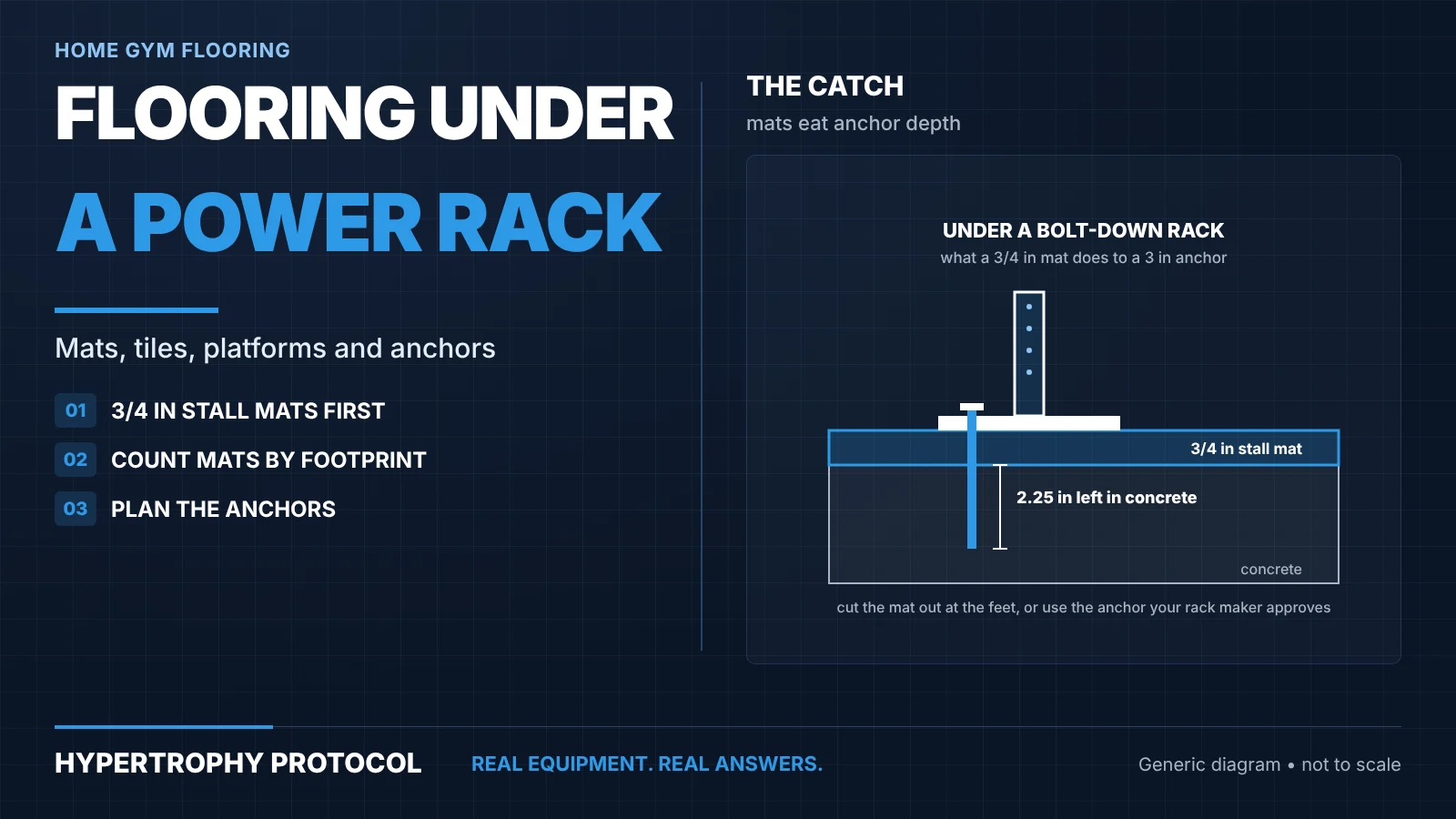
Rogue’s own HD Concrete Anchors are 3/8 by 3 inches, and the product page warns that bolting on top of stall mats may need longer anchors depending on flooring thickness, or cutting the flooring out at the footplate. The arithmetic is plain: a 3/4-inch mat under a 3-inch anchor leaves 2.25 inches in the concrete, a quarter of its length gone. Only the rack maker can tell you whether that remainder is enough.
Other makers leave more room for judgment. Titan recommends bolting down its T-3 for added stability, and its T-3 support page suggests adding plate holders low on the uprights if you choose not to. REP recommends bolting a PR-4000 when you run front spotter arms without the front feet or do kipping pull-ups, and pitches its 41-inch depth to lifters who prefer not to bolt down, per its PR-4000 FAQ.
Platforms add their own rules. Titan’s lifting platform bolts to its TITAN, X-3 and T-3 Series bolt-down racks in 36-inch depth, while Rogue’s OLY Platform must be bolted to the floor for band work. Titan’s platform is 1.575 inches thick, and that comes straight off your headroom, so run the numbers in the rack height and ceiling clearance guide if your ceiling is tight. Before you drill, ask your rack’s maker which anchor and length they approve for your floor and flooring.
Should you get a squat rack with a platform?
“Squat rack with a platform” covers two different setups. One is a rack that bolts onto its maker’s platform, like Titan’s TITAN Series Power Rack Lifting Platform, which fits only TITAN, X-3 and T-3 Series bolt-down racks in 36-inch depth and measures 120.5 by 108.75 inches. The other is a separate lifting platform for pulls, set beside or in front of the rack.
The bolt-on kind makes sense when your rack is on the maker’s list and you want one level base for the whole station. It also adds 1.575 inches under the rack and your feet, which comes off your ceiling clearance. If what you really need is somewhere to pull from the floor, a stand-alone platform does that job without tying you to one rack; the deadlift platform guide covers building one versus buying, with a cut list. For squats and presses inside the rack, the 3/4-inch stall mats covered above remain the default.
How much dropping can each option take?
The flooring around those anchors also has to take whatever you drop. No page checked here gives a drop height or a maximum dropped load for any mat, tile or platform. What you get instead is intent, like Titan’s 1.6-inch tiles that protect floor and plates after a drop.
The one measured number is Regupol’s force reduction of 12.9 to 13.7% for the 3/8-inch AktivLok tile, with no test method beside it. That figure covers the surface’s response to impact and tells you nothing about a dropped deadlift. If you drop loaded bars often, choose flooring whose maker names deadlifts or drops as its use, which in this table means the 1.5 to 1.6 inch tiles or a platform.
Which flooring should go under your rack?
The right pick depends on your rack and how you lift. Find the line that matches your setup.
- Bolt-down rack on a concrete garage floor: lay 3/4-inch stall mats and cut them out under the feet, as Rogue’s R-3 instructions recommend for that rack, unless your rack maker approves a longer anchor through the mat.
- Flat-foot or unbolted rack: one 4 by 6 stall mat covers a T-3 or R-3 sized base, and two cover a 53-inch-square cage. Pick vulcanized or urethane-bonded on odor and availability, since none of the pages checked offers a durability test to split them.
- You drop deadlifts often: add 1.5 or 1.6 inch tiles or a platform in the pulling area. A Titan platform only makes sense if you own one of the bolt-down Titan racks it fits.
- Basement gym or odor-sensitive household: buy early and air the mats out before they go down, as REP suggests, whichever rubber type you choose.
Your next step: open the Power Rack Comparison Tool and check your rack’s base type, bolt-down or flat foot, because that decides whether the anchor question applies to you at all. If it is bolt-down, confirm the anchor and length with that maker before you cut or drill.
Sources checked September 28, 2026. Manufacturers change specs; confirm on the product page before ordering.